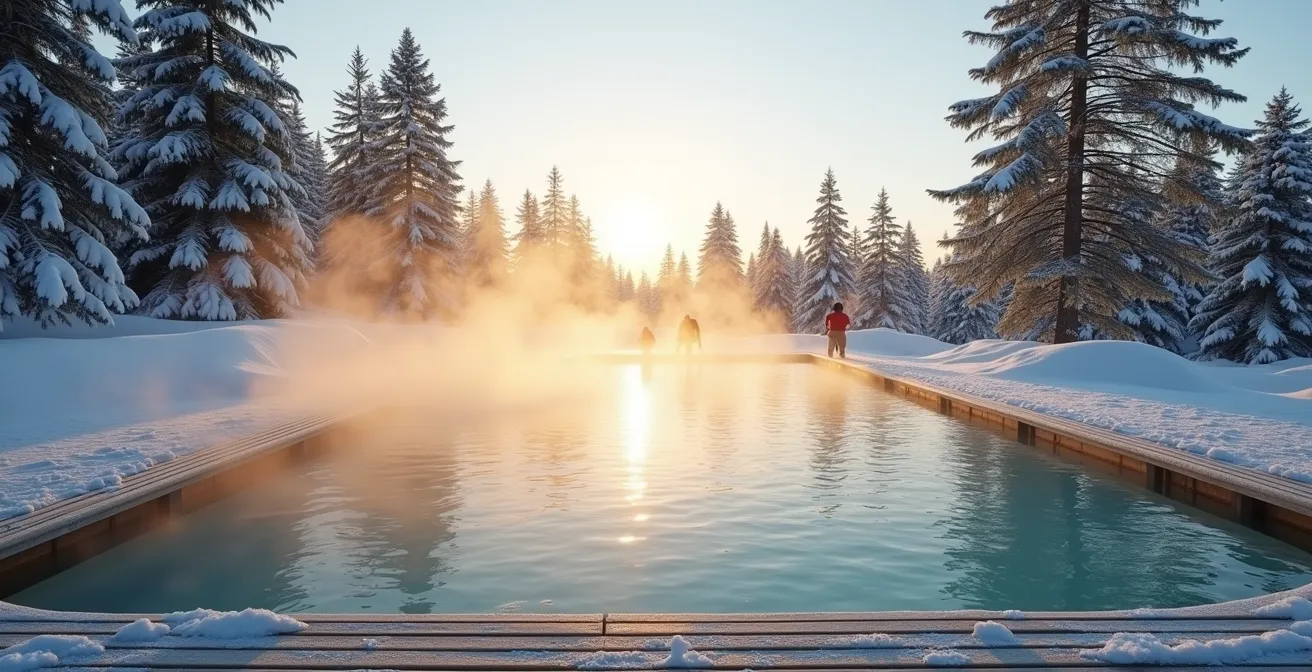
A single Nordic spa day can be more effective than a long weekend away, if you treat it as a strategic physiological reset, not just a luxury.
- The hot-cold-relax cycle is a scientifically-backed method for lowering stress hormones like cortisol and boosting mood-enhancing endorphins.
- Timing and location (weekday vs. weekend, downtown vs. Collingwood) are crucial for avoiding crowds and maximizing value for time-crunched professionals.
Recommendation: Plan your visit with a “tranquility strategy”—arriving early, choosing off-peak days, and preparing for the cold transitions to achieve a true mental and physical reset.
For the stressed Toronto professional or parent, the pressure is a constant hum. The city’s relentless energy, which fuels ambition, can also lead to burnout. The common advice is to book a vacation, but time is a luxury few can afford. We look for quicker fixes: a nice dinner, a weekend shopping trip, or maybe just zoning out in front of a screen. These are temporary distractions, not true resets.
But what if a single day could offer a deeper, more lasting form of decompression? The concept of a Nordic spa day is often seen as a simple indulgence. You get hot, you get cold, you relax. While true on the surface, this view misses the profound physiological benefits. The real key isn’t just escaping the city; it’s about initiating a powerful neurochemical reset that modern urban life actively disrupts. This isn’t about passive relaxation; it’s about actively guiding your body back to a state of balance.
This guide moves beyond the basics. We’ll explore the science of why this cycle is so effective against urban stress, how to strategically plan your visit to maximize its benefits—from packing correctly to avoiding the weekend crowds—and how to weigh the true value of a downtown spa versus a nature retreat. It’s time to transform your spa day from a simple treat into a targeted wellness tool.
To help you navigate your path to true rejuvenation, this article breaks down everything you need to know. From the science of the thermic cycle to the practicalities of planning, you’ll find a clear roadmap to making the most of your precious downtime.
Summary: The Ultimate Guide to a Strategic Spa Day Reset for Torontonians
- Why the Hot-Cold-Relax Cycle Is Essential for Reducing Urban Stress?
- How to Pack for a Winter Spa Visit Without Freezing Between Pools?
- Downtown Hotel Spa or Collingwood Nordic Spa: Which Offers Better value?
- The Sauna Mistake That Leaves You With a Headache Instead of Relaxation
- When to Visit the Spa to Avoid Bachelorette Parties and Noise?
- Why You Need a Wetsuit Even in June When Paddleboarding the Lake?
- When to Schedule “Downtime” in Toronto Parks to Avoid Meltdowns?
- Airbnb vs Hotel in Downtown Toronto: Which is Cheaper for a 4-Day Stay?
Why the Hot-Cold-Relax Cycle Is Essential for Reducing Urban Stress?
The foundation of any Nordic spa experience is the thermic cycle: a sequence of hot, cold, and relaxation. This isn’t just tradition; it’s a powerful bio-hack for the chronically stressed nervous system. When you expose your body to heat in a sauna or hot pool, your blood vessels dilate, your heart rate increases, and your body begins to release stress hormones like cortisol. This initial phase mimics a mild physical stress, preparing the body for the crucial next step.
The magic happens during the cold plunge. The sudden shift to cold water causes blood vessels to constrict, sending blood back to your core. This process triggers the vagus nerve, a key component of the parasympathetic nervous system—your body’s “rest and digest” mode. This stimulation, combined with the release of endorphins (natural mood elevators), effectively short-circuits the fight-or-flight response that city life keeps on high alert. The final relaxation phase allows your system to stabilize and enjoy this newfound state of calm homeostasis.
For a stressed Torontonian, this cycle is a direct antidote to the sensory overload and constant low-grade anxiety of urban living. It’s a way to manually reset your physiological baseline. For maximum benefit, the process should be deliberate:
- Heat Phase (10-20 minutes): Enter the sauna or a hot pool. This dilates blood vessels and can help lower cortisol levels over time.
- Cold Phase (1-3 minutes): Fully immerse yourself in a cold plunge pool. This is what triggers the vagus nerve and the beneficial release of endorphins.
- Relax Phase (15-20 minutes): Rest quietly. This allows your body to return to homeostasis and lets the calming effects set in.
- Repeat: For the most significant stress-reduction benefits, aim to repeat the entire cycle at least three times during your visit.
This isn’t just about feeling good for an hour; it’s about training your nervous system to be more resilient to stress long after you’ve left the spa.
How to Pack for a Winter Spa Visit Without Freezing Between Pools?
A common deterrent to enjoying a winter Nordic spa visit is the thought of that frigid walk between a warm sauna and a steaming outdoor pool. Proper packing is the key to turning this potential discomfort into a seamless and enjoyable part of the experience. The goal is to minimize time spent shivering and maximize time spent relaxing. Your spa bag should be built around a strategy of quick transitions and effective insulation.
The most critical items are those that protect you during the brief but cold journeys across the spa grounds. This includes a thick, plush robe to envelop yourself in immediately after exiting the water and, most importantly, appropriate footwear. Icy or wet pathways are common, so waterproof, non-slip slides or sandals are non-negotiable for both safety and comfort. Many seasoned spa-goers also bring a winter hat (a toque, in Canadian terms) to wear while in the hot pools, which helps prevent heat loss from your head and keeps you comfortable for longer, even as snow falls around you.
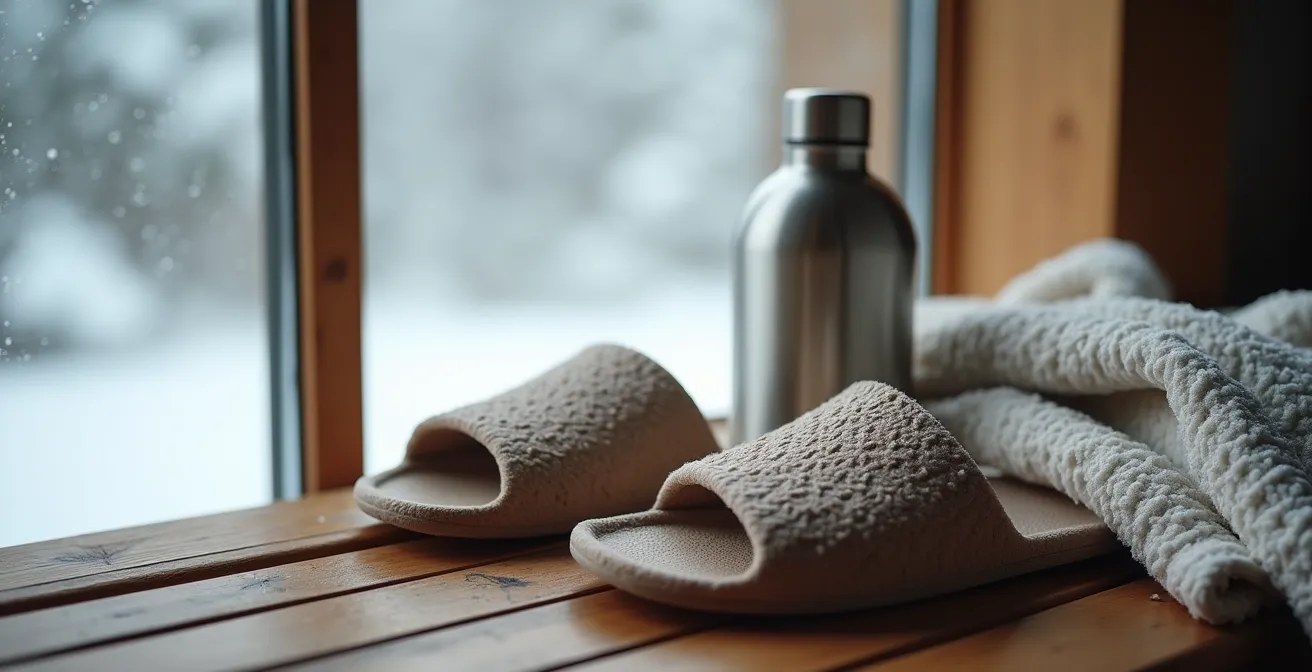
As the image above highlights, texture and insulation are key. Think beyond just a swimsuit. Consider bringing two, so you don’t have to put a cold, wet one back on after a break. An insulated water bottle is also essential to stay hydrated, as you’ll be sweating in the saunas. As the team at Vettä Nordic Spa points out, facilities are designed for year-round use, but guest preparedness is what makes the experience truly comfortable. They specifically recommend waterproof footwear for navigating potentially icy paths and provide heated indoor transition areas, underscoring the importance of being ready for the elements.
By packing strategically, you ensure that the only chill you feel is the intentional, invigorating one from the cold plunge pool.
Downtown Hotel Spa or Collingwood Nordic Spa: Which Offers Better value?
For Torontonians, the choice often comes down to two distinct scenarios: the convenience of a luxury hotel spa downtown versus the immersive nature experience of a destination spa in the Collingwood area. While both offer relaxation, they provide vastly different value propositions, especially for a time-crunched professional seeking a true reset. The decision isn’t just about price, but about the return on your investment of time and money.
A downtown hotel spa offers unparalleled convenience. You can be there in 30 minutes, enjoy a few hours of pampering, and be home for dinner. However, this luxury comes at a premium price, with limited facilities often confined indoors. You’re paying for proximity and a high-touch, but often smaller-scale, experience. In contrast, a Nordic spa near Collingwood, about a two-hour drive from Toronto, offers a complete environmental shift. These are sprawling properties dedicated to the thermic cycle, with multiple saunas, steam rooms, and outdoor pools set against a natural landscape. As expert Liisa Ladouceur notes in her guide, access to most of the day spas costs between $70-$100 per person, a fraction of what many hotel spas charge for access alone.
Nordic spas in Ontario come in different price ranges, from affordable to luxury. Access to most of the day spas costs between $70-$100 per person.
– Liisa Ladouceur, Best Nordic Spas in Ontario Guide
To understand the true cost, we must look beyond the day pass. The following table breaks down the total estimated cost for a one-day escape, factoring in travel and other expenses. This comparison, based on a recent analysis, clearly shows the financial trade-offs.
| Factor | Downtown Hotel Spa | Collingwood Nordic Spa |
|---|---|---|
| Day Pass Price | $150-250 | $70-100 |
| Travel from Toronto | 15-30 minutes | 2 hours |
| Parking | $25-40/day | Free |
| Experience | Urban luxury, limited outdoor | Nature immersion, extensive facilities |
| Crowds | Moderate year-round | Peak on weekends |
| Total Cost (with gas) | $175-290 | $90-130 |
Ultimately, the “better value” depends on your goal. For a quick, luxurious treatment, a hotel spa works. But for a full-day, deep physiological reset, the travel time to a destination Nordic spa pays for itself in both cost and the quality of the immersive experience.
The Sauna Mistake That Leaves You With a Headache Instead of Relaxation
You leave the sauna feeling dizzy, with a pounding headache—the exact opposite of the relaxed state you were seeking. This common experience isn’t a sign that saunas “aren’t for you”; it’s almost always a symptom of one critical mistake: dehydration combined with overheating. The intense heat of a sauna causes you to sweat profusely, losing not just water but also essential electrolytes. Failing to properly hydrate before and during your spa visit is the fastest way to derail the benefits of thermotherapy.
Many people wait until they feel thirsty to drink, but by then, dehydration has already begun. The correct approach is to start hydrating at least 30 minutes before your first heat cycle, preferably with water that includes electrolytes. Furthermore, it’s crucial to respect the recommended time limits. Staying in a sauna for longer than the suggested 10-20 minutes doesn’t increase the benefits; it only increases the risk of overheating and dehydration, which can lead to dizziness, nausea, and the dreaded post-sauna headache. If you start to feel a rapid pulse or any discomfort, it’s a clear signal from your body to exit immediately.
The goal of thermotherapy is to induce a beneficial stress response, not to push your body to its absolute limit. Proper execution leads to positive physiological adaptations, and research published in PubMed demonstrates that this includes improvements in Heart Rate Variability (HRV), a key indicator of your nervous system’s resilience and ability to manage stress. A headache is a sign that you’ve pushed too far, creating negative stress instead of a positive one.
Listen to your body, respect the clock, and above all, hydrate proactively. This simple discipline is the difference between a day of genuine restoration and one that ends in discomfort.
When to Visit the Spa to Avoid Bachelorette Parties and Noise?
You’ve booked a day to decompress, only to find yourself surrounded by the loud chatter of a large group, turning your quest for quiet into a frustrating exercise in noise tolerance. This is a common complaint, especially at popular Nordic spas on weekends. A successful spa day for a stressed professional isn’t just about the facilities; it’s about securing a tranquil environment. This requires a “tranquility strategy” that starts with timing.
Weekends, especially Saturdays, are peak times for social gatherings like bachelorette parties and group outings. While spas are for everyone, the atmosphere can become more lively and less serene. The case of Thermea Spa Village in Whitby, for example, shows it’s a celebrated spot for socializing. Visitors seeking quiet often recommend arriving very early or choosing off-peak times to get a more peaceful experience. The most effective strategy is to avoid the weekend rush altogether. Mid-week visits, particularly on a Tuesday or Wednesday, are consistently reported as the quietest.
If a weekday visit isn’t possible, timing is everything. Arriving right at opening time (often 9 AM) can grant you at least one or two hours of relative calm before the crowds build. Alternatively, booking the last evening slot can also be effective, as larger groups tend to depart earlier. Even the weather can be your ally; a rainy day often deters casual visitors, creating a magical and peaceful atmosphere for those who venture out.
Your Action Plan for a Perfectly Quiet Spa Day
- Target Off-Peak Days: Book your visit for a Tuesday or Wednesday. These days often have fewer crowds and sometimes discounted rates.
- Master Your Arrival Time: Arrive exactly at opening (e.g., 9 AM) to enjoy the “golden hour” of quiet before the mid-day rush begins.
- Leverage the Shoulder Season: Plan your visit during less popular times of the year, such as the post-holiday lull in February and March, to avoid seasonal crowds.
- Embrace “Bad” Weather: Don’t cancel for rain. A rainy day can be one of the most serene and atmospheric times to visit an outdoor spa, as it naturally thins the crowd.
- Book the Late Shift: Choose the last available time slot in the evening. Many large groups and families will have already left for dinner, leaving the pools quieter.
A little foresight transforms your spa day from a gamble into a guaranteed sanctuary from the noise of daily life.
Why You Need a Wetsuit Even in June When Paddleboarding the Lake?
The sun is warm on your face, the city skyline is a beautiful silhouette, and the water of Lake Ontario in June looks deceptively inviting. It’s tempting to hop on a paddleboard in just your swim trunks, but this can be a dangerous mistake. While the air temperature might feel like summer, the lake’s vast, deep water remains shockingly cold well into the early summer months. Falling in without protection can be more than just uncomfortable—it can be life-threatening.
The primary danger is cold water shock. This is an involuntary physiological response that occurs when the body is suddenly immersed in water below 15°C (60°F). Lake Ontario’s surface water in June often hovers in this range. As physiological research shows that a sudden plunge into such temperatures triggers an uncontrollable gasp for air, a dramatic increase in heart rate and blood pressure, and can lead to disorientation. If your head goes underwater during this initial gasp, you risk drowning, even if you are a strong swimmer.
This is where a wetsuit becomes essential safety equipment, not just a comfort item. A wetsuit works by trapping a thin layer of water between your skin and the neoprene material. Your body heat warms this layer, creating an insulated barrier against the cold of the lake. It won’t keep you completely warm if you’re submerged for a long time, but it critically mitigates the initial shock, giving you the crucial moments needed to control your breathing, reorient yourself, and get back on your board safely. It acts as your personal defense system against the lake’s hidden cold.
Think of a wetsuit in June not as an over-cautious accessory, but as the equivalent of a seatbelt for water sports on the Great Lakes—a simple measure that can prevent a beautiful day from turning tragic.
When to Schedule “Downtime” in Toronto Parks to Avoid Meltdowns?
Not every reset requires a two-hour drive or a hundred-dollar entry fee. For the overstimulated Torontonian, scheduling micro-doses of downtime in the city’s green spaces is a powerful and accessible tool for managing stress. However, a trip to a park can quickly become another source of stress if you’re met with crowds, noise, and a lack of personal space. The key to using Toronto’s parks for genuine decompression is to be as strategic about your timing and location as you would be for a spa visit.
To avoid the “meltdown” of a failed attempt at relaxation, you must sidestep peak hours. Weekends after 11 AM are prime time for families, groups, and general crowds. The most serene moments in popular parks like High Park or Trinity Bellwoods are found in the early mornings (before 9 AM) or, counterintuitively, during weekday rush hours (5-6 PM) when most people are commuting, leaving trails and benches surprisingly empty. For true solitude, consider exploring less-frequented ravine systems like the Cedarvale Ravine, which offer a feeling of deep nature immersion just steps from a subway line.
You can even create your own version of the hot-cold-relax cycle without a spa. Find a sunny spot on the grass to warm yourself (the “hot” phase), then take a walk along a deeply shaded, cooler ravine path (the “cold” phase), and finish by sitting quietly on a secluded bench to let your system settle (the “relax” phase). This simple, free practice engages the same principles of thermoregulation to calm the nervous system. To maximize this strategy:
- Visit High Park for its mix of nature immersion and quiet trails, especially during morning hours.
- Choose Cedarvale Ravine for a deeper sense of solitude away from the main park crowds.
- Schedule your park visits during typical commute times (8-9 AM, 5-6 PM) when they are often at their quietest.
- Pack water and a light snack to avoid having to cut your downtime short.
By scheduling downtime with intention, you can transform the city’s own green spaces into reliable sanctuaries for mental and physical recovery.
Key Takeaways
- A Nordic spa day is most effective when viewed as a “neurochemical reset,” actively using the hot-cold cycle to lower stress hormones.
- Strategic planning is crucial: visit mid-week or at opening times to avoid crowds and achieve true tranquility.
- For a full-day immersive reset, a destination spa like those in Collingwood offers better value than a convenient but limited downtown hotel spa.
Airbnb vs Hotel in Downtown Toronto: Which is Cheaper for a 4-Day Stay?
For those planning a multi-day “reset” staycation in Toronto or visiting the city for a wellness-focused trip, the choice of accommodation significantly impacts both budget and experience. The classic debate between a hotel and an Airbnb is particularly relevant in a dense urban core. While hotels offer convenience and amenities, Airbnbs provide space and the potential for cost savings, but each comes with hidden costs and trade-offs.
A hotel’s primary advantage is its integrated service. There are no surprise cleaning fees, and amenities like a gym or, pertinently, an on-site spa can be included. However, the nightly rates are often higher, and the cost of parking in a downtown hotel garage can add a substantial amount to your bill. Furthermore, you are tied to eating out for most meals, which quickly inflates the total cost of your stay. An Airbnb, on the other hand, often has a lower nightly rate and the invaluable option of a kitchen, which can dramatically reduce food expenses. Many also offer free or cheaper parking solutions.
However, the sticker price on an Airbnb listing can be deceptive. You must factor in cleaning fees, which can be significant for a short stay, and service fees. As the Toronto Tourism Board often advises in its urban retreat planning guides, the location’s ambiance is also key; choosing an accommodation near a quiet park or with a balcony away from construction noise can be as important as the cost. To make an informed decision, a clear cost breakdown is essential, as shown by the following analysis of a typical 4-day stay.
| Cost Factor | Downtown Hotel | Airbnb |
|---|---|---|
| Average nightly rate | $200-300 | $150-250 |
| Cleaning fees | Included | $50-100 |
| Parking (4 days) | $100-160 | Varies ($0-80) |
| Food costs | Higher (restaurants) | Lower (cooking option) |
| Spa amenities | Often included | None |
| Total 4-day estimate | $900-1,420 | $650-1,100 |
For the budget-conscious traveler focused on a longer stay, an Airbnb typically offers a more economical and flexible option. For those seeking maximum convenience and built-in amenities for a shorter, more luxurious reset, a hotel remains a compelling choice.