
The most meaningful Toronto souvenirs can’t be bought in a store; they are crafted from personal experience and emotional connection.
- Shift from a passive spectator to an active creator by engaging in hands-on workshops and sensory journaling.
- The best stories come from human connection and exploring local art, not just from iconic landmarks.
Recommendation: Focus on creating a “narrative souvenir”—a story, a skill, or a feeling you can revisit—instead of collecting physical objects.
You return from a trip to Toronto, your phone filled with photos of the CN Tower and a bag containing a neatly folded maple leaf t-shirt. Yet, a quiet question lingers: what did you truly bring back? In a world saturated with digital images and mass-produced keepsakes, the quest for a genuine, lasting travel memory has become more profound. We often follow a checklist of sights, capturing evidence of our presence, but miss the opportunity to build a deeper, more personal connection with the place itself.
The common advice is to visit the major attractions, but this often leads to a shared, generic experience. The real soul of Toronto, while known for its iconic skyline, is found not just in its famous landmarks but in the rhythm of its distinct neighborhoods, the hum of its streetcars, and the creativity pulsing through its local markets and studios. It’s a city that invites you to do more than just look; it invites you to participate.
But what if the key wasn’t to *collect* more souvenirs, but to *architect* more meaningful memories? This guide is built on that premise. It’s a departure from the typical tourist trail, designed for sentimental travelers and couples who want to weave a piece of Toronto into their own story. We will move beyond the visual to engage all your senses, trading passive observation for active creation and fleeting moments for tangible skills and stories. This is about transforming your visit from a series of snapshots into a portfolio of personal, emotional landmarks that last a lifetime.
This article explores a series of deliberate practices and choices, from the art you choose to bring home to the way you experience the city’s most famous natural wonder. Each section offers a new lens through which to view your journey, empowering you to become the architect of your own Toronto experience.
Contents: Beyond Selfies: Crafting Your Toronto Story
- Why Buying Local Art at the One of a Kind Show Beats Airport Souvenirs?
- How to Keep a Travel Journal of Toronto Sounds and Smells?
- Polson Pier Sunset or Graffiti Alley Portraits: Which Photo Tells a Better Story?
- The Screen Mistake That Prevents You From Actually Seeing the Niagara Falls
- How to Start Conversations with Torontonians to Unlock Hidden Stories?
- Why Your Skyscraper Photos Look Distorted and How to Fix It in Post?
- Why “Make Your Own Rings” Workshops Are the New Favorite Date Night in Toronto?
- Pottery or Glass Blowing: Which Toronto Workshop Fits Your Creative Vibe?
Why Buying Local Art at the One of a Kind Show Beats Airport Souvenirs?
An airport souvenir is a transaction; a piece of local art is the beginning of a story. While a keychain from a gift shop serves as a simple location marker, an object crafted by a local artisan is a narrative souvenir. It holds the creator’s vision, a piece of Toronto’s cultural fabric, and the memory of your own discovery. It’s the difference between a mass-produced icon and a one-of-a-kind connection. When you choose a painting, a ceramic piece, or a handcrafted necklace, you are not just buying an object; you are acquiring a tangible piece of someone’s passion and, by extension, a deeper piece of the city itself.
Nowhere is this more evident than at Toronto’s major craft events. The One of a Kind Show, for instance, is far more than a market; it’s a cultural institution. As Canada’s largest craft show, it features works from over 500 talented artisans and draws nearly 200,000 attendees annually. Walking through its aisles is an act of cultural immersion, an opportunity to meet the makers and hear the stories behind their work. This interaction transforms the object from a simple decoration into a vessel for memory and meaning.
Beyond the scale of major shows, Toronto’s spirit of local creation thrives in more intimate settings. Neighborhood markets like the Trinity Bellwoods Flea and Leslieville Flea offer a different kind of discovery. These smaller, curated venues are perfect for serendipitous finds and direct conversations with emerging artists. Here, in a less commercial environment, a genuine connection is forged. You don’t just find a piece of art; you find your piece of art, a unique echo of your time in the city that will resonate long after you’ve returned home.
How to Keep a Travel Journal of Toronto Sounds and Smells?
A photograph captures a moment, but a sensory journal captures an atmosphere. Our memories are profoundly tied to more than just sight; the chime of a streetcar or the scent of a bustling market can transport us back to a place far more powerfully than a picture alone. To truly architect a memory of Toronto, you must look beyond the visual and create a rich sensory imprint. This involves a conscious effort to notice, document, and appreciate the full spectrum of the city’s character. A sensory journal isn’t about writing beautiful prose; it’s about collecting raw data—the sounds, smells, tastes, and textures that define a place.
This practice transforms you from a passive tourist into an active observer, a detective of details. To begin your sensory exploration of Toronto, think of it as a scavenger hunt for the intangible. What makes Toronto *sound* like Toronto? Listen for the distinctive TTC streetcar chime as it navigates Queen Street, or the distant, mournful sound of the ferry horn heading towards the Toronto Islands. What does it smell like? Contrast the warm, savory aroma of peameal bacon sandwiches at St. Lawrence Market with the clean, almost sterile air of the underground PATH system in winter, or the fresh breeze coming off Lake Ontario in the summer.
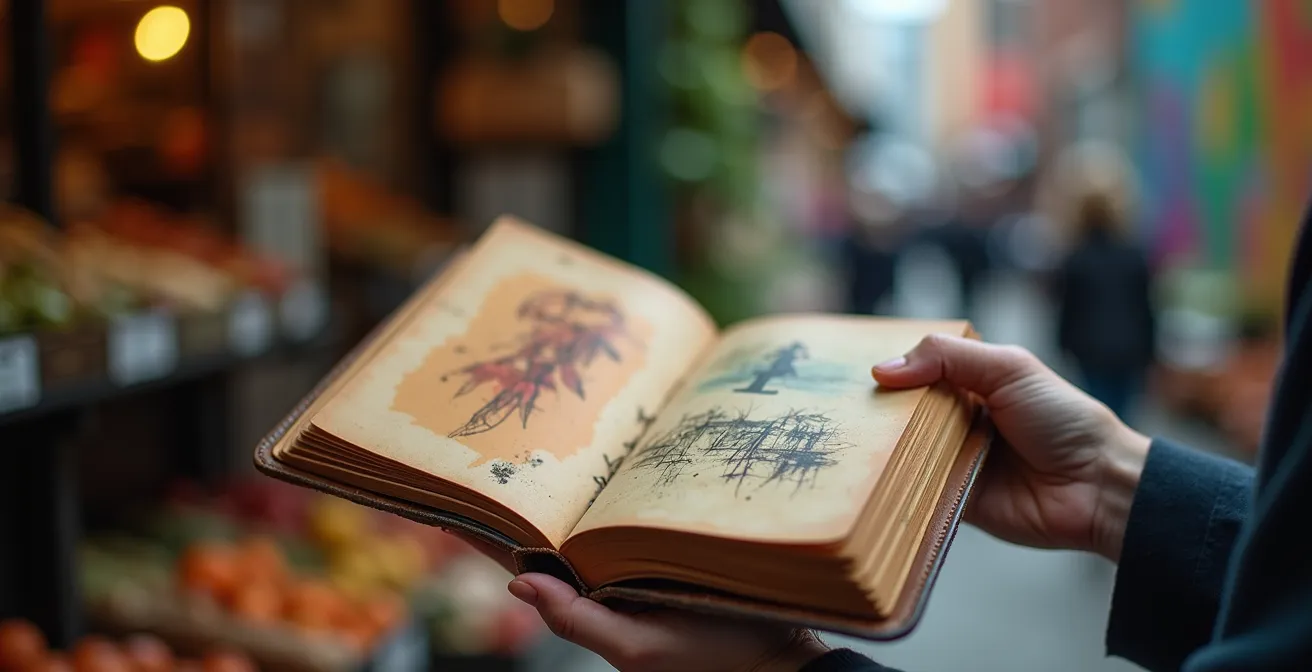
Even visual details can be documented with more depth. Instead of a simple snapshot, note the changing face of the Garden Car, a famous art installation in Kensington Market that evolves with the seasons. Your journal becomes a collection of these unique sensory triggers. A scribble about the feel of the cool lake breeze on your face or the rumbling vibration of the subway under your feet is a far more personal and evocative souvenir than any postcard. It is your unique, un-shareable experience of the city, captured forever.
Polson Pier Sunset or Graffiti Alley Portraits: Which Photo Tells a Better Story?
Every visitor to Toronto with a camera will likely capture the iconic skyline from Polson Pier. It’s a beautiful, sweeping, and undeniably spectacular view. However, it is a photograph of a spectator. You are witnessing the city’s beauty from a distance. A portrait taken in Graffiti Alley, by contrast, tells a completely different kind of story. There, you are not just an observer; you become a participant in the city’s living art. You step into the frame, interacting with a dynamic, ever-changing cultural document. The choice between these two locations isn’t about which is “better,” but about what kind of memory you want to architect.
As the Toronto Street Art Community notes in the Old Toronto Minutes series, Graffiti Alley is far more than just random tags. A representative from the community explains:
Graffiti Alley is not just random tags. It’s a cultural dialogue and a historical ledger of Toronto’s street art scene.
– Toronto Street Art Community, Old Toronto Minutes YouTube Series
This perspective reframes the location from a simple backdrop to an active gallery. A photo here isn’t just of you in Toronto; it’s of you within a specific moment of Toronto’s artistic conversation. The mural behind you might be painted over next week, making your photograph a unique historical record of your personal intersection with the city’s culture.
The decision boils down to the role you wish to play in your own travel narrative. One is about passively consuming beauty, the other is about actively engaging with culture. The following table helps clarify this distinction.
| Aspect | Polson Pier Sunset | Graffiti Alley Portrait |
|---|---|---|
| Photography Role | Spectator – passive observation | Participant – active interaction |
| Story Type | Natural beauty witnessed | Cultural immersion experienced |
| Uniqueness | Repeatable by many visitors | Personal connection to evolving art |
| Memory Trigger | Visual beauty of the moment | Physical presence in living artwork |
Ultimately, a Polson Pier photo says, “I saw Toronto.” A Graffiti Alley portrait says, “I was a part of Toronto’s story.” The latter becomes a more powerful memory trigger because it’s tied not just to a view, but to an interaction and a physical presence within a living artwork.
The Screen Mistake That Prevents You From Actually Seeing the Niagara Falls
Standing before the awesome power of Niagara Falls, the instinctive reaction for most is to raise a phone. We are compelled to capture it, to prove we were there, to contain its magnificent roar within a small digital frame. But this very act of digital capture is the single biggest mistake that prevents us from *actually* seeing it. Your attention shifts from the raw, multi-sensory experience to the technicalities of framing, focus, and filters. You become a content creator for your future self, entirely missing the profound experience of the present moment. The memory becomes the photo, not the feeling.
To truly create a lasting memory of one of the world’s greatest natural wonders, you must intentionally disconnect. The goal is to create an emotional landmark, a moment so vivid that the memory of the feeling—the mist on your skin, the ground vibrating beneath your feet—is stronger than any photo you could take. It requires a brief but radical act of presence. It’s not about avoiding photos altogether, but about carving out a dedicated time to simply exist within the experience, without a screen as an intermediary.
This protocol is about reclaiming your senses from the digital impulse. By giving yourself just 15 minutes of dedicated, screen-free time, you allow your brain to form a much deeper, more visceral memory of the event. The contrast created by then visiting a serene place like a Niagara-on-the-Lake winery further cements the memory of the Falls’ overwhelming power.
Your Action Plan: The 15-Minute No-Phone Experience Protocol
- Upon arrival at a prime viewing area like Table Rock, set a 15-minute timer and physically put your phone away in a pocket or bag.
- Close your eyes for a moment and focus only on non-visual sensations: feel the immense power of the water through the vibrations in the ground and the cool mist on your skin.
- Listen intently to the thunderous, constant roar of the falls. Resist the urge to record it; simply let the sound wash over you.
- After the 15 minutes are up and you’ve taken your photos, create a sensory contrast by visiting the serene wineries of Niagara-on-the-Lake.
- Complete the sensory memory by tasting the region’s unique icewine, a product born from the specific microclimate created by the escarpment and the lakes.
This deliberate act of sensory immersion ensures that years from now, when you think of Niagara Falls, you won’t just remember the photo you posted. You will remember the thunder, the mist, and the feeling of being truly present in the face of nature’s power.
How to Start Conversations with Torontonians to Unlock Hidden Stories?
The most valuable, unique, and unforgettable souvenirs you can bring back from Toronto are not objects, but stories. These are unlocked not in tourist hubs, but in casual conversations with the people who call the city home. However, striking up a natural conversation can feel intimidating. The secret lies in strategy and location. Locals are often guarded in high-traffic tourist zones but are remarkably open and friendly in their own environments. The key is to find the city’s “third places”—the spaces between home and work where community life unfolds.
Independent coffee shops, neighborhood pubs, and local parks are the stages for these authentic interactions. Instead of a chain coffee shop in the Financial District, seek out a local roaster like Pilot Coffee Roasters or Sam James Coffee Bar. Here, the pace is slower, and the patrons are regulars. Commenting on the coffee or asking for a neighborhood lunch recommendation is a natural and welcome conversation starter. Similarly, the sprawling Trinity Bellwoods Park on a sunny afternoon is filled with locals unwinding. A simple question to a dog owner about their pet can easily blossom into a conversation about life in the city.

The “Third Place Strategy” is about positioning yourself for serendipity. One traveler’s experience using Couchsurfing in Toronto perfectly illustrates this; their hosts not only provided insider tips on hidden gems like the surprisingly useful Dollarama but also shared their bikes and introduced them to friends. This transformed a simple visit into a genuine immersion. The goal isn’t to interrogate locals for “secrets,” but to show genuine curiosity. Ask about their favorite neighborhood spot, their opinion on a local sports team, or a recommendation for the best butter tarts. These small questions open the door to bigger stories and create memories rooted in human connection.
Why Your Skyscraper Photos Look Distorted and How to Fix It in Post?
When you stand at the base of a skyscraper in Toronto’s Financial District and point your camera up, you’ll inevitably notice that the buildings appear to be falling backward. This effect, known as keystone distortion, is a natural consequence of perspective. While professional architectural photographers use special lenses to correct this, and software can fix it in post-production, a more artistic approach is not to fight the distortion, but to embrace it. Instead of striving for a perfectly “correct” photo, consider using these powerful angles to tell a more dramatic and creative story about Toronto’s urban landscape.
The question then shifts from “How do I fix this?” to “How do I use this?” Your goal becomes creative participation with the city’s architecture, not just sterile documentation. Think of the towering glass and steel as a canvas for abstract compositions. By intentionally choosing unconventional angles and perspectives, you create an image that is uniquely yours—an interpretation rather than a simple record. This is a core principle of memory architecture: transforming a common subject into a personal vision.
Embracing this creative mindset opens up a world of photographic possibilities that go far beyond the standard skyline shot. You can use the city’s own surfaces and weather to your advantage, turning a rainy day into a photographic opportunity. Here are several creative techniques to try:
- Embrace the ‘Blade Runner’ effect by using extreme low angles in the Financial District, making the buildings feel overwhelmingly futuristic and powerful.
- Use the polished surfaces of buildings like Scotia Plaza or First Canadian Place to capture distorted, abstract reflections of the surrounding architecture.
- After a rain shower, find puddles that reflect the skyscrapers. This not only creates a beautiful, moody image but can also naturally straighten the building’s lines.
- Explore the emerging skylines in Midtown (Yonge and Eglinton) or the unique architectural diversity of Humber Bay Shores to find less-photographed and more personal angles.
By adopting these techniques, you stop being a tourist trying to take a “perfect” photo and become an artist interpreting the city. The resulting images are not just pictures of buildings, but expressions of how those buildings made you feel—a far more powerful and lasting memory.
Why “Make Your Own Rings” Workshops Are the New Favorite Date Night in Toronto?
A dinner date is pleasant, but a ring-making workshop is profound. For couples visiting Toronto, this hands-on experience has emerged as a powerful way to create a lasting memory because it operates on multiple levels. It’s an activity, a creative outlet, and a powerful metaphor all in one. Instead of consuming a meal, you are collaborating on a tangible object that will physically endure. This act of co-creation transforms a simple date night into a meaningful, symbolic act, resulting in a souvenir that is deeply personal and imbued with shared history.
The psychological resonance of this activity is significant. As one relationship psychology expert from Family TLC in Toronto explains, the process itself mirrors the work of building a relationship:
The process of designing, melting, and shaping metal together is a powerful metaphor for building a relationship – a tangible, collaborative project that results in a permanent symbol.
– Relationship Psychology Expert, Family TLC Toronto Date Ideas
This isn’t just about making jewelry; it’s about memory architecture in its most literal form. You are physically building a symbol of your connection and your time in Toronto. The finished rings become wearable memories, far more potent than a simple photograph because they are tied to a process of teamwork, learning, and creation. Every glance at the ring on your finger recalls not just the trip, but the specific moment of its making.
Toronto has become a hub for this trend, with studios like The Devil’s Workshop and the Jewellers Academy of Canada becoming go-to destinations. These spaces offer different atmospheres, from edgy and modern to classic and traditional, allowing couples to choose an environment that matches their own vibe. The experience has grown beyond just date nights, becoming a popular way to mark anniversaries and other milestones, permanently embedding Toronto into the story of a relationship. It is the ultimate experiential souvenir: an object you didn’t just buy, but brought into existence together.
Key Takeaways
- The most valuable travel souvenirs are not objects you buy, but stories, feelings, and skills you develop.
- Shift your mindset from a passive spectator to an active participant by engaging your senses, interacting with locals, and creating something with your own hands.
- The goal of a meaningful trip is to build a portfolio of “emotional landmarks”—personal experiences that give places a unique significance to you.
Pottery or Glass Blowing: Which Toronto Workshop Fits Your Creative Vibe?
Choosing to participate in a creative workshop is a commitment to crafting a deeper kind of memory. Instead of buying a finished product, you are investing in a process and a skill. In Toronto, two of the most popular hands-on experiences are pottery and glass blowing, and while both result in a beautiful, tangible souvenir, they offer vastly different emotional journeys. The choice between them depends on the creative vibe you’re seeking and the kind of memory you want to architect. It’s a decision between the grounding, meditative energy of earth and the thrilling, intense power of fire.
A pottery workshop is an exercise in patience and mindfulness. The feeling of cool, wet clay spinning in your hands is inherently grounding. It’s a slow, deliberate process of shaping and forming, reflecting the natural beauty of Toronto’s own ravines and green spaces. The end product—a mug, a bowl, a vase—is functional. It’s an object that can be woven into your daily life, serving as a gentle, regular reminder of your trip with every morning coffee. It’s a memory that integrates quietly into your routine.

Glass blowing, in contrast, is a dance with danger and intensity. It’s fast-paced, thrilling, and requires complete focus in the heat of the moment. This experience mirrors the vibrant, industrial energy of urban Toronto. You are working with molten material, a substance that is both beautiful and formidable. The resulting object is typically a decorative sculpture—a piece of standalone art that captures a single, brilliant moment in time. It’s a memory that stands out, a dazzling reminder of a thrilling experience.
To help you decide which path of creative participation aligns with your personality, this table compares the two experiences, highlighting popular local studios where you can try them.
| Aspect | Pottery Workshop | Glass Blowing |
|---|---|---|
| Emotional Experience | Meditative, grounding, slow process | Thrilling, intense, fast-paced |
| Connection to Toronto | Reflects city’s ravines and natural spaces | Mirrors urban energy and industrial heritage |
| End Product | Functional items (mugs, bowls) for daily use | Decorative sculptures as standalone art |
| Popular Studios | The Clay Room (Junction/Leslieville) | Playing with Fire, Sheridan College nearby |
| Memory Integration | Regular gentle reminders with morning coffee | Single brilliant moment captured in glass |
Whether you choose the contemplative art of pottery or the exhilarating craft of glass blowing, you are doing more than just making an object. You are creating a story, learning a skill, and forging a souvenir that is infinitely more valuable because it was made not just in Toronto, but by you.
Start designing your Toronto journey not as a tourist ticking off a list, but as a memory architect building a lasting, personal narrative. Choose the experiences that will become the stories you tell for years to come.