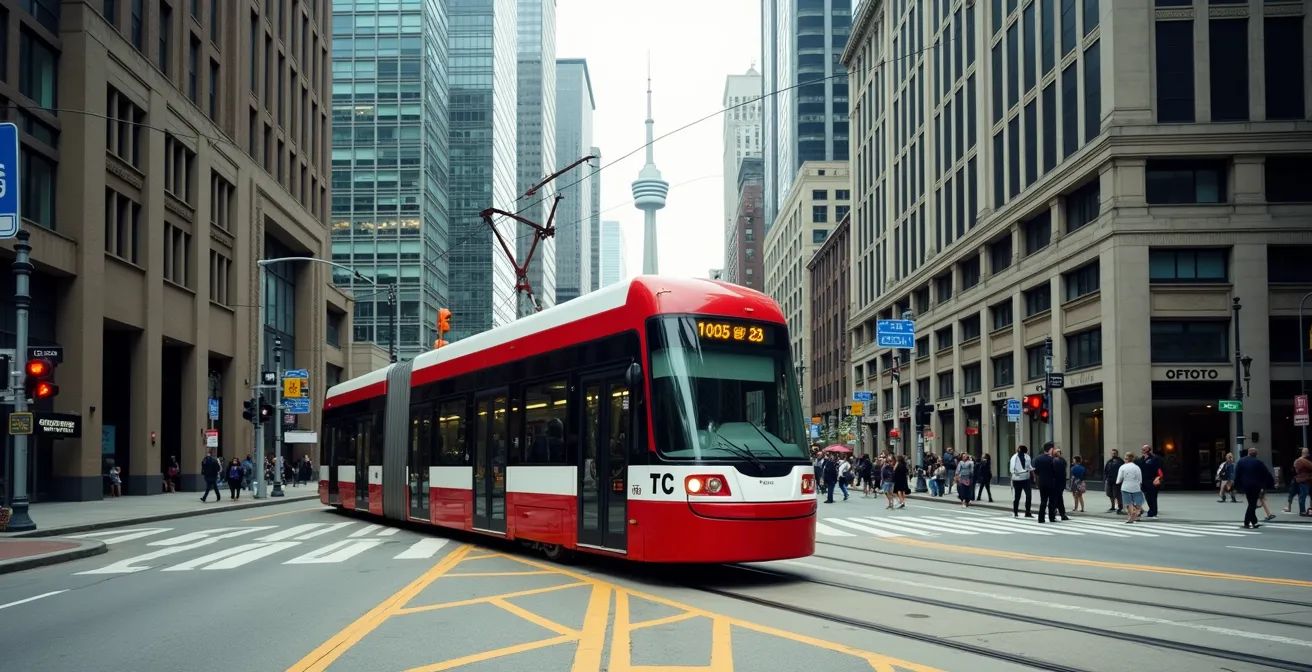
Mastering the TTC isn’t about memorizing the official map; it’s about knowing the unwritten rules locals use to save money, time, and their sanity.
- The PRESTO card isn’t just a convenience; its fare-capping feature makes it a non-negotiable money-saver for anyone riding more than a few times.
- Your real-time escape plan from a subway delay is always the “parallel universe”—the streetcar or bus route running along the same corridor.
Recommendation: Before you even think about heading out on a weekend, always check the TTC’s service advisories online. The shuttle bus is a soul-crushing experience you want to avoid at all costs.
So, you’re in Toronto and you want to use the TTC. You’ve seen the red streetcars gliding down the middle of the street and thought, “That looks charming.” Let me stop you right there. The TTC isn’t charming; it’s a complex beast with its own logic, and the official instructions only tell you half the story. Tourists stand on the corner, confused by a fare machine, while locals are already halfway to their destination, having paid, transferred, and mentally planned their escape route from the inevitable delay.
Most guides will tell you to get a PRESTO card and use a transit app. That’s table stakes. They won’t tell you about the “commuter calculus”—the split-second mental math we do to decide if it’s faster to wait for a delayed subway or bail for the 504 King streetcar. They won’t explain the life-or-death ritual of exiting a streetcar into a lane of impatient Toronto drivers. And they definitely won’t tell you how to turn a two-hour fare into a multi-stop errand-running machine.
Forget the polite, sanitized version of Toronto transit. The real key to mastering this city isn’t just knowing the rules, but understanding the system’s quirks and how to exploit them. This isn’t just a guide to getting from A to B. It’s a crash course in thinking and moving like a local who has seen it all, from rush-hour crushes on Line 1 to the ghost-like appearance of a “short-turning” streetcar that goes out of service right when you need it most.
This guide breaks down the unwritten rules of the TTC, from the critical safety manoeuvres to the fare hacks that separate the rookies from the veterans. We’ll cover the essential strategies that will make your trip smoother, cheaper, and infinitely less stressful. Let’s dive into the details that actually matter.
Summary: Your Street-Wise Guide to Navigating the TTC
- Why the TTC’s 2-Hour Transfer Window Is the Best Deal for Short Errands?
- How to Exit a Streetcar Without Getting Hit by a Car in the Right Lane?
- Credit Card Tap or Presto App: Which Is Faster at the Turnstile?
- The Weekend Mistake of Not Checking for Scheduled Subway Maintenance
- When to Switch to the Bus Network to Bypass a Subway Delay?
- Why Buying Single Fares Instead of a PRESTO Card Costs You 25% More?
- When to Use the 504 King Streetcar for a Scenic Architecture Tour?
- How to Experience Toronto Like a Local in 48 Hours Without Rushing?
Why the TTC’s 2-Hour Transfer Window Is the Best Deal for Short Errands?
The single most underutilized feature by newcomers is the two-hour transfer window. When you tap your PRESTO card or credit card, you don’t just pay for one ride; you unlock 120 minutes of unlimited travel across the entire TTC network—streetcars, buses, and subways. This isn’t just for getting from one side of the city to the other. For a local, this is a strategic tool for running errands.
Think of it as a short-term pass. You can tap on a streetcar, ride a few stops to the post office, hop off, do your thing, then hop back on another streetcar or bus going in any direction, all on the same fare. As long as you are within that two-hour window from your first tap, you won’t be charged again. This effectively turns a single fare into a multi-stop trip, which is how you get real value out of the system. For a newcomer, combining this with a smart payment method like PRESTO is essential; it’s part of the reason smart riders can benefit from up to a 36% discount compared to single cash fares through various programs.
The pro move is to “chain” errands along a major route. For example, take the 504 King streetcar to grab a coffee, then continue on to a meeting, and finally stop at St. Lawrence Market on your way back. As long as your last boarding happens just before the 120-minute mark, your final leg of the journey is covered, even if it extends beyond the window. This is the commuter calculus in its purest form: maximizing value and minimizing cost by treating time as a resource.
How to Exit a Streetcar Without Getting Hit by a Car in the Right Lane?
This isn’t a joke; it’s the most important piece of practical advice for riding a Toronto streetcar. On most routes, the streetcar stops in the middle of the road, and you have to step directly into an active lane of traffic to get to the sidewalk. This is the “Right-Lane Gauntlet,” and navigating it safely is a non-negotiable skill. Legally, drivers are required to stop behind the open rear doors of a streetcar. In reality, you should never, ever trust that they will.
The cardinal rule is simple: Look right before you step off. Always. Assume a car is coming. A glance over your right shoulder should be as automatic as breathing. Watch for cyclists, distracted drivers, or anyone trying to illegally pass the streetcar on the right. As transit guides for tourists often emphasize, you must remain vigilant because not all drivers comply with the law, especially at busy intersections. Once you’ve confirmed the coast is clear, move directly and purposefully to the sidewalk. Don’t linger in the road.
This paragraph introduces a complex concept. To well understand it, it’s useful to visualize its key safety components. The illustration below breaks down this crucial moment.

As you can see, the moment of caution is critical. Your hand should be on the door frame for stability, but your focus must be on the traffic behind you. This isn’t about being paranoid; it’s about internalizing a habit that has kept daily commuters safe for decades. This single act of awareness separates the seasoned rider from the person who ends up as a hood ornament.
Credit Card Tap or Presto App: Which Is Faster at the Turnstile?
The debate between using a PRESTO card versus tapping a credit/debit card seems simple, but the nuances matter. At the reader, a PRESTO card is often marginally faster—it’s an instant tap-and-go. A contactless credit or debit card can sometimes take an extra second or two to process, which feels like an eternity when a line is forming behind you. However, for a visitor, the convenience of not having to buy and load a separate card is a huge plus.
But the decision goes beyond speed. If you’re traveling with family or a group, PRESTO is the clear winner. You can use your PRESTO card to pay for multiple people (you have to tell the driver or station attendant first), whereas a credit card is strictly one tap, one rider. Furthermore, PRESTO gives you a full, detailed transaction history online, perfect for tracking expenses. A credit card just shows a series of “TTC” charges on your bank statement. This becomes particularly relevant when taking advantage of programs like the One Fare Program, which integrates TTC and GO Transit fares, saving up to $3.30 per trip for multi-system riders—a benefit best tracked with PRESTO.
For most short-term visitors, a contactless credit card is perfectly fine. But if you’re staying for more than a week or traveling in a group, getting a PRESTO card is the smarter move. The following table breaks down the key differences to help you decide.
| Feature | PRESTO Card | Credit/Debit Card Tap |
|---|---|---|
| Speed at Reader | Instant tap | 1-2 second processing |
| Group Travel | Can pay for multiple riders | One person only |
| Winter Reliability | Works in extreme cold | Works in extreme cold |
| Transaction History | Full history available online | Limited to bank statements |
| Auto-reload Option | Yes | Not applicable |
| Works Offline | Yes | Yes |
The Weekend Mistake of Not Checking for Scheduled Subway Maintenance
Nothing screams “tourist” louder than standing on a subway platform on a Saturday morning, wondering why no trains are coming, only to realize there’s a planned closure. Torontonians know this pain well: weekend subway maintenance is a fact of life. Large sections of Line 1 (Yonge-University) or Line 2 (Bloor-Danforth) are frequently shut down for upgrades, replacing train service with a fleet of slow, overcrowded shuttle buses.
The single biggest mistake you can make is not checking the TTC’s status before you leave. A trip that should take 20 minutes by subway can easily stretch to over an hour on a shuttle bus. Experienced riders have this check built into their weekend routine. They know that major construction, like the ongoing Ontario Line work, causes significant and long-term diversions. A great example highlighted by local transit analyst Steve Munro was the Fall 2024 diversion of the 501 Queen streetcar, which forced riders to adapt by using the 504 King as an alternative. This proves the importance of knowing what’s closed and what your backup plan is.
Don’t get caught off guard. Avoiding this weekend nightmare is simple if you adopt a local’s proactive mindset. It’s about checking once, saving yourself a massive headache, and not letting your weekend plans get derailed by a shuttle bus.
Your Weekend Survival Checklist: Avoiding the Shuttle Bus Trap
- Friday Night Check: Visit ttc.ca/service-advisories before you go to bed to see the planned weekend closures.
- Set Up Alerts: Follow @TTCnotices on X (formerly Twitter) for real-time updates on unplanned delays and service changes.
- Plan B Routes: Identify the parallel streetcar or bus routes for your journey (e.g., 501 Queen for a Line 1 closure downtown).
- Download Transit Apps: Install an app like Rocketman or Transit for live vehicle tracking to see where the shuttle buses actually are.
- Event Day Strategy: Cross-reference TTC closures with major city events (like a Blue Jays game or a concert) that will compound delays.
When to Switch to the Bus Network to Bypass a Subway Delay?
You’re standing on a packed subway platform. An announcement crackles: “Service is suspended on Line 1… due to a signal problem.” Panic sets in for the tourists. The veterans are already halfway up the stairs. This is the moment where the commuter calculus is most critical: knowing when to abandon the subway and switch to the “parallel universe” of surface routes.
The unwritten rule is the “5-Minute Rule.” If the announced delay is five minutes or less, you stay put. It will likely resolve faster than you can get to the street and find a bus. But if the delay is announced as “longer than 5 minutes,” or if there’s no time estimate at all, you leave immediately. Don’t wait. Your best bet is always the major streetcar or bus route that runs parallel to the subway line you’re on. For a delay on Line 1 downtown, it’s the 97 Yonge bus or the 501 Queen/504 King streetcars. For Line 2, it’s often the 504 King or 505 Dundas. The locals know these alternatives by heart.
This is a strategic decision between two modes of transit. You’re choosing the known, albeit slower, pace of a streetcar over the unknown, potentially infinite wait for a subway.
The most reliable indicator? Watch the locals. If you see a sudden, purposeful exodus from the platform, follow them. They know where they’re going. They’re not panicking; they’re executing a well-rehearsed backup plan. This is your chance to learn from the best and avoid being stranded underground.
Why Buying Single Fares Instead of a PRESTO Card Costs You 25% More?
Let’s be blunt: if you’re paying cash or buying single-fare tickets, you’re throwing money away. A PRESTO card isn’t just a piece of plastic; it’s a key to unlocking the system’s best value, primarily through its automatic monthly fare cap. This is the “fare-capping hack” that every regular commuter relies on.
Here’s how it works: once you’ve paid for 48 trips in a calendar month using your PRESTO card, every subsequent ride on the TTC for the rest of that month is completely free. The system automatically stops charging you. You don’t have to buy a monthly pass upfront or guess how much you’ll be traveling. This feature is so effective that between 2015 and 2019, the percentage of TTC customers using monthly passes dropped significantly from around 50% to 30%, as riders realized the PRESTO cap offered the same benefit without the upfront commitment.
For anyone staying in Toronto for a few weeks or using transit frequently, this is a game-changer. You get the financial benefit of a monthly pass without the risk of paying for it and not using it enough. The system does the math for you. This is the single biggest financial reason to get a PRESTO card on day one. Every tap with cash is a missed opportunity to get closer to that free-ride threshold. Don’t be the person at the end of the month who has paid for 60 individual trips when you could have stopped paying after 48.
When to Use the 504 King Streetcar for a Scenic Architecture Tour?
Once you’ve mastered the basics of survival, you can start using the streetcar network for what it is: one of the best ways to see the city. While the 501 Queen route famously gets all the glory—National Geographic even ranked it the world’s #1 trolley ride—the 504 King streetcar offers a fantastic, condensed tour of Toronto’s architectural evolution.
The 504 route slices through the heart of the city’s commercial and cultural core. It’s a journey from historic industrial grit to gleaming modern finance. The best time to take this tour is during the “golden hour” on a weekday, the hour before sunset, when the light hits the buildings just right and the rush-hour crowds have started to thin. Start at Broadview Station and head west for the full experience.
Your self-guided architectural tour would look something like this:
- Distillery District (get off at King & Parliament): Wander through the stunningly preserved Victorian industrial architecture, now home to galleries and cafes.
- Financial District (King & Bay): Crane your neck to see Toronto’s version of “Wall Street,” with the iconic towers of Canada’s major banks.
- Entertainment District (King & John): Pass by Roy Thomson Hall and the Princess of Wales Theatre, the heart of the city’s performing arts scene.
- Liberty Village (King & Dufferin): See how industrial warehouses have been converted into trendy lofts and modern condos, representing the city’s ongoing transformation.
This isn’t just a commute; it’s a mobile lesson in urban history. You’re seeing the city change block by block, from the comfort of your streetcar seat—for the price of a single fare.
Key takeaways
- The 2-hour transfer window on a PRESTO/contactless payment is a strategic tool for running multiple errands on a single fare.
- Always look right for traffic before stepping off a streetcar; never assume cars will stop. This is the most critical safety rule.
- For weekend travel, checking the TTC service advisories for subway closures is non-negotiable to avoid being stuck on a slow shuttle bus.
How to Experience Toronto Like a Local in 48 Hours Without Rushing?
So, you have 48 hours and want to experience the real Toronto, not just the tourist hotspots. The streetcar network is your key. It connects the city’s most vibrant and diverse neighborhoods, allowing you to hop between distinct cultural pockets without ever feeling rushed. Forget the tour bus; this is how you explore the city on your own terms, with the flexibility to linger where you want.
This itinerary is built around key streetcar routes, designed to give you a true taste of local life. With your PRESTO card and the knowledge you’ve gained, you can navigate this plan seamlessly. The goal is to experience the rhythm of the neighborhoods, not just tick off landmarks.
Here’s a potential 48-hour plan that uses the streetcar as its backbone:
- Day 1 Morning (Culture & Markets): Take the 510 Spadina streetcar. Immerse yourself in the energy of Chinatown, then walk over to the eclectic and bohemian Kensington Market for unique finds and food.
- Day 1 Afternoon (Historic Toronto): Hop on the 506 Carlton. This route takes you through the heart of Little Italy and into Cabbagetown, home to the largest collection of preserved Victorian housing in North America.
- Day 1 Evening (Dinner & a Show): Ride the 504 King to the Entertainment District for pre-theatre dinner and to soak in the downtown buzz.
- Day 2 Morning (Lakeside Brunch): Take the 501 Queen east all the way to The Beaches. Enjoy brunch with a view of Lake Ontario and walk along the boardwalk.
- Day 2 Afternoon (Island Escape): Use the 509 Harbourfront to get to the Jack Layton Ferry Terminal and take a ferry to the Toronto Islands for stunning skyline views.
- Day 2 Evening (Park Life & West End Vibe): Catch the 511 Bathurst to hang out in Trinity Bellwoods Park, the city’s favourite backyard, and explore the trendy shops of West Queen West.
This isn’t just a list of places; it’s a strategy. By using the streetcar, you’re not just traveling between points; you’re seeing the city unfold at street level, the way it’s meant to be seen. Now, go tap your card and start exploring.