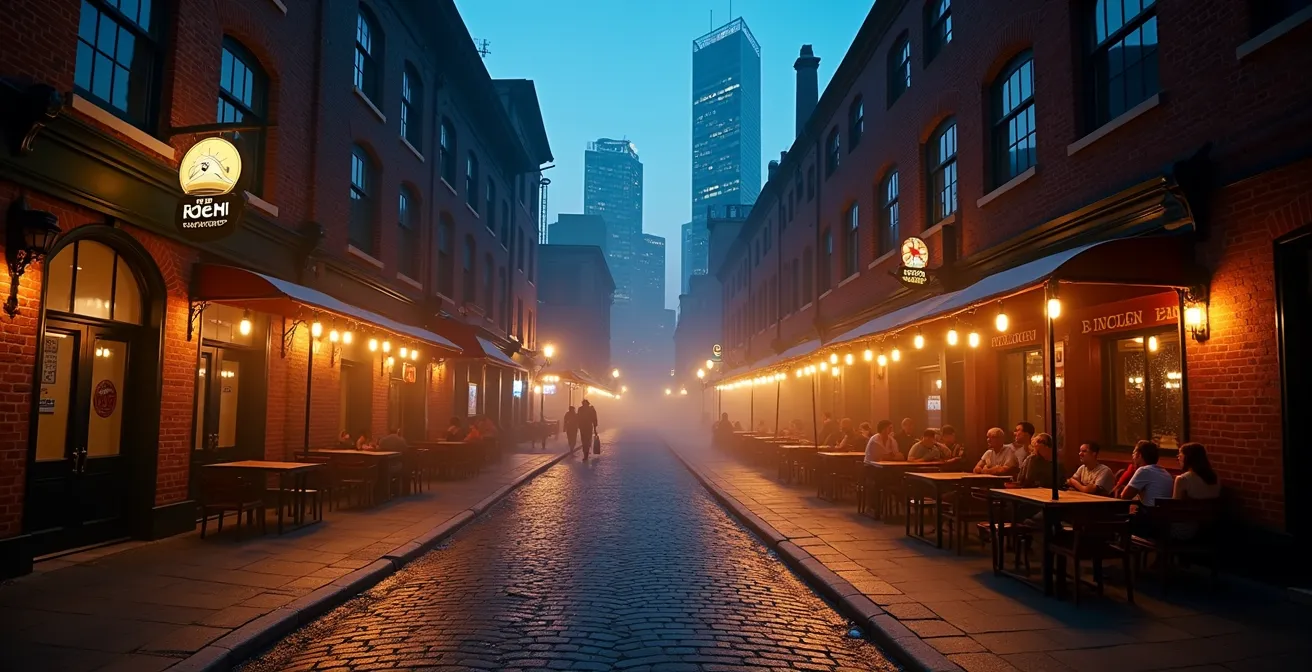
The best Toronto tour isn’t defined by its theme (ghosts or food), but by its ability to connect you to the city’s hidden emotional and sensory story.
- Authentic tours focus on “narrative texture”—the blend of specific history, sensory details, and storytelling that makes a place feel alive.
- Look for guides who connect stories to the physical environment, like the feel of cobblestones or the echo in a theatre, rather than just reciting facts.
Recommendation: Choose your next tour by evaluating its potential for deep storytelling and sensory immersion, not just its topic. This guide shows you how.
You arrive in Toronto, a city teeming with stories, and face the classic visitor’s dilemma: how do you truly connect with its soul? The brochures offer a tantalizing choice. Do you chase the spectral whispers of a ghost walk, hoping for a chill down your spine? Or do you follow the aromatic trail of a food tour, seeking the city’s flavour? Most will tell you to simply pick your preference: spooky or savory. It seems like a straightforward decision between entertainment and indulgence.
But this choice misses the point entirely. What if the real value of a tour has nothing to do with its theme? What if the most memorable experiences, the ones that reveal the true character of a place, are built on something deeper? This guide proposes a new way to look at guided experiences. The secret isn’t in the *what*—the ghosts or the gourmet bites—but in the *how*. It’s about finding a tour with a rich narrative texture, one that weaves together history, emotion, and the very ground beneath your feet into an unforgettable story.
This isn’t about rejecting fun; it’s about finding a more profound kind of engagement. A ghost story can be a powerful vessel for history, just as a simple dish can tell a story of immigration and community. We will explore how to distinguish a superficial “tourist trap” from an authentic local immersion. We’ll analyze how the physical environment itself becomes a character in the story, why your guide’s ability to create emotional resonance matters more than anything, and how to spot the subtle clues that an experience will leave you with more than just a full stomach or a fun fright.
This article will guide you through the art of choosing a tour that doesn’t just show you Toronto, but lets you feel its pulse. By understanding the elements of narrative texture, you can unlock a side of the city that most visitors—and many locals—never get to see.
Summary: Unlocking Toronto’s Hidden Stories, One Tour at a Time
- Why the Haunted Walk of Toronto Changes How You See the Elgin Theatre?
- How to Spot a “Tourist Trap” Tour vs an Authentic Local Experience?
- Walking Tour or Segway Tour: Which Is Better for Exploring the Distillery District?
- The Weather Mistake That Ruins Your Outdoor Architectural Tour
- How Much to Tip Your Tour Guide in Canada to Show Appreciation?
- Why the Distillery District’s Cobblestones Are Protected by Heritage Laws?
- Guided Tour or Solo Exploration: Which Best Unlocks the Canadian Collection?
- How to Experience Toronto Like a Local in 48 Hours Without Rushing?
Why the Haunted Walk of Toronto Changes How You See the Elgin Theatre?
The Elgin and Winter Garden Theatre is an architectural marvel by day, but stand before it at night on a Haunted Walk, and the building transforms. It ceases to be just brick and mortar; it becomes a vessel for stories. This is the power of a tour built on strong narrative texture. A great guide doesn’t just tell you a ghost story; they use the tale of the Lavender Lady to anchor you in the theatre’s Vaudeville-era history, making its gilded opulence feel both alive and hauntingly distant. The story gives the cold marble an emotional temperature.
This experience is far more than a simple scare. It’s a form of emotional resonance. The alleged ghost isn’t the main attraction; she is the key that unlocks a deeper connection to the place. When the guide lowers their voice to describe a sighting in the empty upper balconies, you are no longer a tourist on a busy street. You are a participant in the theatre’s century-long drama. It’s this skilled storytelling that makes tours like the Haunted Walk so popular, part of a thriving industry that draws in a fraction of the city’s visitors. With Toronto welcoming 9 million overnight visitors spending $8.8 billion in a single year, standing out requires more than a gimmick; it requires substance.
The experience highlights a crucial lesson: the theme is secondary to the execution. A food tour could talk about the theatre’s first concession stands, but the ghost story provides a more potent and memorable narrative thread. It taps into a universal human curiosity about the unknown, using it to teach you about the building’s architecture, its purpose, and its place in Toronto’s cultural history. You leave not just knowing about the Elgin, but feeling its presence.
Case Study: The Haunted Walk’s Distillery District Success
The popularity of The Haunted Walk’s 75-minute tour of the Distillery District proves the power of narrative. While other tours focus on art or alcohol, this experience uses tales of mysterious hotspots and unexplainable activity to bring the industrial brickwork to life. By focusing on the district’s darker, forgotten stories, it offers a unique and compelling narrative texture that keeps it in high demand year-round, transforming familiar laneways into stages for history and mystery.
How to Spot a “Tourist Trap” Tour vs an Authentic Local Experience?
The difference between an unforgettable journey into Toronto’s heart and a forgettable “tourist trap” lies in its authenticity. A trap tour deals in clichés and generic facts—stories that could be told anywhere. An authentic experience, however, is woven from the specific, hyper-local fabric of the city. It delivers curated authenticity, where the guide acts as a trusted interpreter of the city’s complex character, not just a walking Wikipedia page. They connect you to the urban palimpsest, showing you the layers of history hidden in plain sight.
So, how do you identify this quality before you book? It’s about looking for markers of deep local knowledge. Does the tour company highlight its guides’ credentials or connections to neighborhood historical societies? Do they talk about the specific evolution of a place like Kensington Market, from its Jewish to Portuguese to Caribbean roots, or do they just say “it’s a diverse market”? A truly local guide will talk about the Toronto Circus Riot of 1855, not just the CN Tower. They won’t just point out a bar; they’ll recommend a specific drink and tell you which TTC streetcar route is the most scenic way to get there.
This level of detail is the hallmark of a tour designed for curious visitors, not just passive tourists. It shows that the experience is built on genuine expertise and a passion for the city’s real stories. It’s the difference between being told a fact and being let in on a secret. Before you spend your time and money, use a critical eye to audit the tour’s promise. The best storytellers leave clues.
Your Checklist for Spotting Authentic Toronto Tours
- Guide Credentials: Check if the company highlights guides’ connections to local historical societies, universities like the University of Toronto, or neighborhood associations.
- Neighborhood Nuance: Look for tours that explain specific neighborhood evolutions (e.g., Kensington Market’s history) rather than using vague terms like “multicultural.”
- Specific Storytelling: Verify if the tour promises to cover specific local events (like the Toronto Circus Riot of 1855) instead of generic Canadian clichés.
- Personalized Advice: See if guides are noted for offering practical, personalized tips, such as specific TTC routes or recommendations for local businesses.
- Academic Rigor: Note any mention of academic credentials or research partnerships, which signals a commitment to historical accuracy over pure entertainment.
Walking Tour or Segway Tour: Which Is Better for Exploring the Distillery District?
When exploring a place as texturally rich as the Distillery District, your mode of transport fundamentally changes the experience. The choice between a walking tour and a Segway tour isn’t just about speed; it’s about sensory anchoring. To walk the district is to feel the history through the soles of your shoes. Each uneven cobblestone, laid for horse-drawn carts and whiskey barrels, connects you physically to its industrial past. This tactile feedback is a powerful part of the narrative, a slow, immersive conversation with the 19th century.

A Segway tour, by contrast, offers efficiency. You glide over the same cobblestones, covering the entire 13-acre complex with ease. It’s an excellent way to appreciate the grand scale of the Gooderham & Worts distillery, but it sacrifices that intimate, tactile connection. The bumps are smoothed over; the sensory narrative is muted. You see the history, but you don’t feel it in the same way. The choice, therefore, depends on your goal. Are you seeking a comprehensive overview or a deep, sensory dive?
For the traveler seeking to understand the true narrative texture of the Distillery District, the walking tour is unparalleled. It forces a slower pace, allowing your eyes to catch the worn brickwork, your ears to notice the acoustics of the laneways, and your feet to read the story written in stone. The Segway provides a great summary; the walk lets you read the book.
This table breaks down the fundamental differences in the experience, helping you choose based on the kind of story you want to be a part of.
| Aspect | Walking Tour | Segway Tour |
|---|---|---|
| Duration | 75 minutes | 40 minutes |
| Physical Connection | Feel historic cobblestones underfoot | Glide over cobblestones smoothly |
| Coverage Area | Focused exploration of key buildings | Covers entire 13-acre complex |
| Age Requirement | Suitable for most ages | 12 years and up |
| Experience Type | Tactile, immersive historical connection | Efficient overview of industrial scale |
The Weather Mistake That Ruins Your Outdoor Architectural Tour
The single biggest weather mistake visitors make in Toronto isn’t underestimating the cold; it’s underestimating the wind. A 5°C autumn day on the forecast can feel like -5°C when you’re standing by the waterfront, thanks to the biting lake effect. In the Financial District, the towering skyscrapers create unpredictable wind tunnels. This isn’t just a comfort issue; it’s a narrative one. When you’re shivering uncontrollably, you’re not listening to the story of the TD Centre’s minimalist design. Your focus shifts from the architectural details to survival, and the tour’s narrative texture is lost.
Dressing for the temperature but not the wind is a classic rookie error. True sensory anchoring means preparing for the full range of the city’s atmospheric personality. An extra layer, a windbreaker, a hat—these are not just practical items; they are your tools for staying present in the story. A knowledgeable guide will often integrate sections of Toronto’s underground PATH system on brutally cold or wet days, demonstrating a mastery of the city’s climate as well as its history. This adaptability is another sign of an authentic, high-quality tour.
Weather is not an obstacle to the story; it *is* part of the story. The wind off Lake Ontario is as much a character in Toronto’s narrative as any historical figure. Visitor patterns reflect this, as Toronto tourism statistics reveal that while October and December have similar visitor numbers, the *type* of activity chosen shifts dramatically. By preparing for the wind, you aren’t fighting the environment; you’re equipping yourself to listen to what it has to say, ensuring your focus remains on the stunning architecture and the stories it holds, not on your chattering teeth.
How Much to Tip Your Tour Guide in Canada to Show Appreciation?
Tipping your tour guide in Canada is more than a transaction; it’s the final chapter in the story they’ve shared with you. It’s a direct acknowledgement of their skill in creating that elusive narrative texture. A great guide doesn’t just recite facts; they manage group dynamics, adapt to sudden downpours, and conjure emotional resonance from thin air. Your tip should reflect the quality of that performance. While there are guidelines, treating tipping as an automatic, fixed percentage misses the point.

In Toronto, the standard is a good starting point. For group tours, according to Canadian tipping guidelines, this is often $2-$5 per person, while private tours warrant 15-20% of the cost. However, this is a baseline. Did the guide handle a disruptive guest with grace? Did they offer you a hyper-personalized tip for a speakeasy that perfectly matched your vibe? Did they make your kids feel included and excited? This is where you adjust upwards. For “pay-what-you-feel” tours, remember this is often the guide’s sole income; a tip of $10-$20 per person is a fair reflection of a quality experience.
But cash isn’t the only currency of appreciation. A powerful, non-monetary “tip” is to leave a detailed online review on TripAdvisor or Google, mentioning the guide by name. This has a direct and lasting impact on their reputation and future bookings. It tells the world that this person is a master storyteller, a true purveyor of authentic Toronto. Tipping, in all its forms, is your way of saying, “You didn’t just show me a place; you made me feel it.”
- Adjust your tip based on service quality; 15-20% is a baseline, not an obligation.
- A detailed online review naming the guide is an invaluable form of appreciation.
- Consider tipping extra for exceptional management of difficult situations (weather, challenging guests).
- For “free” walking tours, where tips are the guide’s only income, a budget of $10-20 per person is appropriate for good service.
Why the Distillery District’s Cobblestones Are Protected by Heritage Laws?
The cobblestone streets of the Distillery District are not mere decoration; they are a protected artifact. Under the Ontario Heritage Act, the district is designated as a “Cultural Heritage Landscape.” This is a critical distinction. The law protects not just the iconic Victorian industrial buildings, but the entire character of the area, including the very streets that once supported the weight of horse-drawn carts groaning with grain and whiskey barrels. These cobblestones are the physical foundation of the district’s narrative texture.
Preserving them is a deliberate act of storytelling. It forces modern visitors to slow down and move through the space as people did in the 19th century. While it presents challenges for accessibility, as noted by Destination Toronto’s advice that “cobblestone walkways can be uneven,” this unevenness is precisely the point. It is a sensory reminder of the area’s rugged, industrial past. To pave them over with smooth asphalt would be to erase a vital chapter of the story, sanitizing the history and severing a direct physical link to the past.
This legal protection acknowledges that a city’s soul is held not only in its grand monuments but in its humble, functional surfaces. The cobblestones are a tangible piece of the “urban palimpsest,” a layer of history that has been deliberately kept visible. They ensure that every tour, whether focused on ghosts, art, or whiskey, is literally grounded in an authentic historical context. They are a silent guide, telling a story of labour, industry, and the passage of time to anyone who walks upon them.
Most venues are wheelchair-accessible, but be aware that cobblestone walkways can be uneven.
– Destination Toronto, Ghost Tour of the Distillery District Guide
Guided Tour or Solo Exploration: Which Best Unlocks the Canadian Collection?
When faced with a vast and significant collection like the Canadian art at the Art Gallery of Ontario (AGO), the choice between a guided tour and solo exploration is a choice between two different narrative philosophies. A guided docent tour offers a curated narrative. It’s a carefully constructed story, designed to connect the dots between major works, provide context on the Group of Seven, and reveal anecdotes you’d never find on your own. The guide acts as a storyteller, shaping your journey and ensuring you grasp the intended historical and artistic significance. It is efficient, insightful, and provides a strong, coherent narrative thread.
Solo exploration, on the other hand, is about creating your own narrative. It allows you the freedom to be drawn to a piece that resonates with you personally, perhaps spending thirty minutes with a single Indigenous carving while skipping a more famous painting. This approach prioritizes personal interpretation and serendipity. You follow your own curiosity, building a story that is uniquely yours. However, you risk missing the broader context and the subtle connections between works that a guide can illuminate.
As the comparison shows, there’s no single “best” way; there is only the best way for *you*. A hybrid strategy is often ideal: take the one-hour docent tour to get the essential framework and hear the expert stories, then use your remaining time to circle back to the pieces that called to you. This combines the strength of a curated narrative with the satisfaction of personal discovery, giving you the richest possible narrative texture from your visit.
The following table from a local expert, Toronto’s Tour Guys, illustrates how each approach serves a different goal.
| Aspect | Guided Docent Tour | Solo Exploration | Hybrid Strategy |
|---|---|---|---|
| Best For | Understanding curated narratives & Group of Seven context | Personal interpretation of Indigenous collections | Comprehensive understanding |
| Duration | 1 hour | Self-paced (2+ hours) | 2.5 hours total |
| Focus | Collection highlights with expert anecdotes | Deep dive into specific interests | Overview plus targeted exploration |
| Cost | Included with admission | Admission only | Admission only |
Key Takeaways
- The true quality of a tour lies in its “narrative texture,” not its theme.
- Authenticity is revealed through specific, local stories and a guide’s deep knowledge, not generic facts.
- How you experience a place (e.g., walking vs. Segway) directly impacts the sensory information you receive and the story you perceive.
How to Experience Toronto Like a Local in 48 Hours Without Rushing?
To experience Toronto like a local in just 48 hours, you must reject the tourist’s mindset of “seeing it all.” With approximately 72,000 visitors per day on average, the city’s popular spots can feel overwhelming. A local’s approach isn’t about ticking off a checklist; it’s about finding the city’s rhythm and immersing yourself in the narrative texture of a few select neighborhoods. The key is depth over breadth. Adopt the “One Neighbourhood Per Half-Day” rule. Spend a morning exploring the independent cafes and boutiques of Leslieville, then an afternoon relaxing in Trinity Bellwoods Park. This allows you to absorb the unique character of each place.
Mastering a few key transit routes is also essential. The 501 Queen streetcar is effectively a cross-city tour for the price of a TTC fare, taking you through distinct areas like West Queen West, the Financial District, and The Beaches. Locals also know which crowds to avoid. Instead of the packed St. Lawrence Market on a Saturday, they head to farmers’ markets at Wychwood Barns or Evergreen Brick Works for a more relaxed and authentic experience. This strategic avoidance is part of living here.
Finally, a local approach means using the city’s infrastructure wisely. The underground PATH system isn’t just for escaping the winter cold; it’s a strategic tool for connecting downtown attractions efficiently, leaving you more time to linger where it matters. By focusing your time, choosing your transit wisely, and moving with intention, you can build a 48-hour story that feels rich and personal, not rushed and superficial. It’s about creating your own authentic Toronto experience, one neighborhood at a time.
Now equipped with the tools to look beyond the theme and evaluate a tour for its narrative depth and sensory detail, your next step is clear. Choose the Toronto experience—be it a ghost walk, a food tour, or a neighborhood stroll—that promises the richest narrative texture, and prepare to write your own unforgettable chapter in the city’s story.
Frequently Asked Questions about Toronto Walking Tours
What should I wear for a Toronto walking tour in shoulder season?
Always bring one more layer than you think you need. A 5°C day can feel like -5°C near the waterfront due to lake effect winds. A windbreaker is essential.
How do I escape sudden weather during a tour?
Familiarize yourself with the PATH underground system entry points before your tour begins. Many downtown tours can integrate sections of the PATH to avoid harsh weather, and knowing where the entrances are can be a lifesaver.
What’s the biggest weather mistake tourists make?
The most common mistake is dressing for the temperature but not the wind. This is especially true in the Financial District, where skyscrapers create powerful and unpredictable wind tunnels that can make a mild day feel intensely cold.