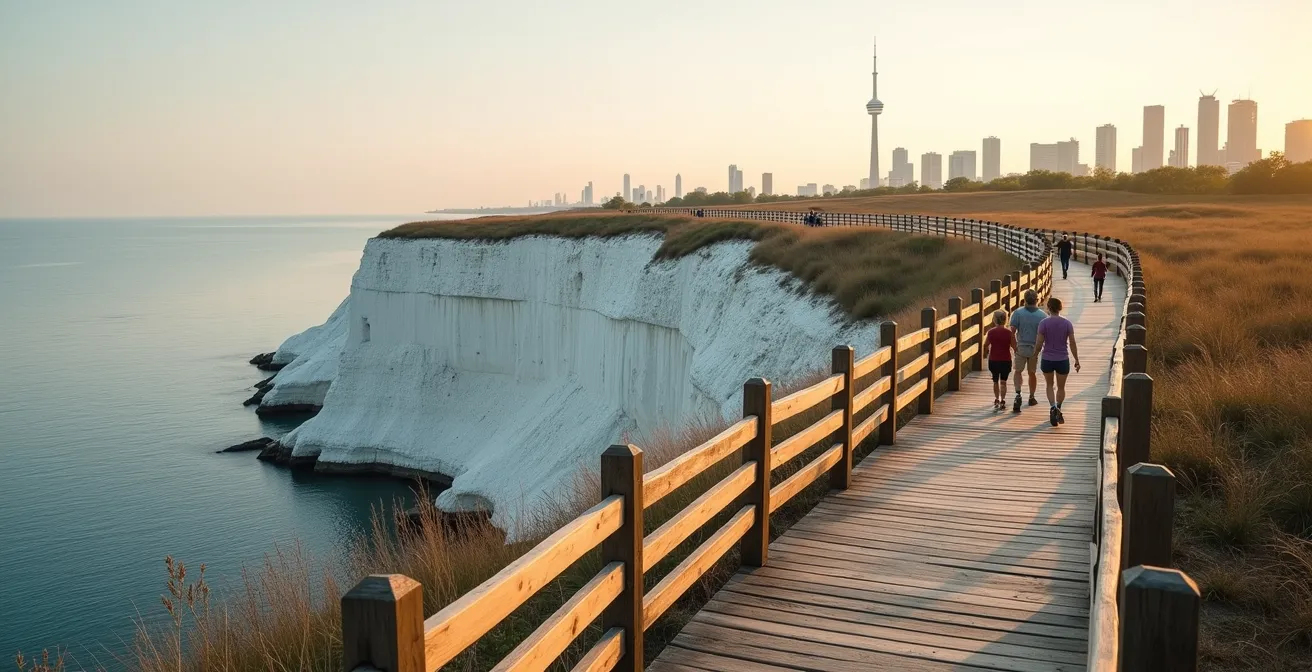
The irresistible beauty of the Scarborough Bluffs hides non-obvious dangers that go beyond the cliff edge, including geological instability, steep fines, and logistical traps.
- The cliffs are made of unstable sediment, making any un-fenced edge a potential collapse zone.
- Trespassing onto unofficial trails can result in a $5,000 rescue bill and diverts critical emergency services.
Recommendation: Adopt a strategic approach by planning your access, choosing designated viewpoints, and understanding the specific rules for a safe and rewarding visit.
The Scarborough Bluffs are one of Toronto’s most breathtaking natural wonders, drawing thousands of visitors who want to capture that perfect photo from the towering white cliffs. But the common advice to simply “be careful” is dangerously inadequate. It fails to address the fundamental instability of the terrain, the serious legal and financial consequences of a misstep, or the logistical challenges of simply getting there. Many visitors, focused on the view, unknowingly put themselves at severe risk.
While most articles focus on the beauty, this guide adopts the mindset of a safety-conscious professional. We will not just tell you where to go, but explain *why* certain areas are safe and others are a deadly gamble. The real key to experiencing the Bluffs isn’t about getting close to the edge; it’s about understanding the mechanics of risk. This involves appreciating the geological forces at play, knowing the specific legal boundaries, and having a solid logistical plan for parking and transit.
This guide will provide you with the knowledge to make informed decisions. We will cover the science behind the instability, detail the official and safe viewing areas, explain the steep cost of trespassing, and offer concrete strategies for parking and TTC access. Finally, we’ll extend this safety mindset to enjoying the water at the base of the cliffs, ensuring your entire experience is memorable for the right reasons.
To help you navigate this essential information, this article is structured to address every key aspect of a safe visit. The following summary outlines the critical topics we will cover, from understanding the risks to practical planning.
Contents: A Strategic Guide to the Scarborough Bluffs
- Why Standing on the Edge of the Bluffs Is a Deadly Risk?
- How to Find Parking at Bluffer’s Park Before the Lot Fills at 10 AM?
- Bluffer’s Park Beach or Scarboro Crescent Park: Which Offers Better Views?
- The Trespassing Mistake That Can Cost You $5,000 in Rescue Fees
- How to Get to the Bluffs by TTC Without a 20-Minute Uphill Walk?
- When to Launch Your Kayak to Catch the Sunset Behind the Skyline Safely?
- Hanlan’s Point vs Centre Island: Which Beach Fits Your Group’s Comfort Level?
- Kayaking or SUP on Lake Ontario: Which Water Sport is Safe for Beginners?
Why Standing on the Edge of the Bluffs Is a Deadly Risk?
The single most important rule at the Scarborough Bluffs is to stay away from the unfenced edge. This isn’t an overcautious warning; it’s a directive based on the geological reality of the area. The Bluffs are not solid rock. As the Toronto and Region Conservation Authority (TRCA) states, “The Bluffs are comprised of various sediments, including silt, sand and clay and are therefore very unstable and susceptible to collapsing at any moment.” The picturesque white cliffs are, in fact, a product of constant erosion, a process that makes them inherently unpredictable. What looks like solid ground can give way without warning.
Factors like heavy rainfall and the spring’s freeze-thaw cycles dramatically increase this instability, weakening the structure from within. The temptation to follow narrow “desire paths” for a better photo is a direct path to danger. These unofficial trails are not maintained and often lead to the most undercut and fragile sections of the cliff face. The danger is quantifiable; Emergency Services respond to approximately 100 calls at the Bluffs each year, many involving people who have slipped, become trapped, or fallen.
There are multiple official trails of varying lengths within the parks system that are designed for safety. The focus should never be on the length of a trail, but on its official designation. Sticking to marked paths, behind all fences and barriers, is the only way to guarantee you are on stable ground. The risk of a catastrophic collapse is real, and no photograph is worth your life.
Your Safety Checklist for Visiting the Bluffs
- Stay on marked paths: Always stick to the designated trails to ensure your safety and protect the fragile habitat.
- Maintain a safe distance: Stay far back from cliff edges and the base of the cliffs, as both are erosion hazards.
- Respect all barriers and signage: Heed posted warnings, signs, and fences. They are there for your protection.
- Avoid unofficial paths: Never use narrow dirt trails or ‘desire paths,’ especially those near the cliff edges, as they are not safe or sanctioned.
- Check weather conditions: Be aware that heavy rains and fluctuating temperatures significantly increase the risk of instability and collapse.
How to Find Parking at Bluffer’s Park Before the Lot Fills at 10 AM?
For those driving to the Bluffs, parking is the first major logistical hurdle. The main lot at Bluffer’s Park, located at the base of the cliffs by the beach, is notoriously small and fills up with astonishing speed, especially on summer weekends. Arriving after 10 AM often means being turned away, leading to frustration and risky attempts at illegal parking. A strategic approach is non-negotiable.
Your best strategy is simple: arrive exceptionally early. On a summer weekend, aiming for a 9 AM arrival is a realistic goal for securing a spot in the primary beach lot. On weekdays, you have slightly more leeway, but the lot can still be full by late morning. If the main lot is full, there are lower boat launch lots that may have space, but these are also in high demand. Relying on street parking at the top of Brimley Road is a poor alternative, as it involves a long, steep downhill walk and an exhausting trek back up.

A highly effective but often overlooked solution is to bypass the parking challenge entirely. During the peak season from May to October, the TTC runs the seasonal 175 Bluffer’s Park bus directly from Kennedy Station down to the beach. This service was specifically designed to alleviate vehicle congestion and is the most stress-free way to access the park. For those committed to driving, planning your arrival time and having backup options are key.
The following table, based on guidance from the City of Toronto, provides a clear framework for your parking strategy.
| Time | Weekday Strategy | Weekend Strategy |
|---|---|---|
| Before 9:30 AM | Main lot usually available | Arrive by 9 AM for beach lot |
| 10 AM – 12 PM | Check lower boat launch lots | Use street parking + TTC bus |
| After 12 PM | Consider Rosetta McClain Gardens | Rideshare recommended |
Bluffer’s Park Beach or Scarboro Crescent Park: Which Offers Better Views?
Visitors often get confused about where to find the “best” view of the Bluffs, but the answer depends on the perspective you seek. There are two primary—and safe—options: the view from the top at Scarboro Crescent Park, and the view from the bottom at Bluffer’s Park Beach. Each offers a dramatically different experience.
Scarboro Crescent Park provides the iconic, top-down panoramic shot you often see in photographs. From here, you can take in the vast expanse of the cliffs stretching along the Lake Ontario shoreline. It is the perfect spot for wide-angle photography, especially at sunrise when the golden light illuminates the cliff faces. The park itself is a simple, grassy area and is generally less crowded than the beach below. However, it’s crucial to stay well behind the fences, as this is the very edge we’ve been discussing.
Conversely, Bluffer’s Park Beach offers an immersive, looking-up perspective. From the beach, the cliffs tower above you, giving a true sense of their immense scale and grandeur. You can walk along the shoreline, feel the breeze off the lake, and even go for a swim in the designated areas during the summer. This view is best in the afternoon when the sun lights up the white clay. A standard 50mm lens is perfect for capturing the details and scale from this vantage point. A great local secret for a similar top-down view but with fewer people is Cathedral Bluffs Park, often used by photographers to avoid the crowds at Scarboro Crescent.
This comparison from Destination Toronto can help you decide which location best fits the experience you’re looking for.
| Feature | Bluffer’s Park Beach | Scarboro Crescent Park |
|---|---|---|
| View Type | Immersive looking-up perspective | Epic top-down panoramic shot |
| Best Time | Afternoon light | Sunrise golden hour |
| Accessibility | Fully accessible, paved paths | Uneven grassy areas |
| Photography | Standard lens (50mm) | Wide-angle lens (24-35mm) |
| Crowds | Busy in summer | Generally less crowded |
The Trespassing Mistake That Can Cost You $5,000 in Rescue Fees
Hopping a fence or ignoring a “trail closed” sign at the Scarborough Bluffs is more than just rule-breaking; it’s a decision with severe financial and public safety consequences. The City of Toronto can and will charge individuals for the cost of complex rescue operations, a bill that can easily reach $5,000. This fee covers the immense resources required to safely extract someone from a precarious position on the cliff face. It is not a fine for trespassing—it is a bill for services rendered in a non-fire emergency.
The impact goes beyond your wallet. As the City of Toronto’s “Don’t Get Stuck on the Bluffs” campaign highlights, “Rescue incidents at the Scarborough Bluffs require a significant number of resources that can’t be deployed to other emergencies.” A single incident can tie up multiple fire trucks and dozens of highly trained personnel for hours. In 2018 alone, 16 separate rescue operations at Scarborough Bluffs involved 413 firefighters and a total of 382 staff hours. When these teams are on the Bluffs, they are unavailable for house fires, medical calls, or other life-threatening emergencies elsewhere in the city.
Understanding what constitutes trespassing is key. Any area behind a fence is off-limits. Any path that is not a wide, clearly marked official trail is considered a “desire path” and is therefore an act of trespassing. These dirt paths are the primary cause of rescue incidents. To avoid this costly mistake, you must treat all signs and barriers as absolute boundaries. For added safety, it’s wise to have the What3Words app on your phone. In an emergency, it can provide your exact location to first responders far more accurately than a typical GPS pin.
How to Get to the Bluffs by TTC Without a 20-Minute Uphill Walk?
Using the TTC to get to the Scarborough Bluffs is an excellent way to avoid parking headaches, but many visitors are deterred by the infamous uphill walk from the main bus routes on Kingston Road. The steep grade of Brimley Road is a challenge for even fit individuals. However, with the right transit tactics, you can get to the Bluffs with minimal strenuous walking.
The most direct and convenient option is the seasonal 175 Bluffer’s Park bus. Running from May to October, this route travels from Kennedy Station all the way down Brimley Road to the beach at Bluffer’s Park, completely eliminating the hill. It’s the best public transit option during the summer months, but be sure to check the TTC website for its operating schedule, as it does not run year-round.
If you’re visiting in the off-season or the 175 isn’t running, you have other strategic choices. A popular local hack involves taking the 12A, 12B, or 12D bus to the top of the hill at Kingston Road and Brimley, and then calling a rideshare for the short 5-minute drive down to the park. The cost is minimal and saves you a significant amount of energy for exploring. Another innovative solution is using Bike Share Toronto’s e-bikes. Picking one up from a major transit stop like Kennedy Station transforms the grueling hill into a manageable and even enjoyable 10-minute ride with great views.
For those taking the 102 Markham Road bus to one of the upper parks like Scarboro Crescent, there are gentler, winding paths that lead into the park system, avoiding the steepest sections. A little planning goes a long way in making your TTC journey a pleasant part of the experience. Here are your top strategies:
- Take the seasonal 175 Bluffer’s Park bus from Kennedy Station (May-October).
- Use the 12A/12B/12D bus to Kingston & Brimley, then use a rideshare or taxi for the final descent.
- Try Bike Share Toronto e-bikes from a major transit hub for an electric-assisted ride down the hill.
- For the 102 Markham Rd route, look for the longer but gentler-grade paths into the park.
- Always check the TTC website for the most current route information and seasonal schedule changes before you leave.
When to Launch Your Kayak to Catch the Sunset Behind the Skyline Safely?
Paddling on Lake Ontario with the Bluffs on one side and the Toronto skyline silhouetted by the sunset on the other is a truly magical experience. However, this activity requires careful planning to ensure it remains safe. Lake conditions can change quickly, and fading light adds an extra layer of risk. A precise timeline is your most important piece of safety gear.
First, always check the Government of Canada marine forecast for Lake Ontario before you even consider launching. You are looking for winds under 15 km/h. Anything stronger can create choppy conditions that are dangerous for small watercraft. Never trust a clear sky alone; offshore winds can be deceptive. Your launch point should be the west end of Bluffer’s Park Beach. Plan to be on the water approximately 90 minutes before the official sunset time for that day.

Paddle west, keeping a safe distance from the shore, for about 40-45 minutes. This will position you perfectly to see the sun dip behind the downtown skyline. The most critical part of the plan is the return journey. The moment the sun touches the horizon, you must turn around and begin paddling back to the beach. This ensures you have enough twilight to navigate back safely before complete darkness sets in. It is mandatory under Canadian law to carry specific safety gear, including a properly fitting PFD (lifejacket), a whistle or other sound-signalling device, a 15-meter buoyant rope, and a waterproof flashlight if there is any chance you’ll be on the water after dusk.
- Check the Government of Canada marine forecast for winds under 15km/h.
- Launch from the west end of Bluffer’s Park Beach 90 minutes before sunset.
- Paddle west for approximately 40 minutes to reach the optimal skyline viewing position.
- Begin your return paddle immediately after the sun touches the horizon.
- Carry all mandatory Canadian-law safety gear: a PFD, whistle, 15m buoyant rope, and waterproof flashlight.
Hanlan’s Point vs Centre Island: Which Beach Fits Your Group’s Comfort Level?
While the Bluffs offer a unique shoreline experience, for a classic beach day, many Torontonians head to the Toronto Islands. The two most popular destinations, Hanlan’s Point and Centre Island Beach, offer vastly different atmospheres. Choosing the right one is key to your group’s enjoyment and comfort level.
Centre Island Beach is the quintessential family destination. The ferry ride is often packed with tourists and families with young children, and the beach itself is wide, bustling, and high-energy. It’s close to numerous amenities like splash pads, the Centreville Amusement Park, and multiple (though often expensive) food options. This is the ideal choice for groups with children or those looking for an active, vibrant atmosphere with lots of things to do.
On the other hand, Hanlan’s Point offers a much more relaxed and adult-oriented vibe. It is internationally known as a clothing-optional beach and has a long history as a safe and welcoming space for the LGBTQ+ community. The atmosphere is body-positive, laid-back, and significantly quieter than Centre Island, especially if you walk 5-10 minutes away from the ferry dock. The ferry to Hanlan’s is typically calmer and less crowded. A local meetup group found a successful strategy was to start their day at Centre Island for activities and then move to Hanlan’s in the afternoon for a quieter, more relaxing end to their day.
The choice ultimately comes down to the social dynamic your group is seeking. Below is a comparison to help guide your decision.
| Aspect | Hanlan’s Point | Centre Island |
|---|---|---|
| Social Atmosphere | LGBTQ+ friendly, body-positive, relaxed | Family-focused, high-energy |
| Personal Space | Crowded near ferry, quiet 5-10 min walk | Wide beach but more crowded overall |
| Amenities | Single snack bar | Multiple food options (expensive) |
| Ferry Experience | Calmer, quicker, adult crowd | Packed with families and tourists |
| Best For | Adults seeking relaxation | Families with children |
Key Takeaways
- The primary danger at the Bluffs is geological instability; all unfenced edges are a collapse risk.
- Safe viewing is limited to designated parks from the top (Scarboro Crescent) or the bottom (Bluffer’s Park Beach).
- Trespassing on desire paths carries a risk of a $5,000 rescue bill and diverts emergency services from the city.
Kayaking or SUP on Lake Ontario: Which Water Sport is Safe for Beginners?
Enjoying the view of the Bluffs from the water is a spectacular experience, but for beginners, the choice between a kayak and a Stand-Up Paddleboard (SUP) is a critical safety decision. While both are popular, Lake Ontario’s cold water and potential for sudden choppiness make one a clear winner for novices.
According to the experts at Oceah Oceah, a First Nations-founded SUP company operating right at Bluffer’s Park, sit-on-top kayaks are the superior choice for beginners on Lake Ontario. The primary reason is stability. A sit-on-top kayak has a lower center of gravity and a wider base, making it far less likely to tip in choppy water compared to a SUP. This stability provides a crucial margin of safety for someone unfamiliar with paddling on a large, open body of water.
The second factor is re-entry. Falling into Lake Ontario’s cold water can be a shock to the system, and getting back onto your watercraft quickly is essential. A sit-on-top kayak is designed for easy re-entry from the water. In contrast, climbing back onto a SUP requires considerable balance and upper body strength, skills that are difficult to execute in cold, wavy conditions. Instructors note that SUPs require significant balance training in calm conditions before one should even attempt paddling on the open lake. For your first time on the water at the Bluffs, choosing a sit-on-top kayak is the responsible and safer decision.
Regardless of your choice, you must carry the legally required safety equipment. This is not optional; it is Canadian law.
- A properly-fitting PFD/lifejacket (one for every person on board).
- A sound-signalling device (a whistle, often attached to your PFD).
- A waterproof flashlight if you are paddling at dawn, dusk, or at night.
- A 15-meter buoyant heaving line (a safety rope).
- Always check for offshore wind warnings before launching your craft.
By understanding the specific geological, legal, and logistical risks, you can transform a potentially hazardous visit into a safe and profoundly rewarding adventure. Plan your trip with this guide’s mindset, and you’ll experience the majesty of the Scarborough Bluffs with the confidence and respect they deserve.