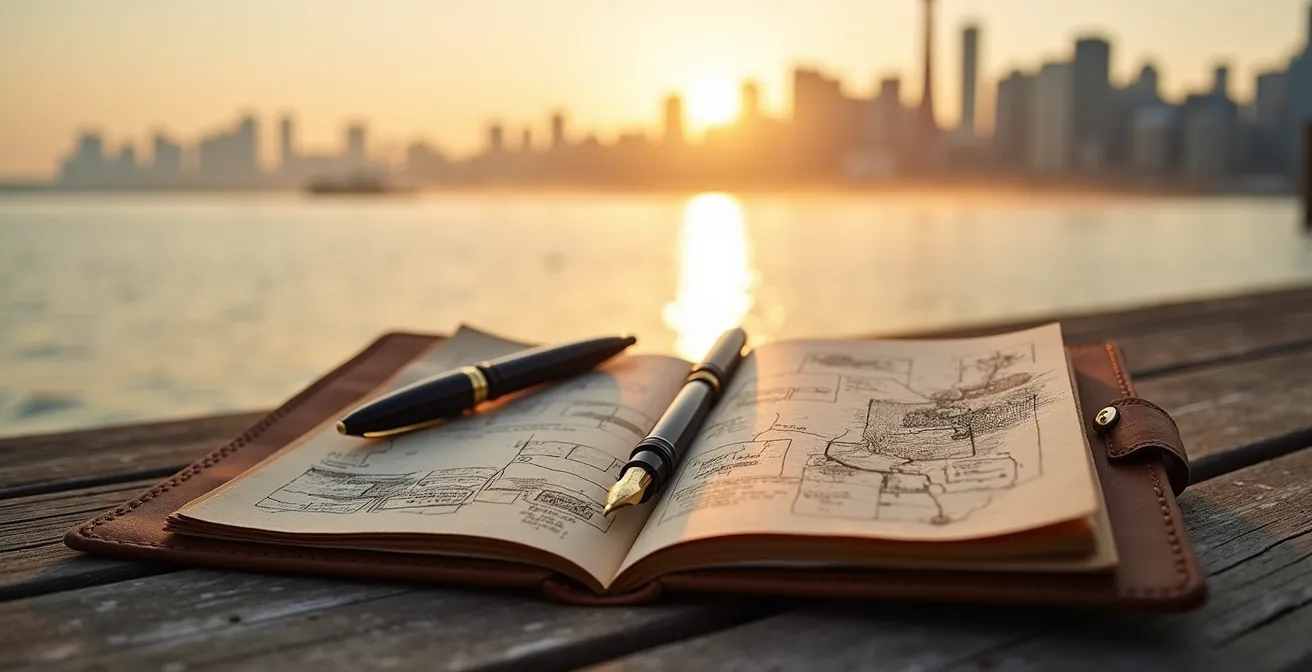
The most powerful Toronto travel journal captures not just what you saw, but the sensory texture of the city itself.
- Focus on “sensory anchors”—the specific sounds, smells, and textures that define a place, from streetcar bells to lake-chilled air.
- Treat light as a character in your story, understanding how its quality at dawn in Graffiti Alley differs from dusk in the Distillery District.
Recommendation: Shift from being a tourist who collects sights to a documentarian who collects moments, using your journal to deconstruct and appreciate the city’s unique narrative.
Your trip to Toronto is booked. The instinct is to prepare for a highlight reel: the CN Tower piercing the clouds, a flash of blue from a Blue Jays game, a plate of peameal bacon. The standard travel journal becomes a checklist of ticked-off landmarks and selfies. But when you return home, flipping through the pages, does it truly resonate with the feeling of the city? Does it capture the hum of a streetcar on Queen Street, the specific red of Victorian brick, or the quiet grandeur of Lake Ontario? For many, the answer is a frustrating no. The journal becomes a logbook, not a time capsule.
This is because we are often taught to document the *what*, not the *how*. We list places, but we forget to record our perception. In a city that saw visitors spend a record $8.8 billion in 2024, standing out requires a different approach. The key to a profound travel journal isn’t about visiting more places or taking more photos. It’s about adopting the mindset of a documentary photographer: focusing on light, texture, narrative, and the sensory data that cameras often miss. It’s about creating an artifact of your personal experience.
This guide will deconstruct that process. We won’t just list photo spots; we will explore how to see them. We’ll delve into methods for capturing fleeting sensory details, understand the dialogue between the city’s old and new architecture, and discover why the memory of making something is more valuable than the object itself. It’s time to create a Toronto journal that does more than just prove you were there—it proves you were paying attention.
To truly capture the essence of Toronto, this guide is structured to take you from the foundational elements of observation to the deeply personal act of creation. Explore each section to build your documentary skillset.
Summary: How to Document Toronto: A Guide for the Creative Traveller
- Graffiti Alley or Humber Bay: where to find the best light at sunrise?
- Blogging or Journaling: which method for never forgetting sensory details?
- The mistake of buying maple syrup at the airport: where to find real craftsmanship?
- Why revisiting the same place twice changes your perception of the city?
- Smartphone or Reflex: what equipment for a day of urban walking?
- How to access the best views of the Scarborough Bluffs without risking a fine?
- Why the Distillery District is the go-to place for design lovers?
- Why paying $100 CAD for a workshop is worth more than buying the finished object?
Graffiti Alley or Humber Bay: where to find the best light at sunrise?
For a documentarian, light is not just illumination; it is the primary narrator. The first decision of your day in Toronto should be about the quality of light you wish to capture. The choice between the urban grit of Graffiti Alley and the natural expanse of Humber Bay Park is a choice between two entirely different stories told by the same sun. Each location demands a different technical and artistic approach to truly capture its morning character.
Graffiti Alley, tucked away in the Fashion District, is a theatre of contrast. Before the city fully awakens, the pre-dawn light is soft, diffusing evenly across the vibrant murals. The real magic, however, happens in the minutes just after sunrise, when low-angle light rakes across the textured brickwork, making the paint pop and casting long, dramatic shadows. This is a scene of contained energy, where the quiet of the morning is set against the explosive colour of the art. The challenge here is capturing the interplay between shadow and hue.
Humber Bay Park, by contrast, offers a story of scale and subtlety. Positioned on the edge of Lake Ontario, it provides an unobstructed view of the skyline. The sunrise here is not about sharp contrasts but about gradual, atmospheric shifts. The light first appears as a soft glow on the horizon, slowly bathing the water and the distant towers in pastel colours. A polarizing filter is essential here to manage the intense glare off the lake and deepen the blues of the sky and water. This is a location for capturing serene, expansive landscapes where the city feels like a distant, sleeping giant.
Choosing your location is choosing your narrative. Do you want the intimate, vibrant, and textured story of Graffiti Alley, or the grand, atmospheric, and reflective tale of Humber Bay? Your journal begins not with a pen, but with this fundamental decision about light.
Blogging or Journaling: which method for never forgetting sensory details?
Once you’ve captured the light, the next layer of documentation is sensory. The crisp chill off the lake, the distant rumble of the first subway, the smell of street vendor coffee—these are the details that truly transport you back to a moment. But how do you capture them effectively? The choice between digital blogging and analogue journaling is less about technology and more about your method of observation. The most effective approach is often a hybrid one, designed to capture sensory anchors.
A digital blog offers immediacy. You can quickly type notes on your phone, record a 10-second audio clip of a street musician, or shoot a short video of steam rising from a manhole. This method excels at capturing raw data in the moment. However, it can also encourage shallow, fragmented documentation. Analogue journaling, with a physical pen and paper, forces a slower, more meditative process. You are compelled to translate sensory input into descriptive language, which deepens your observation and memory encoding.
This is where a hybrid approach shines, as demonstrated by one travel writer’s technique for documenting Kensington Market. As described in a thoughtful Toronto travel guide, the process involves using a smartphone for quick, in-the-moment sensory capture—like the sound of streetcar bells or the chatter of the market—and then later expanding on these clips in a written journal. This allows you to embed the raw feeling of a place within a more reflective narrative.
This method transforms your journal from a simple log into a multi-sensory artifact. The goal isn’t just to write “I heard a streetcar”; it’s to use the audio clip as a prompt to describe the specific “ding-ding” and how it punctuated the morning quiet.

As you can see, the physical journal becomes a vessel for these memories. A pressed leaf from High Park, a coffee sleeve from a local café, a vintage TTC token—these objects become tactile links to the sensory moments you’ve documented. They are not just souvenirs; they are the physical embodiment of your observations, turning your journal into a piece of art.
The mistake of buying maple syrup at the airport: where to find real craftsmanship?
Sensory documentation extends deeply into taste, and in Toronto, no taste is more iconic than maple syrup. However, a common traveler’s mistake is to grab a conveniently packaged bottle at the airport. This is the equivalent of taking a selfie at the CN Tower and calling it a day—it checks a box but misses the entire story. The airport bottle is a generic souvenir; the syrup from a local market or a dedicated producer is a taste of Ontario’s terroir and a lesson in craftsmanship.
Understanding the craft begins with understanding the language. Real maple syrup isn’t a single, uniform product. It’s graded based on colour and harvest time, each with a distinct flavour profile. Seeking out these variations at a place like St. Lawrence Market allows you to document a spectrum of taste, not just a singular sweetness. It’s the difference between saying “I had maple syrup” and “I compared the delicate, vanilla notes of an early-season Golden syrup with the robust, caramel flavour of a late-season Dark.” This is documenting with your palate.
This deeper engagement transforms a simple tasting into a valuable journal entry. Instead of just a photo of a pancake, your journal can contain notes on how a specific grade of syrup interacts with other local flavours, like the saltiness of peameal bacon. It becomes a study in taste pairings, an exploration of a local culinary tradition.
The table below provides a framework for this exploration. Use it not just as a guide for what to buy, but as a template for what to notice and document in your journal. This is how you capture the authentic flavour of the region.
| Grade | Color | Taste Profile | Best Pairing | Harvest Time |
|---|---|---|---|---|
| Golden | Light amber | Delicate, vanilla notes | Fresh fruit, yogurt | Early season |
| Amber | Medium amber | Rich, balanced | Pancakes, oatmeal | Mid-season |
| Dark | Dark brown | Robust, caramel | Peameal bacon, marinades | Late season |
| Very Dark | Almost black | Strong, molasses-like | Baking, glazes | End of season |
By seeking out this level of detail, you move beyond consumption and into appreciation. Your journal entry on maple syrup is no longer about a souvenir; it’s about a connection to the land, the season, and the artisan, which is a memory far richer than any airport purchase can provide.
Why revisiting the same place twice changes your perception of the city?
A travel journal is often seen as a linear progression: day one, day two, day three. But a more profound way to document a city like Toronto is to introduce the variable of time. Revisiting a single location at two different points—be it morning and night, or summer and autumn—reveals that a place is not a static backdrop. It is a dynamic stage where light, weather, and human activity create entirely different scenes. This practice of intentional revisiting is a core tenet of documentary work.
Consider the Toronto Islands. A visit in the peak of summer presents a vibrant, crowded scene filled with picnics, cyclists, and the sounds of laughter against the backdrop of the city skyline. It’s a story of communal joy. Revisiting in the crisp air of late autumn tells a completely different story. The crowds are gone, replaced by a quiet solitude. The same pathways feel more intimate, and the beauty takes on an eerie, melancholic quality as the wind moves through the bare trees. You are not documenting the same place; you are documenting two different moods of the same place.
This principle is powerfully illustrated in how Toronto’s character is shaped by its proximity to the Great Lakes and the resulting weather systems. A place’s narrative can shift dramatically within hours.
Case Study: The Two Faces of the Distillery District
Travel writer Kathi Kamleitner’s work highlights this transformative effect. She documented how the Distillery District, a hub of Victorian industrial architecture, presents a dual personality. By day, it is a quiet, artistic enclave. Sunlight illuminates the intricate brickwork, and visitors wander through galleries and design shops in a calm, contemplative manner. At night, the district transforms. The glow of gaslights creates a dramatic, almost theatrical atmosphere. The cobblestone streets, now bustling with theatre-goers and diners, echo with a different energy. Capturing both moods in a journal reveals the district’s full character—it’s both a historical museum by day and a vibrant entertainment hub by night.
By revisiting a location, you add depth and complexity to your journal. Your entry is no longer a flat snapshot but a comparative study. You begin to understand the rhythms of the city, noticing details on your second visit that you missed on the first. This practice forces you to look deeper, to see beyond the initial impression and document the nuanced, ever-changing soul of Toronto.
Smartphone or Reflex: what equipment for a day of urban walking?
For a day of documenting Toronto on foot, the choice of equipment—a smartphone or a dedicated DSLR/reflex camera—is a fundamental decision that shapes your entire process. This isn’t a simple question of quality; it’s a question of intention. Each tool encourages a different way of seeing and interacting with the urban environment. The best documentarians understand that their choice of gear is a creative constraint that defines the story they tell.
The smartphone is the tool of immediacy and discretion. Its small size allows you to blend in, capturing candid moments without drawing attention. It’s a multimedia sketchbook, perfect for grabbing quick shots, recording ambient sounds like the iconic TTC subway announcements, and making voice memos. However, its greatest strength can also be its weakness. The ease of use can lead to a “snap and forget” mentality, resulting in thousands of images with little thought or composition. To counter this, you must be deliberate, using specific apps and filters to develop a consistent visual language.
A DSLR or other reflex camera, on the other hand, enforces intentional friction. It’s bulkier and more conspicuous, forcing you to slow down and be more deliberate. You can’t just point and shoot; you must consider your lens, aperture, and shutter speed. This friction is a creative benefit. It makes each shot a conscious decision, compelling you to study the architectural details of Cabbagetown or perfectly frame a landscape at the Scarborough Bluffs. It encourages a deeper engagement with your subject.
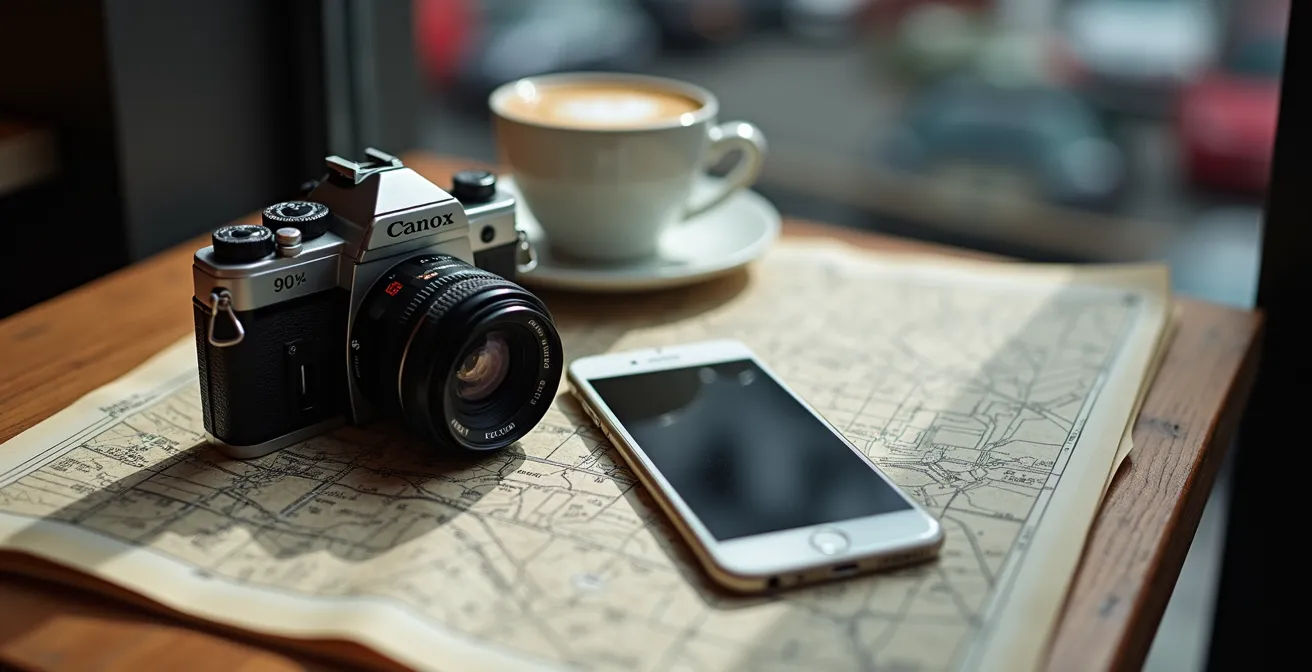
The image above perfectly captures this dialogue between old and new technology. An even more radical form of intentional friction is to use a disposable film camera. With only 24 exposures, every single shot becomes precious. You are forced to decide what truly matters, a powerful exercise for any documentarian. Ultimately, the best equipment is the one that aligns with your documentary goals for the day. Are you seeking candid, multimedia notes, or composed, thoughtful images?
Action Plan: Your Toronto Urban Photography Toolkit
- Smartphone Setup: Use an app like VSCO with presets (e.g., ‘HB1’ or ‘A6’) that complement Toronto’s blend of brick-and-glass architecture to maintain a consistent aesthetic in your visual notes.
- Audio Capture: Use a voice memo app to collect unique sonic signatures of the city, such as the “ding-ding” of a streetcar or the specific announcements on the subway.
- Route Documentation: Use a transit app not just for navigation but to screenshot your journey, creating a visual map of your path through the city’s transit arteries for your journal.
- Impose Creative Limits: Consider using a disposable film camera for a day. The limit of 24 exposures will force you to be highly selective and intentional with your shots.
- Weather Preparedness: Toronto’s weather is notoriously unpredictable due to the lake effect. Always carry a simple rain cover or even a plastic bag for your chosen equipment, whether it’s a phone or a DSLR.
How to access the best views of the Scarborough Bluffs without risking a fine?
The Scarborough Bluffs are one of Toronto’s most breathtaking natural wonders, a dramatic cliff face of 12,000-year-old glacial deposits meeting the vast expanse of Lake Ontario. For a documentarian, they offer a unique opportunity to capture the intersection of geological time and urban landscape. However, their beauty is matched by their fragility and potential danger. Documenting them responsibly is not just a matter of safety; it’s a matter of respecting the environment and the law.
The temptation to find a “secret” or “unspoiled” vantage point along the cliff edge is strong, but it is a serious mistake. The top of the Bluffs is unstable, and erosion is an ongoing process. Toronto City Bylaws are strictly enforced to prevent trespassing on these dangerous and ecologically sensitive areas. Venturing past barriers not only puts you at risk of a fall but can also lead to significant fines. According to a guide from the City of Toronto, these penalties can range from a simple ticket to thousands of dollars if an emergency response is required.
Responsible documentation means working within the designated access points, which offer spectacular and safe views. There are two primary perspectives to capture the Bluffs legally:
- From Below (Bluffer’s Park): Accessible from the foot of Brimley Road, this location puts you on the beach at the base of the cliffs. It offers a dramatic, low-angle perspective that emphasizes the sheer scale and towering height of the Bluffs. This is the ideal spot to capture the textural details of the cliff face and its reflection in the water.
- From Above (Cathedral Bluffs Park / Scarborough Crescent Park): These parks are situated along the clifftop and provide designated, fenced-off viewing areas. From here, you get the sweeping, panoramic vistas that showcase the length of the cliffs and the expansive blue of Lake Ontario. This perspective is perfect for capturing the grandeur of the landscape, especially at sunrise or sunset.
Your journal should reflect this responsible approach. Instead of a risky photo from an unstable edge, document the view from the official lookouts. Note the signs, the barriers, and the reasons they exist. This adds a layer of context to your documentation, telling a story not just of natural beauty, but of the city’s efforts to preserve it and keep its people safe. This is a more complete and honest narrative.
Why the Distillery District is the go-to place for design lovers?
To truly document a city, one must learn to “read” its architecture. The Distillery District is Toronto’s most eloquent chapter on this subject. For a design enthusiast, it is more than just a charming collection of old buildings; it is a masterclass in adaptive reuse and a living museum of urban planning philosophy. Documenting this district means capturing the dialogue between its industrial past and its cultural present.
The area’s primary allure lies in the preservation of the largest collection of Victorian-era industrial architecture in North America. These are not sterile reproductions; they are the original Gooderham & Worts distillery buildings, repurposed with surgical precision. Your journal should focus on this interplay. Notice how contemporary glass-and-steel storefronts are inserted into 19th-century brick archways without disrupting the original structure. Capture the contrast in textures: the rough, weathered brick against the smooth, reflective glass. This is the architectural dialogue that defines the district’s soul.
Furthermore, the entire district is a case study in creating a human-centric space. The decision to make it a pedestrian-only zone is crucial. The absence of traffic noise is a sensory detail worth noting in your journal. It’s replaced by the murmur of conversation, the echo of footsteps on cobblestone, and the sound of music from a nearby gallery. This thoughtful urban design transforms the space from a mere collection of buildings into a cohesive, immersive environment.
Case Study: A “City Within a Park”
The success of the Distillery District’s design philosophy is recognized globally. As noted by experts in a National Geographic feature, the masterful curation of the space goes beyond simple preservation. It involves the strategic placement of large-scale public art installations that interact with the historic architecture, and the preservation of the cobblestone streets. This meticulous planning creates what is described as a “city within a park” experience, an urban oasis that feels both historically significant and vibrantly contemporary, attracting design lovers from around the world who come to study its success.
When you document the Distillery District, look for these design choices. Photograph the sculptures against their brick backdrops. Sketch the way a modern light fixture is hung from an old industrial beam. Write about the feeling of walking on cobblestones instead of pavement. By focusing on these details, your journal entry will capture not just what the district looks like, but why it feels the way it does—a triumph of thoughtful design.
Key Takeaways
- Documentary Focus: Shift from collecting sights to capturing sensory details, light, and narrative to create a meaningful journal.
- Intentional Observation: Use creative constraints like revisiting a location or choosing specific equipment to force a deeper, more deliberate way of seeing the city.
- Process Over Product: The true value of a creative experience, like a workshop, lies in the memory of the process—the feel of the materials, the lessons learned, and the story of its creation.
Why paying $100 CAD for a workshop is worth more than buying the finished object?
In the quest to create a meaningful travel journal, the ultimate form of documentation is not passive observation, but active participation. The final step in transcending a simple logbook is to embed your own creative act within its pages. This is why investing in a hands-on workshop in Toronto—be it pottery, glassblowing, or jewellery making—offers a return far greater than buying a finished craft from a store. You are not just acquiring an object; you are acquiring a story, a skill, and a memory rooted in process, not product.
When you buy a perfectly crafted mug, you buy the result of someone else’s skill. When you pay to make your own, you are paying for the experience: the feel of wet clay spinning on a wheel, the patient guidance of an instructor, the small frustration of a collapsing wall, and the quiet pride of creating something with your own hands. These are the rich, tactile memories that form the most powerful journal entries. Your journal can document the instructor’s story, the smell of the studio, and the beautiful imperfection that makes your creation uniquely yours.
As one participant in a pottery class noted, the experience is often different from the advertisement. The final product might be smaller or simpler than expected, but that misses the point entirely. The testimony highlights a crucial truth: “The process itself becomes the memory… the frustration and pride are what you’re really paying for.”
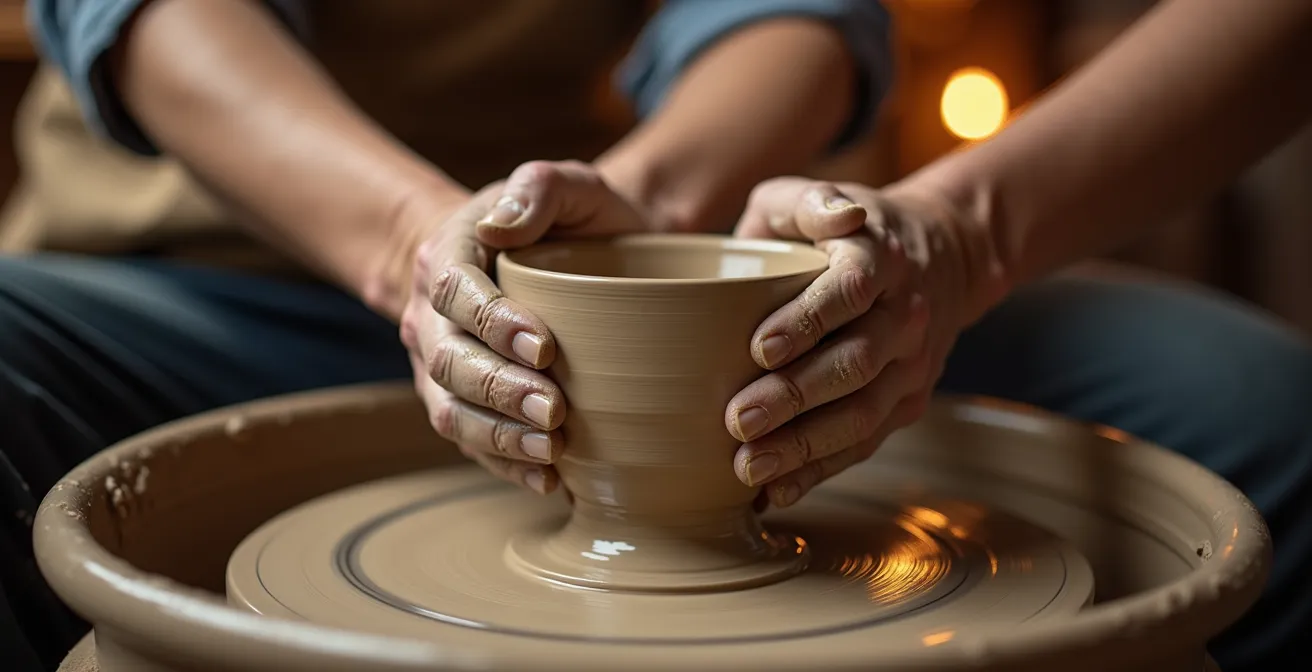
This focus on process is a profound final lesson for the documentarian. Toronto offers a wealth of opportunities to engage in this way, from beginner wheel classes at studios like Spin Pottery to specialized workshops at the Harbourfront Centre or Gardiner Museum. Participating in one of these connects you to the city’s vibrant community of artisans and makers on a personal level.
We did get to use the wheel and make a clay pot/bowl. The picture on the ad is of a large size bowl while the maximum size bowl you can make with this class is a coffee cup… they don’t tell you that you need to take your piece home for two months to dry and then book another decorating class. The process itself becomes the memory – the instructor’s advice, the feel of the clay, the frustration and pride are what you’re really paying for.
– Workshop Participant, TripAdvisor
The slightly wobbly bowl you create carries a far richer story than a flawless one from a shelf. It is a physical anchor to a moment in time, a testament to your willingness to try, and the perfect final chapter for a travel journal that is truly and authentically yours.
Frequently Asked Questions about Documenting Toronto
What are the legal viewing points for Scarborough Bluffs?
Access from below at Bluffer’s Park (foot of Brimley Road) for beach-level views. For clifftop perspectives, use Scarborough Crescent Park or Cathedral Bluffs Park. Both have designated viewing areas with safety barriers.
What are the fines for illegal access?
Toronto City Bylaw Chapter 608 prohibits accessing unstable cliff edges. Fines range from $125 to $5,000 depending on the severity and if it requires emergency response.
Why are the Bluffs geologically significant?
The Bluffs are 12,000-year-old glacial deposits from ancient Lake Iroquois, containing five distinct geological layers visible in the cliff face, making them a record of Ice Age history.