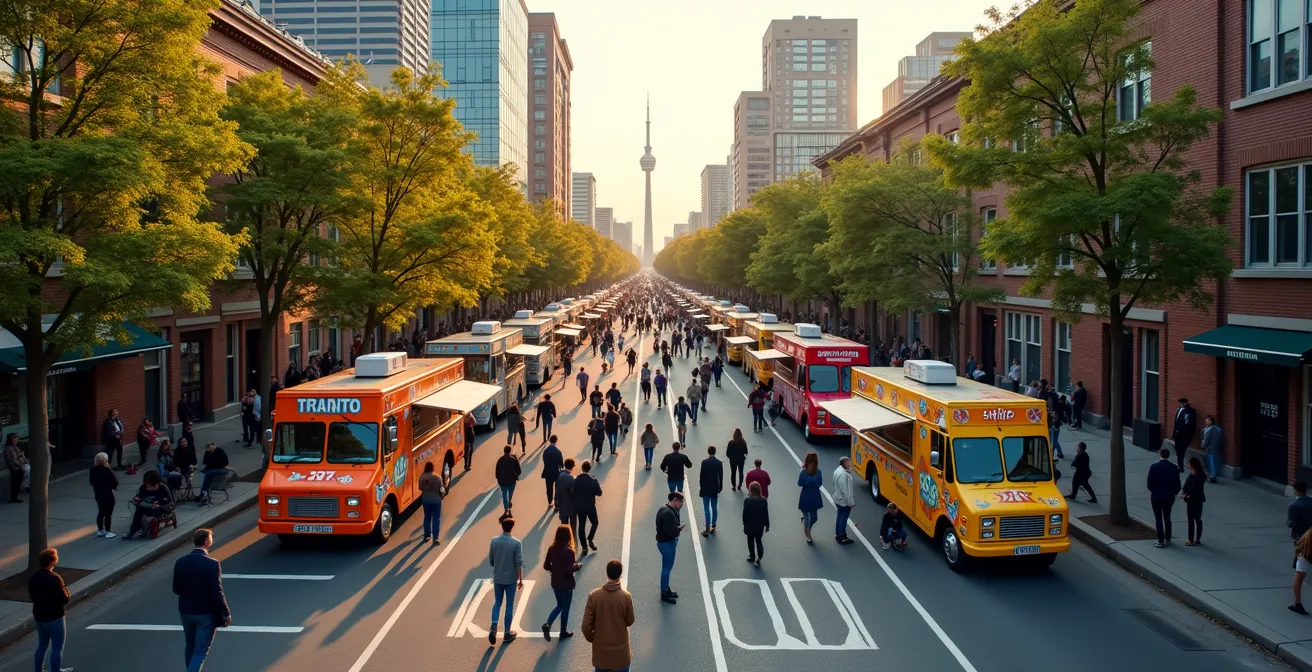
In summary:
- Finding Toronto’s top food trucks is a system, not luck. It involves combining digital tracking with on-the-ground intelligence.
- Always verify the green or yellow DineSafe sticker for food safety before ordering from any mobile vendor.
- Use a combination of the Street Food App for real-time locations and Instagram or Twitter for daily specials and last-minute changes.
- Carry cash ($40-$60) to avoid payment issues caused by network congestion, especially during lunch rushes and festivals.
- For the highest quality and innovation, target isolated street vendors over large, crowded festivals where menus are simplified.
The scent of spicy jerk chicken drifts down King Street, but by the time you pinpoint the source, the truck is gone. It’s a familiar Toronto tragedy for any downtown worker or visitor on the hunt for a quick, original lunch. You’ve heard the buzz about epic poutine fusions and mind-blowing tacos on wheels, but finding them feels like a game of chance. Many people simply wander around hoping to get lucky, or they check a generic blog post that’s already weeks out of date. This passive approach leads to disappointment and, worse, a boring lunch.
But what if the key wasn’t about luck, but about strategy? What if you could think like a seasoned food truck hunter, equipped with the right tools and knowledge to track your culinary target before it vanishes? This isn’t about aimlessly scrolling social media; it’s about understanding the “digital scent” these mobile kitchens leave behind and interpreting the “ground truth” when you find them. It’s a system that combines digital savvy with street-smart logistics, from deciphering health codes to knowing exactly how much cash to have on hand.
This guide is your new playbook. We’ll move beyond simple lists of “best trucks” and dive into the tactical methods the pros use. You’ll learn how to verify a truck’s safety rating in seconds, master the most reliable tracking tools, understand the crucial difference between a festival and a street-side vendor, and even spot the next big culinary innovator before they become famous. Get ready to transform your lunch break from a gamble into a successful hunt.
To navigate this urban culinary landscape effectively, we’ve broken down the essential strategies into a clear, step-by-step guide. The following sections will equip you with everything you need to become a confident and successful food truck hunter in Toronto.
Summary: How to Become a Toronto Food Truck Hunter
- DineSafe Green or Yellow: Why Always Check the Sticker Before Ordering?
- The App or Twitter: What Is the Most Reliable Way to Track Your Favorite Truck?
- Cash or Card: Why Always Having Liquid Can Save Your Meal?
- Food Truck Festivals vs. Isolated Vendors: Where Do You Find the Best Quality?
- Tacos or Poutine Fusion: What Are the Culinary Innovations of the Street This Year?
- How to Explore Kensington Market Without Falling into Tourist Traps?
- How to Organize a Family Vacation in Toronto Without Exploding the Accommodation Budget?
- Kensington Culinary Tour: How to Manage Your Appetite to Last 6 Tastings?
DineSafe Green or Yellow: Why Always Check the Sticker Before Ordering?
Before you even think about the menu, your first move as a food truck hunter is a safety check. In Toronto, this means looking for the DineSafe inspection sticker. This simple color-coded sign displayed on the truck is your first piece of crucial “ground truth.” A green (Pass) sign means the truck has met or exceeded Toronto Public Health’s safety standards. A yellow (Conditional Pass) indicates one or more significant infractions were found, requiring a follow-up inspection. A red sign means Closed, and you should walk away immediately.
Ignoring the DineSafe sticker is a rookie mistake. While a yellow pass doesn’t automatically mean the food is unsafe—it could be for a non-food-related issue like improper record-keeping—it warrants a closer look. The city’s food safety regulations are rigorous for a reason. High-risk food establishments, which include most food trucks, are subject to a risk-based inspection schedule that ensures they are checked regularly. According to Toronto Public Health’s protocols, these vendors can expect up to 3 inspections per year to maintain their operating status.
For the savvy hunter, the yellow sticker is a signal to dig deeper. You can instantly check a truck’s detailed history on your phone at toronto.ca/dinesafe. This will tell you the specific infractions and the date they were recorded. If an infraction is recent (within 48 hours), a re-inspection is likely pending, and the issue might already be fixed. Making this quick check part of your routine separates you from the casual crowd and ensures your culinary adventure is both delicious and safe.
Ultimately, the DineSafe program is a powerful tool in your hunter’s toolkit. It provides a transparent, immediate quality signal that empowers you to make an informed decision in seconds.
The App or Twitter: What Is the Most Reliable Way to Track Your Favorite Truck?
Once safety is confirmed, the hunt begins in the digital world. A food truck’s greatest challenge is also your greatest advantage: they’re mobile. To succeed, they must leave a clear “digital scent” for you to follow. Your primary tools for this are specialized apps and social media platforms, but not all are created equal. While many trucks post on Twitter or Instagram, the most reliable single source of truth is often a dedicated tracking app.
In Toronto, the dominant player is the Street Food App. It provides real-time GPS-based tracking, allowing you to see exactly where trucks are located *right now*. This is a significant advantage over a static Twitter post from three hours ago. The platform allows you to see daily specials, view menus, and even save your favorite trucks for quick access. It has become the de facto standard for the city’s mobile food scene, connecting millions of users with vendors since 2011.
This paragraph introduces the core tracking concept. To really master it, it helps to see how it works in practice. The illustration below captures the essence of the modern food truck hunt: using your smartphone to navigate a map of delicious opportunities.

However, don’t discard social media entirely. It serves a different, complementary purpose. While the app is for location, Instagram and Twitter are for a truck’s personality and daily pulse. The Toronto Food Trucks Instagram account has built a community of over 45,000+ followers, acting as a central hub for announcements and discoveries. Individual trucks use their stories to post “secret” menu items or announce when they’re about to sell out. The best strategy is a two-pronged attack: use the app for the “where” and social media for the “what and when.”
By using these digital tools in tandem, you move from passively hoping to find a truck to actively and strategically tracking them, ensuring you’re always at the right place at the right time.
Cash or Card: Why Always Having Liquid Can Save Your Meal?
You’ve tracked your target, verified its safety, and you’re standing in line, mouth-watering. Then, the dreaded sign appears: “CASH ONLY.” Or worse, their system is down. In the fast-paced world of food trucks, technology can be a weak link. A core rule for any seasoned food truck hunter is to always carry cash. Relying solely on a card is a gamble that can leave you hungry and frustrated, especially during peak times.
The problem is often not the truck’s fault but a result of their environment. At large gatherings like the Toronto Food Truck Festival at Woodbine Park, dozens of trucks and thousands of customers converge in one area. This creates immense strain on local cellular networks, causing electronic payment systems to slow down or fail completely. When you’re in a high-density mobile vendor environment, the most reliable technology is often the paper in your wallet.
A smart cash strategy is part of your hunter’s toolkit. It’s not just about having money, but having the right kind. For a typical food truck crawl hitting 3-4 spots, having $40-$60 in mixed bills ($5, $10, and $20) is a solid plan. This allows you to pay quickly without forcing a vendor to break a large bill during their busiest moments. During the frantic Financial District lunch rush (12-1 PM), having exact change ready can be the difference between a 5-minute wait and a 15-minute one. Before you even head out, a quick check of a truck’s Instagram or Twitter can often save you a trip to the ATM, as many will post “CASH ONLY” in their daily location updates.
Being prepared with cash isn’t old-fashioned; it’s a strategic advantage. It makes your transaction faster, ensures you’ll never be turned away, and keeps you one step ahead of the unprepared crowd.
Food Truck Festivals vs. Isolated Vendors: Where Do You Find the Best Quality?
Not all hunting grounds are created equal. A common dilemma for foodies is choosing between the smorgasbord of a food truck festival and the targeted strike of visiting an isolated street-side vendor. While festivals offer incredible variety and a vibrant atmosphere, the seasoned hunter knows that the best quality and most innovative food is often found at the solitary trucks operating on their own turf.
The reasons are logistical. At a festival, a truck’s goal is to serve hundreds of people as quickly as possible. This forces them to simplify their menus, pre-prep large batches of food, and raise prices to cover festival fees. Wait times can be long, and interaction with the chef is virtually nonexistent. In contrast, an isolated vendor relies on reputation and the quality of their full menu to draw a crowd. The food is more likely to be made-to-order, the pricing is standard, and you often get to chat with the owner or chef who poured their passion into the business. This is where pioneers like The Food Dudes, one of Toronto’s original and most influential trucks, built their reputation. As the Foodism CA Editorial Team notes, they were instrumental in the scene’s development.
The Food Dudes was one of Toronto’s OG food trucks, and has even been credited with pioneering the city’s food truck scene
– Foodism CA Editorial Team, 12 food trucks in Toronto for delicious street eats
The trade-off between variety and quality is a critical strategic consideration for any food truck hunter. The following table breaks down the key differences to help you decide where to focus your efforts, based on a comparative analysis of the Toronto scene.
| Factor | Food Truck Festivals | Isolated Street Locations |
|---|---|---|
| Menu Variety | Simplified, 3-5 items | Full menu, 8-12+ items |
| Wait Times | 20-45 minutes peak | 5-15 minutes average |
| Price Premium | 15-25% higher | Regular pricing |
| Food Freshness | Pre-prepped for volume | Made-to-order possible |
| Discovery Potential | 10-30 trucks in one spot | 1-3 trucks per location |
| Chef Interaction | Minimal (high volume) | Direct engagement possible |
Ultimately, your choice depends on your mission. If you want to sample a wide array of options in a party-like setting, a festival is a great choice. But if your goal is to experience a specific truck’s full culinary vision at its peak quality, hunting down an isolated vendor is almost always the superior strategy.
Tacos or Poutine Fusion: What Are the Culinary Innovations of the Street This Year?
The true thrill of the hunt isn’t just finding food; it’s discovering innovation. Toronto’s street food scene is a culinary laboratory on wheels, where chefs experiment with bold fusion concepts that you won’t find in traditional restaurants. Moving beyond the standard tacos and poutine, the real prize is spotting the next-generation trucks that are pushing the boundaries. This is “culinary reconnaissance,” the most advanced skill in the food truck hunter’s arsenal.
Innovation can take many forms. Sometimes it’s a high-concept collaboration, like when the Me.n.u Food Truck partnered with celebrity chef Susur Lee and Pepsi Co. They didn’t just add a new item; they created a unique tasting experience with specially crafted recipes, featuring distinctive dips and chips that showcased a fusion of flavors and textures. This is a key signal: when a truck invests in a partnership with a renowned chef, it’s a sign of serious culinary ambition.
But innovation isn’t always about celebrity chefs. It’s often found in the details of a truck’s daily operations. A truck that rotates its menu seasonally shows creativity and a commitment to fresh ingredients. One that proudly names its local suppliers—like a specific craft butcher or artisanal bakery—on social media is signaling a dedication to quality from the ground up. These are the trucks run by former restaurant chefs who bring fine dining techniques to the street, or those who create fusions that reflect the city’s diverse neighborhoods, like a Korean-Italian dish born from the intersection of Koreatown and Little Italy. To help you spot these culinary pioneers, follow this checklist.
Your Action Plan: How to Spot Next-Generation Food Truck Innovators
- Look for trucks with rotating seasonal menus that change monthly—this indicates chef creativity and fresh ingredient sourcing.
- Follow trucks that mention specific local suppliers on their social media (craft butchers, artisanal bakeries).
- Track former restaurant chefs who’ve transitioned to trucks—they bring fine dining techniques to street food.
- Watch for fusion combinations reflecting Toronto’s neighborhoods, like Korean-Italian from Koreatown meets Little Italy.
- Seek trucks participating in culinary competitions or featured at chef-driven events rather than just standard festivals.
By shifting your focus from what’s popular now to what’s creatively daring, you elevate your hunt from a simple meal to a genuine culinary discovery. This is how you find the stories, not just the food.
How to Explore Kensington Market Without Falling into Tourist Traps?
Kensington Market is the heart and soul of Toronto’s independent food scene, but its popularity also makes it a minefield of tourist traps. For the discerning food hunter, navigating this vibrant, chaotic neighborhood requires an insider’s approach. The key is to look past the obvious and apply the same principles you’d use for tracking a food truck: look for signs of authenticity and follow the locals, not the crowds.
The most authentic spots in Kensington rarely have flashy signs or prime locations on Augusta Avenue. Instead, they are often tucked away behind unmarked doors or in back alleys. A powerful strategy is to simply observe: where do the local restaurant workers and shopkeepers go on their lunch breaks? They know the hidden gems that offer the best value and quality. Look for handwritten menus on chalkboards rather than professionally printed signs; this is a strong indicator of daily fresh preparation and a menu that changes with ingredient availability.
Kensington Market also acts as a crucial incubator for the wider Toronto food scene. Many successful food trucks started as small stalls or brick-and-mortar shops here before taking their concepts on the road. For example, Chaska’s Indian street food, known for its drool-worthy flavors, proved its concept in a physical location before launching a food truck that is now a staple near Nathan Phillips Square. This demonstrates a key principle: if a place in Kensington is good enough to expand, it’s a sign of genuine quality. To find these authentic spots, you need to adjust your timing and methods:
- Visit on weekday mornings (10-11 AM) when vendors are setting up and locals are shopping.
- Look for the unmarked doors and back-alley entrances where the real magic happens.
- Follow local restaurant workers on their breaks—they are your best guide.
- Prioritize spots with handwritten menus over those with glossy, permanent signs.
- Engage with vendors and ask where they source their ingredients; authentic operators are proud of their local connections.
By treating Kensington Market like a strategic hunt rather than a casual stroll, you can bypass the overpriced and underwhelming, and tap directly into the authentic, innovative heart of Toronto’s food culture.
How to Organize a Family Vacation in Toronto Without Exploding the Accommodation Budget?
A family trip to Toronto can get expensive, fast, with accommodation often being the biggest cost. However, a savvy food truck hunter can turn this challenge into a delicious advantage. By strategically choosing your neighborhood and embracing the city’s mobile food scene, you can significantly cut down on meal costs while providing your family with a fun and diverse culinary experience. The secret is to stay just outside the priciest downtown core in areas that are known food truck hubs.
Neighborhoods like Liberty Village, or areas near Yonge and Adelaide or Roy Thompson Hall, offer a double benefit. They often have more affordable accommodation options (like apartment rentals) compared to the central hotel district, and they are consistent hotspots for food trucks. This means you can save on your stay while having a rotating menu of affordable, high-quality lunch and dinner options right at your doorstep. With Roaming Hunger currently tracking 182 food trucks, trailers, and carts in the city, there is no shortage of options to build a budget around.
A well-planned food truck strategy can make a huge difference to your family’s travel budget. Instead of expensive restaurant meals, you can plan a 3-day food truck crawl. For a family of four, this can keep your total food budget for lunches and even some dinners between $180-$250. Here’s a sample plan:
- Day 1 (Liberty Village): With 2-3 trucks typically present, budget an average of $8-$12 per person for lunch.
- Day 2 (Nathan Phillips Square): A major hub with multiple options. Budget $10-$15 per person to include drinks.
- Day 3 (Harbourfront): After a trip to the Toronto Islands, waterfront trucks often have $6-$10 kids’ meals.
A great pro tip for families is to share adult portions between two kids. This not only saves 30-40% but also allows everyone to try more variety from different trucks. This approach turns mealtime from a costly chore into a fun, affordable adventure that kids will love.
By linking your accommodation choice to food truck accessibility, you transform your vacation budget. You save money, avoid tourist-trap restaurants, and give your family a memorable taste of Toronto’s vibrant street food culture.
Key Takeaways
- Mastering digital tools like the Street Food App and social media is non-negotiable for real-time tracking.
- On-the-ground intelligence, like checking the DineSafe sticker and carrying cash, separates prepared hunters from casual eaters.
- The best food quality and innovation are typically found at isolated street vendors, not crowded festivals.
Kensington Culinary Tour: How to Manage Your Appetite to Last 6 Tastings?
You’ve done your culinary reconnaissance and mapped out a multi-stop food tour of Kensington Market. The challenge is no longer finding the best spots, but surviving the delicious onslaught. Managing your appetite is a strategic skill that determines whether your tour is a triumph or ends in a food coma after stop three. The key is not to “power through” but to eat strategically, using a combination of portion control, hydration, and pacing.
The most effective tactic is the “Three Bite Rule.” When you’re sampling alone, limit yourself to just three bites of any given item. This gives you the full flavor experience without filling you up. If you’re in a group, the rule evolves: order one full portion and split it between two or three people. Hydration is also critical, but must be done correctly. Avoid carbonated drinks that cause bloating. Instead, take small sips of water between stops to cleanse your palate and stay hydrated. Finally, build in physical breaks. Walk the full length of Augusta Avenue between stops to aid digestion and schedule 15-minute rests, perhaps in Bellevue Square Park, after every two or three tastings.
Your strategy should also adapt based on the type of food you’re eating. Starting with heavy, fried items is a rookie mistake that will shut down your appetite. A smarter approach is to begin with lighter fare like fresh salads or vegetarian appetizers and save the richer, heavier dishes for the end of your tour. The following table provides a simple framework for portion strategy to maximize your tasting capacity.
| Food Category | Solo Tasting Portion | Group Sharing (2-3 people) | Stomach Impact |
|---|---|---|---|
| Fried/Heavy Items | 2-3 bites max | 1 item split | High – save for stops 4-6 |
| Soups/Broths | 3-4 oz sample | Small bowl shared | Medium – good for middle stops |
| Breads/Pastries | 1/4 portion | 1 item split | High – limit to 2 stops max |
| Fresh/Raw Items | Full small plate | 2 small plates | Low – ideal for stops 1-2 |
| Proteins | 1-2 oz portion | Single serving split | Medium-High – stops 3-5 |
| Sweets | Single bite | 1 dessert for table | Low – perfect final stop |
By treating your food tour with the same strategic mindset as the hunt itself, you ensure you can enjoy every planned stop. It’s the final piece of the puzzle, turning a delicious marathon into a comfortable and deeply satisfying experience from the first bite to the last.