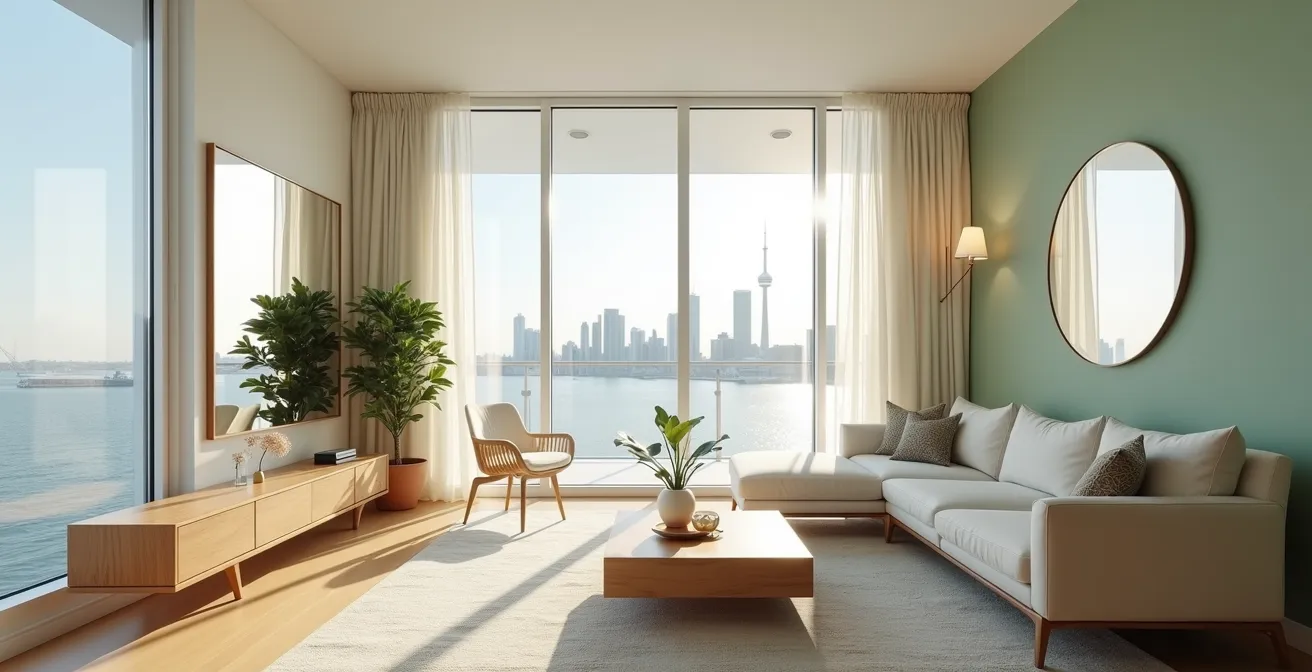
If your dark, poorly oriented Toronto condo feels more like a cave than a home, the solution isn’t just to paint everything white. The true transformation comes from a deeper, psychological approach. This guide reveals how to layer light, texture, sound, and even scent to create a multi-sensory environment that fosters a genuine feeling of spaciousness and emotional well-being, turning your space from depressing to uplifting.
Living in a Toronto condo often means compromising on natural light. When you’re facing the wrong way or shadowed by a neighbouring tower, your home can feel constricting, especially during the long, grey winters. That feeling of being “boxed in” isn’t just a spatial problem; it’s an emotional one. A dark space can genuinely impact your mood, making your sanctuary feel more like a source of stress.
The conventional wisdom is to throw white paint on the walls and hang a few mirrors. While these are pieces of the puzzle, they are often a superficial fix that results in a cold, sterile environment. This advice misses the fundamental point: a home should feel good, not just look bigger. It needs to be a place that actively supports your well-being, engaging all your senses to create a positive atmosphere.
But what if the key wasn’t just about tricking the eye, but about soothing the mind? This guide adopts the perspective of a home psychologist, moving beyond simple decorating tricks. We will explore how to craft a psychological sense of spaciousness. This involves a deliberate strategy of layering not just colours, but also light, textures, sounds, and even scents to create a cohesive and restorative environment tailored to the unique challenges of Toronto condo living.
Together, we will build a complete sensory strategy. We’ll start with the largest surfaces—your walls—and then layer in light, arrange furniture for mental and physical flow, and even consider how acoustics and scent architecture can fundamentally change your perception of home. This is your blueprint for transforming a dark condo into an expansive, uplifting sanctuary.
This article provides a comprehensive roadmap to reclaiming your space. The following sections break down each element of this psychological design strategy, offering practical, Toronto-centric advice to guide you through the process.
Contents: A Psychological Blueprint for a Brighter Condo
- Reflection and light: where to place mirrors to double visual depth?
- Furniture and pathways: how to arrange the living room to avoid bumping into everything?
- The “Total Look” catalogue mistake: why mixing styles creates warmth?
- Rugs and curtains: how to reduce echo and neighbor noise in a condo?
- Candles and diffusers: how scent influences the perception of “clean and tidy”?
- How to create a layered lighting plan for a multifunctional living room?
- How to furnish a 600 sq ft condo to make it spacious and bright?
- Murphy bed or sofa bed: which investment for a 400 sq ft studio?
Reflection and light: where to place mirrors to double visual depth?
Mirrors are the most well-known tool for creating an illusion of space, but their power is often underestimated or misapplied. It’s not about simply hanging a mirror; it’s about strategic placement that manipulates both light and perception. In a dark Toronto condo, a mirror becomes a secondary window, a source of manufactured depth that can fundamentally alter the feel of a room. The goal is to do more than just reflect a wall—it’s to reflect life, light, and an feeling of openness.
The most effective placement is not necessarily opposite a window, but perpendicular to it. This technique allows the mirror to catch the light as it enters and scatter it sideways deep into the room, illuminating corners that would otherwise remain in shadow. According to design experts, mirrors can make rooms feel up to 50% larger when placed with this specific orientation. For Toronto’s cool, northern light, consider a bronze or gold-tinted mirror. The warm tint will counteract the greyish quality of winter light, adding a layer of psychological warmth and coziness.
In the characteristically narrow hallways of many condos, a large horizontal mirror hung at eye level can work wonders. It breaks up the “tunnel effect” by visually pushing the walls apart. For a modern aesthetic that aligns with most new-build condos, opt for frameless or minimal-frame designs. These blend seamlessly into the wall, making the reflected space feel like a true extension of the room rather than just a decorative object. Pair this with a satin or eggshell paint finish on the opposite wall to maximize light diffusion and create a soft, luminous glow.
Think of your mirror as a dynamic piece of art. What it reflects is just as important as the mirror itself. Position it to reflect a beautiful piece of art, a window with a view of the sky, or a well-lit area. This ensures it contributes positively to the room’s atmosphere, creating a focal point that draws the eye and suggests a world beyond the physical walls.
Furniture and pathways: how to arrange the living room to avoid bumping into everything?
In a small condo, the wrong furniture can feel like a series of obstacles in an assault course. The feeling of constantly needing to navigate around bulky items creates a subtle, persistent stress. Achieving a sense of spaciousness is as much about creating clear, intuitive pathways as it is about visual tricks. This concept, known as creating psychological pathways, is about designing a layout that allows your mind and body to move freely, without friction.
The key is to elevate. Furniture with visible legs—sofas, consoles, armchairs—creates an uninterrupted sightline to the floor, making the entire footprint of the room visible. This simple change allows the eye to travel further, which the brain interprets as more space. A case study of a typical 600 sq ft Liberty Village condo showed how using floating furniture with visible legs, crafted from light-coloured Canadian maple, made the space feel 30% larger. This approach maintains a feeling of airiness and prevents the room from feeling weighed down.
This paragraph introduces the following table which compares condo-friendly furniture options from popular Toronto retailers. It highlights features like modular designs and compact scales, helping you choose pieces that enhance, rather than clutter, your space, drawing on insights from a recent analysis of small-space design.
| Retailer | Price Range | Condo-Friendly Features | Best For |
|---|---|---|---|
| EQ3 | $$-$$$ | Modular designs, visible legs, Canadian maple options | Modern minimalist condos |
| Structube | $-$$ | Compact scale, multi-functional pieces | Budget-conscious buyers |
| Article | $$-$$$ | Sleek profiles, storage integration | Mid-century modern style |
Instead of using furniture to physically divide a space, use visual cues. A light-coloured area rug can define the living zone, while a darker material can delineate a dining area under a table. This zoning creates the logic of separate rooms without erecting a single physical barrier. The goal is to maintain an open flow while still providing the structure and function your home needs. Every piece should have a purpose and a place, contributing to a layout that feels both intuitive and expansive.
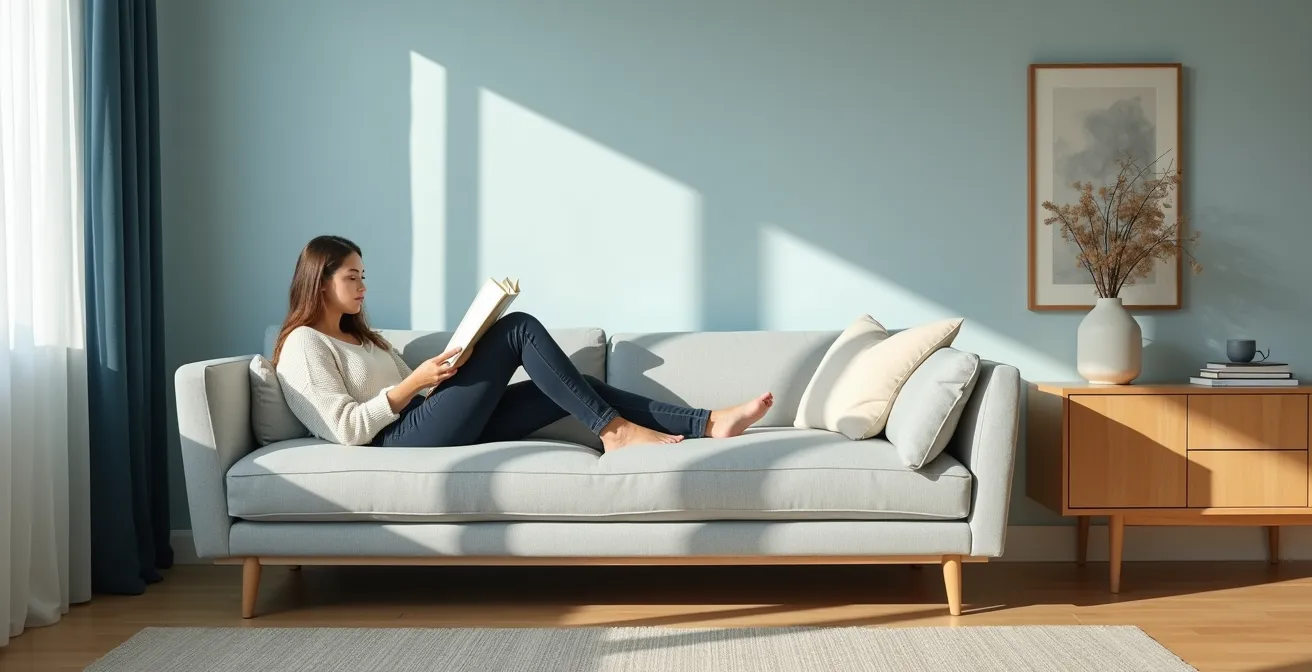
As you can see, the use of furniture with slender, visible legs creates negative space underneath, which is crucial for a feeling of openness. This allows light and air to flow more freely, preventing the room from feeling heavy or cramped and promoting a sense of calm and order.
The “Total Look” catalogue mistake: why mixing styles creates de la chaleur ?
One of the fastest ways to make a home feel impersonal and sterile is to adopt a “total look” straight from a catalogue. While cohesive, these perfectly matched sets often lack soul and the lived-in warmth that turns a space into a home. For a condo owner feeling depressed by their environment, this lack of personality can be particularly draining. The solution lies in a concept of intentional friction: thoughtfully mixing styles, textures, and eras to create a space that tells a story and feels uniquely yours.
This doesn’t mean creating chaos. It means curating a collection of items that you love, even if they don’t “match” in a traditional sense. A sleek, modern sofa from a Yorkville showroom can be beautifully balanced by a vintage credenza sourced from an antique shop on Queen West or in Leslieville. This blend of new and old, high and low, creates visual interest and a sense of history. It suggests the space has evolved over time, reflecting a rich and interesting life.
To do this with confidence, you can lean on a classic designer’s principle. As Carly Heung of 1smallspace Interior Design Toronto notes, a simple framework can guide your choices:
The ’60-30-10′ colour rule is your framework to confidently mix styles: 60% a dominant light neutral, 30% a secondary colour through textiles, and 10% a bold accent from a local Toronto artist.
– Carly Heung, 1smallspace Interior Design Toronto
Texture is another powerful tool for adding warmth. Juxtapose the smoothness of a marble coffee table with a chunky wool throw, or pair velvet cushions with a linen sofa. These tactile variations engage the senses and prevent the room from feeling flat. Finally, bringing in natural elements through biophilic design is crucial. Even in a dark condo, low-light plants like the resilient ZZ plant or snake plant can add life, purify the air, and provide a vital connection to nature. The final 10% accent can be a powerful statement piece—a bold painting or sculpture from a local Toronto artist that injects personality and serves as a conversation starter.
Rugs and curtains: how to reduce l’écho et le bruit des voisins dans un condo ?
A dark condo often feels cold not just visually, but acoustically too. Hard surfaces like concrete, glass, and hardwood floors create a harsh, echoey environment where every footstep and conversation reverbs. This, combined with the inevitable noise from neighbours in a dense Toronto building, can create an atmosphere of constant, low-level irritation. Creating acoustic comfort is a critical, yet often overlooked, layer of making a home feel like a peaceful sanctuary.
Soft materials are your greatest allies in this fight. Textiles absorb sound waves, preventing them from bouncing around the room. A large, plush area rug is the single most effective tool for this. Aim to cover at least 80% of the main living area floor to significantly dampen echoes and reduce the transmission of footstep noise to the unit below. Don’t be afraid of lighter colours; a large wool rug in a cream or light grey can anchor the space and add warmth without visually shrinking it.
Curtains play a dual role in both light management and sound absorption. A double-rod system offers the most flexibility. Use a sheer, light-coloured inner curtain for daytime privacy that still allows diffuse light to filter in. For the outer layer, choose heavy, thick drapes in a material like velvet or a tightly woven linen. A downtown Toronto condo owner implemented this exact system, using heavy charcoal grey outer curtains for evening noise reduction. The result, combined with a large rug and acoustic felt panels, was a 35% reduction in noise complaints. Indeed, acoustic studies show that dark, plush materials can reduce sound transmission through shared walls by a significant margin.

As this image shows, the layering of different fabrics—from the deep-pile rug to the heavy drapes—creates a rich textural landscape. This not only looks inviting but works actively to absorb sound, creating a palpable sense of quiet and calm. You can even take this a step further by using acoustic felt panels from Canadian suppliers and arranging them on a wall as a piece of modern, geometric art, adding another layer of sound-dampening insulation in a stylish way.
Bougies et diffuseurs : comment l’odeur influence la perception de “propre et rangé” ?
Our perception of a space is profoundly influenced by senses we don’t consciously register, and scent is one of the most powerful. A pleasant, subtle fragrance can make a space feel cleaner, more intentional, and more welcoming. Conversely, stale or unpleasant odours can make even the most beautifully designed room feel “off.” Implementing a strategy of scent architecture is the final sensory layer in transforming your condo’s atmosphere from stagnant to vibrant.
The first step is always to achieve a neutral baseline. Before adding a scent, you must eliminate base odours from cooking, pets, or poor ventilation. Unscented air purifiers or activated charcoal bags are excellent for absorbing lingering smells without adding another fragrance to the mix. Once you have a clean slate, you can begin to build your scent profile.
The key is consistency and subtlety. A home that has a single, signature scent feels more cohesive and “put-together.” Alternatively, you can pair specific scents with specific rooms or colours to create psychological associations. As one Toronto resident from Liberty Village discovered, “After implementing a citrus/lemongrass scent in my yellow-accented kitchen and lavender in my blue-grey bedroom, guests consistently comment on how ‘put-together’ my 500 sq ft condo feels. The consistent scent-color pairing creates an immediate sense of intentionality and calm.” This demonstrates how a thoughtful scent strategy can elevate the perception of your entire home.
Your Action Plan: Curating Your Condo’s Scent Signature
- Eliminate Base Odors: Start with unscented air purifiers or charcoal bags to achieve a neutral canvas.
- Choose Your Scent Profile (Seasonal): For spring, use light florals (peony, lilac) to combat cabin fever. For summer, opt for fresh linen or ocean scents. In fall, embrace warm spiced apple or cedarwood. For Toronto’s long winters, use pine or eucalyptus to create a fresh, invigorating feeling.
- Select Your Method: Use high-quality diffusers for a consistent, subtle scent. Reserve scented candles for specific moments to create ambiance and a ritual of relaxation.
- Zone Your Scents: If you prefer variety, assign specific scents to zones. For example, an energizing citrus in the workspace and a calming lavender or chamomile in the bedroom.
- Practice Subtlety: The goal is a scent that is barely noticeable upon entering but contributes to an overall feeling of freshness and care. The scent should never be overpowering.
By curating your home’s fragrance, you are engaging in a subtle but powerful form of psychological design. You’re not just making your condo smell good; you are actively shaping the emotional experience of being in your space, reinforcing feelings of cleanliness, order, and tranquility.
How to create un plan d’éclairage en couches (Layering) pour un salon multifonction ?
In a dark condo, a single overhead light fixture is the enemy of ambiance. It casts harsh shadows, flattens textures, and creates a sterile, uniform brightness that feels more like an office than a home. A sophisticated and psychologically comforting space relies on layered lighting, a plan that combines three distinct types of light—ambient, task, and accent—to create mood, function, and visual interest.
Ambient light is the general, overall illumination of the room. In a condo, this can be improved by using uplighting on light-coloured walls. Placing floor lamps in corners and aiming them at the ceiling makes the standard 8-foot ceilings feel taller and creates a soft, diffuse glow that eliminates dark corners.
Task lighting is directed light for specific activities like reading, working, or cooking. Creating a dedicated “focus nook” can be incredibly beneficial for your well-being. A comfortable armchair, a small side table, and a warm, directed floor or table lamp create a protected zone for concentration. Pairing this with a calming green accent wall can further enhance focus. It’s here that the quality of your light bulbs becomes critical. As lighting specialists report that high-CRI (90+) bulbs can improve colour accuracy by 40%, ensuring the colours of your decor and artwork are rendered truly and vibrantly, which is essential for a positive psychological impact.
Accent lighting is the “jewelry” of your lighting plan. These are spotlights used to highlight architectural features or, more importantly in a condo, pieces of art. An accent light on a beloved painting creates an emotional centerpiece, a focal point that draws the eye and adds a layer of drama and sophistication. For a truly advanced setup, install smart bulbs like Philips Hue. These can be programmed to follow a circadian rhythm, shifting from a cool, energizing 5000K light in the morning to a warm, relaxing 2700K glow in the evening, helping to regulate your sleep cycle and enhance your well-being, especially during Toronto’s darkest months.
How to furnish a condo de 600 pi² pour le rendre spacieux et lumineux ?
The single biggest surface in your condo isn’t the floor; it’s the walls. How you treat them sets the psychological tone for the entire space. While the default advice is “paint it white,” the choice is far more nuanced. The wrong white can feel clinical and cold, while the right off-white or light neutral can create a sense of warmth and expansiveness. In a 600 sq ft space, the goal is to create visual continuity to trick the brain into perceiving a larger area.
A powerful technique is the “One Continuous Colour” rule. As demonstrated in the transformation of a 600 sq ft condo in Toronto’s Entertainment District, painting the walls, baseboards, and even the door trims in the same light colour—in their case, Benjamin Moore’s Cloud White—eliminates the visual breaks that can make a room feel chopped up and smaller. This creates a seamless, flowing backdrop that makes the space feel instantly larger and more serene. Extending this principle to built-in storage, like painting floor-to-ceiling bookshelves to match the walls, makes them visually “disappear,” providing ample storage without adding visual bulk.
Choosing the right neutral is highly dependent on the light your condo receives. This is where understanding undertones becomes critical. The table below offers a starting point for selecting a paint colour based on your unit’s specific lighting conditions.
| Paint Color | Undertone | Best Light Conditions | Psychological Effect |
|---|---|---|---|
| Pale Sage Green | Cool grey-green | North-facing units | Calming, nature-connected |
| Light Greige | Warm beige-grey | Limited natural light | Sophisticated, grounding |
| Warm Off-White | Subtle yellow | East/West facing | Expansive, cheerful |
Such a project can be a significant investment, but one with a clear return. While costs vary, you can expect to invest anywhere from $100 to $250 per square foot for full condo renovations in Toronto. In the case of the Entertainment District condo, a focused investment of $45,000 in paint, lighting, and vertical storage resulted in a space that felt 40% larger, dramatically increasing both its livability and potential resale value.
Key takeaways
- Go Beyond Visuals: True spaciousness is a psychological state achieved by layering light, texture, sound, and scent.
- Layer Your Lighting: Combine ambient, task, and accent lighting with high-CRI bulbs to create mood and function while supporting your circadian rhythm.
- Embrace Acoustic & Scent Comfort: Use soft textiles to absorb harsh sound and a subtle, consistent fragrance to create a perception of clean, calm order.
Murphy bed ou canapé convertible : quel investissement pour un studio de 400 pi² ?
In a studio apartment of 400 sq ft or less, every square inch is precious real estate. The single largest piece of furniture—the bed—presents the biggest challenge and the greatest opportunity. The choice between a sofa bed and a Murphy bed isn’t just about function; it’s a critical investment decision that impacts your daily quality of life and the financial value of your property. While a sofa bed is a common solution, a quality Murphy bed often represents a superior investment in both livability and return.
A sofa bed, by its nature, is a compromise. It is rarely as comfortable as a real bed, nor is it as comfortable as a dedicated sofa. It also visually anchors the “sleeping” function in your main living space, 24/7. A Murphy bed, however, allows for a true transformation. During the day, the room is a fully functional living room or office, completely free of the psychological weight of a bed. At night, it becomes a proper bedroom with a real mattress, offering superior sleep quality.
This transformational quality has a quantifiable financial benefit. A case study of a King West studio owner highlights the impressive ROI. By investing $3,500 in a quality Murphy bed from a GTA supplier like B.O.F.F. Wall Beds, they created a dynamic space. When the bed is raised, it reveals a charcoal-coloured feature wall with integrated shelving, turning a functional item into a design statement. This single upgrade increased the unit’s rental appeal by 25% and allowed it to command $200 more in monthly rent than comparable studios with sofa beds, meaning the investment paid for itself in under 18 months.
This financial upside is amplified by market trends. With a competitive market, thoughtful upgrades make a unit stand out. In fact, recent Toronto real estate data shows that renovated condos can sell for significantly more than dated units in the same building. A Murphy bed is precisely the kind of smart, space-maximizing renovation that signals a high-value property to potential buyers or renters, making it a wise investment in your home’s long-term worth.
Ultimately, transforming your condo is an act of self-care. By thoughtfully applying these principles of psychological and sensory design, you are not just decorating a space; you are building an environment that actively supports your well-being. Begin with one small change—a new lamp, a plush rug, or a fragrant diffuser—and see how it shifts your perception of home.