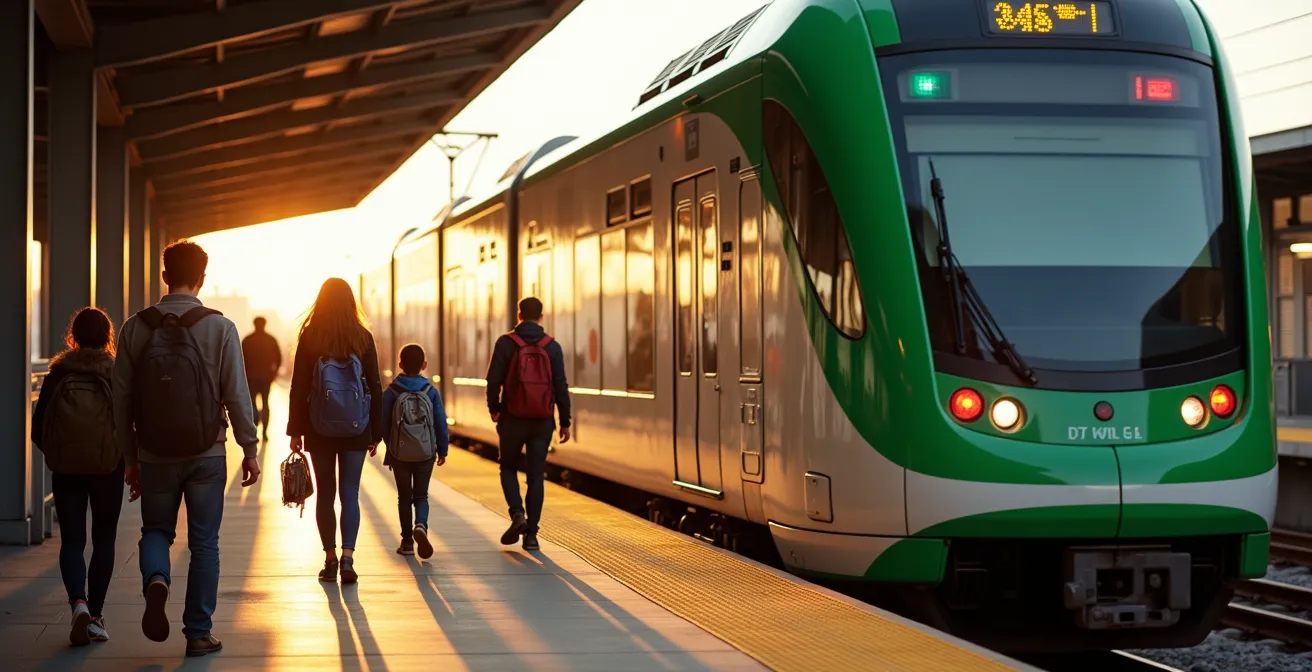
In summary:
- Master the $10 Weekend Pass for unlimited travel, a massive saving over standard PRESTO fares.
- Always remember to tap off with your PRESTO card to avoid being charged the maximum possible fare.
- The upper deck is a designated Quiet Zone; keep conversations and noise to an absolute minimum.
- Strategically use free 48-hour station parking to create multi-day getaways without downtown car hassles.
For many Torontonians without a car, the city can sometimes feel like an island. The thought of escaping to see the waterfalls of Hamilton or the trails of the Rouge Valley seems reserved for those with four wheels. The GO Train presents itself as the obvious solution, a green and white lifeline to the suburbs and beyond. Most guides will give you a simple list of destinations, treating the train as just a bus on rails. But this approach misses the point entirely and often leads to frustration, missed trains, and overpaid fares.
The truth that seasoned commuters know is that using the GO Train effectively is a skill. It’s a system with its own unwritten rules, hidden costs, and strategic “fare hacking” opportunities. Simply buying a ticket and hopping on is the tourist’s way; the local’s way involves understanding the delicate social contract of the Quiet Zone, knowing the exact moment to activate a digital pass, and treating station choice not as a given, but as a tactical decision. The difference between a stressful, expensive journey and a seamless, affordable adventure lies in these very details.
This guide isn’t another list of places to go. It’s a masterclass in using the GO system itself. We’ll deconstruct the unspoken etiquette that will save you from dirty looks, reveal the costly PRESTO mistake almost everyone makes at least once, and show you how to leverage the system’s own rules—from parking to passes—to unlock the full potential of your next day trip. Forget just getting to your destination; it’s time to master the journey.
This article breaks down the essential strategies for transforming your GO Train experience. From passenger etiquette to fare optimization, you’ll find everything you need to travel like a seasoned pro. The summary below outlines the key areas we will explore.
Summary : Mastering the GO Train for Your Next Toronto Getaway
- Upper deck: why silence is sacred and how to avoid dirty looks?
- $10 unlimited pass: how to get the most out of this little-known tourist offer?
- Tapping on/off: the mistake that charges you the maximum default fare
- Rouge Hill or Burlington: which station best serves hiking trails?
- Free 48h parking: can you leave your car at the station for the weekend?
- How to access the best views of the Scarborough Bluffs without risking a fine?
- How to combine car and public transit to cross the GTA efficiently?
- Who mows the lawn when you’re in Toronto: managing logistics from 200km away
Upper deck: why silence is sacred and how to avoid dirty looks?
The first rule of GO Train club is: you do not talk on the upper deck. This isn’t just a suggestion; it’s a sacred social contract. The upper level of every train is designated as the Quiet Zone, a sanctuary for those looking to read, work, or simply decompress in silence. Breaking this rule is the fastest way to earn the infamous “Canadian Glance”—a polite but firm stare that communicates everything a shout ever could. The expectation is complete silence, which means phone calls are absolutely forbidden, conversations should be taken downstairs, and headphones must be kept at a volume inaudible to your neighbours.
Etiquette extends beyond just noise levels. During rush hour, the train is packed, and courtesy becomes paramount. Bags belong on your lap or on the floor, not on the seat beside you. While eating is permitted, it’s best to avoid bringing aromatic foods that will permeate the entire carriage. The system functions on a shared understanding of mutual respect. However, situations can change the dynamic. After a big Toronto Blue Jays game or a concert, the late-night trains are often filled with an excited energy where the strict rules of silence are temporarily and communally relaxed, though basic courtesy still applies.
Navigating this social code is key to a pleasant journey. If someone is being disruptive in the Quiet Zone, the escalation is subtle: start with eye contact, then perhaps a polite gesture towards the Quiet Zone sign. If the behaviour persists, a quiet word with the Customer Service Ambassador is the final, and most effective, step. Mastering these etiquette signals ensures you’re not just a passenger, but a respected member of the commuting community.
To fully grasp the nuances of this unspoken code, it’s worth reviewing the official guidelines and how they apply in different scenarios. Familiarizing yourself with the complete GO Train etiquette guide for various zones helps prevent any accidental missteps.
$10 unlimited pass: how to get the most out of this little-known tourist offer?
Here is the single most valuable piece of GO Train knowledge for any adventurer: the Weekend Pass. For just $10 for unlimited travel on any Saturday, Sunday, or holiday, you can traverse the entire GO network. This isn’t just a discount; it’s a complete game-changer that transforms the system from a simple A-to-B transit line into an all-access pass for exploration. This is the cornerstone of “fare hacking” on GO Transit, allowing for multi-stop journeys that would be prohibitively expensive using standard PRESTO fares.
The value proposition is staggering. A regular round trip from Union Station to Burlington can cost over $24. With the pass, it’s $10. Want to visit a friend in Oshawa in the morning and then head to Hamilton for dinner? It’s still just $10. The pass empowers you to be spontaneous, to hop off at a random town you’ve never seen, and to explore without the mental calculus of adding up each leg of your journey. The key is that the pass must be purchased online in advance via the GO e-ticket website; it is not available at stations or on your PRESTO card. Once purchased, you simply activate it on your smartphone five minutes before boarding your first train.
This table illustrates just how significant the savings can be, especially when you adopt a multi-stop strategy to maximize the pass’s value.
| Route | Regular Round Trip | Weekend Pass | Savings |
|---|---|---|---|
| Oshawa to Toronto | $24.50 | $10 | 59% |
| Union to Burlington | $24.60 | $10 | 59% |
| Allandale to Union | $31.60 | $10 | 68% |
| Multiple stops strategy | $40+ | $10 | 75%+ |
One crucial detail to remember is that the pass is valid only on GO Transit buses and trains. It does not include local transit connections like the TTC in Toronto or the WEGO bus system at Niagara Falls. Plan accordingly for that “last-mile” of your journey.
Tapping on/off: the mistake that charges you the maximum default fare
If the $10 Weekend Pass is the GO Train’s greatest gift, the default fare is its cruelest trap. Every PRESTO user has a horror story of forgetting to tap off and later discovering they were charged for the longest possible journey on that line. The system is simple but unforgiving: you must tap your PRESTO card on a reader when you board and tap off when you exit. When you tap on, the system deducts the maximum fare from your balance as a hold. When you tap off, it calculates the actual cost of your trip and refunds you the difference. If you forget to tap off, you forfeit that refund.
This is especially punitive for short trips. A quick one-stop ride that should cost a few dollars can easily turn into a $15-$20 charge if you forget that crucial final tap. The mistake is most common at busy, complex hubs like Union Station, where transferring between the GO Train, TTC subway, and UP Express creates a confusing “tapestry” of different readers and rules. It’s critical to remember that your GO journey is a separate transaction; you tap on at your origin GO station and tap off at your destination GO station, regardless of other transit systems you might use.
This simple action is the mechanical heart of using the PRESTO system correctly. Always look for the green PRESTO readers at the station entrances and exits, and make a mental habit of tapping every time you enter and every time you leave a GO Transit-controlled area.
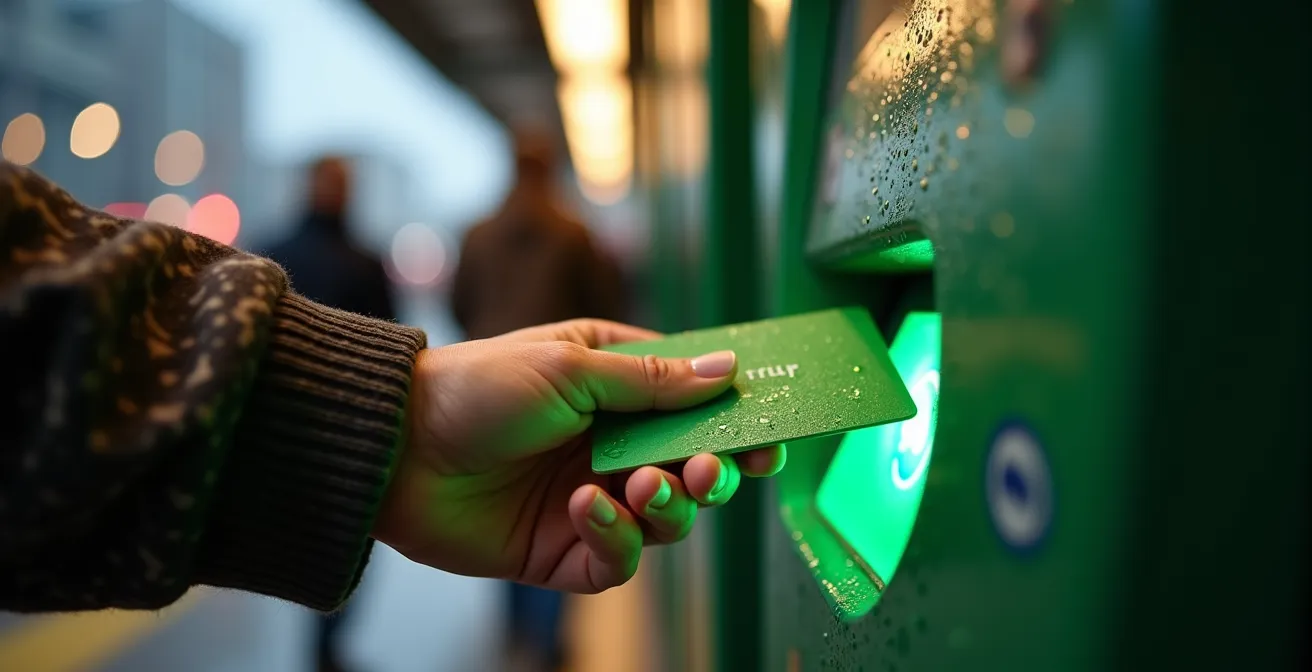
As you can see, the reader is a distinct and ever-present part of the station architecture. Making the tap an automatic reflex, like checking for your keys, is the best defence against the costly default fare. If you do make a mistake, you can file a claim on the PRESTO website, but it’s a hassle best avoided. Remember: the journey isn’t truly over until you’ve tapped off.
Rouge Hill or Burlington: which station best serves hiking trails?
Using the GO Train for a hiking trip requires solving the “last-mile problem”: getting from the station to the trailhead. Not all stations are created equal in this regard. Two popular choices, Rouge Hill on the Lakeshore East line and Burlington on the Lakeshore West line, offer fantastic but very different access to nature. Your choice of station should be a strategic one, based on the type of experience you’re seeking.
Rouge Hill Station is the undisputed champion for direct, walkable access to a major park. It’s located a mere 10-minute walk from the entrance to Rouge National Urban Park, a vast expanse of forests, wetlands, and trails right on the edge of the city. This makes it incredibly convenient for a spontaneous trip, especially in the fall when you can witness the salmon run. Burlington GO Station, on the other hand, offers access to the beautiful waterfront trails of Spencer Smith Park and the wider Lake Ontario shoreline. While it’s a slightly longer 15-minute walk (or a short local bus ride), it connects you to a more manicured, urban park experience perfect for summer strolls and cycling.
The best choice depends on your goal. For rugged, immersive nature, Rouge Hill is superior. For a scenic walk by the lake combined with the amenities of a city, Burlington is the better bet. The table below compares these and other excellent stations for trail access.
| Station | Trail Access | Distance to Trails | Best Season |
|---|---|---|---|
| Rouge Hill | Rouge National Urban Park | 10-minute walk | Fall (salmon run) |
| Burlington | Waterfront Trail, Spencer Smith Park | 15-minute walk or HSR bus | Summer |
| Hamilton GO | Multiple waterfalls | Local bus connection | Spring/Summer |
| Barrie South GO | Lake Simcoe trails | 20-minute walk | All seasons |
Your Action Plan: Auditing a GO Station for Trail Access
- Map the Route: Before you go, use an online map to trace the walking path from the GO station exit to the primary trailhead. Check for sidewalks and road crossings.
- Assess the “Last Mile”: Determine the walking distance and time. Is it a pleasant 10-minute stroll or a 30-minute trek along a busy road? Research local bus connections from the station as a backup.
- Check Trail Conditions: Visit the park’s official website (e.g., Parks Canada for Rouge Park) or a conservation authority site for any trail closures, advisories, or seasonal highlights like fall colours or a salmon run.
- Verify On-Site Amenities: Confirm the availability of washrooms, water fountains, and picnic areas near the trailhead, as these are often absent at the GO station itself.
- Plan Your Return: Note the frequency of the return GO Train service, especially on weekends, to ensure you can get back to the station in time without rushing your hike.
Free 48h parking: can you leave your car at the station for the weekend?
For those who own a car but dread driving downtown, the GO Train offers a powerful “park-and-ride” strategy. You can drive to your local GO station, park for free, and enjoy a stress-free train ride into the city or across the GTA. But what about longer trips? Can you leave your car for an entire weekend? The answer is a resounding yes. It is officially permitted to park for up to 48-hour for free at most GO station lots. This policy is a huge, often overlooked benefit for planning weekend getaways.
This opens up a world of possibilities. You can drive to a station like Aldershot or Burlington on a Friday evening, park your car, and use a $10 Weekend Pass to explore Toronto for the entire next day. You could even head to Niagara for a Saturday trip, stay overnight, and return on Sunday, all while your car waits safely and free of charge. This piece of “transit jiu-jitsu” uses the commuter infrastructure for leisure travel, saving you hundreds of dollars in downtown Toronto or Niagara Falls parking fees.
The key is to choose your station wisely. While most stations have ample parking on weekends, some smaller or more central ones can fill up. Larger hub stations further out from the city, like Aldershot, Pickering, or Barrie South, are generally your safest bets for finding a spot. It’s a simple strategy: trade a bit of driving to a suburban station for huge savings and the convenience of not having to worry about your car for the rest of your trip. Combined with the Weekend Pass, it’s the most cost-effective and stress-free way to plan a multi-day excursion from the GTA.
How to access the best views of the Scarborough Bluffs without risking a fine?
The Scarborough Bluffs are one of Toronto’s most spectacular natural wonders, but their beauty hides a significant danger. The cliff edges are unstable, and erosion has made many of the unofficial “lookout” spots treacherous. In response, authorities have cracked down hard on trespassing. Getting caught in a restricted area for that perfect Instagram shot isn’t just risky for your safety; it can also result in fines up to $5,000 for trespassing in restricted areas, a steep price for a photograph.
Fortunately, you can experience the stunning vistas safely and legally. The city has designated several official parks and viewing areas that offer breathtaking views without the risk. The goal is to enjoy the majesty of the Bluffs, not to stand on the very edge of them. The best and safest access points are:
- Bluffer’s Park: Accessed from the base of the cliffs, this park offers incredible views looking up at the white escarpment, along with a beach and marina. You can get here via the seasonal 175 TTC bus from Kennedy Station.
- Cathedral Bluffs Park: Located at the top of the cliffs, this park has designated viewing areas with safety barriers, offering the iconic, sweeping panoramic views you see in photos.
- Scarborough Bluffs Park: Another great option at the top, providing safe and official lookout points to take in the scenery.
From a GO Train perspective, you can take the Lakeshore East line to Scarborough GO station and then connect to a local TTC bus that will take you towards the Brimley Road South entrance to Bluffer’s Park.
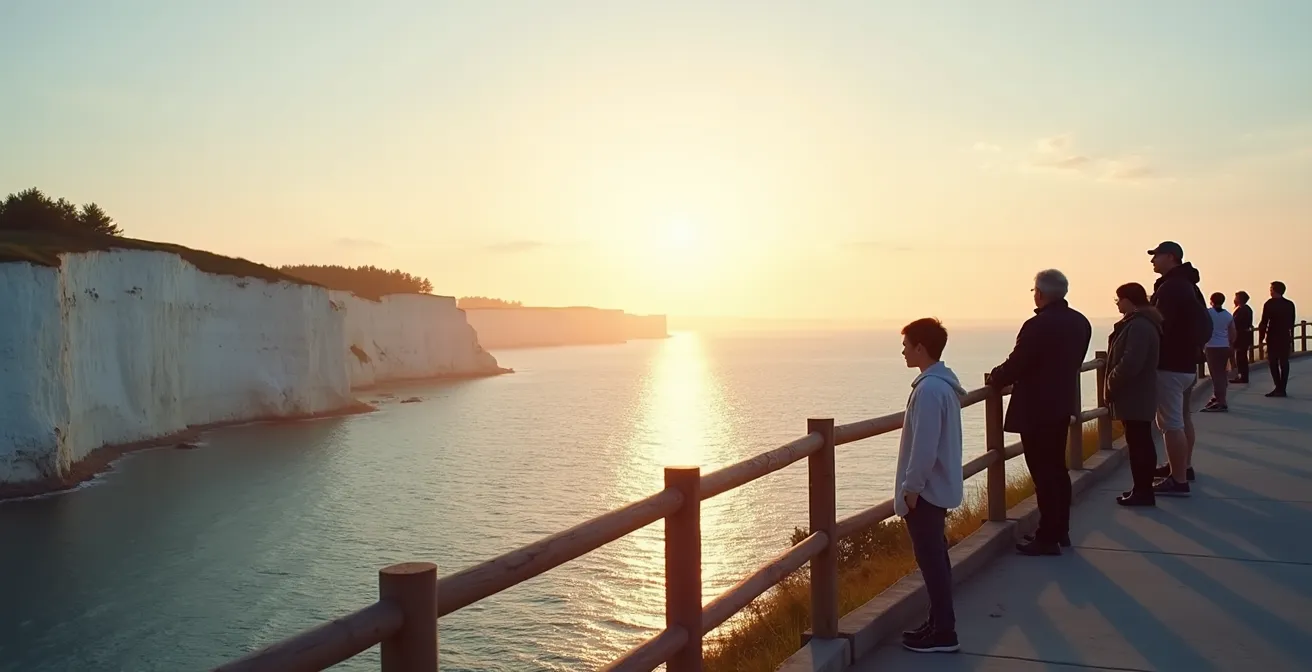
As this image shows, the official platforms provide a spectacular and completely safe vantage point to enjoy the golden hour over Lake Ontario. Resisting the temptation to hop a fence not only protects your wallet from a massive fine but also preserves the fragile ecosystem and ensures you’ll be around to enjoy the view for years to come. The best view is always the safe one.
How to combine car and public transit to cross the GTA efficiently?
For those living in the outer suburbs, a trip across the vast Greater Toronto Area can feel like a logistical nightmare. Driving the whole way means battling the 401, while taking transit from your front door can involve multiple buses and a long journey just to reach the GO line. The most efficient solution is often a hybrid approach: a strategic combination of driving and taking the train. This “park-and-ride” method isn’t just for commuting into downtown; it’s a powerful tool for crossing the entire region.
The core strategy is to drive to a major GO station that is outside the zone of major congestion but offers frequent train service. For example, instead of driving from Hamilton all the way to Scarborough, you could drive to Burlington GO, park for free, and take the Lakeshore West and East lines across the city. You avoid the most stressful part of the drive (the DVP/Gardiner/401 interchange) and can relax, read, or work on the train. This is particularly effective for specific tasks, like a run to Pearson Airport by parking at Malton GO and connecting to the UP Express, or avoiding concert traffic by parking at Port Credit and training into Exhibition Station.
Some regions offer even more integrated “transit jiu-jitsu” opportunities. For instance, Barrie’s transit policy includes local bus fare in your GO ticket if used within 30 minutes of arrival. This allows a seamless, no-cost transfer from the GO station to your final destination within the city. The key is to see the GO network not as an isolated system, but as a backbone that you can connect to at its most convenient point. By identifying the right “hub” station for your trip, you can cut down on travel time, save on gas and parking, and eliminate a significant amount of stress.
Key takeaways
- The GO Train’s upper deck is a designated Quiet Zone; silence is the expected and enforced norm.
- The $10 Weekend Pass offers unlimited travel on Saturdays, Sundays, and holidays, providing massive savings over standard fares.
- Always tap your PRESTO card both on and off to avoid being charged a costly maximum default fare.
Who mows the lawn when you’re in Toronto: managing logistics from 200km away
The allure of the day trip is its simplicity: leave in the morning, return at night, and sleep in your own bed. But when using a transit system that serves a region as large as the GTA, the line between a “day trip” and an “overnighter” can become surprisingly blurry. The final piece of mastering the GO Train is understanding its operational limits and planning for the “what ifs.” The whimsical title of this section is a metaphor for a very real logistical challenge: what happens if you miss the last train home?
While GO service is expanding, it’s not a 24/7 subway system. On many lines, especially on weekends, the last train can depart earlier than you might think. A leisurely dinner in a town like Stratford or a concert that runs late in Kitchener can easily put you past the final departure time. Transit experts confirm that for more distant destinations, a “day trip” often requires careful, almost military-style planning of your return journey. The farther you go, the more critical it is to check the return schedule before you even commit to the trip. This is the essence of reverse commuter logic: planning your trip from the end-point backwards.
This reality check transforms how you plan. It forces you to ask practical questions. Do I have a backup plan? Is there a friend I could stay with? What’s the cost of a last-minute hotel? It connects your fun excursion back to the real-world logistics of your life 200km away—the dog that needs to be let out, the lawn that needs mowing, the work you have the next day. A successful GO Train adventurer doesn’t just know how to get there; they know for certain how and when they can get back. The most liberating trips are built on the foundation of a solid, realistic return plan.
Now that you’re armed with these insider strategies, the entire Greater Toronto Area is your playground. Start planning your next escape by choosing a destination and applying these principles to build a seamless, affordable, and truly adventurous journey.