
In summary:
- Embrace the “strategic proximity” of watching games for free at Maple Leaf Square for an unmatched playoff atmosphere.
- Master the “eleventh-hour play” by using last-minute ticket apps like Gametime right before the game for the best deals.
- Avoid the post-game chaos at Union Station by using the PATH system—the ultimate local escape route.
- For family fun, choose high-energy, affordable Marlies or Argonauts games over pricey Leafs or Raptors tickets.
You see the jerseys flooding into Union Station. You feel the buzz in the air. You want to be part of the action when the Raptors or the Leafs hit the court or the ice. But then you check the ticket prices and your heart sinks. Welcome to the classic Toronto sports fan dilemma: a deep love for your team versus the brutal reality of your bank account. It feels like you have two choices: sell a kidney or watch from your couch.
The common advice is always the same—buy nosebleed seats months in advance, go on a Tuesday night against a losing team, or beg a corporate friend for their tickets. But that’s missing the point. Being a true fan in this city isn’t just about getting through the door. It’s about being smart, understanding the rhythm of the city, and mastering the entire game-day ecosystem. It’s about knowing when to be inside the arena and when the real party is happening just outside of it.
Forget the conventional wisdom that bleeds your wallet dry. The real secret isn’t just finding a cheaper ticket; it’s about fundamentally changing your approach to game day. This guide is your new playbook. We’re going to break down how to outsmart the system, from pre-game strategy and last-minute ticket hacks to the all-important post-game escape plan. It’s time to stop being a spectator and start experiencing Toronto sports like a seasoned pro who knows all the angles.
This article provides a complete playbook, breaking down everything from scoring last-minute deals and navigating the arena district to finding value in other local sports. Discover the insider strategies that separate the tourists from the true Toronto faithful.
Summary: The True Fan’s Playbook for Toronto Sports
- Maple Leaf Square: why watching the game outside is sometimes better than being inside?
- Gametime or StubHub: which application to use 1h before the coup d’envoi?
- The error of taking the subway at Union Station right after the final siren
- Sun or shade: which side to choose for a Blue Jays game in july?
- Argonauts or Marlies: why minor league sports offer better family entertainment?
- How to obtain tickets for the TIFF without being a VIP of the industry?
- How to combine car and transport in common to cross the GTA efficiently?
- CityPASS or individual tickets: which option to choose to visit 4 major attractions?
Maple Leaf Square: why watching the game outside is sometimes better than being inside?
Let’s be honest, the atmosphere inside Scotiabank Arena is electric, but it comes at a steep price. For many, the idea of paying hundreds of dollars for a seat is simply out of reach, especially when you consider that Raptors arena tickets average between $11 and $136 even for less popular games, and playoff prices are astronomical. This is where the true genius of Toronto’s sports culture shines: Maple Leaf Square, or as it’s lovingly known during Raptors playoff runs, “Jurassic Park.”
This is the epitome of strategic proximity. You are physically at the heart of the action, surrounded by thousands of passionate, screaming fans, sharing in every single basket and every gut-wrenching moment. The energy here isn’t a diluted version of what’s inside; during the 2019 NBA Finals, it was arguably the epicenter of the entire country’s celebration. You get the same collective euphoria, the same sense of community, and the same live-action viewing on a massive screen—all for the glorious price of zero dollars.
Choosing the square over a seat isn’t a compromise; it’s a strategic decision. You’re trading an assigned seat for an ocean of fans, an overpriced beer for one from a nearby bar, and a massive ticket cost for an experience that is, in many ways, more raw and communal. For those high-stakes playoff games, being in the middle of Jurassic Park is a badge of honor, a story you’ll tell for years. It’s the ultimate proof that you don’t need a ticket to be part of the victory.
Gametime or StubHub: which application to use 1h before the coup d’envoi?
Every seasoned Toronto fan knows the “rookie move”: buying tickets weeks or months in advance and paying top dollar. The pro move is the eleventh-hour play. This involves leveraging the panic of resellers on secondary market apps right before the puck drops or the ball is tipped. As game time approaches, sellers who haven’t offloaded their tickets start slashing prices dramatically. Your best weapons in this battle are apps like Gametime, StubHub, and SeatGeek.
While StubHub is a well-known giant, Gametime has carved out a niche specifically for last-minute deals, often showing plunging prices in the final 60-90 minutes before an event. Their interface is designed for quick, on-the-go decisions, showing you the view from the seat and simplifying the purchase process. It’s a high-risk, high-reward strategy, but one that can land you in the lower bowl for the price of a nosebleed seat if you time it right. The key is to be near the arena, monitor the app relentlessly, and be ready to pull the trigger when a price drops into your target zone.
Comparing the platforms reveals different strengths. Gametime is built for speed and last-minute discounts, while others might offer a wider selection earlier on. The important thing is to understand their fee structures and how prices are displayed to make a true comparison. For the pure thrill of the last-minute hunt, Gametime is often the local’s choice.
To help you navigate this, here’s a look at how some platforms stack up for finding those last-minute deals, based on data often seen on their platforms.
| Platform | Minimum Price | Average Price | Key Feature |
|---|---|---|---|
| Gametime | $20 | $50-$150 | Last Minute deals for steep discounts |
| Vivid Seats | $11 | $136 | All-In Pricing (fees shown upfront) |
Your Action Plan: Snagging a Last-Minute Deal on Gametime
- Open the app about 90 minutes before game time and search for the Raptors or Leafs game.
- Don’t fixate on one section. Use the map view and watch prices drop across the arena. Pay attention to “Last Minute Deals.”
- Set a mental “buy now” price. When a ticket hits that number, choose your seat and head straight to checkout.
- Select your preferred mobile ticket delivery and complete the purchase. The tickets will be sent to your phone almost instantly.
The error of taking the subway at Union Station right after the final siren
You’ve just witnessed an incredible victory. The buzzer sounds, the crowd erupts, and you’re riding a wave of pure joy. And then, reality hits. You and 20,000 other people are now trying to cram into the same Union Station subway entrance. This is the ultimate game-day buzzkill. The slow, suffocating shuffle through the concourse can erase all the goodwill from the game. It’s the biggest rookie mistake a fan can make.
The savvy Torontonian knows the secret to preserving that post-game high: the escape route. And the best escape route is Toronto’s underground PATH system. Instead of heading directly for the TTC entrance inside the station, you duck into this sprawling network of tunnels. It allows you to bypass the worst of the bottleneck, walking underground to other, less-crowded subway entrances like St. Andrew or King Station. It might add a few minutes to your walk, but it saves you ten times that in waiting and frustration.
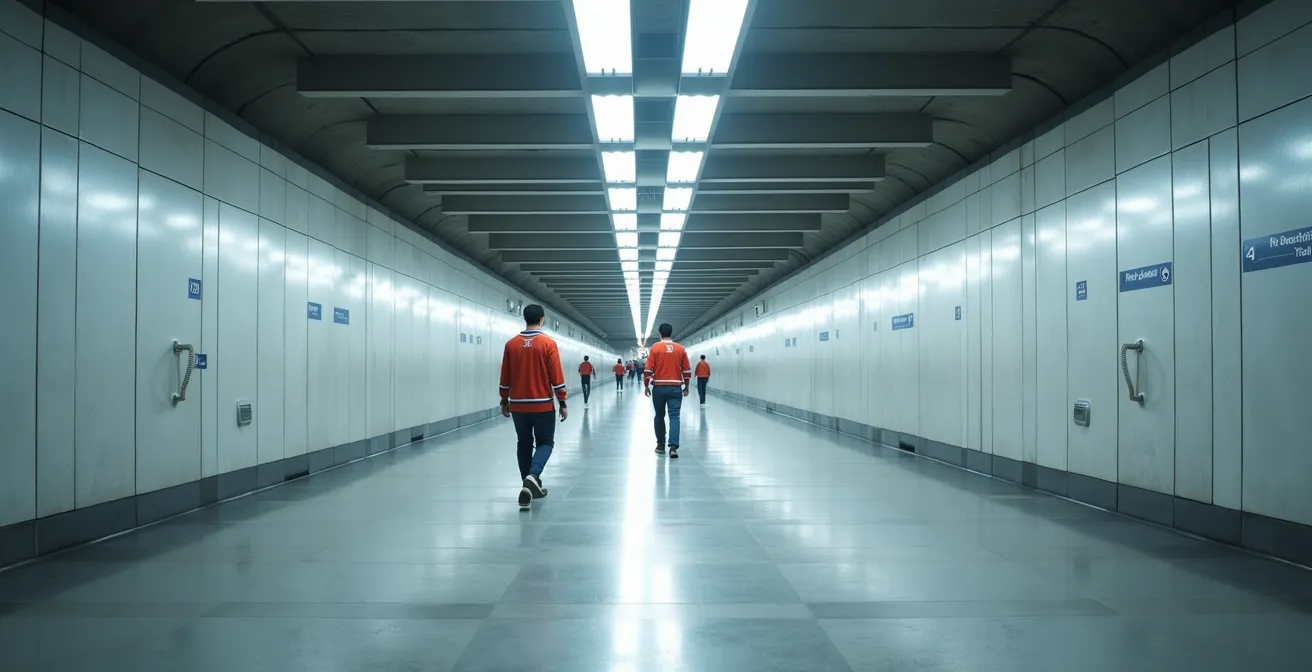
This simple choice is the difference between a triumphant journey home and a stressful ordeal. The PATH is clean, well-lit, and feels like a secret passage known only to locals. It’s a moment of quiet decompression after the sensory overload of the arena. This strategy highlights the core of the local fan’s mindset: the experience doesn’t end at the final buzzer. The post-game plan is just as important as the pre-game one. The frustration of high costs and crushing crowds is a real part of modern sports, a sentiment perfectly captured by one fan.
As Toronto sports fan Creo expressed in The Link newspaper, the cost of fandom can be a heavy burden:
Fans are emotional, and so decisions that teams make have a long-term effect on your fanbases going forward. We want to keep loving our sports and loving our guys, but it’s hard to do when we can’t afford to go.
– Creo, The Link newspaper
Sun or shade: which side to choose for a Blue Jays game in july?
Toronto summers can be glorious, but a three-hour Blue Jays game under the blazing July sun can turn a fun afternoon into a sweaty, sunburnt ordeal. When you’re at the Rogers Centre for a day game, your choice of seating section is not just about the view—it’s a crucial strategic decision for your comfort. The sun is the opponent you can’t see on the scoreboard.
Here’s the simple, insider rule that every seasoned Jays fan knows: for a sunny afternoon game, sit on the third base side. The sun travels across the sky behind the first base line, meaning sections along third base (the 125-130 range in the lower bowl, and the 200/500 levels above) are cast into shadow first. As the game progresses, these seats become a cool, shady oasis while the first base side continues to bake.
Conversely, if you’re a sun-worshipper or attending a cooler spring game, the first base side is your spot. You’ll get direct sunlight for most of the game, which can be perfect for working on a tan or staying warm in May. The outfield seats can be a bit of a gamble, with some sections getting a mix of sun and shade as the day goes on. But for a guaranteed escape from the heat, the third base line is the undisputed champion of comfort. This isn’t just a preference; it’s fundamental knowledge for surviving a Toronto summer at the ballpark.
Argonauts or Marlies: why minor league sports offer better family entertainment?
We love the Leafs and the Raptors, but let’s face it: taking a family of four to a game can cost more than a weekend getaway. The relentless focus on the big leagues often causes fans to overlook the incredible value and entertainment right in our own backyard. This is where you practice value-stacking: getting more bang for your buck by looking at the broader sports landscape. For a family, the Toronto Argonauts (CFL) and Toronto Marlies (AHL) are, without question, the superior choice.
The difference in cost is staggering. You can get fantastic seats for a Marlies game at the Coca-Cola Coliseum for a fraction of the price of a single nosebleed ticket to see the Leafs. According to pricing data, Toronto Marlies tickets start at around $14-$50, whereas Leafs tickets often start at $70 and quickly climb into the hundreds. The same logic applies to the Argos at BMO Field versus the pricier major league options.
But it’s not just about the price. The atmosphere at these games is incredibly family-friendly. There’s a greater focus on in-game entertainment, fan interaction, and creating a relaxed environment. You’re still watching high-level, professional athletes compete with passion, but without the intense, sometimes intimidating, pressure of a major league playoff hunt. Kids can get closer to the action, the food and drinks are more reasonably priced, and the overall experience feels less like a corporate event and more like a community gathering. It’s the perfect way to introduce young fans to the thrill of live sports without breaking the bank.
How to obtain tickets for the TIFF without being a VIP of the industry?
The Toronto International Film Festival (TIFF) transforms the city every September, and the desire to be part of it is just as strong as wanting to be at a Leafs playoff game. Just like with sports, there’s a perception that you need to be an industry insider or have a bottomless budget to participate. This is another myth that locals know how to bust. The secret to TIFF is embracing the rush line and the art of the same-day ticket.
While industry delegates and patrons get first dibs, a significant number of tickets are held back for the general public. If a screening appears “Off-Sale” online, it doesn’t mean it’s completely sold out. It means your best bet is to show up at the venue’s box office on the morning of the screening or, even better, get in the rush line. The rush line is where hopefuls queue up for seats that become available just minutes before the show starts, usually from no-show ticket holders. It requires patience and a bit of luck, but the payoff can be a seat at a world premiere next to the film’s director.

This strategy mirrors the last-minute sports ticket hunt: the closer you get to the event time, the higher your chances of an unexpected opportunity. It’s about being physically present and ready to act. You can also snag same-day tickets online at 7 a.m. each morning of the festival, but you have to be quick. The ultimate TIFF experience for a non-VIP isn’t about having a guaranteed schedule; it’s about the thrill of the hunt and the serendipity of discovering your new favorite film by taking a chance on the rush line.
How to combine car and transport in common to cross the GTA efficiently?
For anyone living outside the downtown core, the first question of any game-day plan is “How are we getting there?” Driving all the way to the arena means navigating the Gardiner Expressway, paying exorbitant parking fees ($30-$50 is common), and then facing the traffic jam on the way out. Taking public transport the whole way can be slow and crowded. The true GTA pro uses a hybrid approach: combining the car and public transport for an optimal balance of cost and convenience.
The strategy is simple: drive to a GO Train station or a TTC subway station on the edge of the city, park for free, and ride the rest of the way in. Stations like Kipling, Finch, or any GO station along the Lakeshore lines are perfect for this. You get the comfort and speed of your car for most of the journey, but you skip the most stressful and expensive part—downtown driving and parking. The GO Train drops you right at Union Station, directly connected to Scotiabank Arena.
This method is a core component of the “game-day ecosystem.” Your journey is part of the experience, and optimizing it saves you money and stress that can be better spent enjoying the pre-game buzz. For those who absolutely must drive downtown, the key is to exit the Gardiner Expressway at York Street and head north, but be prepared for congestion. The smartest play is almost always to let the GO Train or TTC handle the “last mile” of your journey. It’s the most efficient way to cross the vast Greater Toronto Area and arrive at the arena relaxed and ready for the game.
Key Takeaways
- The smartest Toronto fans prioritize the experience over the seat, using free viewing areas and affordable minor league games to stay in the action.
- Patience and timing are your best assets. Last-minute ticket apps and rush lines reward those who wait for the right moment to buy.
- Your game-day strategy must include an escape route. Using the PATH system and hybrid transit options is essential for avoiding costly and stressful bottlenecks.
CityPASS or individual tickets: which option to choose to visit 4 major attractions?
For tourists coming to Toronto for a game, or even for locals planning a “staycation,” the question of how to experience the city’s other top attractions often comes up. The Toronto CityPASS bundles admission to several major sites, including the CN Tower, Ripley’s Aquarium of Canada, Casa Loma, the Royal Ontario Museum, and the Toronto Zoo or Ontario Science Centre. On the surface, it looks like a great deal, but is it the right play for you?
The answer depends entirely on your mission. If your goal is to be a full-blown tourist and hit three or more of these major attractions within a nine-day window, the CityPASS is almost always a financial win. Do the math: buying individual adult tickets for the CN Tower, Ripley’s, and Casa Loma would cost significantly more than the pass. It simplifies your trip and saves you money. For a visiting fan looking to build a full Toronto experience around a game, it’s a no-brainer.
However, for a local or a visitor with a more focused agenda, the pass can be a trap. If you only really want to see the CN Tower and the Aquarium, buying individual tickets is cheaper. The pass pressures you into a whirlwind tour of attractions you might not be interested in just to “get your money’s worth.” The savvy local applies the same principle here as with sports: don’t pay for what you won’t use. Evaluate your actual interest level in each attraction and buy tickets a la carte if your plan is limited. The CityPASS is a tool, and like any tool, it’s only effective when used for the right job.
Now you have the playbook. Stop paying tourist prices and getting stuck in tourist traps. It’s time to start experiencing Toronto sports and entertainment like you own the place. Go Leafs Go. Let’s Go Raptors.