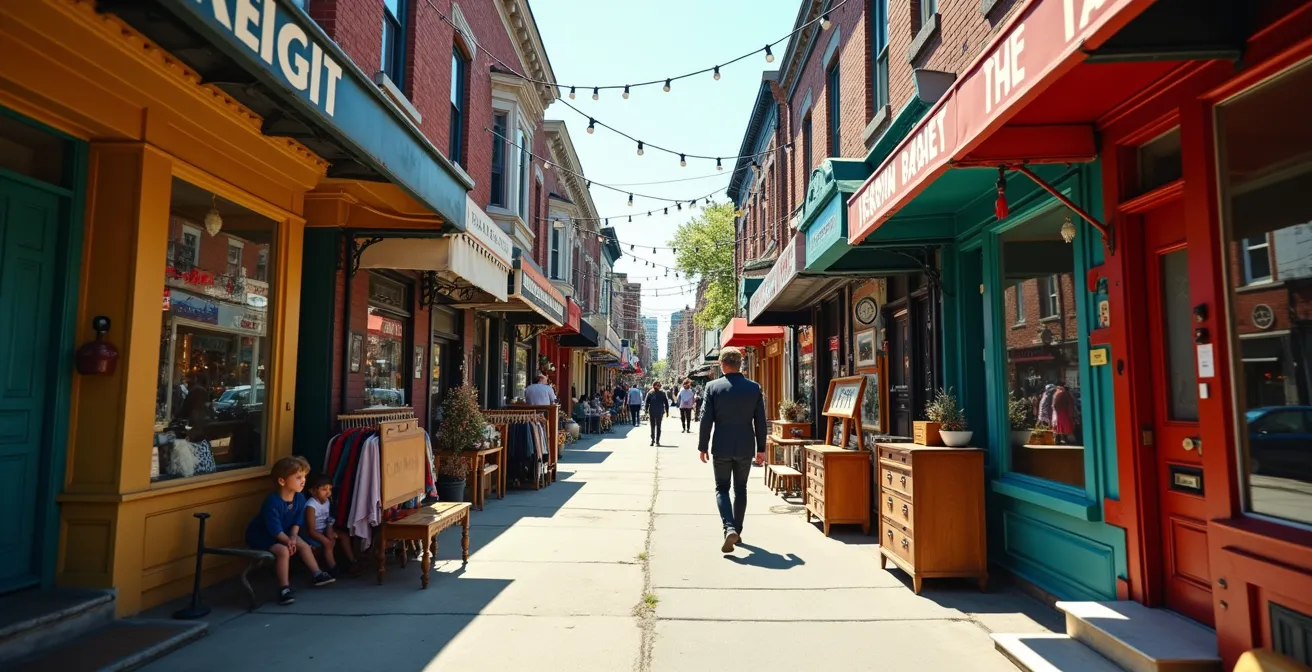
Finding true vintage under $50 in Kensington Market isn’t about luck; it’s a strategy that starts with knowing how to spot fakes.
- Most “vintage” racks are filled with used fast fashion; an authenticity checklist is crucial to avoid overpaying.
- Mastering the market’s rhythm—like knowing the best times to shop on Pedestrian Sundays and saving money on food—unlocks the best deals.
Recommendation: Start by learning to identify a pre-1972 garment by its lack of a care label—it’s the quickest way to filter out modern clothing.
Let’s be real: you’re in Kensington Market for a reason. You’re hunting for that one-of-a-kind piece that tells a story, something that screams ‘you’ and not ‘everyone else’. You’re rejecting the endless cycle of fast fashion for something with soul. But the dream of snagging a perfect, authentic 70s leather jacket or a floral 60s dress for under $50 CAD can feel like a fantasy when you’re faced with racks of overpriced, modern-day cast-offs masquerading as “vintage”. We’ve all been there, feeling the frustration of finding a cool-looking item only to realize it’s a five-year-old piece from a mall brand with a 300% markup.
Most guides will give you a list of the big-name stores like Courage My Love or Exile. And while they are institutions, they’re just the surface. The real magic of the Market, especially on a budget, isn’t just about knowing *where* to look, but *how* and *when*. It’s about understanding the unique ecosystem of this vibrant Toronto neighbourhood. This isn’t just a shopping district; it’s a living community where nearly 35% of residents walked to work long before it was trendy, a testament to its self-contained culture.
So, what if the key to a successful grail hunt wasn’t just digging through racks, but mastering the entire Kensington experience? What if eating the best cheap tacos and knowing which patio to relax on were part of the strategy? This guide is your new playbook. We’re going beyond the obvious to decode the market’s rhythm. You’ll learn the strategic advantages of certain days, how to fuel your hunt for less than a TTC fare, how to spot a true vintage piece from a fake in seconds, and ultimately, how to walk away with a piece you love, with money still left in your pocket.
This article will guide you through a complete strategic approach to conquering Kensington Market. You’ll discover the secrets of shopping during its most vibrant days, learn how to eat well without draining your wallet, and gain the critical skills to distinguish true treasures from vintage traps. Let’s get started.
Summary: Kensington Market on a Budget: Your Guide to Finding Authentic Vintage Gems Under $50
- Why Visiting Kensington on “Pedestrian Sundays” Changes Your Shopping Experience?
- How to Eat Your Way Through Kensington Market for Less Than $20 CAD?
- Augusta Avenue or Baldwin Street: Where to Find the Best Patio Vibes?
- The “Vintage” Label Trap That Makes You Overpay for Used Fast Fashion
- When to Shop at Kensington Fruit Stands to Get the Freshest Produce at Discount?
- Fusion or Authentic: Which Taco Spot in Kensington Should You Choose?
- Polson Pier Sunset or Graffiti Alley Portraits: Which Photo Tells a Better Story?
- Where to Find Authentic Global Cuisine in the GTA That Rivals the Home Country?
Why Visiting Kensington on “Pedestrian Sundays” Changes Your Shopping Experience?
Ask any local and they’ll tell you: Kensington Market on a Pedestrian Sunday is a completely different beast. From May to October, the last Sunday of the month sees the streets closed to cars, transforming the entire neighbourhood into a bustling festival of music, street performers, and pop-up vendors. For the strategic vintage hunter, this isn’t a day to avoid crowds—it’s a day of prime opportunity. The market rhythm is at its peak, offering access to unique, one-off pieces from artisans and temporary sellers you won’t find on a quiet Tuesday.
The energy is electric, but it’s also a crucial driver of the local economy. These days are so vital that when one was cancelled, Leonardo Segovia, owner of Segovia Foods, noted the financial hit, stating, “They’re taking away one of the six key days that we actually make some money.” This highlights the “shop local” energy that you, as a conscious consumer, are tapping into. While some spots see more traffic on regular days, Pedestrian Sundays bring new eyes to the neighbourhood, creating a cycle of discovery and return visits.
To leverage this, you need a plan. Don’t just wander aimlessly. Arrive around 11:30 AM as the streets are closing to get first dibs at the established shops like Exile and Bungalow before the main crowds descend. Then, dedicate the peak hours of 1-4 PM to exploring the pop-up stalls on the street—this is where you’ll find handmade jewelry or prints from local artists. With Augusta Avenue’s road closure extended until 10 p.m., the evening offers a more relaxed atmosphere for browsing and even a bit of friendly negotiation as vendors look to pack up. It’s the perfect way to turn your shopping trip into an unforgettable Toronto experience.
How to Eat Your Way Through Kensington Market for Less Than $20 CAD?
A successful vintage hunt requires energy, but a $15 lunch can kill your under-$50 budget before you even start. This is where you apply the resource allocation principle: every dollar saved on food is another dollar you can put toward that perfect vintage piece. Fortunately, Kensington Market is one of the best places in Toronto to eat incredibly well for next to nothing. The goal is to spend less than $20 for a full, satisfying tour of the market’s best cheap eats.
Forget sit-down restaurants. Your strategy is a food crawl. Start with a coffee from an indie spot like Fika Cafe or Jimmy’s Coffee ($3-4) to get you going. Then, keep an eye out for the South American street vendors or bakeries for a cheap and filling empanada or arepa ($4-5). This is the authentic fuel of the market. For your main course, you have iconic options. You could grab two life-changing tacos from Seven Lives Tacos Y Mariscos for around $7, or hit the hot table at Perola Supermarket for a hearty Portuguese meal that rarely tops $10. To finish, a fresh churro from Pancho’s Bakery is a must-have and will only set you back a few bucks.
This paragraph introduces the vibrant food scene. The illustration below captures the essence of grabbing a quick, delicious bite from one of the market’s many diverse vendors.
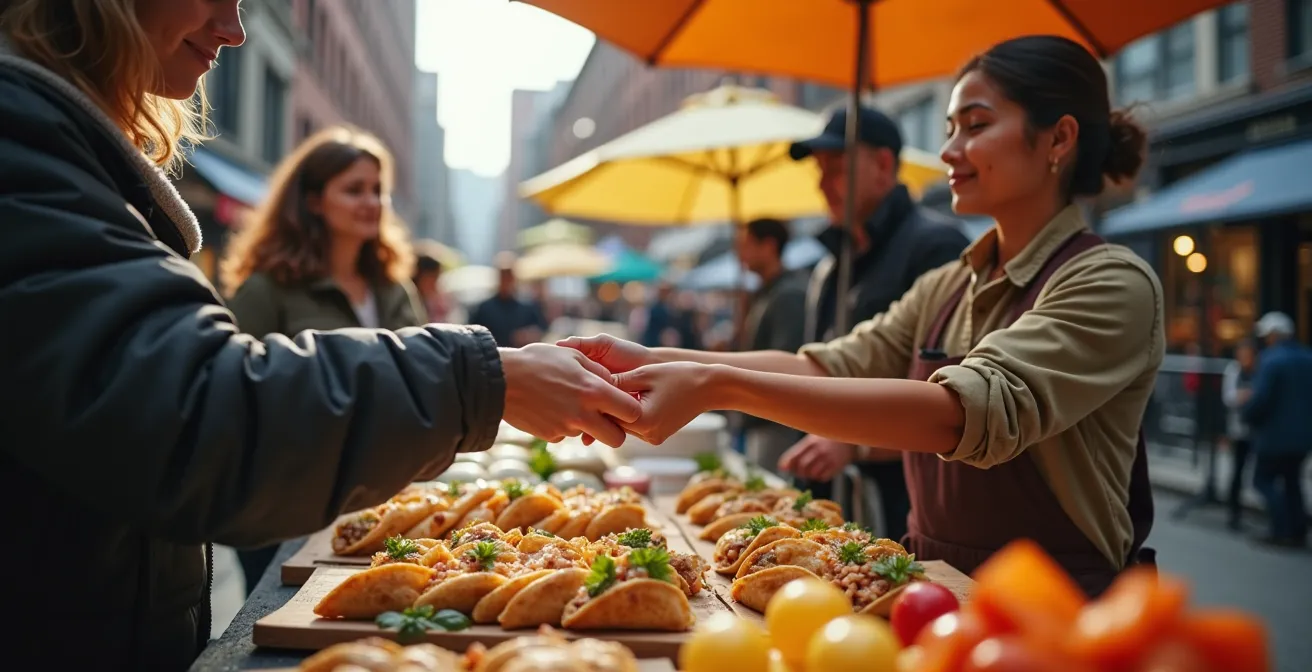
As you can see, the experience is about more than just the food; it’s about the interaction and the energy of the street. Alternatively, for a more relaxed approach, create a picnic. Grab a fresh bagel from Nu Bügel, some cheese from Global Cheese, and fruit from a stand. You’ll have a delicious, customized meal for about $10-12, leaving you with plenty of cash and energy for the real mission: the grail hunt.
Augusta Avenue or Baldwin Street: Where to Find the Best Patio Vibes?
Part of mastering the market rhythm is knowing when to take a strategic pause. A patio break isn’t just about resting your feet; it’s about soaking in the atmosphere, people-watching, and planning your next move. It’s a key part of the vibe-hacking strategy. But not all patios are created equal. Your choice between the main drag of Augusta Avenue and the quieter Baldwin Street depends entirely on the experience you’re after.
Augusta Avenue is the heart of the action. Its patios, like the iconic Ronnie’s Local 069, are prime territory for extroverts and people-watchers. Here, you’re in the thick of it, watching the market’s eclectic cast of characters go by. Many bars on Augusta have a flexible Bring-Your-Own-Food (BYOF) policy, so you can grab a taco or a Jamaican patty and enjoy it with a drink. It’s bustling, energetic, and the place to be if you thrive on a festival atmosphere, especially during the long summer afternoons.
In contrast, Baldwin Street offers a more intimate, locals-focused vibe. Patios at places like the Kensington Brewing Company are perfect for quiet conversations and escaping the busiest crowds. It’s where you go to decompress and actually talk about the vintage finds you’ve scored. Many of these spots have heated and covered areas, extending the patio season well into the cooler days of spring and fall, making it a reliable year-round option.
The following table breaks down the core differences, helping you choose the right spot for your mood and mission.
| Feature | Augusta Avenue | Baldwin Street |
|---|---|---|
| Best For | People-watching extroverts | Quiet conversations |
| Top Spots | Ronnie’s Local 069 | Kensington Brewing Company |
| BYOF Policy | More flexible at bars | Limited options |
| Peak Season | June-October afternoon sun | Year-round with heaters |
| Crowd Level | Bustling, festival atmosphere | More intimate, locals-focused |
The “Vintage” Label Trap That Makes You Overpay for Used Fast Fashion
This is the most critical skill for any budget vintage shopper: the authenticity audit. The “vintage” label is thrown around loosely, and many Kensington racks are filled with used fast fashion from the last decade, sold at a premium. Falling into this trap is the fastest way to blow your $50 budget on something worthless. True vintage refers to items at least 20 years old, while anything over 100 is an antique. Your mission is to learn the tell-tale signs of a genuinely older garment.
Forget the brand for a moment and become a detective. Your primary clues are tags, zippers, and fabric. A quick look at these elements can tell you more than the price tag. For example, a metal zipper, especially on a dress, generally means the item was made before the 1970s, as plastic zippers only became common after 1968. Another huge giveaway is the care label. Standardized care labels became mandatory in 1972, so an item with no care instructions is very likely a pre-70s piece. The fabric itself also tells a story; pre-1970s polyester has a distinct, often heavier feel than its modern counterparts.
To truly master this, you need a mental checklist every time you pick up a potential gem. This audit will save you from overpaying and ensure you walk away with a piece of history, not just someone’s old clothes.
Your 5-Point Authenticity Audit Checklist
- Check for Union Tags: Look for the International Ladies’ Garment Workers’ Union (ILGWU) label. Its design changed over the decades, so a tag with “AFL-CIO” but no “R” symbol dates an item to between 1955 and 1963.
- Examine the Zipper: Is it metal or plastic? Metal zippers, especially on the side or back of a dress, are a strong indicator of a pre-1970s design.
- Hunt for the Care Label: The complete absence of a care and content label is your strongest clue that the garment was made before 1972.
- Feel the Fabric: Trust your hands. Authentic vintage fabrics, even synthetics like early polyester, often feel different—sturdier, less flimsy—than modern textiles.
- Verify the Logo: If it’s a known brand, do a quick search on your phone to see how the logo has evolved. A modern logo on a supposedly “60s” item is a dead giveaway of a reproduction.
When to Shop at Kensington Fruit Stands to Get the Freshest Produce at Discount?
Another key to resource allocation on your Kensington adventure is leveraging the market’s famous fruit stands. Not only do they provide healthy, cheap snacks to fuel your shopping, but they also operate on a daily and seasonal rhythm that you can use to your advantage. Buying a bag of fresh Ontario peaches in August is not just a delicious treat; it’s a smart financial move that keeps you away from expensive packaged snacks and saves your cash for clothing.
The first rhythm to understand is seasonal. Shopping for produce that’s in peak season in Ontario means you’re getting the best quality at the best price. In June, you’ll find vibrant local strawberries. July is the time for stone fruits like cherries, and by August, the stands are overflowing with incredible peaches and plums from the Niagara region. Come September, it’s apple season, with bulk discounts perfect for stocking up. Aligning your snacking with the seasons ensures you’re eating fresh and saving money.
The second rhythm is daily. The end of the day is when the real deals appear. As vendors look to clear out their stock before closing, you’ll start seeing impromptu sales. Visit the fruit stands between 5 and 6 PM and listen for calls of “two for one” or “fill a bag for $5.” This is the best time to score amazing bargains. Don’t be afraid to ask vendors about “slightly bruised” produce either. If you plan to eat it right away, you can often get a 30-50% discount on perfectly good fruit that just isn’t picture-perfect. This is the ultimate K-Market hack for eating well on a shoestring budget.
Fusion or Authentic: Which Taco Spot in Kensington Should You Choose?
In Kensington, tacos aren’t just food; they’re a cultural cornerstone. Choosing a taco spot is part of your overall strategy. Are you looking for a quick, cheap, and truly authentic bite to maximize your shopping time, or do you want an adventurous, Instagram-worthy meal that’s part of the experience itself? The market offers a full spectrum, and knowing the difference is key.
On one end, you have the purists. Places like Gus Tacos or the hidden taquerias inside small groceries offer authentic Mexican street-style tacos. They are simple, delicious, and cheap, often costing just $3-5. They’re served on hand-pressed corn tortillas with no-frills toppings. This is your go-to for a fast, budget-friendly refuel that gets you back to the hunt as quickly as possible. It’s the choice for the shopper on a mission.
On the other end is the fusion experience. Spots like Seven Lives (Baja-style seafood) and Rasta Pasta (Jamaican-Italian-Mexican fusion) are destinations in themselves. During Pedestrian Sundays, these places are “buzzing with visitors,” as noted by Toronto Scoop. The tacos here are bigger, more creative, and more expensive ($6-8). They’re perfect for when the meal is part of the day’s adventure, designed for savoring and, yes, for taking a great photo. This is the choice for the shopper who wants the full sensory experience of the market.
There’s no wrong answer, but there is a strategic one. Your choice depends on your priorities for the day: speed and budget, or a culinary adventure. This table helps clarify your decision.
| Restaurant | Style | Price Range | Best For | Signature Feature |
|---|---|---|---|---|
| Gus Tacos | Authentic Mexican street-style | $4-6 per taco | Quick, no-frills bite | Hand-pressed corn tortillas |
| Seven Lives | Baja-style fusion | $6-8 per taco | Instagram-worthy meals | Creative seafood options |
| Rasta Pasta | Caribbean-Mexican fusion | $5-7 per taco | Adventurous eaters | Jerk-spiced proteins |
| Hidden grocery taqueria | Family-run authentic | $3-5 per taco | Budget authenticity | No-hype local favorite |
Key Takeaways
- Authenticity is everything: Learn to spot fake vintage by checking zippers, tags, and fabrics to avoid overpaying.
- Master the market’s rhythm: Shop on Pedestrian Sundays for unique finds and visit fruit stands late for the best deals.
- Allocate your resources: Save money on food by hitting up cheap eats like tacos and empanadas to maximize your vintage budget.
Polson Pier Sunset or Graffiti Alley Portraits: Which Photo Tells a Better Story?
You’ve done it. You’ve successfully navigated the market, avoided the traps, and scored an amazing, authentic vintage piece for under $50. Now you need the photo to celebrate your find. In a city full of iconic photo spots, the temptation is to head to a famous location like Graffiti Alley or Polson Pier for that perfect skyline shot. But this is a mistake. Your photo’s story should be as unique as your outfit. A generic backdrop undermines the very essence of your hunt for authenticity.
Graffiti Alley, while cool, has become a mainstream location. Polson Pier is beautiful, but it’s a 20-minute drive away and tells a story about the Toronto skyline, not about your specific K-Market victory. The real pro move is to find a backdrop that captures the eclectic, bohemian spirit of Kensington itself. You want a location that feels as authentic as the pre-1972 jacket you’re now wearing.
Your best bet is a hyper-local icon that most tourists miss. Find the famous Garden Car on Augusta Avenue. This mural-covered vehicle with a garden growing out of it is unofficially Toronto’s smallest public park. It perfectly embodies the market’s artistic, sustainable, and wonderfully weird character. A portrait here, with your vintage haul, tells a complete and compelling story. It says you didn’t just shop in Kensington; you understood it. Other great options include the colourful Victorian row houses on Wales Avenue or the quiet, leafy paths of Bellevue Square Park. These locations frame your finds in their natural habitat, creating a narrative that’s genuine and memorable.
Where to Find Authentic Global Cuisine in the GTA That Rivals the Home Country?
Mastering Kensington Market is like earning a degree in urban exploration. You’ve learned to look past the hype, seek out authenticity, and understand the rhythm of a place. You’ve applied these skills to find both fashion and food. Kensington is a microcosm of Toronto’s multiculturalism, a place where you can find Jamaican patties, Colombian arepas, and Tibetan momos all within a few blocks, often made by first-generation immigrants. But this is just the beginning.
The skills you’ve honed in the market are your passport to exploring the incredible, authentic food scenes scattered across the Greater Toronto Area (GTA). The “Strip Mall Gem” principle—that the most authentic food is often found in unassuming suburban plazas, not downtown—is the key. Your next grail hunt isn’t for a jacket, but for a flavour that transports you.
Ready to explore? Take the TTC to Gerrard Street East for a bowl of pho that rivals anything in Saigon. Head north to the Highway 7 corridor in Richmond Hill or Markham for world-class Shanghainese dim sum. Craving real jerk chicken? Eglinton West, Toronto’s Little Jamaica, is your destination. And for some of the best Sri Lankan food, including kottu roti, you need to explore the strip malls of Scarborough. Each of these neighbourhoods offers an experience just as rich and authentic as Kensington, waiting for you to apply your well-trained eye for quality and value.
Your journey into authentic Toronto culture has just begun. Use the skills you’ve built in Kensington to continue exploring, eating, and discovering the incredible diversity the entire GTA has to offer. Your next adventure awaits.