
Your single, builder-grade condo light creates a flat, uninviting space. The solution is not just more lamps, but a strategic, layered lighting plan that treats light as an architectural tool.
- Use different color temperatures (3000K for ambiance, 4000K for tasks) to define functional “zones” within one room.
- Focus on wall-washing and perimeter lighting instead of a rigid grid of pot lights to create an illusion of space, especially with concrete ceilings.
Recommendation: Start by auditing your existing lights and replacing incompatible, older dimmers to gain immediate, flicker-free control over your new LED environment.
In the typical Toronto condo, a single, harsh dome light in the center of the ceiling is expected to do the impossible: illuminate a space that serves as a home office by day, a dining area by evening, and a relaxation zone by night. The result is often a flat, uninviting glare that fails at all three tasks. The common advice is to “add a floor lamp” or “install a dimmer,” but these are tactical fixes, not a strategy. They are the equivalent of patching a crumbling wall instead of rebuilding the foundation.
The true transformation of a multifunctional space doesn’t come from simply adding more light sources. It comes from a paradigm shift in thinking. The key is to stop seeing light as mere illumination and start using it as an architectural material. This approach, which we’ll call zoning with light, involves creating distinct, functional areas within a single open-concept room by carefully manipulating the quality, direction, and intensity of light. It’s about sculpting your environment and creating a visual hierarchy that guides the eye and serves your needs.
This guide moves beyond the generic “ambient, task, accent” mantra. We will deconstruct the technical elements of a professional lighting plan, tailored specifically for the challenges of Toronto living—from our concrete ceilings and compact footprints to our long, dark winters. We will explore how to select the precise color temperature for focus versus relaxation, how to arrange fixtures to avoid the dreaded “runway” effect, and how to leverage smart technology for true circadian synchronization. This is a designer’s blueprint for turning a generic box into a dynamic, responsive home.
To guide you through this process, this article breaks down the core components of a successful layered lighting plan. The following sections provide a structured path from foundational concepts to advanced applications, all tailored for the unique context of a Toronto residence.
Summary: Layered Lighting Demystified: A Designer’s Guide for Multifunctional Toronto Condos
- 3000K or 5000K: which bulb to choose for the kitchen vs the bedroom?
- Recessed lighting layout: how to avoid the “runway” effect on the ceiling?
- Salle de bain: why does lighting above the mirror you give bad mine?
- Compatibilité LED: why your new bulbs do they flicker with the old dimmer?
- Smart bulbs: how to program light scenes for the alarm clock?
- How to furnish a 600 sq ft condo to make it look spacious and bright?
- How to use the psychology of colors to enlarge a dark condo in Toronto?
- Solar or wired: how to illuminate the alley for safety and style?
3000K or 5000K: which bulb to choose for the kitchen vs the bedroom?
The single most impactful—and most misunderstood—metric in lighting is not brightness (lumens), but color temperature, measured in Kelvin (K). Choosing the right Kelvin temperature is the foundation of zoning with light. It’s how you tell your body it’s time to work or time to unwind. A 5000K bulb emits a crisp, blue-white light similar to midday sun, promoting alertness and focus. This is excellent for task-heavy areas like a kitchen prep counter or a home office nook. Conversely, a 3000K bulb casts a warm, yellowish-white glow, mimicking the gentle light of late afternoon. This is the ideal choice for creating a relaxing, inviting atmosphere in living rooms and bedrooms.
In a multifunctional Toronto condo, you can’t have one temperature for the whole space. The strategy is to mix them with intention. Use warmer 2700K-3000K lights for the primary, ambient layer (e.g., track lights, floor lamps) to unify the space with a cozy feel. Then, strategically deploy cooler 3500K-4000K lights for specific task zones, like under-cabinet strips in the kitchen or a dedicated desk lamp. This creates “light zones” without building walls. As the experts at Lights Canada note in their “Living Room Lighting Ideas Guide”:
Cool colour temperatures (5000K-6500K) are suitable for task lighting and daytime activities, creating a bright and alert atmosphere, while warm temperatures (2700K-3000K) are ideal for relaxation and evening settings.
– Lights Canada, Living Room Lighting Ideas Guide
This approach also has significant energy benefits. According to Toronto Condo News, modern LED upgrades where lighting improvements can increase efficiency by over 80 percent. By using the right light only where and when it’s needed, you optimize both ambiance and operational cost. The key is to ensure all bulbs have a high Color Rendering Index (CRI) of 90+ so that colors under the light appear true and vibrant, whether it’s the food on your plate or the clothes in your closet.
Recessed lighting layout: how to avoid the “runway” effect on the ceiling?
The default solution for modern condos—a rigid grid of recessed pot lights—is often the biggest design crime. It creates a flat, institutional feeling known as the “runway effect” and produces harsh overhead shadows. The expert approach treats the ceiling as a canvas for light as architecture. Instead of a uniform grid, the goal is to create a visual hierarchy and define zones. In Toronto condos, where concrete ceilings often restrict drilling, this requires even more strategic thinking.
The primary technique is to shift focus from the floor to the walls. Wall-washing, where recessed lights are placed closer to walls and angled to skim the vertical surface, makes a room feel instantly larger and brighter. This creates volumetric brightness—the perception of a light-filled space—rather than just pools of light on the floor. For long, narrow floor plans common in Toronto, an asymmetrical placement breaks monotony and adds dynamism. A powerful local example of this philosophy is seen in the work of a celebrated local firm. The Toronto Eaton Centre project by Marcel Dion Lighting Design, which won a 2018 IES Toronto Section Illumination award, masterfully avoids the runway effect through strategic clustering and wall washing, creating depth and visual interest.
For those with restrictive concrete ceilings, recessed lighting is not the only option. The key is to achieve layers through other means. The following table outlines several effective strategies for Toronto condo ceilings.
Case Study: Toronto High-Rise Concrete Ceiling Solution
Marcel Dion Lighting Design’s award-winning Toronto Eaton Centre project demonstrates how to avoid the runway effect through strategic clustering. Instead of evenly spaced downlights, they used off-centered positioning combined with wall washing techniques to create depth and visual interest while maintaining functional illumination levels throughout the space.
This table outlines professional strategies to overcome common layout challenges, particularly in buildings with structural limitations.
| Layout Strategy | Best For | Key Benefit | Installation Consideration |
|---|---|---|---|
| Clustered Zoning | 12ft-wide Toronto condos | Defines separate areas without grid effect | Group lights on separate circuits |
| Perimeter Lighting | Concrete ceiling high-rises | Creates illusion of height and width | Use track systems instead of recessed |
| Asymmetrical Placement | Long narrow floor plans | Adds visual interest and movement | Focus on task areas, not uniform spacing |
| Surface-Mounted Alternatives | Condos with ceiling restrictions | Achieves layered look without drilling | Check condo board regulations first |
Bathroom: why does lighting above the mirror make you look bad?
The single overhead vanity light, a ubiquitous feature in many condos, is the primary culprit for unflattering reflections. This placement casts harsh, downward shadows under the eyes, nose, and chin, a phenomenon known as “monster lighting” among designers. It artificially ages your appearance and makes tasks like applying makeup or shaving an exercise in frustration. The solution lies in a core principle of layered lighting: cross-illumination.
To achieve flattering, shadow-free light, you need to light the face from both sides, not from above. The ideal setup involves placing two vertical fixtures or sconces on either side of the mirror, with their center point at roughly eye level (typically 60-65 inches from the floor). This provides even, balanced light across the entire face, eliminating shadows and rendering skin tone and details accurately. This side lighting is your primary task layer. It should be paired with a separate ambient light source on the ceiling—like a dimmable flush mount—to provide general illumination for the rest of the bathroom.

As this image demonstrates, the combination of vertical task lighting and a warm overhead ambient source creates a functional yet spa-like environment. For those in rental units or unable to perform major renovations, excellent non-permanent solutions exist. High-quality, battery-operated LED strips can be affixed to the sides of a mirror, and plug-in portable LED mirrors offer a perfect task-lighting solution without needing an electrician. The goal is always to have light sources at face level to counteract the shadows cast by any overhead fixture.
LED Compatibility: why do your new bulbs flicker with the old dimmer?
You’ve invested in new, energy-efficient LED bulbs, but when you connect them to your existing dimmer switch, they flicker, buzz, or refuse to dim smoothly. This is a common and frustrating issue in many Toronto homes, especially those built before the widespread adoption of LEDs. The problem isn’t the bulb; it’s a technological mismatch between your new lights and your old control system.
Older dimmers, known as ‘Leading Edge’ or TRIAC dimmers, were designed for the high power draw of incandescent bulbs. LEDs use a fraction of that power, often falling below the minimum load required for the old dimmer to function correctly. This power gap causes the flickering and buzzing. The modern solution is a ‘Trailing Edge’ or ELV (Electronic Low Voltage) dimmer, specifically designed to work with the low power and sensitive electronics of LED and CFL bulbs. They provide smooth, silent, flicker-free dimming across the full range.
Upgrading your dimmers is not just a fix; it’s a fundamental part of a successful lighting plan. Without proper dimming control, you lose the ability to shift the mood and intensity of your layers, defeating the purpose of the entire design. In pre-1990 Toronto homes, budgeting for an electrician to update key dimmers should be considered a mandatory part of any lighting renovation. For a simpler, DIY-friendly alternative, smart bulbs are an excellent option as they contain their own dimming technology, controlled via an app, bypassing the wall switch’s limitations entirely.
Your Action Plan: LED Dimmer Compatibility Checklist
- Check if your dimmer is ‘Leading Edge’ (older) or ‘Trailing Edge’ (LED-compatible) by looking up the model number.
- Look for the minimum load rating on the dimmer; many LEDs fall below the minimum wattage of older models, causing flicker.
- Ensure you are buying LEDs specifically marked as “dimmable”—not all are designed to dim.
- For large projects, test the compatibility of one bulb and dimmer combination from a store like Home Depot Canada before buying in bulk.
- For pre-1990 Toronto homes, budget for an electrician to update main switches to modern, LED-compatible dimmers.
- Consider smart bulbs (e.g., Philips Hue, Wyze) as a powerful alternative; they dim via an app, completely bypassing the need for a compatible wall dimmer.
Smart bulbs: how to program light scenes for waking up?
For Toronto residents, the dark winter mornings can make waking up a difficult, jarring experience. This is where smart lighting transcends convenience and becomes a powerful tool for well-being. By programming “light scenes,” you can automate your environment to support your natural sleep-wake cycle, a concept known as circadian synchronization. The most effective application of this is creating a simulated sunrise.
Using a smart lighting system like Philips Hue, you can program a wake-up routine that mimics the natural progression of dawn. This involves more than just slowly turning up the brightness; it requires a gradual shift in color temperature. The scene should begin 30 minutes before your alarm with a very dim, deep amber glow (around 2200K), similar to the first light of day. Over the next 30 minutes, the light should smoothly transition in both intensity and color, moving from warm amber to a soft warm white (3000K), and finally to a bright, crisp daylight white (4000K-5000K) at your desired wake-up time. This gentle, progressive shift coaxes your body out of sleep naturally, rather than shocking it with a sudden alarm in a dark room.
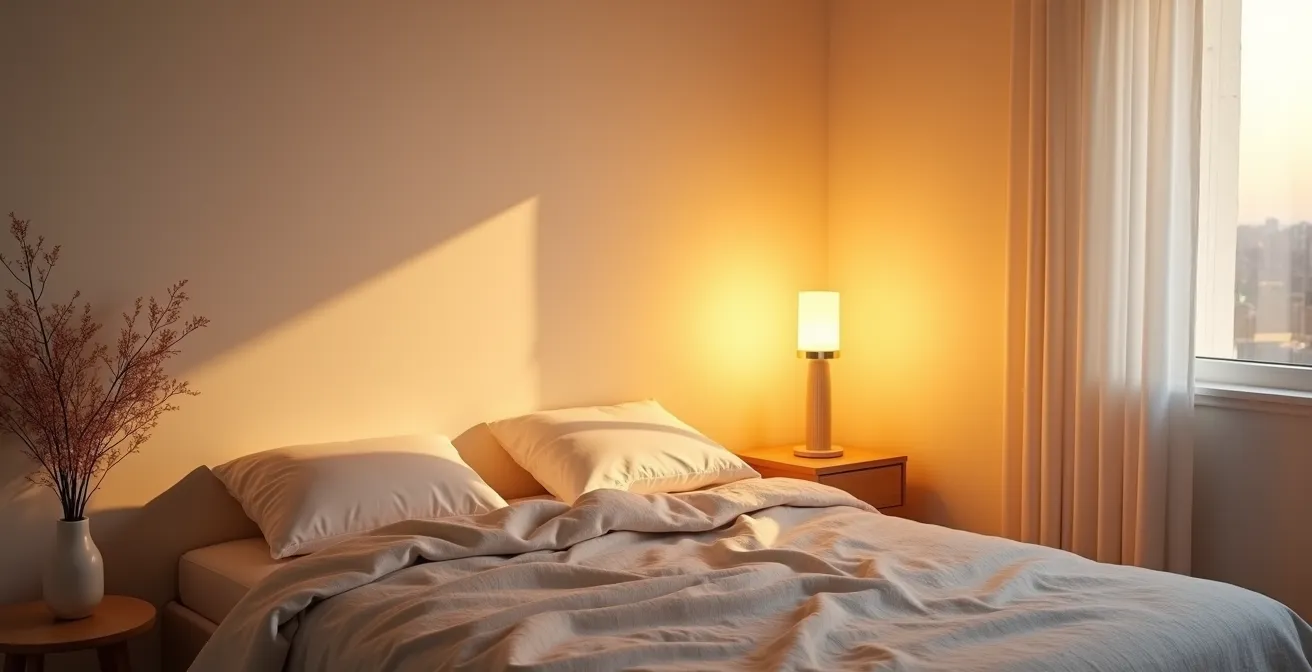
This technique has proven highly effective. A case study of a Liberty Village resident highlighted on CondoTrend.com showed how programming a 30-minute sunrise simulation helped them maintain consistent wake times and combat the effects of seasonal affective disorder (SAD) throughout the challenging November to March period. The beauty of smart lighting is its infinite customizability. You can create a “Focus” scene with 4000K light for your work-from-home hours, a “Relax” scene with 2700K for the evening, and a “Movie Night” scene with deeply dimmed, warm accent lights, all accessible with a single tap or voice command.
How to furnish a 600 sq ft condo to make it look spacious and bright?
In a compact 600-square-foot Toronto condo, furniture and lighting are not separate disciplines; they are two parts of a single strategy to manipulate the perception of space. The goal is to create clear sightlines and allow light—both natural and artificial—to travel uninterrupted. According to Del Condominium Rentals, maximizing natural light is a key energy-saving strategy, as the big, beautiful windows on recent Toronto condominium buildings can eliminate the need for artificial light during daytime hours from May to October. Your furniture choices must support this.
The first rule is to choose low-profile furniture. Sofas and chairs with low backs and exposed legs, like those found in EQ3’s apartment collection, create a sense of openness by allowing you to see more of the floor and wall behind them. Second, think vertically. Free up precious floor space by using wall-mounted lighting like sconces or track systems from stores like Structube instead of bulky floor lamps. Similarly, use vertical shelving units that draw the eye upward, creating an illusion of height. Finally, incorporate materials that don’t obstruct light. Glass coffee tables, acrylic chairs, and large mirrors bounce light around the room, enhancing both brightness and the feeling of spaciousness.
A successful transformation in a Liberty Village condo showcased this integrated approach perfectly. The owner used a modular sectional that could be reconfigured, wall-mounted sconces from Lightform to save table space, and a layered lighting plan that combined low-profile ceiling fixtures with corner uplighters. This combination of space-conscious furniture and a strategic lighting plan made the small unit feel significantly larger and fully functional for a modern, hybrid lifestyle. Your furniture should not just fill the space; it should actively work with your lighting to expand it.
How to use color psychology to make a dark Toronto condo look bigger?
Paint is the most cost-effective tool for transforming a space, but its effect is entirely dependent on the light that hits it. A common mistake is choosing a “bright” white paint for a dark, north-facing Toronto condo, only to find it looks dull and grey. The secret is not the color itself, but the interaction between the paint’s undertones and the color temperature of your lighting. This synergy is central to making a dark space feel both larger and more inviting.
For north-facing units that receive cool, indirect light, a stark white can feel cold. Instead, opt for a white with warm, creamy undertones like Benjamin Moore’s “Cloud White.” When paired with 3000K warm-white lighting, this combination creates a sophisticated, luminous glow that counteracts the cool natural light. In open-concept spaces, a neutral grey like Behr’s “Dolphin Fin” paired with a neutral 3500K light provides a balanced, modern backdrop that allows accent colors to pop without feeling sterile. Even dark colors can be used to create an illusion of depth. An accent wall in a deep shade like Benjamin Moore’s “Hale Navy” doesn’t shrink a room if it’s properly lit. By using a wall-washing technique with very warm 2700K light, the wall appears to recede, adding a dramatic sense of depth without overwhelming the space.
The right pairing is critical. A cool-toned grey paint under a very warm 2700K light can look muddy and drab. Conversely, a warm beige under a very cool 4000K light can appear sickly yellow. The key is to test paint swatches on your wall and observe them at different times of day under your chosen light bulbs before committing. The following table provides a starting point for successful pairings in a Toronto condo context.
This comparative table helps align wall colors with the right light temperature to achieve specific psychological effects in your space.
| Wall Color | Light Temperature | Effect | Best For |
|---|---|---|---|
| Benjamin Moore Cloud White | 3000K warm white | Sophisticated and spacious | North-facing units |
| Behr Dolphin Fin (grey) | 3500K neutral | Modern and balanced | Open concept spaces |
| Benjamin Moore Hale Navy (accent) | 2700K + wall washing | Depth without darkness | Feature walls |
| Warm beige undertones | 3000K-3500K | Counteracts cool daylight | Units with limited sun |
Key takeaways
- Light layering is not just adding lamps; it’s a technical strategy for zoning with light in a small space.
- Color temperature (Kelvin) is your most powerful tool: use 2700-3000K for relaxation and 3500-4000K for focus to support your circadian rhythm.
- In Toronto condos with concrete ceilings, prioritize track lighting, wall sconces, and uplighters over complex recessed installations to achieve a layered effect.
Solar or wired: how to light the driveway for safety and style?
Exterior lighting for a Toronto home—whether it’s a suburban driveway or the walkway to a ground-floor condo—serves a dual purpose: ensuring safe passage and extending the home’s aesthetic. The choice between solar and low-voltage wired systems depends heavily on our specific climate. While solar is appealing for its ease of installation, its reliability can be compromised during Toronto’s short, overcast winter days, precisely when you need it most. For this reason, a low-voltage wired system is generally the more robust and dependable choice for critical safety lighting.
A wired system offers consistent output regardless of weather and allows for more powerful fixtures that can effectively illuminate potential hazards like black ice near downspouts. Given Ontario Hydro’s time-of-use rates, where off-peak energy use (7 p.m. to 7 a.m.) is more economical, running a low-voltage system overnight is highly cost-effective. When selecting fixtures, durability is paramount. Opt for materials like brass or stainless steel that resist corrosion from road salt, and ensure they have a minimum IP65 rating, certifying they are sealed against dust and jets of water, making them resilient to snow and ice.

Installation height is also a critical consideration. Fixtures should be placed 18-24 inches high to remain visible above typical snow accumulation, ensuring the path remains illuminated all winter long. Finally, always check local regulations. The City of Toronto has municipal bylaws regarding light trespass and maximum brightness to ensure your stylish and safe installation doesn’t become a nuisance to your neighbours. By choosing a durable, wired system and installing it with our Canadian winters in mind, you create a seamless and safe transition from the street to your front door.
To truly transform your space, the next logical step is to draft your own lighting plan. Begin by mapping your home’s functional zones and then select the right fixtures, color temperatures, and control systems for each, applying the principles of layered design to create an environment that is not just lit, but alive.