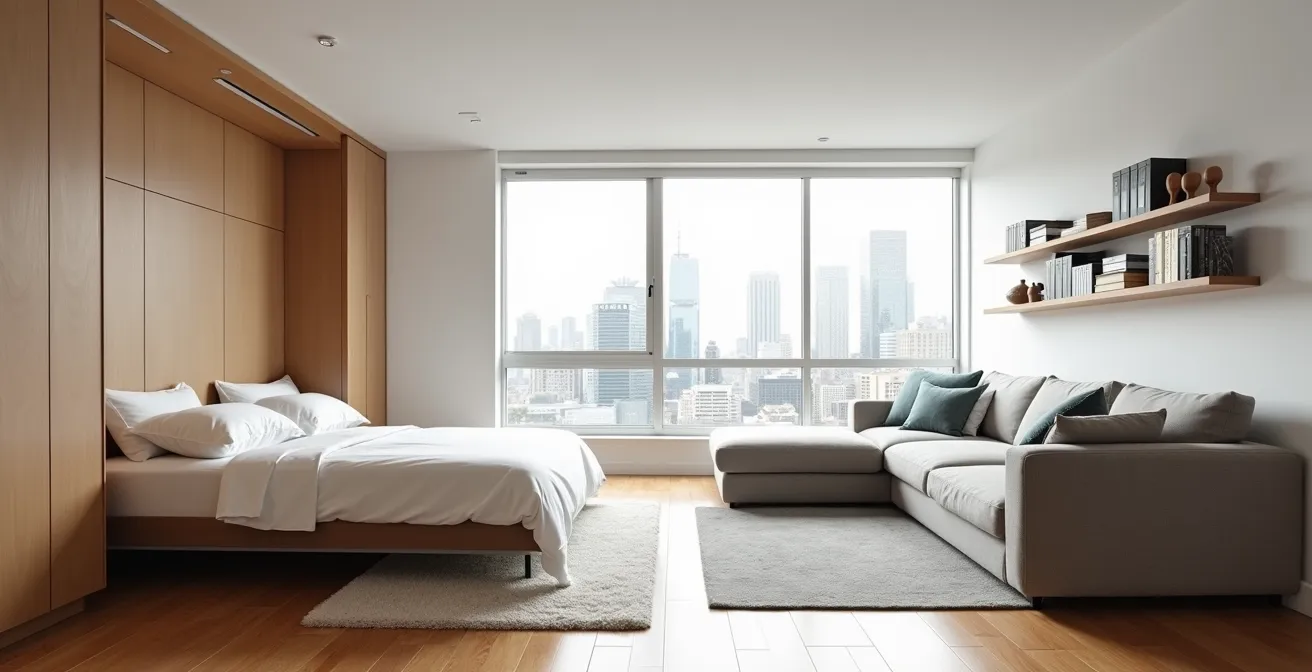
For a Toronto studio, a high-quality Murphy bed is a superior long-term investment over a sofa bed, provided it’s chosen and installed with engineering precision.
- A Murphy bed reclaims the entire room’s floor space for daytime use, whereas a sofa bed retains a permanent, bulky footprint.
- The financial decision extends beyond initial cost, impacting potential resale value, especially in competitive Toronto neighbourhoods like Liberty Village.
Recommendation: Evaluate your choice not just on space, but on mechanical safety, mattress comfort, and its potential to increase your property’s specialized appeal.
For anyone living in a Toronto studio, the battle for every square foot is relentless. The central conflict often revolves around the largest piece of furniture: the bed. The conventional debate pits the Murphy bed against the sofa bed, usually framed as a simple question of saving floor space. But this perspective is dangerously incomplete. In a city where real estate is a significant investment, your choice of transformable furniture should be viewed through the same lens: as a matter of engineering, long-term comfort, and financial return. Common advice focuses on measuring your room, but rarely delves into the mechanical integrity of pistons, the impact of custom built-ins on resale value, or the specific challenges posed by Toronto’s condo construction.
This guide reframes the decision entirely. We will move beyond the superficial “space-saving” platitude to analyze these options as functional systems integrated into your home. The real question isn’t just “which saves more space?” but rather, “which is the more intelligent, safer, and more valuable long-term solution for my specific Toronto condo?” We will dissect the critical components, from the safety of the lifting mechanism to the strategic value of hidden storage for bulky winter gear, and even how lighting choices can transform the feel of your newly optimized space. This is about making a choice that serves you not just today, but also protects your investment for tomorrow.
To help you navigate this important decision, this article breaks down the key engineering, financial, and lifestyle factors. Explore the sections below to understand the mechanics, costs, and practical applications of making your small space work smarter.
Summary: Choosing the Right Transformable Furniture for Your Toronto Condo
- Why Investing in High-Quality Pistons for Your Murphy Bed Is Crucial for Safety?
- How to Choose Modular Sofas with Hidden Storage for Winter Gear?
- Custom Built-in or Flat-Pack: Is the Cost of a Custom Wall Unit Recoverable at Resale?
- The Assembly Mistake That Ruins the Mechanism of Your Modular Desk
- When to Reconfigure Your Modular Table to Seat 8 People in a Condo?
- Why Ignoring Your Walls Is the Biggest Waste of Space in a Small Condo?
- How to Spot Wasted Space in Modern “Shoebox” Condo Floor Plans?
- Warm or Cool Light: Which Color Temperature Best Suits a North-Facing Living Room?
Why Investing in High-Quality Pistons for Your Murphy Bed Is Crucial for Safety?
The core of a Murphy bed is not its frame or mattress, but its lifting mechanism. This is the single most critical component determining the bed’s safety, longevity, and ease of use. While a sofa bed’s mechanism is about folding cushions, a Murphy bed’s system must safely manage hundreds of pounds of weight against gravity, day after day. Cheaper models often use basic spring systems that can lose tension over time, leading to difficult lifting or, in the worst-case scenario, a dangerous and sudden drop. High-quality gas pistons, conversely, provide a smooth, controlled, and near-effortless motion. They function like the hydraulic supports on a car’s hatchback, ensuring the bed remains securely in place, whether up or down, and can be operated with minimal physical effort.
The investment in a superior piston system is a direct investment in safety. Think of it as the braking system for your wall bed. This is especially true in a multi-use studio where the bed is operated daily. A quality mechanism is engineered and tested for thousands of cycles, ensuring it won’t fail under repetitive stress. This is why when considering a Murphy bed, which folds up to take only 16-20 inches of depth against the wall, the conversation must start with the quality of its internal mechanics, not just its aesthetic.
Your Action Plan: 5 Questions for Toronto Murphy Bed Installers
- Authenticity & Warranty: Do you use authentic Murphy hardware with a manufacturer’s warranty, or a generic equivalent?
- Structural Knowledge: What is your experience with the post-tension concrete slabs common in Toronto high-rise condos?
- Modern Construction: Are you equipped to install on metal stud walls, which are prevalent in newer downtown buildings?
- Anchoring Protocol: Can you detail your process for properly anchoring the unit to different wall types to guarantee stability?
- Warranty Coverage: What, specifically, is included in your 25-year warranty, and what does it exclude?
Ultimately, a failing piston doesn’t just mean an inconvenient piece of furniture; it represents a significant safety hazard in your primary living space. Prioritizing the quality of this mechanism is non-negotiable.
How to Choose Modular Sofas with Hidden Storage for Winter Gear?
For a Toronto condo dweller, storage is a year-round challenge, but it becomes acute with the change of seasons. Bulky parkas, salt-stained boots, and winter accessories can quickly overwhelm a small closet. This is where a sofa bed can theoretically shine, but only if it’s a modern, modular design with integrated storage. A standard sofa bed offers seating and sleeping, but nothing more. A modular storage sofa, however, is an engineered solution to a specific Toronto problem. Look for designs where the chaise lounge or ottoman sections lift up, revealing deep, hollow compartments perfect for stashing off-season items.
The key is to evaluate the storage’s practicality. Is the compartment lined? Is the lifting mechanism hydraulic and easy to operate, or is it a clumsy manual lid? A well-designed unit provides a significant amount of concealed space without compromising the sofa’s primary function or aesthetic. The goal is to find a piece that looks like a stylish sofa but functions like a discreet storage chest. This dual-purpose capability is what transforms it from mere furniture into a strategic tool for small-space living.

As seen in the image, the best designs integrate storage seamlessly. The mechanism should be robust, and the available volume should be substantial enough to make a real difference in your organizational strategy. This focus on utility is what separates a gimmick from a genuinely functional solution for a four-season city.
Case Study: Integrated Storage in Downtown Toronto Condos
MurphySofa’s Toronto showroom directly addresses this need by showcasing wall beds with integrated sofas. These modular designs are particularly relevant for the local market, featuring elevator-friendly packaging crucial for navigating downtown high-rises. The sofa components are designed with hidden storage compartments, providing a perfect spot for Canadian winter gear while maintaining a sleek, uncluttered appearance during the warmer months, proving that you don’t have to choose between a bed, a sofa, and a closet.
Choosing a sofa with this built-in utility means you are actively reclaiming space that would otherwise be lost, making it an intelligent choice for maximizing a compact floor plan.
Custom Built-in or Flat-Pack: Is the Cost of a Custom Wall Unit Recoverable at Resale?
The decision between a custom built-in Murphy bed and a freestanding flat-pack model is fundamentally a financial one with long-term implications. A flat-pack solution is a purchase; a custom built-in is an investment in your property. While the upfront cost of a custom unit is significantly higher, its potential to add value at resale is a critical factor often overlooked in the Toronto market. A generic, freestanding unit is personal property that you take with you. A professionally designed and installed built-in, however, becomes a permanent fixture of the condo itself, transforming a standard studio into a highly functional, specialized living space.
For potential buyers, a well-executed built-in that includes a wall bed, shelving, and integrated lighting can be a major selling point. It solves the small-space problem for them, making a “shoebox” condo feel purpose-built and luxurious. This can translate into a higher perceived value and, in a competitive market, a faster sale. The key is quality. A cheap or poorly designed built-in can be a liability, but a high-end, seamless installation can make your unit stand out to the specific demographic of young professionals who value design and efficiency.
This table outlines the core financial differences for the Toronto market, showing how the initial expense can translate into different outcomes at resale. A professional installation from a company like VorobCraft Custom Cabinets highlights this distinction.
| Feature | Custom Built-in | Flat-Pack Solution |
|---|---|---|
| Initial Cost (CAD) | $8,000-$15,000 | $2,000-$4,000 + installation |
| Installation | Professional required | DIY or TaskRabbit ($300-$500) |
| Resale Value Impact | Potential premium in Liberty Village | Minimal impact |
| Removability | Semi-permanent negotiable | Fully removable |
| Target Buyer Appeal | Downtown professionals | General market |
A well-designed built-in makes a generic ‘shoebox’ condo uniquely attractive to a specific demographic in competitive Toronto neighbourhoods, potentially leading to faster sales.
– VorobCraft Custom Cabinets, Murphy Wall Beds in Toronto Guide
Therefore, while a flat-pack bed solves the immediate space issue, a custom built-in can be a strategic upgrade that pays dividends when it’s time to sell your Toronto property.
The Assembly Mistake That Ruins the Mechanism of Your Modular Desk
Whether it’s a Murphy bed, a modular sofa, or a convertible desk, the promise of transformable furniture lives or dies by its assembly. A single mistake during installation can compromise the entire mechanism, leading to premature wear, misalignment, and eventual failure. The most common and damaging error is not a single action but a flawed mindset: treating the assembly like it’s simple IKEA furniture. These are often complex mechanical systems that require precision. One of the most critical errors is over-tightening bolts, especially in furniture made from particleboard or MDF. Unlike solid wood, these materials can be crushed by excessive torque, creating a weak point where the hardware is seated. Over time, the repetitive stress of movement will cause this weakened area to fail.
Another frequent mistake, particularly relevant in Toronto condos, is failing to account for uneven floors. Many high-rise floors are not perfectly level. Assembling a large unit without first checking for level and using shims to correct it places the entire frame under constant stress. This torsion misaligns moving parts, causing pistons to work unevenly and hinges to bind. Finally, the importance of anchoring to wall studs cannot be overstated. Even if instructions suggest it’s optional, securely fastening the unit to the wall structure prevents subtle shifting that can, over months of use, throw the delicate geometry of the mechanism out of alignment. When installed correctly, these systems are remarkably robust; a properly installed Murphy bed, for instance, can safely support up to 500 lbs.
To avoid these pitfalls, follow these critical assembly steps:
- Level First: Before starting, use a level and shims to create a perfectly flat base for the furniture. This is crucial as many Toronto condo floors are uneven.
- Torque Carefully: Tighten bolts until they are ‘snug,’ not to their absolute maximum. The goal is a firm connection, not to crush the wood composite.
- Anchor Always: Always anchor the unit to wall studs (metal or wood). This prevents the micro-movements that cause long-term mechanical strain.
Proper assembly is not just about following steps; it’s about respecting the engineering of the piece and ensuring its mechanical integrity for years of reliable function.
When to Reconfigure Your Modular Table to Seat 8 People in a Condo?
Owning a small Toronto condo doesn’t mean sacrificing the ability to host. The challenge is having furniture that adapts to the occasion. A modular, expandable dining table is a prime example of this philosophy. The question isn’t just *how* to seat more people, but *when* it makes practical sense. The ideal time to reconfigure your table is for those specific, high-value occasions that define city living: holiday dinners, milestone celebrations, or hosting a close-knit group of friends, events where booking an impersonal and often expensive condo party room feels like overkill.
The brilliance of a well-engineered transforming table is its ability to live compactly for daily life and expand dramatically for these special events. Modern designs can transition from a small coffee table or a two-person console into a full dining table capable of seating eight or more. This prevents a large, rarely used dining table from dominating your living space 95% of the time. The decision to expand the table should be event-driven. Think about the Canadian holidays: Thanksgiving, Christmas, or even a long-weekend brunch. These are the moments when transforming your living room into a dining hall for a few hours provides immense social value.

A successful gathering in a small space, as depicted, relies on furniture that can perform on demand. The transformation should be a planned event, not a daily chore. It’s about having the capability in reserve for when it truly matters.
Case Study: Hosting for Eight in a 600 sq ft Toronto Condo
Expand Furniture’s Toronto showroom specializes in these solutions, demonstrating coffee tables that transform to seat 8 guests. Their designs feature adjustable height mechanisms, allowing a table to go from a 16-inch coffee table to a 30-inch dining table. Crucially, they can expand in length from 2 feet to over 6 feet, making them perfect for hosting during Canadian holidays without the hassle and cost of booking a separate party room—a common pain point for condo residents.
Ultimately, a modular table isn’t about eating dinner; it’s about enabling hospitality and connection, turning your small condo into a welcoming hub when the occasion calls for it.
Why Ignoring Your Walls Is the Biggest Waste of Space in a Small Condo?
In the quest to maximize a small condo’s footprint, we obsess over floor plans and square footage. This is a two-dimensional error. The single biggest untapped resource in any “shoebox” condo is the vertical space: your walls. Floor space is finite, but the volume of your room is not. Treating walls as mere surfaces for art is a missed opportunity. They should be considered the foundation for your storage and functional strategy. This is the fundamental principle behind the Murphy bed, a device that reclaims an entire bedroom’s worth of floor space by leveraging the wall. A queen bed occupies roughly 35 sq ft; a Murphy bed reduces that floor usage to zero during the day.
This “go vertical” philosophy extends far beyond the bed. Every wall is a potential storage area. Narrow entryways can house slim, wall-mounted shoe cabinets. The dead air space above a sofa can be utilized with floating shelves or an etagere. In the kitchen, a pot rack mounted near the ceiling can free up an entire cabinet. The key is to see your condo not as a floor area, but as a cube of available space. By utilizing walls, you draw the eye upward, which can make the room feel larger, and you functionally increase your storage capacity without adding a single piece of bulky, floor-hogging furniture. A Murphy bed is the ultimate expression of this, taking up only 16-19 inches of depth when folded, a small price for a huge gain.
Here are some practical vertical storage solutions ideal for Toronto condos:
- Install ceiling-mounted bike hoists, but be sure to check your specific condo corporation’s bylaws first.
- Add high-mounted pot racks in kitchens with standard 8- or 9-foot ceilings to free up valuable cabinet space.
- Use slim, wall-mounted shoe cabinets to organize narrow and cluttered entryways.
- Mount open-backed etageres over your sofa to utilize the “air space” above furniture for books and decor.
- Install over-the-toilet ladder shelves to create instant vertical storage in small bathrooms.
Ignoring your walls is equivalent to leaving money on the table. In a city where space is the ultimate luxury, every vertical inch counts.
How to Spot Wasted Space in Modern “Shoebox” Condo Floor Plans?
Modern Toronto condo floor plans, especially the ubiquitous “shoebox” layout, are often designed for marketing appeal, not functional living. Learning to read a floor plan with a critical, engineering eye is the first step to reclaiming lost space. The most common culprit is poorly defined “flex” space, such as a tiny den or an oversized hallway. These are often the biggest sources of waste. A 5’x7′ den is too small for a proper bedroom but too large for a simple closet. It becomes a dumping ground. The solution is to assign it a single, dedicated purpose with hyper-efficient furniture, such as a wall-mounted floating desk to create a compact office, or floor-to-ceiling shelving to turn it into a functional walk-in pantry.
Another major area of waste is the permanent footprint of single-purpose furniture. This is where the Murphy bed versus sofa bed debate becomes a clear-cut mathematical problem. A sofa bed, even when closed, occupies a significant and permanent chunk of your living area. A Murphy bed, by contrast, has a near-zero daytime footprint. It allows one room to serve two distinct functions—living room and bedroom—without compromise. The mattress in a Murphy bed is typically a standard, comfortable mattress, whereas a sofa bed forces you to sleep on a thin, foldable one. This isn’t just about space; it’s about quality of life.
The table below, based on an analysis from Sparkles and Stretchmarks, quantifies the efficiency differences, making it easy to see the spatial return on investment.
| Factor | Murphy Bed | Sofa Bed |
|---|---|---|
| Floor Space When Not in Use | 0 sq ft (folds into wall) | 15-20 sq ft (permanent footprint) |
| Mattress Thickness | 12-15 inches (standard) | 4-5 inches (foldable) |
| Wall Space Required | 16-20 inches depth | None |
| Daytime Functionality | Full room usage | Seating only |
Case Study: Transforming a Tiny Toronto Condo Den
Organized Interiors in Vaughan, just outside Toronto, actively demonstrates solutions for these awkward spaces. Their showroom at 201 Chrislea Road shows how a typical 5’x7′ condo den, common in many GTA developments, can be transformed from a cluttered closet into a functional home office with a floating desk or a highly organized pantry with floor-to-ceiling shelving, effectively rescuing wasted square footage.
Spotting wasted space is a skill. It requires looking past the glossy brochure and analyzing the plan for its true functional potential, turning dead zones into active, useful parts of your home.
Key Takeaways
- A Murphy bed’s safety and longevity depend entirely on the quality of its piston mechanism; this is a non-negotiable engineering feature.
- Custom built-in wall units can be a strategic real estate investment in Toronto, potentially increasing resale value and appeal to specific buyer demographics.
- The biggest mistake in small-space living is ignoring vertical space; walls are your most valuable and underutilized asset for storage and function.
Warm or Cool Light: Which Color Temperature Best Suits a North-Facing Living Room?
Once you’ve optimized the physical layout of your Toronto studio, the final step is to optimize its atmosphere. This is where lighting becomes a critical tool. North-facing rooms, common in Toronto’s condo landscape, receive only indirect sunlight. This light has a naturally cool, blue-grey tone that can make a space feel dim and cold, especially during the city’s long, overcast winters. The common mistake is to fight this with intensely bright, cool-toned bulbs (5000K+), which only exacerbates the sterile, clinical feeling. The correct engineering approach is to counterbalance the cool natural light with warm artificial light.
The key metric here is color temperature, measured in Kelvin (K). For a north-facing room, the goal is to create a cozy, inviting atmosphere. This is achieved with bulbs in the 2700K to 3000K range. This “warm white” light has a yellowish hue that mimics the glow of incandescent bulbs or late-afternoon sun, effectively neutralizing the cold grey of the ambient daylight. It’s not about making the room brighter, but making it feel warmer and more welcoming. A single overhead fixture is insufficient. A successful strategy involves creating layers of light.
A layered lighting plan provides both function and mood, making a space feel more dynamic and larger than it is. It’s the final piece of the puzzle in transforming a functional space into a comfortable home.
Your Action Plan: Layered Lighting for a North-Facing Toronto Studio
- Ambient Foundation: Install warm (2700K-3000K) flush-mount ceiling fixtures to provide general, inviting illumination that counteracts Toronto’s grey light.
- Focused Task Lighting: Add specific task lighting at a cooler 4000K (neutral white) for desk areas or reading nooks where clarity is needed.
- Depth with Accents: Use adjustable track lighting or picture lights with warm bulbs to highlight artwork or architectural features, creating visual interest and depth.
- Smart Adaptation: Install smart bulbs that can be programmed to change color temperature throughout the day—cooler and more energizing in the morning, warmer and more relaxing in the evening.
- Light Multiplication: Strategically position large mirrors directly opposite windows to reflect and double the perceived amount of natural and artificial light.
By choosing the right color temperature, you are no longer a passive victim of your condo’s orientation; you are actively engineering the mood and comfort of your home.
Frequently Asked Questions about Lighting in Toronto Condos
Why do north-facing Toronto condos feel so grey and cold?
North-facing rooms receive indirect sunlight that carries a cool, grey tone, especially pronounced during Toronto’s long winters. This creates a perpetually dim atmosphere that requires warm artificial lighting to counterbalance.
What’s the ideal color temperature range for north-facing spaces?
2700K-3000K provides the warm light needed to counteract the cool grey natural light, making spaces feel more inviting and cozy throughout the day.
Should I use different color temperatures in the same room?
Yes, layered lighting with varied temperatures works best: warm ambient light (2700K) for general atmosphere, neutral task lighting (4000K) for work areas, and warm accent lighting (3000K) for highlighting features.