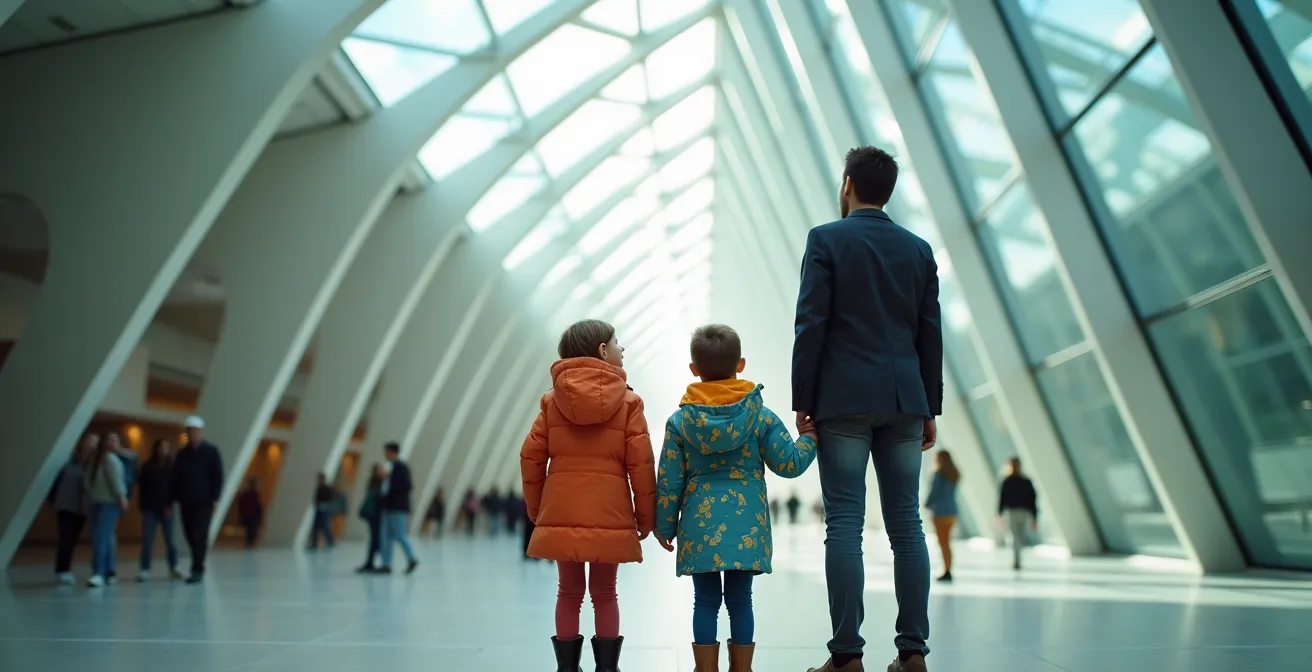
The key to a successful ROM visit with kids isn’t seeing more; it’s a surgical strike for maximum wonder and minimum meltdowns.
- Adopt a “reverse itinerary” starting on the third floor to manage energy levels.
- Use logistical hacks like underground parking to skip the dreaded coat check lines.
- Focus on a few high-impact exhibits instead of attempting to see the entire museum.
Recommendation: Treat your visit like a mission. Prioritize the dinosaurs and mummies, but structure the journey around your child’s sensory and energy needs to ensure a happy experience for everyone.
The thought of taking young children to a vast institution like Toronto’s Royal Ontario Museum can spark a mix of excitement and dread. You picture their eyes widening at the sight of a T-Rex skeleton, but you also have flashbacks of a full-blown tantrum in a crowded public space. Most advice boils down to “get there early” or “plan your visit,” but for a parent on a mission, this isn’t enough. The challenge isn’t just navigating the building; it’s navigating a child’s limited reserves of energy, patience, and focus.
Many families make the classic mistake of trying to see everything, starting at the front door and marching onward until exhaustion sets in. This approach almost guarantees you’ll hit the high-interest exhibits like the dinosaurs and Ancient Egypt just as your little one’s battery hits zero. But what if the secret to a successful two-hour trip wasn’t about endurance, but about strategy? What if you treated it less like a leisurely tour and more like a precision-planned operation designed for peak enjoyment?
This guide abandons the “see it all” mentality. Instead, it offers a strategic, child-focused mission plan. We’ll focus on logistical hacks, sensory management, and an energy-conscious itinerary that puts the best exhibits at the right moments. It’s about maximizing the “wow” factor per minute, ensuring you conquer the ROM’s greatest hits and make it out with smiles intact, leaving the meltdowns for someone else’s vacation photos.
This article provides a complete mission plan for your family’s two-hour ROM adventure. Below is a summary of the key strategic areas we will cover to ensure your visit is a resounding success.
Summary: A Parent’s Strategic Guide to Conquering the ROM in Two Hours
- Why the Bat Cave Exhibit Might Be Too Scary for Toddlers?
- How to Navigate the ROM Coat Check Line During March Break Without Stress?
- Family Membership or Single Tickets: Which Pays Off After Two Visits?
- The “See Everything” Mistake That Leads to Meltdowns on the Third Floor
- Where to Eat Near the ROM That Isn’t the Expensive Cafeteria?
- How to Use the Toronto CityPASS to Save 40% on Major Attractions?
- How to Spot a ‘Tourist Trap’ Tour vs an Authentic Local Experience?
- Is an AGO Annual Pass Worth the Cost for Someone Living in the GTA?
Why the Bat Cave Exhibit Might Be Too Scary for Toddlers?
The ROM’s Bat Cave is a rite of passage for many Toronto kids, but for toddlers and younger children, it can be more terrifying than terrific. The challenge isn’t the concept of bats; it’s the intense sensory experience. The exhibit is designed to be a realistic simulation, which means complete darkness, sudden noises, and narrow passages. For a child who is still learning to distinguish between real and pretend, this can be genuinely frightening and trigger a mid-visit meltdown that derails your entire plan.
Before you commit, it’s crucial to assess your child’s specific sensory sensitivities. Does they dislike loud movie theaters? Are they afraid of the dark in their own room? The Bat Cave is a step above these experiences. The exhibit is a fantastic piece of design, but it scores high on the “fear factor” scale for the 2-4 age group, ranking more intense than Ripley’s Aquarium’s shark tunnel. The key is to know your audience—your child. Pushing them through a scary experience will drain their “adventure energy” and sour them on the rest of the museum.
Action Plan: Sensory Scorecard for the Bat Cave
- Darkness Level: Prepare for an 8/10 level of darkness. It’s not just dim; it’s almost completely dark in sections.
- Sudden Noises: Anticipate bat screeches and wing-flapping sounds occurring every 30-60 seconds.
- Space Confinement: Be aware of narrow passages, some only 3-4 feet wide, which can feel confining for both parent and child.
- Escape Routes: Locate the two emergency exits, marked with dim lighting, before you enter, so you have a quick retreat plan.
- Compare and Contrast: Honestly compare this to your child’s comfort with similar experiences. If a Halloween house is a definite ‘no’, the Bat Cave probably is too.
Ultimately, skipping the Bat Cave on a time-crunched visit with a young child isn’t a failure; it’s a strategic decision. You’re conserving their bravery and energy for the giant dinosaurs and fascinating mummies that await.
How to Navigate the ROM Coat Check Line During March Break Without Stress?
Arriving at the ROM, especially during peak times like March Break or a rainy Saturday, often presents the first hurdle: the coat check line. This slow-moving queue can easily eat 15-20 minutes of your precious two-hour window, testing a child’s patience before you’ve even seen an exhibit. The primary cause of this bottleneck is the high volume of school groups. The busiest periods are typically between 10:15 AM and 11:30 AM, when buses unload and hundreds of students descend on the entrance at once.
Trying to power through this line with impatient kids is a recipe for pre-museum fatigue. A far better approach is a logistical hack used by savvy Toronto parents: skip the coat check entirely. This strategy involves using off-site parking and a heated underground connection to enter the museum like a pro, bypassing the main entrance crowds and preserving your family’s energy for the wonders inside. It’s a classic “work smarter, not harder” tactic that pays huge dividends in time and sanity.
The secret lies in parking at the Cumberland Parkade (148 Cumberland Street). From there, you can walk through the underground PATH connection from Cumberland Terrace. This route allows you to leave all bulky winter coats and bags securely in your vehicle. You then emerge and enter the ROM through the quieter Weston Entrance on Queen’s Park, completely avoiding the main entrance congestion. This single move embodies the “surgical strike” mindset, eliminating a major point of friction right at the start of your mission. It may seem like a small detail, but saving that initial 20 minutes sets a positive, efficient tone for the entire visit.
Family Membership or Single Tickets: Which Pays Off After Two Visits?
For families living in the GTA, a trip to the ROM often sparks the recurring debate: should we buy single tickets or invest in an annual membership? The answer depends almost entirely on one factor: how many times you realistically plan to visit within a year. A common mistake is overestimating your future attendance. While a membership offers enticing perks, the financial break-even point is a hard number that can guide your decision.
Generally, a standard family membership pays for itself on the third visit. If you’re planning just one or two trips in a year, paying for single-day tickets is almost always more economical. For a family of four (two adults, two children), two separate visits would cost approximately $136, while the basic family pass is around $169. As you can see, you’d still be ahead financially without the year-long commitment. However, the membership model becomes more compelling if you have a larger family or plan to bring grandparents along.
The following table, based on the ROM’s pricing structure, breaks down the cost analysis. It’s a clear guide to help you make a purely financial decision, separate from the emotional appeal of being a “member.”
| Family Size | Single Visit Cost | 2 Visits Cost | Annual Family Pass | Break-Even Point |
|---|---|---|---|---|
| 2 Adults + 1 Child (4-14) | $54 CAD | $108 CAD | $169 CAD | 3.1 visits |
| 2 Adults + 2 Children | $68 CAD | $136 CAD | $169 CAD | 2.5 visits |
| 2 Adults + 1 Child + 1 Grandparent | $74 CAD | $148 CAD | $189 CAD | 2.6 visits |
If you’re testing the waters with a two-hour visit, starting with single tickets is the low-risk, financially sound choice. You can always apply the cost of your day’s admission toward a membership on your way out if the family is truly captivated and demanding a return trip.
The “See Everything” Mistake That Leads to Meltdowns on the Third Floor
The single biggest mistake families make at the ROM is attempting a comprehensive, floor-by-floor tour. This “see everything” approach is a trap. It’s born from a desire to get your money’s worth, but it ignores the reality of a child’s stamina. Studies and parent reports confirm the consequences: most families report spending 4 hours with only half the museum explored, ending the day in exhaustion. For a two-hour mission, this strategy is a guaranteed failure. The secret is to flip the standard museum itinerary on its head.
Instead of starting on the ground floor and working your way up, you should employ the “Reverse Itinerary Strategy.” This means taking the elevator straight to the top floors upon arrival. You begin with the calmer, less stimulating galleries while your kids’ energy and focus are at their peak. You then work your way down, saving the high-excitement, high-energy exhibits like the dinosaurs for the end. This acts as a grand finale, giving them a burst of adrenaline just when they’re starting to fade.
This counter-intuitive plan is a masterclass in energy management. Here is a sample two-hour mission plan:
- Start at Level 3 (30 mins): Begin your visit in the quiet galleries of Ancient Egypt. The mummies and artifacts are fascinating but presented in a calm environment. This is where you see one of your “must-do” items while everyone is fresh.
- Move to Level 2 Minerals (15 mins): Head down to the gem and mineral collection. The sparkling crystals provide a visually stunning but low-stimulation mental break.
- Explore Level 2 Biodiversity (30 mins): The interactive Schad Gallery of Biodiversity, with its hands-on drawers and diverse displays, is perfect for re-engaging curious minds.
- Grand Finale at Level 2 Dinosaurs (45 mins): This is your final stop. Unleash the remaining energy on the awe-inspiring dinosaur skeletons, including the massive 110-foot-long Futalognkosaurus. This high-impact exhibit provides the perfect climax to your visit.
As an optional cool-down, the WonderWorks hands-on gallery, also on Level 2, can serve as a great decompression zone before you head for the exit. This strategic path ensures you see the stars of the show without the preceding fatigue.
Where to Eat Near the ROM That Isn’t the Expensive Cafeteria?
A well-timed snack or meal is a critical tool for meltdown mitigation. However, the on-site cafeteria at the ROM, while convenient, can be crowded and expensive, especially for a family. Furthermore, you can’t just have snacks in the galleries, so a dedicated break is essential. Fortunately, the museum’s location in the heart of Toronto’s Bloor Street Culture Corridor means you are surrounded by budget-friendly and kid-approved options, perfect for a quick refuel before or after your two-hour mission.
The most effective strategy is the “Indoor Picnic.” This involves grabbing takeout from a nearby food court and finding a comfortable public space to eat. It saves money, offers more variety, and gives your family a much-needed break from the museum environment. There are several excellent options within a five-minute walk:
- Manulife Centre Food Court (55 Bloor St W): A 3-minute walk away, offering a wide variety of choices to please even the pickiest eaters.
- Yorkville Village: In winter, the heated public areas provide a warm place to enjoy a packed lunch or takeout.
- Jesse Ketchum Park: In good weather, the park’s picnic tables adjacent to the ROM are perfect for an outdoor break.
- ROM’s Pop-up Coffee Bar: For a quick on-site option without the full cafeteria experience, the new coffee bar on the main floor offers drinks, pastries, and seating.
Case Study: The Post-Museum Pizza Plan
A family of four from North York perfected their post-ROM routine to prevent car-ride meltdowns. After their visit, they walk two minutes to Pizza Pizza on Bloor Street for affordable slices (under $20 for the family). Then, they head to the open fields of Queen’s Park, just south of the museum, to let the kids run and burn off their remaining energy. This combination of an affordable meal and physical activity provides the perfect transition from the quiet focus of the museum back to the real world.
By planning your food strategy in advance, you remove a major stressor and ensure your family’s energy levels remain stable throughout your adventure.
How to Use the Toronto CityPASS to Save 40% on Major Attractions?
If your ROM visit is part of a larger Toronto sightseeing trip, a single-day ticket might not be the most cost-effective choice. The Toronto CityPASS bundles admission to several major attractions, including the ROM, CN Tower, and Ripley’s Aquarium, at a significant discount. The program advertises savings of up to 40% compared to buying individual tickets, which can add up quickly for a family.
The value of the pass, however, depends heavily on your family’s makeup and your commitment to visiting at least three of the included attractions. For families with very young children, the math can be tricky. For example, since children under 4 get free admission to the ROM, buying a CityPASS for them would be a waste. The key is to run the numbers for your specific group before purchasing. It’s a powerful tool for savings, but only if it aligns with your actual plans.
This comparative analysis, based on data from a recent US News Travel review, shows how the value proposition changes for different family configurations.
| Family Configuration | Individual Tickets Total | CityPASS Cost | Savings | Best Strategy |
|---|---|---|---|---|
| 2 Adults + 1 Child (3 years) | $145 CAD | $108 CAD (child free) | $37 CAD | Buy CityPASS for adults only |
| 2 Adults + 2 Children (5, 7) | $218 CAD | $154 CAD | $64 CAD | Full family CityPASS |
| 1 Adult + 2 Teens (14, 16) | $184 CAD | $127 CAD | $57 CAD | CityPASS for all |
For a family on a mission to see the best of Toronto, the CityPASS can be a strategic financial move. It simplifies ticketing and provides substantial savings, freeing up your budget for more important things, like ice cream or souvenirs.
How to Spot a ‘Tourist Trap’ Tour vs an Authentic Local Experience?
When visiting a world-renowned museum, there’s often an internal pressure to see the “famous” things—a checklist-driven approach that can feel like a tourist trap. You rush from one highlight to the next, take a photo, and move on. But an authentic experience, especially with children, isn’t about checking boxes. It’s about finding moments of genuine wonder and engagement. The true “tourist trap” is feeling obligated to follow a prescribed path at the expense of your child’s actual interests.
Redefining “authentic” is the key. An authentic visit is one that works for *your* family. As one local parent wisely noted, the most memorable trips are often the most unconventional. As a contributor to a Help! We’ve Got Kids Toronto Guide put it:
The ‘tourist trap’ is feeling obligated to see the famous exhibits. The authentic local experience is spending the entire 2 hours in the hands-on CIBC Discovery Gallery and the Bat Cave.
– Local Toronto Parent Forum, Help! We’ve Got Kids Toronto Guide 2019
This perspective is liberating. It gives you permission to skip a “must-see” gallery if your child is captivated by the interactive drawers in the biodiversity exhibit. Sometimes, the most authentic experience is choosing a smaller, more manageable museum altogether, especially if you’re feeling overwhelmed by the ROM’s scale.
Case Study: The Micro-Museum Alternative
Many Toronto families opt for “micro-museums” near the ROM for a less overwhelming cultural fix. The Bata Shoe Museum (a 5-minute walk) offers quirky, focused exhibits that are perfect for short attention spans. The Gardiner Museum of ceramics (a 2-minute walk) often hosts hands-on clay workshops for kids. Both can be fully explored in under 90 minutes with significantly lower admission fees, delivering a high-quality, low-stress experience.
An authentic visit is one that leaves your family feeling inspired, not exhausted. It prioritizes quality of engagement over quantity of exhibits seen.
Key Takeaways
- A successful ROM visit with kids is a 2-hour strategic mission, not an exhaustive tour.
- Employ a “Reverse Itinerary” by starting on the top floors to manage child energy levels effectively.
- Use logistical hacks, like off-site parking, and plan your food breaks to avoid common stress points and prevent meltdowns.
Is an AGO Annual Pass Worth the Cost for Someone Living in the GTA?
For culture-loving families in the Greater Toronto Area, the debate often extends beyond the ROM. The Art Gallery of Ontario (AGO) presents another compelling option for a family membership. While the ROM offers a universe of natural history and world cultures, the AGO provides a world-class art experience. Deciding between a ROM and AGO pass—or any museum membership—comes down to aligning the museum’s strengths with your family’s specific interests and age composition.
The AGO has a significant financial advantage, especially for families with older children: admission is free for anyone under 25, and its family pass is generally cheaper. This makes it an incredibly attractive option for parents of teens. In contrast, the ROM’s “free for kids” policy ends at age 4. However, the ROM shines with its multiple hands-on galleries, like the CIBC Discovery Gallery and WonderWorks, which are specifically designed for younger, more tactile learners. The ROM’s record-breaking attendance of over 1.4 million visitors annually speaks to its broad appeal, but also means the AGO can sometimes feel less crowded.
The best choice isn’t universal; it’s personal. The following table compares the two flagship institutions on key features for a GTA family.
| Feature | ROM Family Pass | AGO Family Pass | Best For |
|---|---|---|---|
| Annual Cost | $169 CAD | $140 CAD | AGO wins on price |
| Kids Free Age | Under 4 | Under 25 | AGO wins for teens |
| Interactive Spaces | 3 hands-on galleries | 1 art studio | ROM for younger kids |
| Reciprocal Museums | 13 Canadian museums | North American network | Tie – different networks |
| Annual Attendance | 1.44 million visitors | 950,000 visitors | AGO can be less crowded |
Ultimately, the “worth” of a pass is measured in joy and engagement, not just dollars. A two-hour strategic visit to the ROM can be the perfect diagnostic tool. It allows you to gauge your family’s interest in natural history before committing to a full year, helping you decide where your family’s cultural investment will yield the highest return in shared, happy memories.
Now that you have a strategic plan, you are equipped to turn a potentially stressful museum trip into a memorable family adventure. Start planning your two-hour mission today to conquer the ROM with confidence.