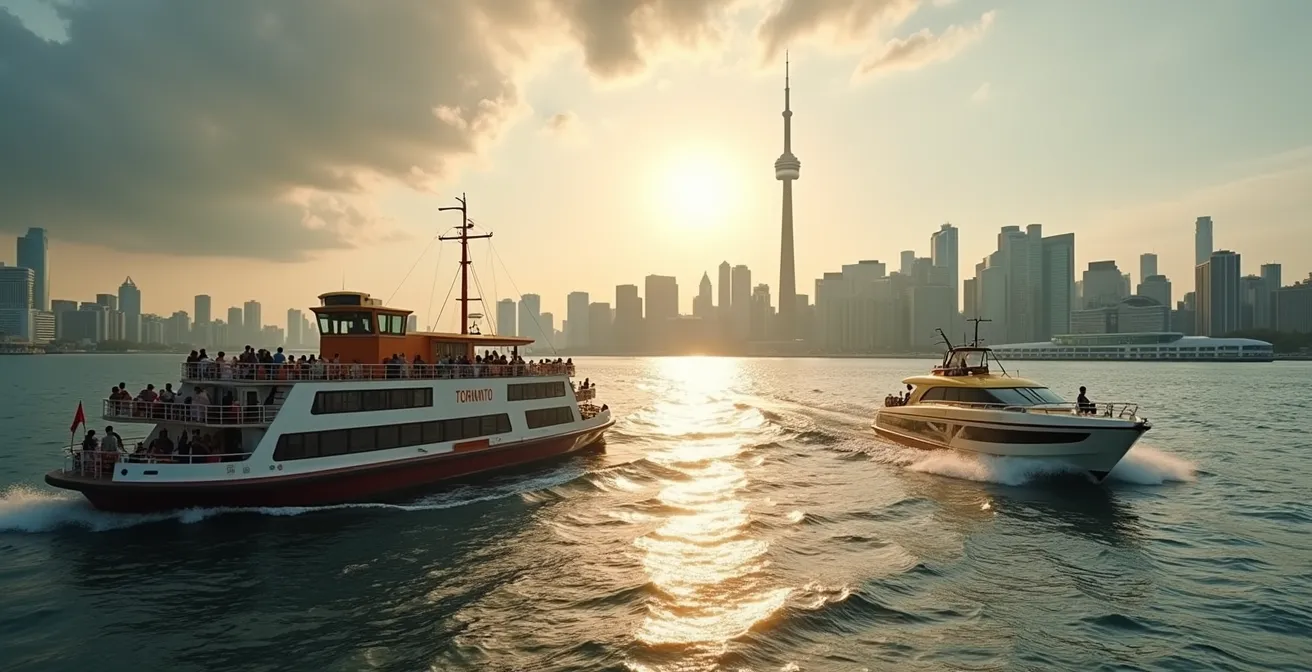
The choice between a Toronto water taxi and the public ferry isn’t about which is “better”—it’s about matching your transportation to your specific trip mission.
- The ferry offers significant cost savings but can involve major time sinks at the Jack Layton Ferry Terminal, especially on weekends.
- Water taxis provide near-instant departure and a more direct route, making their higher price a strategic investment when time or convenience is your priority.
Recommendation: Use the public ferry for leisurely, budget-conscious trips on weekdays. Opt for a water taxi on busy weekends, for late-night returns, or anytime avoiding a long queue is more valuable than saving $10.
The scene is a Toronto summer classic: the sun is high, the CN Tower glints in the background, and a massive, winding queue of people snakes its way from the Jack Layton Ferry Terminal. For visitors and locals alike, this is the first hurdle in what should be a relaxing trip to the Toronto Islands. The debate immediately begins: do we endure the long wait for the cheaper public ferry, or do we splurge on one of the zippy water taxis buzzing nearby?
The common wisdom frames this as a simple trade-off: water taxis are faster but more expensive, while the ferry is cheaper but slower. While true on the surface, this thinking misses the bigger picture. The best choice isn’t static; it’s a strategic decision that depends entirely on your goal for the day—your ‘trip mission’. Are you a family with a stroller and a picnic basket, or a couple heading for a concert at Hanlan’s Point? Are you trying to catch the golden hour for photos, or simply seeking the most budget-friendly day out?
This guide moves beyond the basic cost-benefit analysis. We’ll treat this decision like a local would, breaking down the specific scenarios where one option clearly triumphs over the other. By understanding the logistical bottlenecks, accessibility differences, and late-night risks, you can make a savvy choice that optimizes your time and money, ensuring your island adventure starts and ends on the right note.
To help you master the art of island transport, we’ve broken down the key decision points you’ll face. This structured guide will walk you through everything from avoiding the biggest queues to planning a seamless return trip after a full day of activities.
Summary: Water Taxi vs Ferry: Is Saving 20 Minutes Worth the Extra $10 Cost?
- Why the Jack Layton Ferry Terminal Is a Bottleneck on Summer Weekends?
- How to Locate Water Taxi Docks That Are Less Crowded Than the Main Hub?
- Ferry or Taxi: Which Is Easier for Strollers and Wheelchairs?
- The Late-Night Mistake of Missing the Last Ferry from Hanlan’s Point
- When to Buy Your Ferry Return Ticket to Avoid the Ticket Booth Line?
- When to Head to the Docks to Beat the 30-Minute Ferry Lineup?
- Where to Stand on the Island Ferry for the Best Skyline Photo Op?
- How to Organize a BBQ on Toronto Islands Without Missing the Last Ferry?
Why the Jack Layton Ferry Terminal Is a Bottleneck on Summer Weekends?
The Jack Layton Ferry Terminal is the single point of departure for all three public ferry routes to the Toronto Islands. On a sunny Saturday, thousands of people converge on this one location, creating a perfect storm for delays. The bottleneck isn’t just the boat capacity; it’s the entire process, from ticket purchasing to security screening and boarding, that grinds to a halt under pressure. While the ferry ride itself is a pleasant 15 minutes, the total journey time can easily stretch to over an hour.
The difference in total travel time is stark. Water taxis depart from multiple smaller docks along Queens Quay, completely bypassing the main terminal’s congestion. They offer a direct, on-demand service that drastically cuts down on waiting. This isn’t just a minor convenience; it’s a significant time-saver that can redefine your day.
Real-World Test: The Ferry vs. Water Taxi Race
To quantify the delay, a recent test pitted the two options against each other. The water taxi journey, including the walk to the dock and the trip across the harbour, took a mere 16 minutes. In that same timeframe, the person taking the ferry was still waiting in the long line to board. The entire ferry journey, including the queue and the trip, took a full hour. This demonstrates that the water taxi can save you a substantial amount of time, with a recent BlogTO comparison test showing up to 45 minutes saved on a typical trip.
For visitors with limited time, this ‘time arbitrage’ is critical. The extra cost of a taxi essentially buys you nearly an extra hour on the Islands, a valuable trade-off when you want to maximize your visit. This is especially true for families with impatient children or anyone on a tight schedule.
How to Locate Water Taxi Docks That Are Less Crowded Than the Main Hub?
One of the water taxi’s greatest advantages is its decentralized network of docks. Unlike the ferry’s single, congested terminal, water taxis operate from numerous points along the central waterfront. This means you can almost always find a departure point with a minimal wait, even on the busiest days. The key is to know where to look beyond the most obvious spots.
The main cluster of water taxi stands is located along Queens Quay West, between York Street and Spadina Avenue. The dock at the foot of York Street (207 Queens Quay West) is often the busiest as it’s closest to the ferry terminal and Union Station. However, a short walk can lead you to a much shorter line. If the first dock you see is crowded, simply walk 100 metres east or west; you’ll likely find another operator with immediate availability. Different companies have varying wait times, so it pays to be mobile.
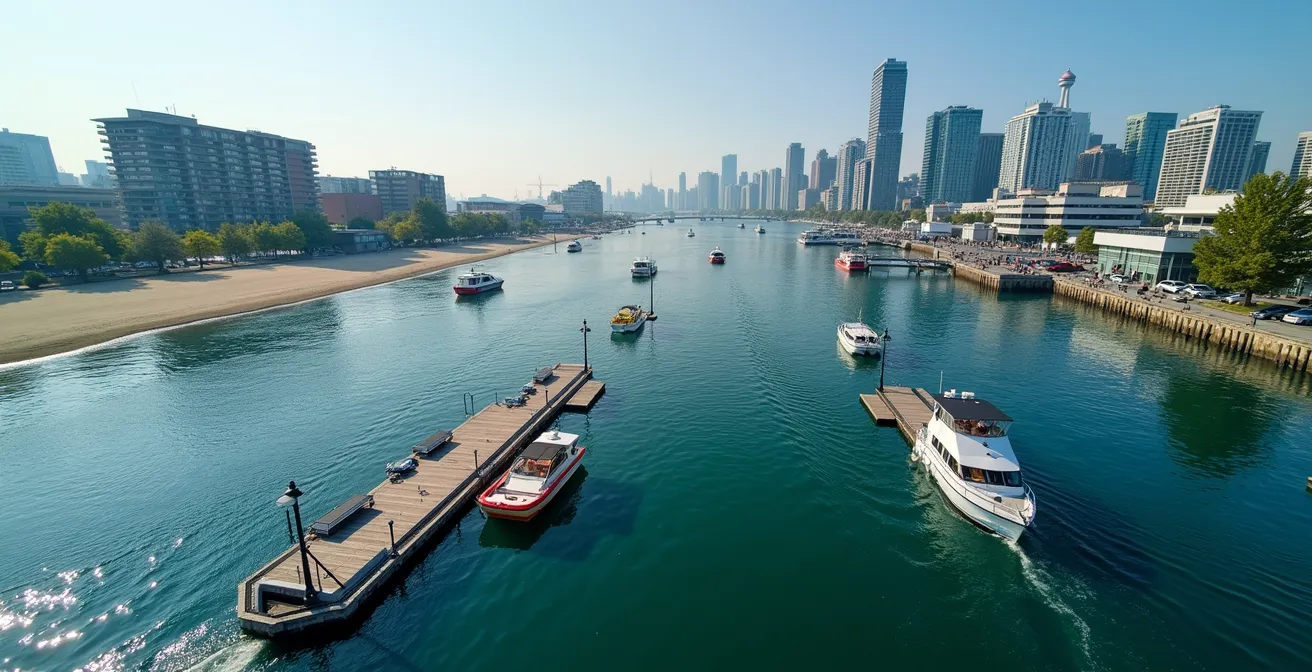
As the map above illustrates, the options are plentiful. For those coming from the west end of the city, like Liberty Village, the docks near Spadina are particularly convenient. Here are the key locations to remember:
- York Street Slip (207 Queens Quay West): The most central and often the busiest dock, right in the heart of the tourist hub.
- Yonge Street Slip (5 Queens Quay West): A solid alternative just east of the main action, sometimes overlooked by the crowds.
- Spadina WaveDeck area (375-437 Queens Quay West): Often the best bet for shorter waits, this area services multiple taxi companies and is ideal for those arriving from the west.
Don’t be afraid to walk a little. That five-minute stroll along the waterfront could save you a 30-minute wait in line, making it a very efficient use of your time.
Ferry or Taxi: Which Is Easier for Strollers and Wheelchairs?
When your ‘trip mission’ involves navigating with a stroller, wheelchair, or other mobility aids, the choice between ferry and water taxi becomes less about time and more about accessibility and ease of boarding. Both options can accommodate you, but the experience is quite different. The public ferries are large vessels designed for mass transit and are fully AODA (Accessibility for Ontarians with Disabilities Act) compliant. They feature wide, stable ramps for smooth roll-on, roll-off access and have spacious deck areas.
However, during peak times, these “spacious” areas become extremely crowded, making it difficult to maneuver a stroller or wheelchair through the throng of passengers. While you are guaranteed to get on, the experience can be stressful. Water taxis, being smaller boats, offer a more personal experience. The captain can often provide direct assistance, but the accessibility itself can vary. Some boats are easier to board than others, and you may need to lift a stroller over a small gap between the dock and the boat. It’s always a good idea to call ahead to the water taxi company to confirm the accessibility of their available boats.
As the Waterfront BIA points out for operators like Toronto Harbour Water Taxi, it’s not just about people:
Bikes, strollers and pets are welcome onboard.
– Waterfront BIA, Toronto Harbour Water Taxi listing
This table breaks down the key differences for your consideration:
| Feature | Toronto Ferry | Water Taxi |
|---|---|---|
| Wheelchair Access | Fully AODA compliant | Varies by boat – call ahead |
| Stroller Access | Easy boarding via ramp | May require lifting over gap |
| Space Available | Large deck areas but crowded | Limited but less crowded |
| Staff Assistance | Trained city employees | Personal assistance from captain |
| Cost for Equipment | No extra charge | Usually no extra charge |
The Late-Night Mistake of Missing the Last Ferry from Hanlan’s Point
One of the most common and stressful mistakes visitors make is misjudging the last ferry back to the city. After a long day enjoying the island, the trek back to the dock can feel longer than you expect, and realizing you’ve missed the final departure is a terrible feeling. This is a scenario where understanding the schedule is not just a suggestion—it’s crucial. The key detail many people miss is that the last ferry does not depart from all island docks at the same time.
Specifically, the last ferry from Hanlan’s Point leaves earlier than from the other docks. According to official schedules, the latest ferry runs at 11:45 p.m. from Centre Island and Ward’s Island, and 11 p.m. from Hanlan’s. If you are at a late-night event or bonfire at Hanlan’s and miss that 11:00 PM boat, you are faced with a long, dark walk to the Centre Island or Ward’s Island docks, where you might also find that you’ve missed the last boat there too.
This is where the “return trip strategy” becomes a lifesaver. While water taxis don’t have a fixed late-night schedule, they are well aware of this common problem. You will often find taxis “patrolling” the waters near the island docks after the last ferry has departed, ready to pick up stranded passengers. However, this convenience comes at a premium price, and availability isn’t guaranteed. To avoid this costly mistake:
- Set a “Pack Up” Alarm: Set an alarm on your phone for at least 45 minutes before the final departure time to give yourself time to pack up, walk to the dock, and account for delays.
- Know Your Dock’s Time: If you’re at Hanlan’s Point, your deadline is earlier. Do not assume the 11:45 PM time applies to you.
- Have a Backup Plan: If you know you’ll be cutting it close, consider pre-booking a late-night water taxi. While it costs more, it provides peace of mind.
- Expect Premium Rates: If you miss the ferry and have to rely on a waiting water taxi, be prepared to pay a higher-than-usual fare. They operate on a supply-and-demand basis at that hour.
When to Buy Your Ferry Return Ticket to Avoid the Ticket Booth Line?
The first major queue you’ll face at the Jack Layton Ferry Terminal is often the ticket booth line. On a busy weekend, this can add a significant delay before you even get into the boarding queue. The single best way to bypass this is to buy your ferry tickets online in advance. The City of Toronto’s online ticketing system allows you to purchase your round-trip tickets and receive a QR code that gets you straight to the boarding line.
This is also where the cost-benefit analysis becomes most clear. The financial appeal of the ferry is undeniable. A two-way ferry trip will cost adults $9.11, compared to the $13 price tag of a one-way water taxi trip. For a family of four, the savings with the ferry are substantial. However, buying your ticket online is the key to realizing this value without sacrificing too much time at the start of your journey.
Once you have your e-ticket, a few pro-tips can make the process even smoother. Mobile reception can sometimes be spotty in the crowded terminal, so relying on loading an email at the gate is a rookie mistake. Here’s how to handle your QR code like a local:
- Screenshot Your QR Code: As soon as you receive your e-ticket, take a screenshot. This saves the image directly to your phone’s photo gallery, ensuring you can access it instantly without needing an internet connection.
- Save to Your Lock Screen: For ultimate convenience, temporarily set the screenshot of your QR code as your phone’s lock screen. You won’t even have to unlock your phone to have it scanned.
- Buy Ahead of Time: On major long weekends, the ticketing website itself can get overloaded. Consider buying your tickets a day or two in advance to avoid any potential site crashes.
- Water Taxi Payment: It’s worth noting that most water taxis operate on a simpler system. They typically accept cash or e-transfer right at the dock. Having cash on hand is often the fastest way to pay and board a taxi.
Buying tickets online is non-negotiable for a smooth ferry experience. It separates the savvy traveller from the one stuck in the first of many lines.
When to Head to the Docks to Beat the 30-Minute Ferry Lineup?
Even with your ticket purchased online, you are not immune to the biggest time sink of all: the boarding queue. Boarding for the ferry is strictly first-come, first-served. When a boat’s capacity is reached, the gates close, and everyone remaining in line has to wait for the next one, which could be 15, 30, or even 45 minutes later during peak season. On a long weekend, it’s common to be prepared to wait 30-60 minutes just to get on a boat.
The only effective strategy to counter this is simple: go early. The tipping point for the crowds is usually around 10:30 AM. If you can arrive at the terminal between 9:00 AM and 10:00 AM, you will likely walk through the queueing area with little to no wait. Arriving at 11:30 AM or later, especially on a weekend, virtually guarantees you will be in a long, slow-moving line. The difference between an early start and a midday arrival is a completely different travel experience.
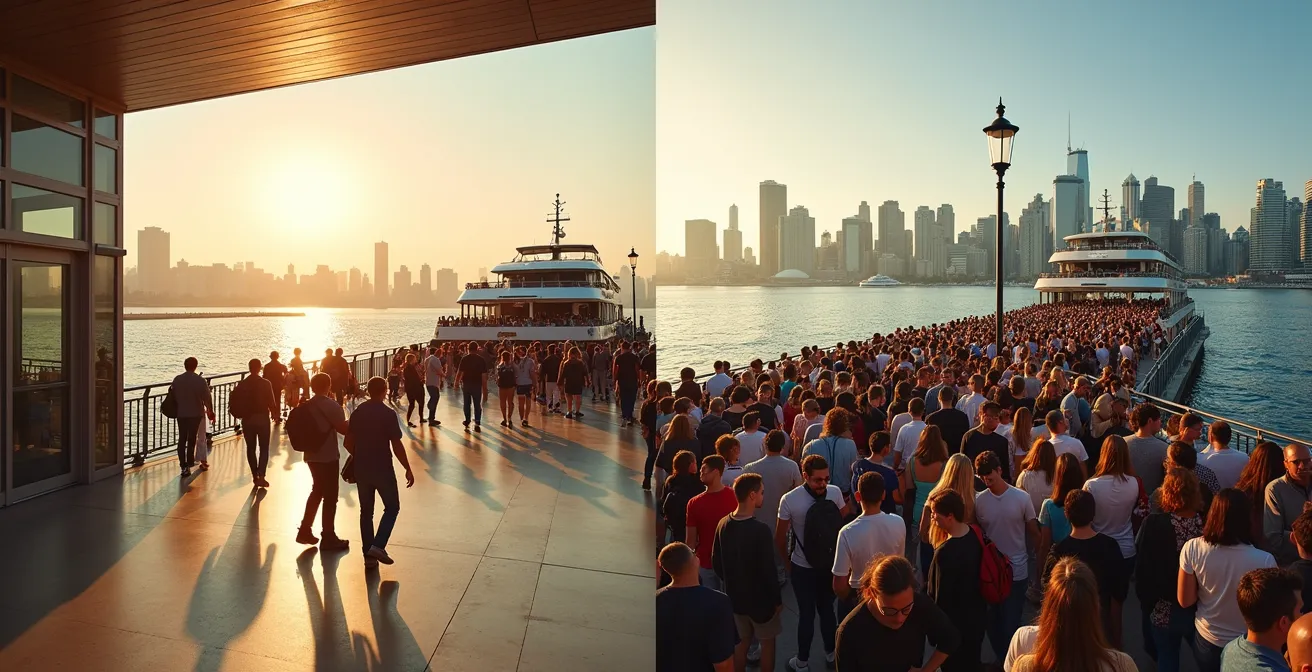
The visual contrast is stark. A 9:30 AM arrival means a peaceful stroll onto the ferry, securing a great spot on the upper deck. A 1:00 PM arrival means standing in a packed, uncovered queue under the hot summer sun, slowly shuffling forward. This is a key moment where the extra cost of a water taxi provides immense situational value. If your schedule doesn’t allow for an early start, paying for a taxi might be the best decision you make all day, saving you from a frustrating and draining wait.
Think of your time as part of the cost. If you value your leisure time, avoiding a 45-minute queue might easily be worth the extra money for a taxi, allowing you to start enjoying the islands the moment you arrive at the waterfront.
Where to Stand on the Island Ferry for the Best Skyline Photo Op?
For many visitors, the journey to and from the Toronto Islands is as much a part of the experience as the islands themselves. The ferry ride offers one of the most iconic and breathtaking views of the Toronto skyline. Capturing that perfect photo is a key ‘trip mission’ for many. To get the best shot, your position on the ferry is everything, and it changes depending on your direction of travel.
The upper deck is always the best place for an unobstructed view, away from the windows of the lower cabin. The key is to position yourself at the correct end of the boat. Many people make the mistake of rushing to the front of the boat on the way to the island, only to find the skyline shrinking behind them. Here is the definitive guide:
- Going TO the Islands: Stand at the stern (the back) of the ferry. As the boat pulls away from the city, you’ll have a perfect, receding view of the full skyline, including the CN Tower and the downtown core.
- Coming FROM the Islands: Stand at the bow (the front) of the ferry. This will give you a dramatic, approaching shot as the city grows larger and more detailed. This is especially magical during sunset or at night.
- Timing is Everything: For that ‘golden hour’ glow on the buildings, aim to take a ferry back to the city around sunset (the 7 PM or 8 PM ferries in the summer are ideal).
- Use Panoramic Mode: As the ferry departs the dock, it often makes a slow turn. This is a perfect opportunity to use your phone’s panoramic mode to capture the entire sweep of the skyline.
While the ferry provides a classic, wide-angle view, water taxis offer a different photographic advantage. Being smaller and lower to the water, they can provide a more dynamic and unique perspective. You can often ask the captain to pause for a moment to allow for a great shot, a level of service you won’t get on the public ferry.
Got really good shots of the skyline also
– Pirate Taxi review
Ultimately, both options provide fantastic photo opportunities. The ferry offers a stable, elevated platform for the classic postcard shot, while the water taxi provides a more intimate and customizable angle.
Key Takeaways
- Assess your “trip mission” before choosing: Prioritize cost, time, or convenience to determine the best transport mode for your specific needs.
- Your return trip plan is crucial: Taking the ferry out with gear and a water taxi back when tired or late is a savvy hybrid strategy.
- Online ferry tickets are essential: They help you skip the ticket line but do not eliminate the potentially long boarding queue, especially on weekends.
How to Organize a BBQ on Toronto Islands Without Missing the Last Ferry?
A BBQ on the Toronto Islands is a quintessential summer activity, but it’s a ‘trip mission’ with significant logistical challenges. You’ll be hauling a cooler, food, and other supplies, and you need to manage your time carefully to avoid a stressful end to the day. This is the perfect scenario for a hybrid transport strategy, using both the ferry and water taxis to your advantage.
The best public BBQ pits are located on Centre Island, Olympic Island, and Hanlan’s Point. Olympic Island is often a great choice as its pits are a relatively short walk from the Centre Island ferry dock. The key to a successful BBQ is planning your return journey before you even start cooking. The process of cleaning up, packing leftovers, and hauling your gear back to the dock always takes longer than you think.
This is where a hybrid approach shines. Use the cheaper, larger ferry for the trip TO the island when you’re fresh and have time. You can load all your heavy gear without worrying about extra costs. For the return trip, when you’re tired, full, and racing against the clock of the last ferry, a pre-booked water taxi is a brilliant investment. It eliminates the stress of the ferry queue and guarantees you a ride back, even if your cleanup runs a little late.
Your Action Plan for a Flawless Island BBQ
- Transport Strategy: Take the public ferry TO the island with your heavy BBQ gear, coolers, and supplies. Pre-book a water taxi for your RETURN trip to avoid stressful queues and the risk of missing the last ferry.
- Location Choice: Use the public BBQ pits on Olympic Island. They are a short and pleasant walk from the Centre Island ferry dock, making them logistically ideal. Remember that bringing your own alcohol to the islands is prohibited.
- Time Management: Set a “cleanup” alarm on your phone for 1.5 hours before the last ferry. This allocates 30 minutes for cleanup, 30 minutes for the walk to the dock, and a 30-minute buffer for unforeseen delays.
- Gear Hauling: To make moving your supplies from the dock to the picnic site easier, consider renting a wagon or quadricycle on the island. It’s a small expense that saves a lot of effort.
- Final Check: Confirm the departure time for the last ferry from your chosen dock (Centre Island) and the meeting point for your water taxi. Double-check that you have left your picnic site clean.
By adopting this strategic approach, you get the best of both worlds: the affordability of the ferry for the heavy lifting and the speed and certainty of a water taxi for a guaranteed, stress-free trip home.
Now that you’re equipped with the strategies for every scenario, from a simple photo trip to a full-blown BBQ, you can approach the waterfront with confidence. Apply this situational thinking to your next island adventure to ensure your transportation choice perfectly matches your plans for the day.