
In summary:
- Visit after 5 PM on any day to take advantage of ‘Sharks After Dark’ pricing and significantly smaller crowds.
- Use the Toronto CityPASS for bundled savings, but always book your Ripley’s timed-entry slot first as it’s the most popular.
- Never use flash photography; it stresses marine life and worsens your photos in the low-light environment.
- Opt for a Flex Ticket only if your schedule is highly unpredictable due to Toronto traffic or travelling with small children.
The thought of visiting Ripley’s Aquarium of Canada in Toronto often conjures two conflicting images: the mesmerizing glide of a sand tiger shark overhead, and the daunting, seemingly endless queue snaking around the building. For many tourists and locals, the primary challenge isn’t deciding to go, but figuring out how to experience the magic without the stress and congestion. Most advice is generic: go on a weekday, buy tickets online. While not wrong, this barely scratches the surface of a truly optimized visit.
This approach misses the fundamental point. Avoiding the crowds at a world-class attraction like Ripley’s isn’t about simple luck or minor adjustments. It requires a strategic system. The real key lies in understanding the attraction’s internal dynamics—its crowd flow, its ticketing psychology, and its hidden value opportunities. It’s about shifting your perspective from merely ‘attending’ to strategically ‘conquering’ the experience, ensuring your time and money are spent on wonder, not waiting.
This guide moves beyond the basics to provide a data-driven, tactical plan. We will deconstruct every phase of your visit, from choosing the right ticket and the perfect arrival time to mastering photography in the iconic Dangerous Lagoon and navigating the entire Toronto attraction ecosystem. This is your planner’s playbook for transforming a potentially stressful outing into a seamless, premium adventure.
Summary: Your Strategic Guide to Ripley’s Aquarium and Toronto Attractions
- Why Visiting the Aquarium After 7 PM Saves You Money and Stress?
- How to Take Good Selfies in the Dangerous Lagoon Tunnel Without Blocking Traffic?
- Flex Ticket vs Timed Ticket: Is the Extra Cost Worth the Flexibility?
- The Flash Mistake That Distresses Marine Life and Ruins Your Photos
- How to Exit the Aquarium Without Spending Another $50 on Plush Toys?
- How to Use the Toronto CityPASS to Save 40% on Major Attractions?
- Why You Need a Wetsuit Even in June When Paddleboarding the Lake?
- Visiting the ROM with Kids: How to See the Dinosaurs and Mummies in 2 Hours?
Why Visiting the Aquarium After 7 PM Saves You Money and Stress?
The single most effective strategy for optimizing your Ripley’s Aquarium visit is not about which day you go, but what time. While most visitors aim for midday, this puts them directly in the path of maximum congestion. The secret is to leverage the evening hours. According to Destination Toronto, peak hours at Ripley’s Aquarium occur between 11:00 a.m. – 4:00 p.m. on weekends and 11:00 a.m. – 2:00 p.m. on weekdays. By simply avoiding this window, you bypass the worst of the crowds.
The aquarium actively encourages this with its “Sharks After Dark” program, offering a discount of about $5 on tickets for entry after 5 PM daily. This dual benefit—lower cost and fewer people—is the cornerstone of a strategic visit. Arriving between 5:30 PM and 7:00 PM allows the massive daytime crowds and school groups to dissipate, granting you far more personal space and better viewing opportunities. The experience transforms from a frantic shuffle to a tranquil exploration.
With fewer people, you can enjoy the most popular exhibits, like the Dangerous Lagoon tunnel and the mesmerizing Planet Jellies gallery, without feeling rushed. It’s crucial, however, to check the official calendar before you book. Occasionally, special events like Friday Night Jazz can create a different kind of crowd, so if a quieter experience is your main goal, plan around those dates. This simple timing shift is the difference between a stressful ordeal and a magical underwater journey.
How to Take Good Selfies in the Dangerous Lagoon Tunnel Without Blocking Traffic?
The Dangerous Lagoon, with its 360-degree view of sharks and sea turtles, is the aquarium’s photographic heart. It’s also a potential bottleneck, thanks to the slow-moving sidewalk and everyone trying to capture the perfect shot. Taking a great photo here without causing a traffic jam requires understanding the tunnel’s unique crowd flow dynamics. The key is to separate your viewing from your photography.
First, use the moving walkway for an initial “reconnaissance” pass. Enjoy the immersive experience and scout potential photo locations. Then, use the stationary walking path that runs alongside it. As noted by Active Parents, you can step off the moving sidewalk at designated points. This allows you to walk back against the light foot traffic to your chosen spot without holding anyone up. The final 10 meters of the tunnel are notably wider, offering a perfect stationary area for group photos or more complex shots.
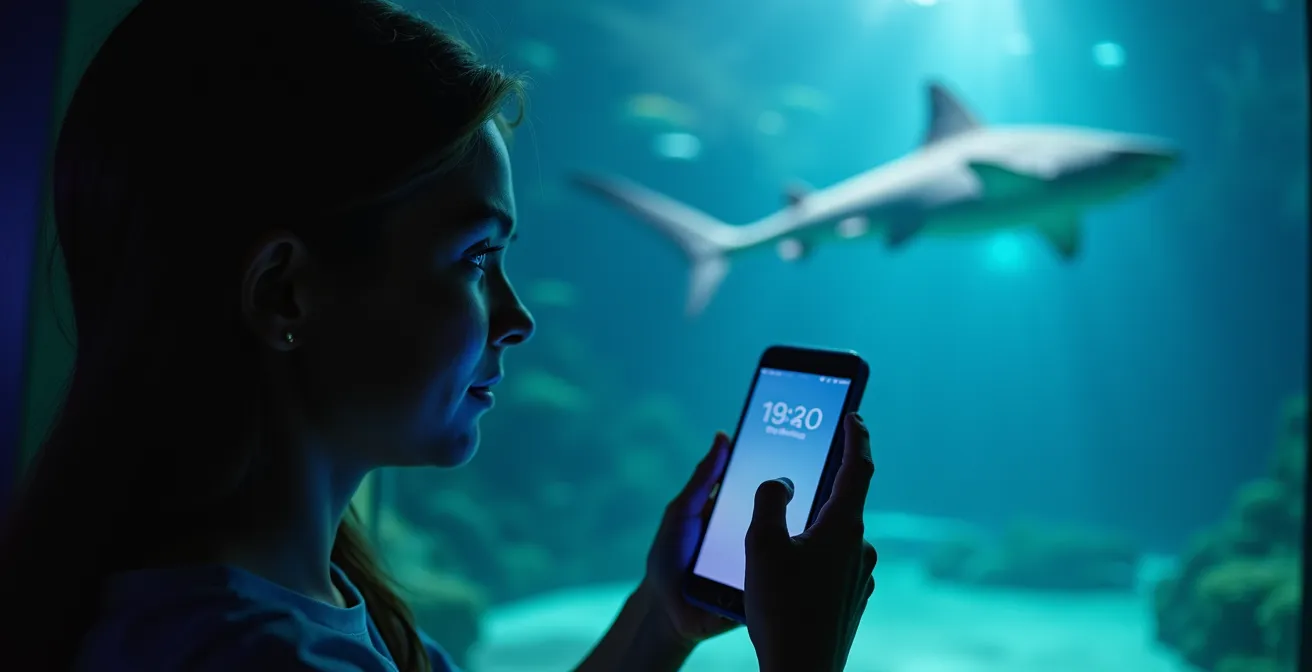
As you can see in the image, achieving a clear shot in low light requires stability. Brace your phone or camera against the acrylic tunnel wall to minimize shake. This is far more effective than raising the ISO too high, which creates a grainy image. Experiment with different angles; shooting upwards can create dramatic silhouettes of the marine life against the blue glow. Remember to have your camera fully charged and ready, as you may need multiple attempts to capture that perfect moment when a sea turtle glides by.
Flex Ticket vs Timed Ticket: Is the Extra Cost Worth the Flexibility?
When purchasing tickets online, Ripley’s Aquarium presents you with a strategic choice: the standard Timed Ticket or the pricier Flex Ticket. A Timed Ticket requires you to select a specific one-hour window for entry, while a Flex Ticket allows you to arrive at any point on a chosen day. The decision hinges on your tolerance for risk and the predictability of your schedule. For a visitor with a well-planned itinerary, the Timed Ticket is almost always the superior, more cost-effective choice.
However, the extra ~$10 CAD for a Flex Ticket can be a worthwhile investment in peace of mind under specific circumstances. As one travel planning analysis notes, “If unpredictable Toronto weather, traffic, or a toddler’s nap schedule gives you a >30% chance of being late, the extra ~$10 for the Flex Ticket is worth the peace of mind.” This reframes the extra cost not as a luxury, but as an insurance policy against the notorious unpredictability of navigating a major city.
If unpredictable Toronto weather, traffic, or a toddler’s nap schedule gives you a >30% chance of being late, the extra ~$10 for the Flex Ticket is worth the peace of mind.
– Travel planning perspective, Based on Toronto traffic patterns analysis
The following table, based on information from ticketing and travel sites like CityPASS, breaks down the core differences to help you make a data-driven decision.
| Feature | Timed Ticket | Flex Ticket |
|---|---|---|
| Entry Window | 1-hour specific window | Any time during operating hours |
| Price Difference | Standard price | ~$10 CAD extra |
| Best For | Planned itineraries | Unpredictable schedules with kids |
| Reservation Required | Yes, specific time slot | Date only |
| Traffic/Weather Buffer | No flexibility | Complete flexibility |
Ultimately, the choice is a calculated risk. If your plans are solid and you are confident in your arrival time, save the money. If you are juggling multiple variables, the flexibility buffer offered by the more expensive ticket might just save your visit from starting on a stressful note.
The Flash Mistake That Distresses Marine Life and Ruins Your Photos
In the dark, ambient environment of the aquarium, the instinct to use your camera’s flash is strong, but it’s a critical mistake for two reasons. First and foremost, it’s a matter of animal welfare. The CityPASS Guide to the aquarium confirms that flash photography is strictly prohibited. The sudden, bright lights can startle and cause stress to the animals, whose eyes are adapted to the aquarium’s carefully controlled, low-light environment. This rule also extends to the AF-assist lights on DSLRs and some smartphones, which can be equally disruptive.
Secondly, using a flash is counterproductive to getting a good photo. The flash will reflect off the acrylic tanks, creating a harsh glare that completely washes out the image and obscures the marine life you’re trying to capture. The beauty of aquarium photography comes from capturing the vibrant, ambient blue light of the water, not from overpowering it with an artificial light source. The professional photographers you see in the aquarium never use flash; they rely on technique.
Instead of flash, you must learn to work with the available light. This involves adjusting your camera settings—primarily increasing the ISO—and using physical stability to compensate for the longer shutter speeds required in low light. Embracing these ethical techniques not only protects the animals but also results in far superior, more atmospheric photographs.
Your Action Plan: Ethical Low-Light Photography Techniques
- Pre-visit Check: Disable the flash and AF-assist light on your smartphone and/or DSLR before you even enter the aquarium.
- Adjust Settings: Moderately increase your camera’s ISO settings to make it more sensitive to the available light.
- Find Stability: Brace your camera or phone against the tank glass or another stable surface to eliminate camera shake during longer exposures.
- Use the Light: Position yourself so the aquarium’s existing ambient light illuminates your subject, using it as your key light.
- Post-Processing: Download a free app like Lightroom Mobile to brighten and enhance your photos after you’ve taken them, rather than trying to perfect them in-camera.
How to Exit the Aquarium Without Spending Another $50 on Plush Toys?
For many families, the final and most challenging exhibit at Ripley’s Aquarium isn’t a tank—it’s the mandatory walk through the Cargo Hold Gift Shop to exit. This space is expertly designed to trigger impulse buys, especially from children dazzled by the experience they just had. Navigating this area without adding a significant, unplanned expense to your trip requires a proactive, not reactive, strategy.
The most effective tactic is to set expectations and budget *before* you arrive. Have a clear conversation with your children, establishing a firm “no” or a specific, small budget for a souvenir. This prevents the in-the-moment negotiations that are so difficult for parents to win. Another powerful strategy is the promise of an alternative, post-aquarium treat. Offering a guaranteed stop for a BeaverTail or another iconic Toronto snack from a nearby vendor can be an effective way to redirect desire away from the expensive plush toys.
If a child is insistent, use the “think about it” delay tactic. Suggest that you can look at the item on the official Ripley’s online store later. More often than not, the impulse will have faded by the time you get home. When it’s time to leave, move through the gift shop with purpose. Don’t linger or browse. Holding hands and focusing on the exit doors helps keep everyone on task. A well-timed snack brought from home can also be a lifesaver, as hunger is a major trigger for impulse-buy demands. By planning your exit as carefully as your entry, you can keep your budget intact.
How to Use the Toronto CityPASS to Save 40% on Major Attractions?
For any tourist planning to visit more than two major Toronto attractions, the Toronto CityPASS is an essential tool for value hacking. The pass bundles prepaid admission to five of the city’s top destinations—the CN Tower, Ripley’s Aquarium of Canada, Casa Loma, the Royal Ontario Museum (ROM), and either the Toronto Zoo or the Ontario Science Centre. While the exact savings fluctuate with ticket prices, the official CityPASS website confirms savings of up to 38% compared to buying individual tickets.
The key to maximizing the CityPASS is strategic planning. Because Ripley’s Aquarium is arguably the most popular and crowd-sensitive attraction on the pass, you must make it your first priority when booking. As soon as you purchase your CityPASS, use it to secure a timed-entry reservation for the aquarium, ideally using the “Sharks After Dark” evening strategy. The other attractions on the pass generally have more capacity and less congestion, giving you more flexibility.
The financial benefit is significant. One travel blogger from Teaspoon of Adventure detailed their experience testing the pass. By visiting all five attractions (CN Tower, Ripley’s, ROM, Toronto City Cruises, and the Zoo) in August 2023, they confirmed that the pass saved them approximately $53.50 USD per adult. This real-world case study demonstrates that for an action-packed itinerary, the CityPASS isn’t just a convenience—it’s a core component of a budget-conscious Toronto trip.
Key Takeaways
- Strategic Timing is Everything: Visiting after 5 PM is the single best way to avoid crowds and save money.
- Plan Your Photos: Use the stationary path in the Dangerous Lagoon and brace your camera on the glass for clear, flash-free shots.
- Buy Tickets Smart: Stick with Timed Tickets unless your schedule is genuinely unpredictable; the savings are worth the planning.
Why You Need a Wetsuit Even in June When Paddleboarding the Lake?
As a specialized planner, my role is to ensure your entire trip is safe and enjoyable, and that includes activities beyond the aquarium. Many visitors to Toronto see the beautiful expanse of Lake Ontario and plan for water activities like paddleboarding, especially in early summer. However, there’s a crucial piece of local knowledge that is often overlooked: the shocking temperature of the water. While the June air temperature can be a pleasant 20-25°C, the lake itself is a different story.
Fed by the Great Lakes system, Lake Ontario remains dangerously cold well into the summer season. Data from local resources shows that in June, Lake Ontario’s water temperature can be a shocking 10-14°C (50-57°F) near shores like Cherry Beach. Falling into water this cold without protection can lead to cold water shock, a dangerous physiological response that can incapacitate even a strong swimmer in minutes. It is not an exaggeration to say that it can be life-threatening.
For this reason, a wetsuit is not optional, it is essential safety equipment for paddleboarding on Lake Ontario in May or June. A wetsuit works by trapping a thin layer of water between your body and the suit, which your body then heats up, providing critical insulation against the cold. Numerous rental shops near the Toronto Islands ferry terminal, Woodbine Beach, and the Scarborough Bluffs offer daily wetsuit rentals, typically for $30-50 CAD. Factoring this into your plan is a non-negotiable part of responsible trip planning.
Visiting the ROM with Kids: How to See the Dinosaurs and Mummies in 2 Hours?
The strategic mindset you apply to Ripley’s Aquarium is directly transferable to Toronto’s other world-class attractions, like the Royal Ontario Museum (ROM). For families with kids, the goal is often to see the star exhibits—the dinosaurs and mummies—before fatigue and overstimulation set in. A 2-hour “surgical strike” is not only possible but preferable to a long, meandering visit.
The plan is simple and depends on your arrival time. If you arrive 15 minutes before opening, head directly to the dinosaur hall on Level 2 to experience it before the crowds build. If you arrive midday when the dinosaur exhibit is at its peak, execute a reverse strategy: visit the mummies and other Ancient Cultures galleries on Level 3 first, then circle back to the dinosaurs later in the afternoon as crowds begin to thin. Using the quieter Weston Family Entrance on Queen’s Park can also save valuable time compared to the main entrance. When the kids inevitably need a break, the CIBC Discovery Gallery offers a perfect hands-on decompression zone.
This strategic approach also extends to your budget. As a Destination Toronto visitor guide points out, pairing the ROM’s free admission on the 3rd Tuesday evening of each month with Ripley’s “Sharks After Dark” discount on another day are two of the most powerful budget-saving tactics for a Toronto trip. This demonstrates how a holistic, attraction ecosystem mindset elevates your entire vacation from a series of individual events into one cohesive, optimized experience.
Apply this strategic mindset to every part of your Toronto itinerary. By planning ahead, understanding crowd dynamics, and leveraging value opportunities, you can transform your visit from a series of queues into a collection of unforgettable experiences.