The greatest myth about Toronto’s food scene is that authenticity lives downtown; the truth is, it thrives in unassuming suburban strip malls where fierce competition and deep-rooted communities create culinary excellence.
- Superior quality in cuisines like Dim Sum is a direct result of hyper-local “culinary ecosystems” in Markham and Richmond Hill, not downtown trends.
- True authenticity is revealed by subtle indicators, such as menus in native languages or a parking lot full of taxis, not just long lines of tourists.
Recommendation: Ditch the downtown guides. To eat like a local, explore the city’s immigration corridors and plan your next food adventure around the vibrant, authentic hubs of the Greater Toronto Area.
For any serious foodie, Toronto presents a tantalizing promise: a world of cuisine in a single city. The standard advice is predictable—wander through Kensington Market, brave the crowds in downtown Chinatown, and follow the trendiest food bloggers. But this well-trodden path often leads to a sanitized version of global food, tailored for tourists and prioritizing ambiance over authenticity. You’re left with a nagging feeling that the real deal, the flavour that truly rivals the home country, is hiding somewhere else.
The conventional wisdom misses the fundamental story of Toronto’s food scene. It fails to acknowledge that as immigrant communities have flourished and moved, their culinary centers of gravity have shifted with them. The most vibrant, uncompromising, and authentic food is no longer concentrated in historic downtown enclaves. It has migrated to the suburbs, taking root in sprawling plazas and unassuming strip malls across Markham, Scarborough, and Mississauga.
This guide breaks from the pack. We’re rejecting the downtown-centric narrative and embracing a more adventurous philosophy: the “Suburban Superiority Thesis.” The key to unlocking Toronto’s most authentic food is not about where it’s trendy, but about understanding the city’s geography of immigration. It’s about learning to spot the subtle indicators of quality that locals know and trusting your palate over an influencer’s post. We will explore the culinary ecosystems that drive excellence, deconstruct the false dichotomy of fusion versus authentic, and give you the tools to find those hidden gems that deliver a transportive taste of home.
This journey will take us from the grand dim sum halls of Markham to the budget-friendly bites of Kensington, and even along the historic 501 streetcar route. The following sections provide a detailed roadmap to navigate Toronto’s real culinary landscape and discover flavours that are not just authentic, but truly world-class.
Summary: A Food Critic’s Guide to Uncovering Toronto’s Most Authentic Eats
- Why the Best Dim Sum Is Found in Markham and Not Downtown Chinatown?
- How to Order at a Traditional Hakka Restaurant Without Overwhelming Spice Levels?
- Fusion or Authentic: Which Taco Spot in Kensington Should You Choose?
- The Mistake of Skipping “Hole-in-the-Wall” Spots That Have Michelin Recognition
- How to Plan a “World Food Tour” Along the 501 Queen Streetcar Route?
- How to Eat Your Way Through Kensington Market for Less Than $20 CAD?
- Tacos vs Poutine: Which Food Truck Cuisine Feeds a Crowd Faster?
- How to Find Authentic Vintage Gems in Kensington Market Under $50 CAD?
Why the Best Dim Sum Is Found in Markham and Not Downtown Chinatown?
The belief that downtown Chinatown holds the crown for Toronto’s best dim sum is an outdated tourist myth. For those in the know, the undisputed heartland of dim sum excellence has migrated north to the suburbs of Markham and Richmond Hill. This isn’t a matter of opinion; it’s the result of a powerful culinary ecosystem driven by demographic shifts and intense local competition. As the Chinese Canadian community has grown and prospered in these areas, so has the demand for high-quality, authentic cuisine that meets the standards of a discerning palate.
This paragraph introduces the core concept. To better understand it, let’s look at the visual evidence. The image below is not a scene from Hong Kong, but from a typical high-end restaurant in Markham.
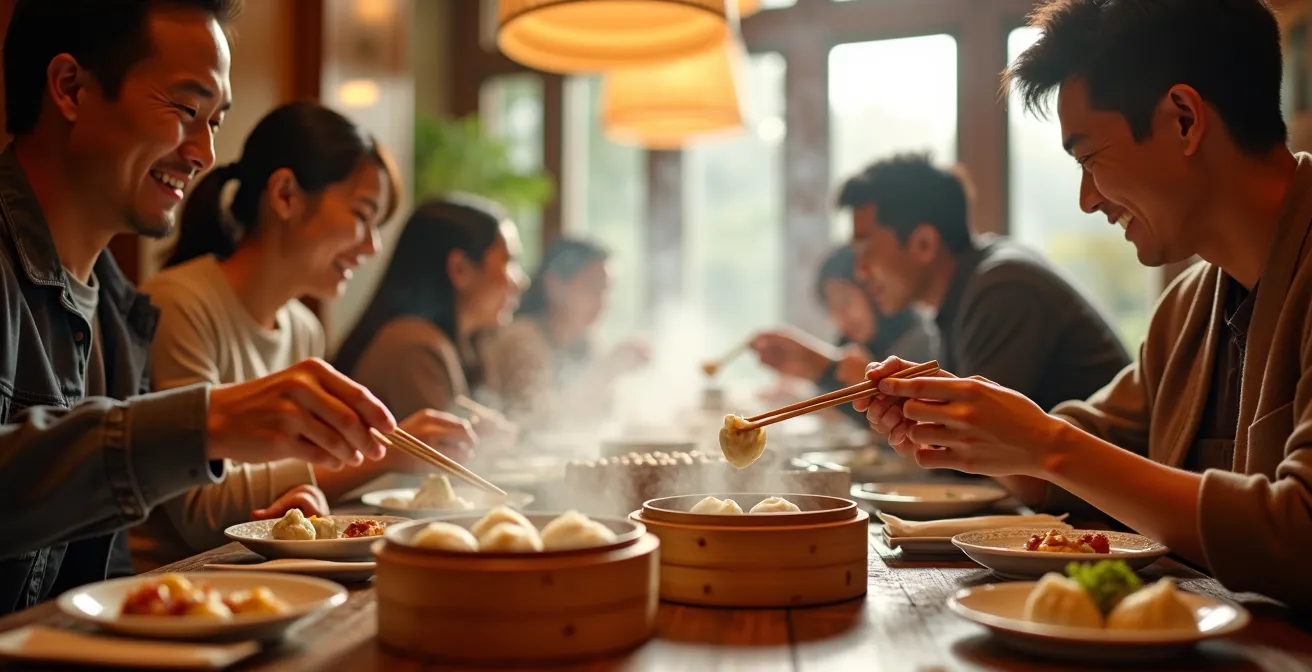
As you can see, these are not small, quaint eateries. They are grand, opulent banquet halls operating at an incredible scale. In plazas like First Markham Place, dozens of high-end restaurants compete side-by-side for the same customers. This fierce rivalry creates an environment where only the best survive. A restaurant like Yang’s Fine Chinese Cuisine in Richmond Hill has maintained its popularity and long queues for over a decade because its quality is consistently exceptional. In this market, diners are unforgiving; survival and success are direct proof of uncompromising authenticity.
Unlike downtown spots that can rely on tourist traffic, these suburban establishments must earn the loyalty of a local community that knows the cuisine intimately. They serve dishes you’ll rarely find downtown, like traditional Phoenix Talons and complex offal preparations, as a testament to their credentials. The result is a “Suburban Superiority Thesis” in action: the best, most innovative, and most authentic dim sum experience is found where the community and competition are strongest.
How to Order at a Traditional Hakka Restaurant Without Overwhelming Spice Levels?
Navigating a Hakka menu in Toronto can be a fiery endeavor, but understanding its unique heritage is the key to controlling the heat. First, it’s crucial to know what “Toronto Hakka” is: a distinct Indian-Chinese fusion cuisine that originated in Kolkata, India. It’s beloved by the city’s massive South Asian diaspora and differs significantly from the Hakka food of mainland China. The heat in Toronto-style Hakka primarily comes from fresh green chilies, not the dried red peppers or Szechuan peppercorns of other Chinese cuisines. This makes managing the spice level surprisingly straightforward if you know what to ask for.
The prevalence and authenticity of this cuisine are directly tied to Toronto’s demographics. With over 57.2% of the population being visible minorities as of 2024, and South Asians forming the largest group, there is a built-in audience that demands genuine flavours. This has led to a concentration of authentic Hakka restaurants in neighborhoods like Scarborough and Mississauga, where these communities are centered.
To avoid a spice level that overwhelms your palate, start by asking for “dry” versions of popular dishes. For example, ordering “Chili Chicken Dry” instead of the default version means the chicken is stir-fried with aromatics rather than swimming in the spiciest gravy. The most effective request, however, is to simply ask for “less green chili.” This targets the primary heat source directly without altering the fundamental savoury, umami-rich flavour profile of the dish. If you’re new to the cuisine, gateway dishes like Hakka Chow Mein or milder Manchurian preparations (often vegetable or chicken-based) are an excellent starting point before graduating to the bolder flavours.
By understanding the distinction between Toronto Hakka and its mainland counterpart and using a few key phrases, you can confidently explore one of the city’s most beloved and unique fusion cuisines without fear of an all-out assault on your taste buds. It’s about precision, not avoidance.
Fusion or Authentic: Which Taco Spot in Kensington Should You Choose?
The question of “fusion or authentic” when choosing a taco in Kensington Market presents a false dichotomy. Toronto’s culinary identity is built on creative interpretation, and tacos are a perfect example. A more useful approach is to think in terms of culinary philosophy, as the city’s most celebrated spots often blend tradition with local innovation. Instead of a simple binary, the scene is a spectrum ranging from strict traditionalists to bold creators, each offering a valid and delicious experience.
This nuanced landscape is best understood by breaking it down into distinct approaches. The following table illustrates the different taco philosophies you’ll encounter, not just in Kensington but across the city, providing a framework for choosing your perfect bite.
| Taco Philosophy | Restaurant Example | Signature Style | Best For |
|---|---|---|---|
| Strict Regionalists | Authentic Mexican spots | Jalisco-style birria, traditional preparations | Purists seeking a Mexico City street stall experience |
| Technique Purists | Artisanal taco shops | In-house nixtamalization for tortillas | Those valuing craft and process |
| Creative Innovators | Seven Lives Tacos y Mariscos | Baja-style fish tacos with local ingredients | Adventurers wanting Toronto-unique experiences |
Seven Lives Tacos y Mariscos stands as Kensington’s most celebrated example of the “Creative Innovators” philosophy. It has achieved legendary status not by slavishly replicating Mexican recipes, but by respecting traditional techniques while embracing local Canadian ingredients. Their famous Baja-style fish tacos are a distinctly Toronto creation, drawing massive, consistent crowds. Their success proves that fusion, when done with respect and skill, can create an experience that is authentic to its new home.
Ultimately, the “right” choice depends on your craving. Are you seeking the pure, unadulterated taste of a specific Mexican region? Or are you open to a new creation that could only exist in Toronto? The beauty of Kensington Market is that you don’t have to choose. You can have a traditional al pastor taco from one stall and a ground-breaking fusion creation from another, all within a few steps. The real win is embracing this diversity.
The Mistake of Skipping “Hole-in-the-Wall” Spots That Have Michelin Recognition
In a city obsessed with image, the biggest mistake a serious foodie can make is judging a restaurant by its facade. Many of Toronto’s most profound culinary experiences are found in “hole-in-the-wall” establishments—modest, often family-run spots in unassuming strip malls or quiet residential streets. These are the places that prioritize flavour over decor, and their excellence is no longer just a local secret. The arrival of the Michelin Guide in Toronto has begun to formally recognize these hidden gems with its Bib Gourmand award, given for exceptional food at affordable prices.
This formal recognition is growing. Since the Michelin Guide’s 2022 Toronto debut, the number of Bib Gourmand awards has steadily increased, highlighting the depth of quality hiding in plain sight. Many of the initial honorees were Caribbean and Sri Lankan restaurants located deep in the suburbs, places that have served their communities for years, far from the gaze of downtown food critics. Their inclusion validates the core principle for any culinary explorer: authenticity thrives away from the hype.
While the Michelin star brings welcome attention, it also brings crowds. The real skill lies in finding these gems *before* they’re famous. This requires learning to spot the pre-Michelin indicators of authenticity that have long guided local foodies. It’s about a fundamental shift in perspective: from looking for trendy design to searching for signs of deep community connection.
The image above captures the soul of these places—intimate, unpretentious, and entirely focused on the food. Finding them is a skill you can develop. It’s an audit of authenticity that goes beyond a simple Google search.
Your Action Plan: Finding Pre-Michelin Authentic Indicators
- Community Media Scan: Look for restaurants featured in community-specific media, like Tamil newspapers or on Chinese community message boards, rather than mainstream blogs.
- The Taxi Driver Test: Notice lineups or gatherings of taxi drivers from a specific country. This is one of the most reliable, time-honoured indicators of authentic, well-priced food.
- Location Context: Check if a restaurant is located inside a cultural community centre or a non-descript suburban plaza rather than a trendy downtown neighbourhood.
- Follow the Diaspora: Visit the neighbourhoods where specific communities have settled, like the Sri Lankan spots in Scarborough that earned early Bib Gourmand recognition.
- Off-Peak Exploration: If a spot has been awarded, go during off-peak hours (e.g., a weekday lunch) to avoid the inevitable post-Michelin crowds and get a more genuine experience.
How to Plan a “World Food Tour” Along the 501 Queen Streetcar Route?
The 501 Queen streetcar, one of the longest streetcar routes in North America, offers more than just a ride across the city; it’s a moving feast that traces Toronto’s history of immigration through its food. A well-planned day trip along this route can feel like a world tour, taking you from the flavours of Tibet and Poland in the west to Vietnamese and Chinese cuisine in the east. Planning this tour requires a bit of logistical savvy, but the payoff is a deep and delicious understanding of how Toronto’s neighborhoods have been shaped by the communities that settled them.
The first step is to get a PRESTO Day Pass, which allows for unlimited hops on and off the streetcar. For the best experience (and lighting for photos), plan your journey from west to east, starting your tour in the morning. This path follows the sun and also mirrors historical settlement patterns. You can begin in Parkdale, a neighborhood that showcases both older and more recent waves of immigration with its established Polish bakeries and vibrant Tibetan restaurants.
As you travel east, each distinct neighborhood offers a new culinary chapter. A stop in Portugal Village is essential for authentic Portuguese tarts and grilled sardines. Further on, West Queen West provides a look at trendier, fusion-forward options before the route takes you towards the classic Vietnamese and Chinese establishments in the east end. These restaurants are more than just places to eat; they are what academics call “third places”—vital community spaces that promote a sense of belonging for immigrants. They are the living rooms and social hubs for their respective diasporas, making the food they serve an uncompromising expression of cultural identity.
The most important strategy for this tour is the “One Block Off” rule. The businesses directly on Queen Street often cater to general foot traffic. The real treasures are frequently found by walking just a minute or two north or south into the residential side streets. This is where you’ll find the family-run spots with the most loyal local followings. This simple rule of thumb can be the difference between a good meal and an unforgettable one.
How to Eat Your Way Through Kensington Market for Less Than $20 CAD?
Kensington Market is a sensory overload, a whirlwind of sights, sounds, and smells. While it’s a top destination for food lovers, it can also be a deceptively expensive one if you don’t have a strategy. The key to an affordable and authentic tasting tour is to think like a local: graze, combine, and know where the real value lies. With a smart approach, you can assemble a diverse and deeply satisfying meal for less than a single entree at a sit-down restaurant, all while supporting the small, family-owned businesses that are the heart and soul of the market.
Forget the pricey cafes and tourist-focused spots. The $20 challenge is about creating your own “Kensington Combo” tasting menu. Start with a Jamaican patty from a spot like Golden Patty ($3), add a hot, cheese-filled Salvadoran pupusa from a vendor like Torteria San Cosme ($4), and round it out with a savoury empanada from a Latin American grocer ($4). This trio alone gives you a taste of three different cultures for around $11, leaving you plenty of room in the budget for more. This diversity is no accident; according to 2024 restaurant industry data, Toronto’s diverse population supports a massive food scene, with Mexican cuisine being a city-wide favourite.
To stretch your dollar even further, apply a few savvy shopping tactics. Skip the expensive lattes and grab a can of Latin American soda or a fresh-pressed juice from a grocery store for a couple of dollars. Many bakeries offer discounts on day-old bread in the early morning, and hot food counters often reduce prices in the last hour before closing. An even better strategy is to assemble a “Grocery Store Picnic.” For a few dollars, you can buy fresh bread, a wedge of cheese, some olives, and fruit from the market’s many grocers and enjoy your feast in nearby Bellevue Square Park. This not only saves money but gives you a more relaxed and authentic market experience.
Finally, if your visit coincides with one of the market’s “Pedestrian Sundays” (held on the last Sunday of the month from May to October), you’ll often find special deals from street vendors. By grazing strategically and thinking beyond sit-down meals, Kensington Market reveals itself as one of the city’s best-value culinary destinations.
Tacos vs Poutine: Which Food Truck Cuisine Feeds a Crowd Faster?
When organizing an event, the speed of food service is critical. In Toronto’s food truck scene, tacos and poutine are two titans, but they operate on fundamentally different models of assembly and service. The answer to which is “faster” depends entirely on the context of your event. For sheer speed with uniform orders, poutine wins hands-down. For variety and accommodating dietary needs, tacos offer more flexibility, albeit at a slightly slower pace per order.
The difference comes down to the production line. A poutine truck’s process is brilliantly simple: scoop batch-fried fries, add pre-warmed cheese curds, and ladle on hot gravy. It’s an assembly line that can produce a consistent product at an incredible rate. The primary bottleneck is the fryer’s capacity. A taco truck, on the other hand, is a station for customization. Each taco is typically assembled to order with a choice of protein, salsa, and various toppings, making the process inherently more complex and time-consuming per individual unit.
This operational difference makes each cuisine better suited for different types of events. A poutine truck is the ideal choice for a corporate lunch or an event where the priority is feeding a large number of people quickly with minimal variation. A taco truck excels at public festivals, weddings, or private parties where guest choice, variety, and catering to dietary restrictions (vegan, gluten-free) are more important than raw speed. The table below breaks down the key operational differences.
| Factor | Poutine Trucks | Taco Trucks |
|---|---|---|
| Assembly Process | Simple: batch-fried fries, scooped curds, ladled gravy | Complex: individual assembly with multiple toppings |
| Speed for Uniform Orders | Faster – assembly line efficiency | Slower – each taco customized |
| Customization Options | Limited – mainly size variations | Extensive – proteins, toppings, dietary options |
| Best Event Type | Corporate events prioritizing speed | Public festivals/weddings needing variety |
| Bottleneck Risk | Fryer capacity limits during high demand | Slower but continuous service with good prep |
It’s also worth noting that Toronto’s food truck scene has evolved far beyond this binary. Trucks serving bao, jerk chicken, or wood-fired pizza now offer a middle ground, each with its own unique speed-to-customization ratio. This diversification is a direct reflection of Toronto’s multicultural palate, where demand for authentic global flavours has pushed the mobile food scene to innovate continuously.
Key takeaways
- The Suburban Superiority Thesis: The most authentic and high-quality versions of certain cuisines, like Dim Sum, are now found in suburban hubs like Markham due to immigration patterns and fierce local competition.
- Beyond the Lineup: True authenticity is revealed by nuanced indicators such as community media features, taxi driver congregations, and location within cultural centers, not just tourist-heavy queues.
- Embrace Nuanced Fusion: The “authentic vs. fusion” debate is a false dichotomy; Toronto’s best food spots, like those in Kensington Market, often create new forms of authenticity by blending traditional techniques with local ingredients.
How to Find Authentic Vintage Gems in Kensington Market Under $50 CAD?
Kensington Market is a treasure trove for more than just food; it’s a bohemian paradise for vintage hunters. Yet, the same principles of strategic exploration apply. Finding a truly great vintage piece for under $50 requires the same patience, keen eye, and willingness to dig that finding a perfect taco does. The most effective way to tackle a vintage hunt in Kensington is to weave it into a culinary one, using the market’s incredible food as fuel for your fashion quest.
As the Toronto Tourism Board aptly puts it in their Ultimate Toronto Foodie Guide, the market’s magic lies in its vibrant chaos:
Kensington Market is delightfully raw and chaotic—a bohemian paradise where vintage shops co-mingle with taquerias, gourmet burgers, and vegan bakeries
– Toronto Tourism Board, Ultimate Toronto Foodie Guide 2025
Plan your attack by pairing food with shops. Grab a Golden Patty for energy before diving into the basement treasures of Courage My Love or searching for 70s rock tees at Sub-Rosa. An empanada can be the perfect quick bite before exploring the curated 90s sportswear at Bungalow or the sprawling costume collection at Exile. This approach turns a potentially exhausting day of sifting through racks into a delightful, multi-sensory adventure. A smart budget split would be allocating around $30 for your vintage finds and $20 for the food and drinks needed to sustain your shopping energy.
To find true value, focus on what makes the market’s vintage scene unique. Look for “true vintage” (items over 20 years old) rather than just recent second-hand clothing. Don’t overlook the housewares and decor; you can often find unique, character-filled pieces for your home at a fraction of the price of new items. Finally, time your visit with Pedestrian Sundays if you can. Many shops put out special racks and offer deals, creating a festive atmosphere where you’re just as likely to score a vintage leather jacket as you are a delicious, budget-friendly meal. In Kensington, food and fashion are two sides of the same coin.
Your next great meal is waiting in an unassuming strip mall or a bustling market stall, far from the downtown hype. Start planning your own suburban food tour today and taste the real, authentic flavours that make Toronto one of the world’s greatest food cities.