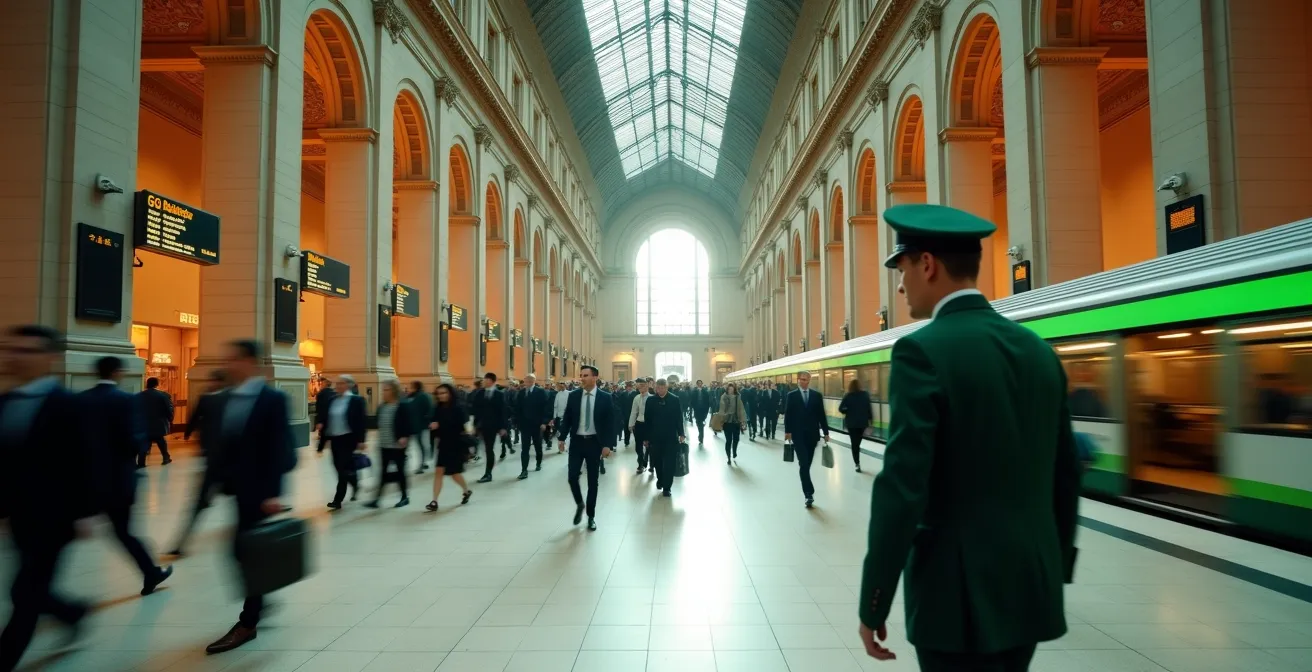
Choosing the GO Train over driving from Burlington is not a simple cost-saving measure; it’s a strategic shift to a more financially predictable and resilient commuting system.
- Driving exposes you to volatile costs (gas, insurance, repairs) and systemic risks (traffic, accidents) that are absent from the fixed-fare GO system.
- The GO Train’s Service Guarantee and seamless integration with local transit, like free Burlington Transit co-fares, create a built-in financial safety net.
Recommendation: Shift your analysis from a simple ticket vs. gas comparison to a full audit of your commute’s “Systemic Risk” and “Cost-per-Predictable-Minute.”
For any Burlington resident commuting to downtown Toronto, the daily decision between taking the car or the GO Train feels like a simple calculation of gas and parking versus a train ticket. The familiar crawl along the QEW, with its unpredictable delays and rising fuel costs, is often weighed against the straightforward fare of a train ride. Most analyses stop there, concluding that the train is probably a bit cheaper and less stressful. This surface-level comparison, however, misses the fundamental point.
The real difference lies not in the obvious daily expenses, but in the hidden financial ecosystem surrounding each choice. Driving is a high-risk system burdened with “friction costs”—small, unexpected expenses and inefficiencies that compound over time. The GO Train, by contrast, operates as a managed, lower-risk system with built-in financial resilience. It transforms commuting from a source of volatile expense and dead time into a predictable cost and an opportunity for productivity.
But if the true key to financial efficiency isn’t just avoiding the cost of gas, but mitigating systemic risk and optimizing every minute of your travel time, how do we quantify that? This analysis moves beyond the ticket price to dissect the hidden financial mechanics of your commute. We will explore the costly mistakes, the overlooked benefits, and the strategic advantages that make the GO Train not just a cheaper option, but a fundamentally smarter financial decision for the daily journey from Burlington to Union Station.
This guide breaks down the true, comprehensive cost of your commute. By examining the hidden rules, risks, and efficiencies of the system, you’ll gain a clear, analytical view of why the train is the superior financial choice.
Summary: The True Cost of a Burlington to Toronto Commute
- Why Forgetting to Tap Off Can Cost You the Maximum Fare to the End of the Line?
- How to Respect the Etiquette of the Upper Level Quiet Zone?
- GO Train or GO Bus: Which Is More Reliable During Winter Storms?
- The Parking Mistake of Staying Over 48 Hours in a Commuter Lot
- When to Claim the Service Guarantee for a Late Train Arrival?
- How to Find a Parking Spot at GO Stations Before 7:AM?
- Where to Find Authentic Global Cuisine in the GTA That Rivals the Home Country?
- Island Airport vs Pearson: Is the Convenience Worth the Limited Flight Options?
Why Forgetting to Tap Off Can Cost You the Maximum Fare to the End of the Line?
One of the most common “friction costs” for new GO Train commuters is the penalty for a missed tap-off. When you tap your PRESTO card at Burlington GO, the system deducts a minimum fare. It doesn’t know your destination, so it waits for you to tap off at Union Station to calculate the final cost. If you forget to tap off in the rush to get to your meeting, the system assumes you travelled to the furthest point on that line from your origin. This results in the maximum possible fare being charged to your card, a significant penalty that can easily double the cost of your actual trip.
This isn’t a bug; it’s a fundamental mechanic of the distance-based fare system. While GO Transit allows for a certain number of fare adjustments, repeatedly forgetting to tap off creates a financial leak in your commuting budget. A single journey from Burlington GO to Union Station costs between $7 and $10, but a missed tap-off could result in a charge of over $20, depending on the line’s terminus. This financial risk is entirely avoidable.
The strategic solution is to program a “default trip” into your PRESTO account. By setting a default route from Burlington GO to Union Station, you instruct the system to automatically complete your trip for you if you forget to tap off. This simple, one-time setup eliminates the risk of overcharges and turns a potentially volatile expense into a fixed, predictable cost. It’s a perfect example of building a safeguard into your personal commuting financial system.
How to Respect the Etiquette of the Upper Level Quiet Zone?
The true value of the GO Train commute isn’t just about avoiding traffic; it’s about “time arbitrage”—the ability to convert what would be stressful, unproductive driving time into valuable, focused work or relaxation. The epicenter of this value is the upper level Quiet Zone. This designated area is a sanctuary for commuters looking to read, work, or simply decompress in peace. However, its value is entirely dependent on collective adherence to a specific etiquette.
Understanding and respecting these rules is paramount. The core principle is simple: your activities should not be audible to your neighbours. This means phone calls are strictly forbidden. If you must take a call, you need to move to the lower level. Likewise, conversations with fellow passengers should be kept in hushed tones or, ideally, taken downstairs. Music, podcasts, or videos are perfectly acceptable, but only with headphones, and at a volume that doesn’t bleed out for others to hear.

What about productivity? Using a laptop is welcome, but be mindful of noisy keyboards. If you’re a frequent typist, the constant clatter can be disruptive. For those who encounter a noisy passenger, the approved protocol is to first politely point to the Quiet Zone signage. If the behaviour continues, you should notify the Customer Service Ambassador rather than engaging in a direct confrontation. By respecting this space, commuters collectively create an environment that transforms a 60-minute journey into a productive hour, a benefit with real financial and mental-health value that driving simply cannot offer.
GO Train or GO Bus: Which Is More Reliable During Winter Storms?
For a Toronto commuter, winter reliability is a critical factor in calculating “systemic risk.” A single major snowstorm can paralyze the region’s road network, turning a 60-minute drive into a multi-hour nightmare. When evaluating the GO system, the choice between the train and the bus becomes a calculation of which mode is more resilient during adverse weather. While both are subject to delays, their failure modes are fundamentally different.
The GO Bus is entirely dependent on highway conditions. During a blizzard, it faces the same gridlock, accidents, and poor visibility as every other vehicle on the QEW or Gardiner Expressway. While Metrolinx may deploy additional buses, they are still operating within a chaotic and unpredictable environment. Delays are not just possible; they are highly probable and their duration is unknown.
The GO Train, operating on a dedicated rail corridor, is insulated from road traffic. Its primary winter risks are switch failures due to ice buildup and track-level issues. While these can and do cause delays, they represent a more manageable, “systemic” problem. Metrolinx has dedicated crews and equipment to address these issues, and delays are often more predictable in duration. Furthermore, trains run every 30 minutes between Burlington and Union, offering a high frequency that can better absorb delays compared to the less frequent bus schedule. The following table provides a clear comparison of their winter performance.
| Service | Travel Time | Frequency | Winter Delays | Alternative During Storms |
|---|---|---|---|---|
| GO Train | 1h 3min | Every 30 min | Track-level issues possible | Express bus service |
| GO Bus | 1h 15min | 3 times daily | Highway conditions dependent | Additional buses deployed |
From a risk-analyst perspective, the train is the superior choice. Its potential for delay is more contained and predictable than the high-volatility risk of highway gridlock, making it the more resilient option for a winter commute.
The Parking Mistake of Staying Over 48 Hours in a Commuter Lot
The free parking at GO stations is a significant cost-saver, but it comes with a critical rule that many commuters overlook at their peril. This rule represents another hidden financial risk that can instantly negate weeks of savings. The policy is clear and strict, designed to ensure parking is available for daily commuters, not for long-term storage.
The rule is a “friction cost” that can escalate into a catastrophic one if ignored. While anecdotal reports from other commuters might suggest leniency, relying on them is a high-risk gamble. One commuter on a travel forum mentioned, “I’ve done 72 hours with no issues. I went inside GO at Union and asked some dude if they are very fussy on the 48 hour rule, he said, ‘Nah’.” This casual advice is dangerous. The official policy is the only metric that matters for a pragmatic cost analysis. Relying on the whims of enforcement is not a strategy; it’s a lottery ticket where the losing prize is a towed vehicle, along with the associated fines and significant inconvenience.
For commuters who need to leave a car for a weekend trip or an overnight stay in Toronto, this 48-hour limit must be factored into their plans. The only way to guarantee compliance and avoid risk is to either return within the 48-hour window or arrange for alternative transportation to the GO station. A reserved parking space offers no exception to this rule; it guarantees you a spot, but does not extend the time limit. As the official GO Transit policy states:
Free overnight parking is available for GO Transit customers in any empty, non-reserved parking space for a maximum of 48 consecutive hours.
– GO Transit, GO Transit Parking Policy
When to Claim the Service Guarantee for a Late Train Arrival?
A core component of the GO Train’s “financial resilience” is its Service Guarantee. This policy acts as a built-in insurance policy for your commute, a benefit utterly absent from driving. If your train is delayed by 15 minutes or more of its scheduled arrival time, you are entitled to a full refund for that trip. This mechanism transforms a potential loss of time into a financial credit, directly mitigating the cost of system failures.
Understanding when and how to claim this guarantee is key to maximizing the financial efficiency of your commute. The 15-minute threshold is firm. A 14-minute delay does not qualify. The delay is measured against the scheduled arrival time, not the expected journey duration. For a trip from Burlington to Union, where the average train journey is about 59 minutes, you should be ready to claim if your arrival is significantly later than this. The claim must be submitted online within a specific timeframe after the delayed trip.
Failing to claim this credit is equivalent to leaving money on the table. It is a feature of the system designed to hold it accountable and to reduce the financial burden on its users. For the pragmatic commuter, tracking delays and submitting claims should be a routine part of their commuting process. It reinforces the predictability of the system: even when it fails, there is a clear and defined recourse.
Your Action Plan: Claiming the GO Transit Service Guarantee
- Note the train number and your actual arrival time when a delay exceeds the 15-minute threshold.
- Visit the GO Transit website within 7 days of the delayed trip to access the claim section.
- Fill out the online Service Guarantee claim form with your specific trip details and PRESTO number.
- Review and submit the form; the system will verify the delay against their records.
- Receive your fare credit automatically on your PRESTO card, typically within 5-7 business days.
How to Find a Parking Spot at GO Stations Before 7:AM?
For many Burlington commuters, the first challenge of the day isn’t the train ride itself, but the battle for a parking spot. The lots at stations like Burlington GO and Aldershot can fill up remarkably early, forcing latecomers to circle endlessly or park in unofficial areas, risking tickets. The conventional wisdom is simple: arrive before 7:00 AM. While effective, this solution forces you to adapt your schedule to the system’s constraints and isn’t always practical.
A more strategic approach, however, doesn’t involve winning the parking war—it involves sidestepping it entirely. The most efficient solution to the GO station parking problem is to eliminate the need for a car in the first place by leveraging local transit. This is a prime example of optimizing the entire commuting system, not just one part of it.
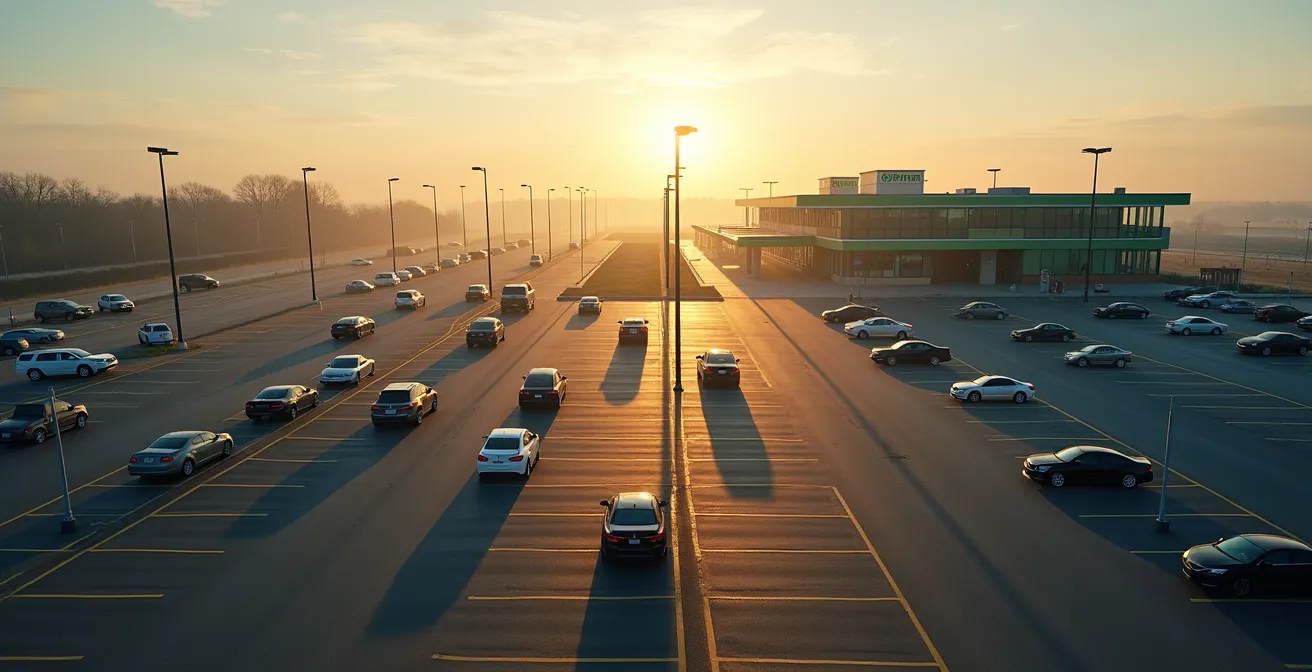
Burlington Transit offers a significant incentive that many commuters overlook: a free co-fare program when connecting with GO Transit. By using your PRESTO card to ride a Burlington city bus to the GO station, your local transit fare is completely free. This strategy provides several advantages. It eliminates the stress and uncertainty of finding parking, saves wear and tear on your vehicle, and removes the risk associated with the 48-hour parking rule. Instead of leaving home extra early to secure a spot, you can rely on a predictable bus schedule, effectively outsourcing the “last mile” of your journey to an integrated system.
Where to Find Authentic Global Cuisine in the GTA That Rivals the Home Country?
The value of the GO Train commute doesn’t end when you step off the platform at Union Station. For a car-based commuter, the journey ends in a specific, expensive parking garage. For the GO Train commuter, Union Station is a gateway, a central node that connects you to the entire cultural and culinary fabric of Toronto. This “network benefit” is a significant, if often unquantified, advantage of the train system.
Thanks to Toronto’s integrated transit network, your GO fare often includes further travel at no extra cost. The One Fare Program allows for free transfers between GO Transit and the TTC when using a PRESTO card. This means your single fare from Burlington can take you directly to the doorstep of some of the most authentic global food scenes in North America. Want the best soup dumplings? The 510 Spadina streetcar from Union takes you to the heart of Chinatown. Craving authentic pasta? Line 1 to St. Clair West station drops you in Corso Italia.
This seamless integration makes exploring the city’s diverse food landscape incredibly efficient and affordable. Trying to replicate this experience by car would involve navigating downtown traffic, searching for multiple parking spots, and paying exorbitant rates at each stop. With the GO/TTC connection, the city’s neighbourhoods become accessible extensions of your commute. Here’s a quick guide to culinary exploration from Union Station:
- Take Line 1 North to Bloor, then transfer to Line 2 West for Koreatown (Christie Station).
- Use the 510 Spadina streetcar right from Union for Chinatown (Dundas stop).
- Take Line 1 North to St. Clair West station for Corso Italia (Little Italy).
- Travel up Line 1 to Bloor-Yonge, then head east on Line 2 for Greektown on the Danforth (Broadview Station).
- Board the 504 King streetcar to access the vibrant restaurants of Little Portugal (Dufferin stop).
Key Takeaways
- Systemic Risk vs. Predictability: Driving entails unpredictable risks (traffic, accidents, repairs), while the GO Train offers a financially predictable system with built-in safeguards like the Service Guarantee.
- Friction Costs Add Up: Small, overlooked expenses like parking penalties, missed tap-off fees, and the mental load of finding a spot create significant financial drag over time.
- Time Arbitrage is Real Value: The ability to convert commute time into productive work or relaxation in the Quiet Zone is a tangible benefit with monetary value that driving lacks.
Island Airport vs Pearson: Is the Convenience Worth the Limited Flight Options?
The commuter’s mindset of system optimization extends beyond the daily trip to the office. For a Burlington resident, choosing a Toronto airport is another logistical puzzle where the GO Train network is a crucial piece. The decision between Toronto Pearson (YYZ) and Billy Bishop Toronto City Airport (YTZ) is a classic trade-off: Pearson’s vast flight network versus Bishop’s proximity to the downtown core. From a pure transit-cost and time perspective, the analysis is surprisingly close.
Reaching either airport from Burlington GO involves a transfer at Union Station. To get to Pearson, you take the GO Train to Union and then transfer to the UP Express, a dedicated rail link. For Billy Bishop, you take the GO Train to Union and then a short streetcar ride on the 509 or 510 to the ferry terminal or pedestrian tunnel. As the data shows, the total time and cost are competitive.
| Airport | Route from Burlington GO | Total Travel Time | Connections | Cost Estimate |
|---|---|---|---|---|
| Pearson (YYZ) | GO Train + UP Express | 1h 30min | 1 transfer at Union | $19-22 |
| Billy Bishop (YTZ) | GO Train + 509/510 streetcar | 1h 20min | 1 transfer at Union | $10-13 |
From a purely logistical standpoint, Billy Bishop appears to be slightly faster and significantly cheaper to access via transit. The convenience of its downtown location is a major plus, allowing for a seamless transition from the commuter rail system. However, the critical factor remains the “limited flight options.” Billy Bishop primarily serves short-haul destinations in Canada and the U.S. via Porter Airlines and Air Canada. Pearson, as a major international hub, offers global connectivity that Bishop cannot match. Therefore, the choice isn’t just about convenience; it’s about purpose. For business trips to Montreal or New York, Billy Bishop is an incredibly efficient choice. For international travel, Pearson remains the only viable option.
Ultimately, analyzing your commute is the first step. To truly optimize your personal finances, re-evaluating your commute as a core component of your budget, rather than a simple daily expense, is the most critical action you can take.