
The greatest mistake a curious traveller can make is choosing a tour that shows them everything but makes them feel nothing.
- Generic bus tours offer a checklist of sights, overwhelming you with disconnected facts and fleeting photo ops.
- Thematic guided tours build a story, transforming passive sightseeing into an active, memorable experience by focusing on a single, compelling narrative.
Recommendation: Instead of asking “How much can I see?”, ask “What story do I want to experience?” This shift in perspective is the difference between being a tourist and being an explorer in Toronto.
You arrive in Toronto, a city bristling with energy, history, and a thousand hidden corners. The immediate temptation is to conquer it, to see it all. You eye the double-decker bus, a promise of efficiency, a rolling checklist of landmarks from the CN Tower to Casa Loma. It seems logical. But for the insatiably curious, this approach often leads to a peculiar kind of disappointment: a phone full of photos but a mind empty of real connection.
The conventional wisdom is to “get off the beaten path,” but this advice is as vague as it is common. We’re told to find “hidden gems” or “live like a local,” but we’re rarely given the tools to do so. The problem isn’t the sights themselves, but the lack of a story to connect them. A generic tour gives you a collection of dots; a great thematic tour draws the constellation, revealing a picture you’ll never forget. This is the power of narrative cohesion.
But what if the true key to unlocking a city isn’t about seeing more, but about seeing more deeply? This guide abandons the checklist mentality. We will explore the cognitive and experiential mechanics that make a thematic tour—whether it’s about ghosts, gastronomy, or architecture—a superior investment of your most precious resource: your attention. We will analyze the value proposition of different tour formats, provide strategies for maximizing your experience, and equip you to distinguish genuine discovery from a well-marketed tourist trap.
This article provides a structured path to understanding this choice. By exploring specific Toronto examples, from its darkest histories to its most vibrant markets, you’ll gain a framework for making your next visit not just a trip, but a story worth telling.
Summary: Why a Thematic Guided Tour Trumps a Generic Bus Tour
- Haunted Walk: why does Toronto’s dark history fascinate adults so much?
- Tour culinaire de Kensington : comment gérer son appétit pour tenir 6 dégustations ?
- Visite privée vs Groupe public : quand l’investissement de 200 $CAD est-il justifié ?
- L’erreur d’arriver pile à l’heure au lieu de rassemblement : la règle des 15 minutes
- PATH souterrain : la meilleure option de visite guidée quand il fait -20°C ?
- Comment explorer Kensington Market sans tomber dans les pièges à touristes ?
- Comment visiter le ROM en 3 heures sans manquer les pièces maîtresses ?
- Dîner-croisière ou tour guidé : quelle expérience offre le meilleur rapport vue/prix ?
Haunted Walk: why does Toronto’s dark history fascinate adults so much?
The appeal of a haunted tour goes far beyond a simple desire for a Halloween-style scare. It taps into a fundamental human fascination with the stories that lurk in the shadows of official history. A generic tour might point out Massey Hall; a haunted tour breathes life into its ghostly legends, connecting the architecture to specific, emotion-laden events. This is experiential curation at its finest. The guide isn’t just a narrator; they are a weaver of atmosphere, using the city’s own dimly lit laneways and historic facades as a stage.
The fascination for adults, in particular, lies in this tangible connection to the past. Stories of the 1837 Upper Canada Rebellion or the spectral residents of the Mackenzie House are not just spooky tales; they are a form of folk history that makes abstract historical events feel personal and immediate. The darkness provides a powerful narrative thread that a daytime historical tour often lacks. For a price that is quite accessible, with adult tickets at $29.99 for tours running 7 nights a week, it offers an incredible return on attention.
Instead of a dry recitation of dates, you receive a curated sequence of suspense and revelation. Each stop builds on the last, creating a sense of a hidden, parallel city. This is the essence of narrative cohesion: transforming a walk through familiar streets into a journey through an unseen dimension of Toronto’s past, making the experience both thrilling and intellectually stimulating.
Tour culinaire de Kensington : comment gérer son appétit pour tenir 6 dégustations ?
A food tour in a place as diverse as Kensington Market is a thematic journey for the senses. Unlike a restaurant meal, the goal isn’t to be full, but to be enlightened. The narrative here is told through flavour, texture, and origin stories. However, the sheer variety can be overwhelming. The difference between a delightful tasting experience and an uncomfortable food coma lies in strategy. Managing your appetite over six or more stops is a crucial skill for maximizing your return on attention (and investment).
The key is to treat it like a marathon, not a sprint. A seasoned guide will often provide tips, but an informed participant comes prepared. It begins before the tour even starts. A light breakfast is essential; avoid heavy Canadian staples and opt for something simple. During the tour, the “one-bite rule” is your best friend. For some items, a single, mindful bite is enough to grasp the flavour profile, saving your palate and stomach for the next stop. For portable items like pastries or empanadas, don’t be afraid to use the takeaway strategy for later enjoyment.

Hydration is another critical, often overlooked, element. Sipping water between tastings acts as a palate cleanser and helps manage feelings of fullness. Remember, the goal of the tour is detail resonance—to have that one perfect dumpling or uniquely spiced taco become an anchor for your memory of Kensington Market. It’s about tasting, not finishing every portion.
- Start with a light breakfast: Opt for coffee and a small pastry, not a full meal.
- Apply the ‘one-bite rule’: Fully commit to only one or two tastings; sample the others.
- Use the takeaway strategy: Save portable items for later.
- Stay hydrated: Water acts as a natural palate cleanser.
- Pace yourself: It’s about the variety of tastes, not the volume of food.
Visite privée vs Groupe public : quand l’investissement de 200 $CAD est-il justifié ?
The choice between a public group tour and a private guide often boils down to a simple question of economics. While a standard walking tour offers excellent value, the higher price point of a private tour—often around a flat $200 CAD or more—is an investment in something fundamentally different: a completely bespoke narrative. The investment is justified when your interests are too specific for a generalist agenda or your group’s needs demand flexibility.
A private tour allows for what experts call cognitive scaffolding, where the guide builds the entire experience around your existing knowledge and curiosity. Imagine you’re a photography buff who wants to linger in Graffiti Alley during the golden hour, or a family with toddlers needing a slower pace and frequent breaks in the Distillery District. These scenarios are impossible in a fixed-itinerary group. A private guide can merge interests, combining a deep dive into the history of St. Lawrence Market with an architectural focus on the Financial District, creating a tour that exists only for you.
This table, based on typical pricing structures in Toronto, clarifies the financial trade-offs. While the per-person cost can seem higher initially, for a small group or family, the total cost can be comparable, with an incomparable gain in flexibility.
| Tour Type | Group Size | Price per Person | Total Cost | Flexibility |
|---|---|---|---|---|
| Public Walking Tour | Up to 10 | $35-60 CAD | $140-240 (family of 4) | Fixed schedule & route |
| Private Tour | Up to 8 | $50 CAD (for 4 people) | $200 CAD flat | Custom timing & focus |
| Private Tour | 8+ people | $37 CAD (for 8 people) | $295 CAD flat | Full customization |
Ultimately, the $200 is justified when you are not just buying information, but commissioning the creation of a personal, unforgettable Toronto story.
L’erreur d’arriver pile à l’heure au lieu de rassemblement : la règle des 15 minutes
In the world of guided tours, punctuality is a virtue, but arriving exactly on time is a rookie mistake. The savvy traveller understands the “15-Minute Rule”: arriving at least 15 minutes early to the designated meeting point. This small buffer of time is not about idly waiting; it’s a strategic move to transform a good tour experience into a great one. In a city like Toronto, this practice is especially critical.
First, it accounts for the “TTC Effect”—the notorious unpredictability of Toronto’s subway and streetcar system. A minor delay can cause you to miss the tour entirely, as many walking tours sell out and cannot accommodate latecomers. Arriving early eliminates this stress. But more importantly, this pre-tour window is a golden opportunity. It allows you to have an informal chat with your guide before they switch into their “on-stage” persona. Mentioning a specific interest—”I’m really fascinated by Victorian architecture”—can subtly influence the guide’s commentary, adding a layer of personalization even to a group tour.
This time can also be used for observation and social connection. Grabbing a coffee at a nearby spot like Balzac’s in the Distillery District allows you to absorb the ambiance of the meeting point. It’s also a chance to break the ice with fellow participants, which can significantly improve the group dynamic. Arriving early isn’t dead time; it’s the prologue to your experience, setting the stage for a more engaging and personal journey.
- Beat the TTC Effect: Build in a buffer for common transit delays.
- Secure Pre-Tour Intel: Chat with your guide about your interests before the tour starts.
- Transform Waiting into Observation: Absorb the atmosphere of the meeting point.
- Break the Ice Early: Meet other participants for a more convivial group dynamic.
- Ensure Your Spot: Guarantee your participation on tours that frequently sell out.
PATH souterrain : la meilleure option de visite guidée quand il fait -20°C ?
When a Toronto winter descends and the temperature plummets to -20°C, the idea of an outdoor walking tour loses its charm. The city’s famous underground PATH system, the world’s longest underground shopping network, presents itself as the obvious solution. A guided tour of the PATH seems like the perfect way to explore the city while staying warm. But is it truly the best option?
A tour of the PATH offers a unique narrative, focusing on the history of the skyscrapers above and the logistical marvel of connecting over 70 downtown buildings. As one local publication notes, guides act as a “human GPS with narrative,” pointing out hidden public art and telling stories you’d never discover in the notoriously confusing maze. It’s a theme of “the city beneath the city.” However, this choice comes with a significant trade-off. By staying underground, you miss the very soul of Toronto’s architectural beauty—the grand facades of Old City Hall, the historic character of Osgoode Hall, and the vibrant street life that defines the city’s character.
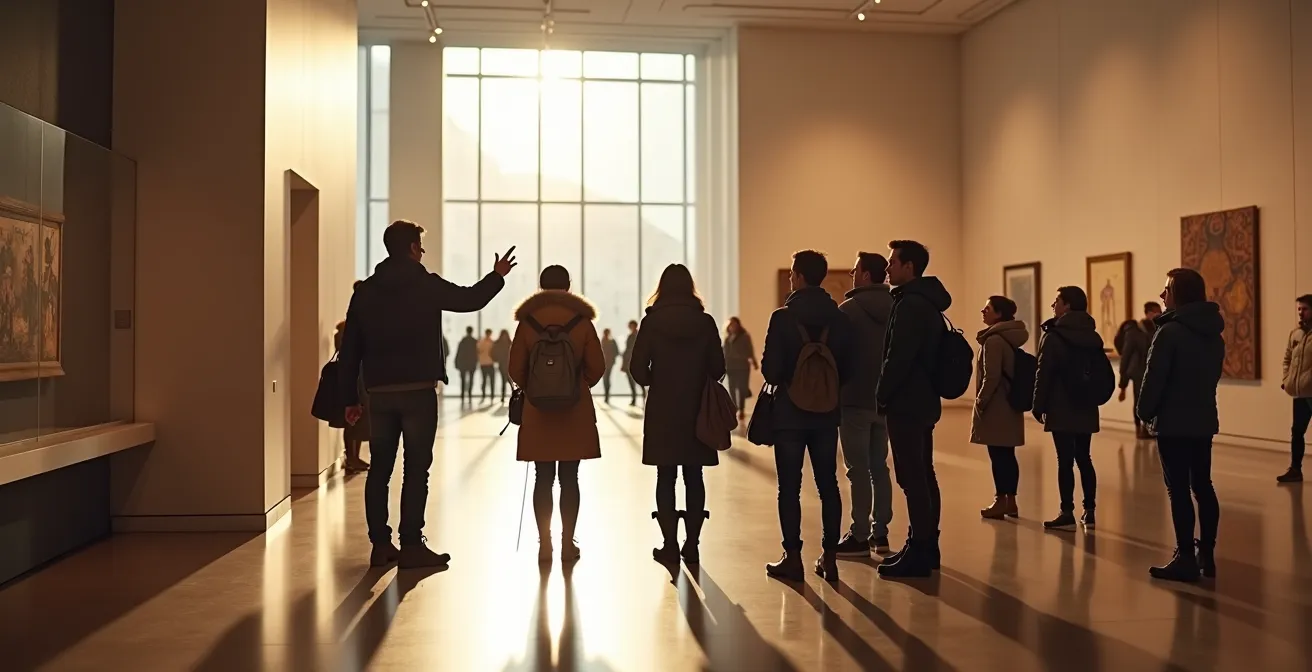
The truly erudite choice is to think thematically beyond the PATH. For the same price and comfort, a guided tour of the Royal Ontario Museum (ROM) or the Art Gallery of Ontario (AGO) offers a far richer experiential curation. These institutions are worlds unto themselves, offering deep dives into natural history, world cultures, or artistic movements. A guide transforms a potentially overwhelming museum visit into a coherent story, all within a stunning, climate-controlled environment. The PATH is a fascinating novelty, but for a truly profound indoor experience, Toronto’s world-class cultural institutions are the superior thematic choice.
Comment explorer Kensington Market sans tomber dans les pièges à touristes ?
Kensington Market is the beating heart of Toronto’s independent and multicultural spirit. Yet, its very popularity makes it susceptible to the creep of inauthenticity. For the discerning visitor, the challenge is to separate the genuine, legacy businesses from the newer, tourist-focused traps. This is where the narrative lens becomes a practical tool for discernment. As the experts at Tour Guys, a local operator, put it, the real story of Toronto is found in its “graffiti-covered laneways to epic food markets and powerful stories.”
From graffiti-covered laneways to epic food markets and powerful stories of how Toronto became Toronto—these are the experiences that guests keep recommending
– Tour Guys Toronto, Tour Guys Official Website
An authentic Kensington spot often has a “no-frills” aesthetic. Look for handwritten signs, a focus on product over polished decor, and an unpolished, gritty presentation. These are signs that the business prioritizes its craft and community over slick marketing. Another powerful method is the “Weekday Test.” Visit on a Tuesday or Wednesday afternoon. The busy shops—the butchers, the cheese mongers, the bakeries—are the ones serving the local residents, not just weekend tourists. Identifying these legacy businesses, often run by the same family for decades, is key to an authentic experience.
A good guide’s value here is immeasurable. They possess the insider knowledge to distinguish a 50-year-old institution from a 5-month-old imitation. They provide the stories behind the storefronts, giving you the context needed to truly appreciate the market’s unique ecosystem.
Your Action Plan: Auditing a Kensington Market Shop for Authenticity
- Survey the Signals: List all the visual and atmospheric cues the shop emits. Note the style of signage (hand-painted vs. corporate), the window display (product-focused vs. generic), and the general vibe.
- Gather Evidence: Inventory the specific elements. Are the products unique and locally sourced, or do they look like mass-produced souvenirs? Is the focus on the craft or on a polished brand?
- Test for Coherence: Confront these signals with Kensington Market’s core values: independence, multiculturalism, and a certain gritty charm. Does the shop fit this narrative or does it feel like an outsider?
- Gauge Memorability: Does the shop offer a unique point of view or a memorable interaction? Or is it a generic, forgettable experience designed for high turnover? This is the test for detail resonance.
- Make an Informed Choice: Based on your audit, decide whether to patronize the business. If it fails the test, use your new insight to seek out a more authentic alternative you noticed during your survey.
Comment visiter le ROM en 3 heures sans manquer les pièces maîtresses ?
The Royal Ontario Museum (ROM) is a magnificent beast. Its collections span the globe and millennia, from dinosaurs to Dior. For the time-crunched visitor, a 3-hour self-guided tour can easily become a frantic, disorienting dash, resulting in decision fatigue and a shallow appreciation of the treasures within. The common approach of “seeing the highlights” often means missing the most compelling stories. This is where a thematic guided tour provides its greatest value: it imposes a powerful, clarifying narrative on an otherwise overwhelming space.
Expert guides at the ROM don’t offer a simple checklist. They create thematic “sprints,” such as “A 3-Hour History of Global Trade Through 10 Objects” or “From Dinosaurs to Dior: A Design Journey.” This approach of narrative cohesion transforms the visit. Instead of just looking at a fossil, you understand its place in the scientific debate. Instead of just admiring an artifact, you learn about its controversial acquisition history—context that museum labels often omit.
According to extensive visitor feedback, 3-hour guided tours are consistently rated as the optimal duration for a meaningful yet manageable experience. The guide’s expertise is the key. They know the significant but often overlooked items in the Canadian and First Peoples galleries that tourists, rushing to the dinosaurs and mummies, invariably miss. The investment in a guided tour is an investment in efficiency and depth. It eliminates the stress of navigation and choice, guaranteeing that your three hours are spent absorbing a coherent story, not just wandering through galleries.
Key Takeaways
- Narrative Over Checklist: A compelling story makes a place memorable; a list of sights does not.
- Curation Creates Value: A guide’s greatest skill is not what they show you, but what they choose to leave out to strengthen the story.
- Authenticity Requires Effort: Distinguishing a true local experience from a tourist trap is an active skill you can develop.
Dîner-croisière ou tour guidé : quelle expérience offre le meilleur rapport vue/prix ?
The allure of a dinner cruise on Lake Ontario is powerful: dining with the iconic Toronto skyline as your backdrop. It promises a romantic, picture-perfect evening. However, when evaluated through the lens of value and experience, it often falls short compared to a well-chosen thematic tour. The question is not just about the view or the price, but about the quality of the overall experience and the depth of engagement with the city.
A dinner cruise offers one magnificent, but ultimately static, view. You are a passive observer from a distance. In contrast, a walking tour offers hundreds of dynamic, ground-level views of architecture, people, and the vibrant pulse of city life. The cost is often comparable when you factor in a curated dining experience. For the typical ~$150 CAD cost of a cruise with mediocre buffet food, you could enjoy a $60 walking tour followed by a $90 dinner at a top-tier local restaurant of your choice, hand-picked for its quality, not its convenience to a boat dock.
This comparative table, using data based on offerings from aggregators like Civitatis Toronto, illustrates the stark difference in value.
| Experience | Cost (CAD) | Duration | View Type | Food Quality | Cultural Value |
|---|---|---|---|---|---|
| Dinner Cruise | ~$150 | 2.5 hours | Single panoramic skyline | Buffet-style, mediocre | Passive observation |
| Walking Tour + Restaurant | $60 + $90 = $150 | 3 hours + dinner | Dynamic street-level views | Curated local dining | Active immersion |
| Toronto Hack Option | $60 tour + $9 ferry + meal | Full day flexibility | Same skyline + city details | Choice of top restaurants | Maximum engagement |
The “Toronto Hack Option” offers the best of all worlds: take a thematic walking tour for active immersion, then take the cheap public ferry to the Toronto Islands for the same stunning skyline view as the cruise, and use the money saved to dine at a truly exceptional restaurant. This approach maximizes engagement, choice, and quality, offering a far superior return on your investment.
Now that you have the framework to distinguish a simple outing from a true narrative experience, your next step is to choose the Toronto story you want to live. Will it be a tale of ghostly intrigue, a culinary adventure, or a deep dive into art and history? The choice is yours.