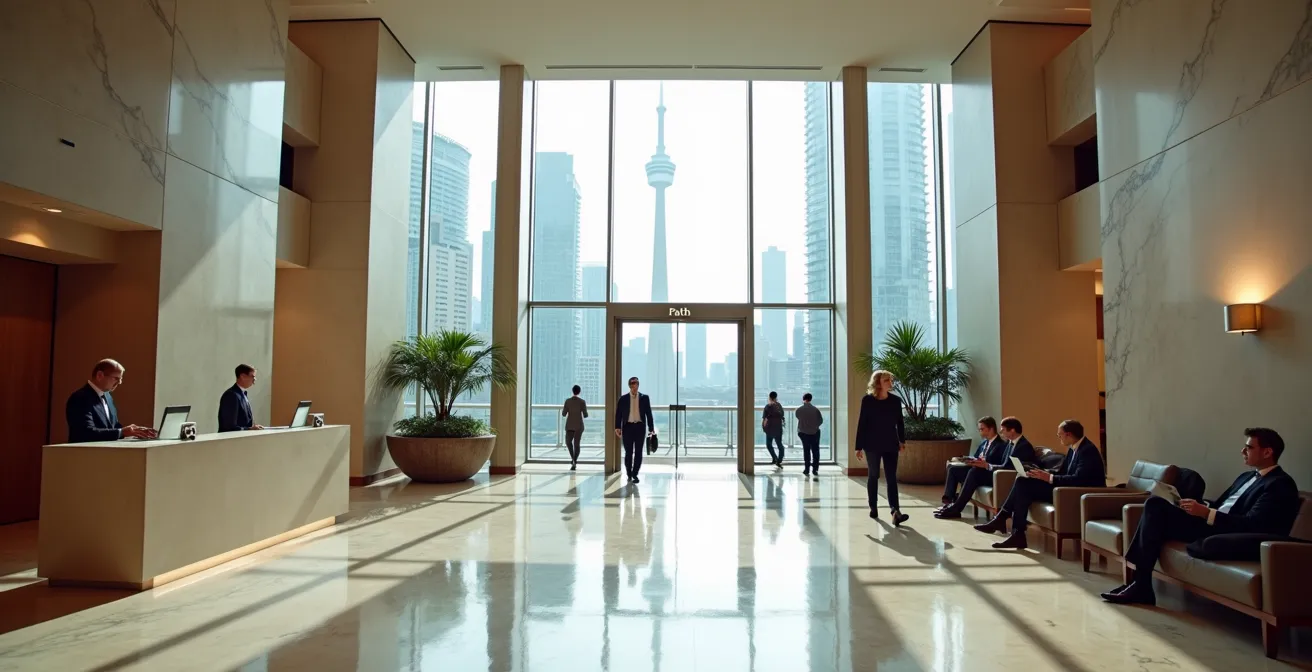
Choosing a hotel in Toronto’s Financial District is a strategic decision that directly impacts your productivity, not just your budget.
- The right hotel functions as a productivity hub with reliable, high-speed internet and ergonomic workspaces.
- Seamless logistics, from the UP Express connection to expense-compliant invoices, are non-negotiable for saving time.
Recommendation: Prioritize hotels that offer tangible business perks like guaranteed connectivity, streamlined expense reporting, and strategic loyalty benefits over simple proximity or room rate.
For the busy executive, a trip to Toronto’s Financial District is a calculated investment of time and resources. The common advice—find a hotel close to your meetings—is dangerously simplistic. In a world where a single dropped video call or a delayed expense report can have significant consequences, your choice of accommodation is not merely about a place to sleep. It is about securing a high-performance, temporary base of operations. The standard approach of comparing prices and looking for generic amenities like “free Wi-Fi” completely misses the point.
The true challenge lies in identifying the factors that genuinely enhance productivity and eliminate friction. Have you ever considered that your hotel’s Wi-Fi might be robust, but the building’s structure creates cellular “dead zones” that kill your calls? Or that the invoice you receive at checkout might be rejected by your accounting department, creating hours of administrative work? These are the hidden time-sinks that generic travel guides ignore.
But what if the hotel itself could become your greatest productivity tool? This guide abandons platitudes and focuses on a new framework: selecting a hotel as a strategic productivity hub. We will move beyond location to analyze the critical, often-overlooked details that define an efficient and successful business trip. From ensuring connectivity integrity for mission-critical tasks to leveraging loyalty programs for immediate on-the-ground advantages, you will learn how to make a choice that maximizes every billable minute.
This article provides a detailed roadmap for selecting the optimal business hotel in Toronto. We will cover everything from the tangible benefits of loyalty programs to the non-negotiable criteria for a functional remote workspace, ensuring your next trip is as productive as it is seamless.
Summary: A Strategic Guide to Choosing a Business Hotel in Toronto’s Financial District
- Points and statuses: why staying loyal to a hotel chain pays for your vacation?
- Detailed receipt or global invoice: what your accountant absolutely requires
- The mistake of not testing the internet speed before a critical video call
- Hotel lobby or private room: where to conduct a confidential interview?
- Extending the stay: how to turn a business trip into a personal weekend at a lower cost?
- UP Express or Uber: what’s the best way to get to the centre from Pearson?
- Lake view or CN Tower view hotel: which one to choose for a memorable stay?
- Ergonomic desk and fibre: the non-negotiable criteria for the remote worker
Points and statuses: why staying loyal to a hotel chain pays for your vacation?
For the strategic business traveller, loyalty is not about sentiment; it’s about return on investment. While accumulating points for future personal vacations is a pleasant side effect, the immediate, tangible benefits of elite status are what truly impact a business trip’s efficiency. In an ecosystem where 62% of room nights at major chains like Marriott and Hilton are booked by loyalty members, not participating means actively choosing a lower tier of service and amenities.
The real value lies in perks that save time and enhance productivity. Think of an executive lounge not as a place for free canapés, but as a quiet, semi-private workspace away from the chaos of a lobby or the confines of a room. Consider late check-out not as a luxury, but as a strategic tool that allows for a full day of meetings before a red-eye flight from Pearson, without worrying about luggage storage. Free premium Wi-Fi, complimentary breakfast, and room upgrades are not just “nice-to-haves”; they are direct cost savings and efficiency gains for your company.
Case Study: Strategic Loyalty in Toronto’s Financial District
Marriott’s extensive footprint in Toronto’s core, with premium properties like The Ritz-Carlton and St. Regis, exemplifies this principle. These hotels offer elite members not only luxurious accommodations but also direct access to the city’s underground PATH system—a critical time-saver during harsh Canadian winters. Loyalty status grants access to executive lounges that function as productive work environments and late checkout options that are invaluable for travellers managing late-night flights from Toronto Pearson International Airport (YYZ). This demonstrates how a loyalty program transforms a hotel stay into a seamless business advantage.
Choosing a hotel chain with a strong presence in the Financial District and committing to it allows you to build status quickly. This transforms every stay from a simple transaction into an experience where the hotel actively works to facilitate your business needs. It’s a calculated decision that pays dividends in convenience and productivity long before you ever redeem a single point for a holiday.
Detailed receipt or global invoice: what your accountant absolutely requires
One of the most significant points of friction in business travel is not the travel itself, but the administrative aftermath. An improper hotel invoice can lead to rejected expense claims, hours of back-and-forth with accounting, and delays in reimbursement. In Canada, the requirements are particularly specific, and a generic “global invoice” is often insufficient for corporate or tax purposes. Your accountant doesn’t just need a number; they need a detailed breakdown for compliance and tax recovery.
A compliant Canadian hotel invoice, or “folio,” must clearly itemize charges. Specifically, the 13% Harmonized Sales Tax (HST) and, in Toronto, the 4% Municipal Accommodation Tax (MAT) must be shown as separate line items. Lumping these into a single room rate makes it impossible for your company’s finance department to properly claim tax credits. Furthermore, incidental expenses such as meals from the restaurant, parking, or spa services must be clearly separated from the room charge itself, even if you booked a “package deal.” Failure to secure this level of detail at checkout can create a significant administrative headache upon your return.

The most efficient approach is to proactively manage this process. When you check in, inform the front desk that you will require a fully itemized folio for business expense purposes. Before you leave the counter at checkout, review the printed document to ensure it meets all the necessary criteria. The few moments this takes can save hours of frustration later.
Your Action Plan: Securing a Compliant Invoice in Toronto
- Request an itemized folio that clearly shows the 13% Harmonized Sales Tax (HST) separately from the 4% Municipal Accommodation Tax (MAT).
- Ensure room charges are separated from incidental expenses like meals, parking, and other services, even within a package.
- Verify that the hotel’s official business name and its GST/HST registration number are visible on the invoice.
- Request that a digital copy of the final folio be emailed to you immediately upon checkout to avoid front desk delays or lost papers.
- Remember to keep all receipts for any business expense over $30 CAD, as mandated by Canadian tax regulations for proper documentation.
The mistake of not testing the internet speed before a critical video call
In today’s business environment, “free Wi-Fi” is a meaningless promise. The critical metric is not its cost, but its connectivity integrity. For a business traveller, a dropped connection during a multi-million dollar presentation or a lagging video feed in a client negotiation is a catastrophic failure. Relying on the hotel’s marketing materials is a gamble; proactive testing and understanding the technological landscape are essential. The assumption that all hotel internet is created equal is one of the costliest mistakes a travelling executive can make.
Most hotels in Toronto’s Financial District offer a tiered internet service. The standard, complimentary Wi-Fi is often sufficient for basic email and web browsing, but it may be heavily throttled or suffer from congestion during peak evening hours. For high-stakes activities like 4K video streaming, large file transfers, or mission-critical video conferences, investing in the premium, paid tier is a non-negotiable insurance policy. Furthermore, savvy travellers should always look for a physical Ethernet port in the room, which provides a far more stable and secure connection than any wireless network.
Complicating matters in Toronto is a unique local challenge. Network connectivity challenges in Toronto’s core mean that the Financial District’s ‘canyon effect’ from dense skyscrapers can reduce cellular signal strength by up to 40%. This means you cannot rely on your phone’s data hotspot as a dependable backup. Your hotel’s internal network performance is paramount.
To give you a clear idea of what to expect, here is a benchmark of typical internet speeds you’ll find in business-oriented hotels in downtown Toronto, as detailed in a recent analysis of hotel amenities.
| Connection Type | Expected Speed | Cost (CAD/day) | Best For |
|---|---|---|---|
| Standard Free Wi-Fi | 15-25 Mbps | Free | Email, browsing, standard video calls |
| Premium Wi-Fi | 50-100 Mbps | $15-20 | 4K video calls, large file transfers |
| Ethernet (if available) | 100-500 Mbps | Usually free | Mission-critical presentations, stable connection |
The best practice is simple: upon arrival, run a speed test (using a site like Speedtest.net) to verify the performance of both the standard and premium Wi-Fi, if available. Making this a part of your check-in routine ensures you have the reliable connection you need, long before your first critical meeting begins.
Hotel lobby or private room: where to conduct a confidential interview?
The need for a discreet meeting space can arise unexpectedly during a business trip, whether for a sensitive client negotiation, a confidential job interview, or a private team discussion. The default choice for many—the hotel lobby—is often a poor one. A lobby, by its very nature, is a public space. Even those that appear quiet can lack acoustic privacy, leading to overheard conversations and a compromised sense of confidentiality. Choosing the right venue is a matter of professional judgment and risk management.
An effective meeting space depends entirely on the level of confidentiality required. A casual catch-up with a colleague might be perfectly suitable for a well-designed lobby lounge. However, for any discussion involving proprietary information, personnel matters, or contract negotiations, a private setting is non-negotiable. This doesn’t necessarily mean booking a full-day conference room. Many modern business hotels offer flexible solutions, such as bookable “pods” or small, private meeting rooms available by the hour. An executive lounge, accessible through loyalty status, can also offer a step up in privacy from the main lobby.
Case Study: A Tale of Three Toronto Lobbies
The choice of venue can make or break a confidential meeting, and Toronto’s top hotels offer varied environments. The Shangri-La Toronto’s lobby lounge, for instance, is specifically engineered for quiet business talks, featuring acoustic dampening materials and strategically separated seating arrangements that enhance privacy. In stark contrast, the magnificent lobby of the Fairmont Royal York acts as a major public thoroughfare connected to Union Station, with constant high foot traffic making it entirely unsuitable for any sensitive discussion. The Ritz-Carlton offers a compelling middle ground; its ground-floor DEQ lounge provides semi-private nooks that are a significant upgrade from a completely open space, suitable for less formal but still discreet conversations.
The key is to assess the hotel’s offerings before you need them. When booking, inquire about the availability and cost of private or semi-private meeting spaces. A quick look at photos of the lobby can also provide clues: are the seating areas clustered together or spaced out for privacy? Making this assessment part of your hotel selection criteria ensures you have a viable, confidential meeting option ready if the need arises.
Extending the stay: how to turn a business trip into a personal weekend at a lower cost?
The concept of “bleisure”—blending business travel with leisure—has evolved from a trend into a strategic tool for work-life balance and talent retention. For the executive visiting Toronto, extending a trip through the weekend offers a chance to decompress and experience the city without the cost of a separate flight. The key to doing so cost-effectively is leveraging the logistical advantages of your business stay, particularly if your hotel is strategically located near the Financial District and major transport hubs.
Many companies are open to this arrangement, provided there is a clear separation of costs. The typical agreement involves the company covering the “business” portion of the stay, including the flight and weekday accommodation, while the employee covers the additional hotel nights and personal expenses for the weekend. To make this attractive, negotiate with your hotel for a reduced weekend rate. Hotels are often eager to fill rooms on Fridays and Saturdays and may offer a corporate rate extension, especially if you hold elite status with their loyalty program. Booking directly with the hotel, rather than through a third-party site, gives you the most leverage for this type of negotiation.

Case Study: Using Union Station as a “Bleisure” Gateway
The proximity of Financial District hotels to Union Station transforms it into a perfect hub for weekend exploration. After a week of meetings, an executive can easily pivot to leisure travel. The UP Express provides a direct, reliable route back to Toronto Pearson Airport for connections or a stress-free departure. For regional adventures, VIA Rail, also at Union Station, offers comfortable and scenic train journeys to destinations like Montreal (a 4.5-hour trip), the capital city of Ottawa (4 hours), or the historic city of Kingston (2.5 hours). Even a day trip to Niagara Falls is simplified, with dedicated bus services running directly from the area. Many hotels near Union Station capitalize on this by offering packages that bundle accommodation with VIA Rail tickets, further streamlining the transition from business to leisure.
By planning ahead, you can transform a demanding business trip into a refreshing mini-vacation. The trick is to see your hotel not just as a weekday base, but as a launchpad for personal discovery, using the city’s world-class infrastructure to your advantage.
UP Express or Uber: what’s the best way to get to the centre from Pearson?
Your first decision upon landing at Toronto Pearson International Airport (YYZ) will set the tone for your entire trip. The choice between a ride-sharing service like Uber or the dedicated UP Express train to Union Station is not a matter of preference, but a strategic calculation of time versus cost. For the time-conscious executive, where minutes can translate directly into billable hours or missed opportunities, the answer is almost always clear. While Uber offers door-to-door convenience, it is subject to the notorious volatility of Toronto’s traffic.
The Gardiner Expressway and Don Valley Parkway, the main arteries into the downtown core, are frequently congested, especially during peak morning and afternoon rush hours. A journey that might take 35 minutes in light traffic can easily stretch to 90 minutes, making any arrival time unpredictable. The cost is equally variable, with surge pricing during rush hour or bad weather often pushing fares into the $80-$120 range. While Uber can be cost-effective for a group of three or four, for a solo traveller, the risk of delay often outweighs the convenience.
In contrast, the UP Express is a model of efficiency and predictability. Transportation data confirms that the UP Express guarantees a 25-28 minute journey from Pearson to Union Station for $12.35 or less. Trains depart every 15 minutes, seven days a week. This guaranteed travel time removes all the uncertainty of road traffic, allowing for precise planning of your arrival at the hotel or your first meeting. From Union Station, most hotels in the Financial District are a short walk, often through the climate-controlled PATH system, or a quick, inexpensive taxi ride.
This table, based on information from official sources like the Toronto Transit Commission (TTC), breaks down the core trade-offs for a solo traveller heading to the Financial District.
| Transportation Mode | Travel Time | Cost (CAD) | Best For |
|---|---|---|---|
| UP Express | 25-28 minutes | $12.35 ($9.25 with PRESTO) | Solo travelers, guaranteed timing |
| Uber/Lyft (off-peak) | 35-45 minutes | $50-70 | Groups of 2-3, direct to hotel |
| Uber/Lyft (rush hour) | 60-90 minutes | $80-120 | Heavy luggage, mobility issues |
| TTC (900 Airport Express) | 60-75 minutes | $3.35 | Budget travelers, flexible schedule |
Unless you are travelling with a group or have excessive luggage, the UP Express is the superior strategic choice. The certainty of its schedule provides a level of control and predictability that is invaluable at the start of a packed business trip.
Lake view or CN Tower view hotel: which one to choose for a memorable stay?
While logistical factors are paramount, the psychological impact of your environment should not be underestimated. The view from your hotel room is more than just a backdrop for an Instagram post; it can actively influence your mood, energy levels, and even your productivity. In Toronto, the choice often comes down to two iconic perspectives: the dynamic, urban energy of the CN Tower and city skyline, or the calm, expansive tranquility of Lake Ontario. The “best” view is not absolute—it’s relative to the goals of your trip.
An environment can prime your mindset. A view of the bustling Financial District and the iconic CN Tower can be energizing and motivating, keeping you mentally connected to the business pulse of the city. It serves as a constant reminder of the objectives of your trip. Conversely, a serene view over the vast expanse of Lake Ontario can have a calming effect, providing a mental escape and helping to reduce stress after a day of high-stakes meetings. For a trip focused on intense negotiation or creative problem-solving, this psychological distance can be a powerful asset.
Case Study: The Psychology of a Room View at The St. Regis Toronto
Data from hotels like The St. Regis Toronto reveals a fascinating correlation between room view and guest behaviour. The hotel has observed that guests in rooms facing the CN Tower report higher energy levels and a greater sense of productivity during daytime working hours. In contrast, Lake Ontario-facing rooms are preferred by guests seeking stress reduction, with internal surveys showing that 68% of these guests feel more relaxed after intensive meetings. Interestingly, the hotel’s data also indicates that north-facing rooms, which receive the most consistent and neutral natural light throughout the day, are ideal for remote work and are less prone to creating glare or backlighting issues during video calls.
Ultimately, the decision is a personal one. If your trip is a short, intense burst of meetings where you need to be “in the zone,” a city view might be the superior choice. If you’re in town for a longer, more strategic session that requires clear-headedness and reduced stress, a lake view could be a worthwhile investment in your mental well-being. Consider the nature of your work and choose the environment that best supports it.
Key Takeaways
- Your hotel is a productivity hub; its primary function is to maximize your efficiency.
- Connectivity integrity (reliable, high-speed internet) and ergonomic workspaces are non-negotiable.
- Streamline logistics by choosing hotels with easy access to the UP Express and that provide expense-compliant invoices.
Ergonomic desk and fibre: the non-negotiable criteria for the remote worker
The modern business trip has fundamentally changed. The hotel room is no longer just a place to sleep; it’s a remote office, a video conference studio, and a command centre. As such, the two most critical pieces of in-room infrastructure are a functional workspace and a rock-solid internet connection. Treating these as afterthoughts is a direct path to inefficiency, discomfort, and professional embarrassment. A “desk” that is merely a small, round table and a chair designed for aesthetics rather than support are unacceptable for any serious work session.
An ergonomic workspace is essential for maintaining focus and avoiding physical strain. Key features to look for include:
- Sufficient Desk Space: A minimum width of 48 inches (122 cm) and depth of 24 inches (61 cm) is needed to accommodate a laptop, a second screen or documents, and a drink without feeling cramped.
- An Adjustable Chair: Look for a true office chair with adjustable height, proper lumbar support, and armrests. A stylish but unsupportive side chair will lead to discomfort within an hour.
- Accessible Power: There should be at least three accessible power outlets near the desk, so you are not forced to crawl under furniture to plug in your devices.
- Good Lighting: A combination of natural light from a window and adjustable task lighting is crucial to prevent eye strain.
Alongside the physical setup, the digital infrastructure is equally vital. As discussed, a wired Ethernet connection (fibre) is always superior to Wi-Fi for stability and speed, making it a non-negotiable for anyone planning mission-critical presentations or long video conferences from their room.
Case Study: Toronto Hotels Embracing the “Work-From-Hotel” Model
Leading Toronto hotels are recognizing this shift. The Fairmont Royal York, for example, has renovated rooms to create dedicated ‘productivity zones’ that feature high-end Herman Miller chairs and height-adjustable desks. They also offer a library-style business lounge with individual work pods as an alternative workspace. Meanwhile, newer properties like the Ace Hotel Toronto are built from the ground up to be work-friendly, with integrated co-working spaces that blur the lines between a traditional hotel and a modern office, catering directly to the needs of the remote professional.
Your choice of hotel is the single most important decision for a productive Toronto business trip. By moving beyond price and prioritizing factors like connectivity, workspace ergonomics, and logistical efficiency, you transform your accommodation from a simple expense into a strategic asset. Evaluate your options through this lens to ensure your next trip is not just successful, but seamlessly efficient.
Frequently Asked Questions About Toronto Business Hotels
Is it worth paying extra for a premium view room?
For business travelers staying only one or two nights, a standard room often offers better value. The savings, typically ranging from $50 to $100 per night, can be more strategically allocated to productivity enhancers like premium Wi-Fi, room service to save time, or a car service for a critical meeting.
How does room orientation affect video call quality?
Room orientation is a critical but often overlooked factor. North-facing rooms in Toronto provide the most consistent, neutral, and soft lighting for video calls throughout the day. This orientation helps you avoid the harsh shadows of an east-facing room in the morning or the strong backlighting of a west-facing room in the afternoon, ensuring you always look professional on camera.