
In summary:
- Unlock major savings by timing your visit for the “shoulder season” (like November) to cut accommodation costs by up to 40%.
- Master the PRESTO card for seamless travel on both the TTC (city) and GO Transit (suburbs), avoiding costly traffic and parking.
- Prioritize depth over breadth: fully experience two or three “neighbourhood clusters” instead of rushing to check off a long list of sights.
You’ve got the long weekend booked, and a map of Toronto is staring back at you. There’s that initial jolt of excitement, quickly followed by a wave of low-key panic. The CN Tower, Ripley’s Aquarium, countless museums, and a dozen neighbourhoods all vying for a spot on your tight 72-hour schedule. The fear of missing out is real, and the fear of blowing your budget is even more pressing. Most guides will give you the standard checklist: see the tower, eat some poutine, maybe buy a CityPASS. It’s a formula for a trip that’s predictable and, frankly, inefficient.
But what if the secret to a memorable and affordable Toronto weekend wasn’t about *what* you see, but *how* you navigate the city’s pulse? The key isn’t a frantic race against the clock, but a strategic understanding of the city’s operational rhythms. It’s about knowing when to visit, how to move, and where to focus your energy to unlock a richer experience for a fraction of the cost. This isn’t just about saving money; it’s about saving your most valuable asset: time.
This guide is your local’s playbook. We’ll dismantle the common tourist traps and give you a framework for a smarter trip. We’ll start by showing you the single biggest money-saving decision you can make, then dive into mastering the transit system that is the city’s lifeblood. From there, we’ll analyze the real value of attraction passes and show you how to eat, explore, and enjoy Toronto like someone who calls it home, all while keeping your budget firmly intact.
To help you structure your planning, this guide is broken down into key strategic decisions. Follow these steps to build an itinerary that is both ambitious and realistic, ensuring your three days in Toronto are spent making memories, not stuck in traffic or tourist lines.
Summary: How to Organize a 3-Day Weekend in Toronto for Less Than $1000 CAD
- Why Visiting Toronto in November Can Save You 40% on Accommodation
- How to Use the PRESTO System and the TTC to Traverse Greater Toronto Without Stress
- CityPASS or Individual Tickets: Which Option to Choose for Visiting 4 Major Attractions?
- The Planning Mistake That Makes You Lose 3 Hours in Gardiner Expressway Traffic
- Where to Eat Like a Local Near Tourist Attractions Without Paying the “Tourist Price”
- How to Combine Car and Public Transport to Cross the GTA Efficiently
- Why Visiting Fewer Neighbourhoods Allows for a Better Understanding of Toronto
- How to Plan a Family Trip to Toronto Without Blowing the Accommodation Budget
Why Visiting Toronto in November Can Save You 40% on Accommodation
Alright, let’s get one thing straight: the single biggest factor that will determine if you stay under that $1000 budget is *when* you visit. Summer in Toronto is fantastic, but it’s also peak season, with hotel prices to match. The secret weapon for budget-savvy travellers is the “shoulder season,” and November is the prime example. While you might trade sunny patios for crisp autumn air, the financial payoff is enormous. The city is quieter, the crowds at major attractions thin out, and your wallet stays heavier.
The numbers don’t lie. Post-Thanksgiving and pre-Christmas rush, downtown business hotels often see significant price drops. In fact, recent travel data shows that the average nightly hotel rate can plummet from around $149 in peak season to as low as $89. For a three-night stay, that’s an immediate saving of nearly $180, which can be reallocated to experiences, food, or shopping. This isn’t a small discount; it’s a game-changer that makes the entire budget feasible.
Beyond the hotel bill, the benefits of a November visit compound. You’ll experience the Royal Ontario Museum (ROM) and Art Gallery of Ontario (AGO) with minimal crowds, allowing you to actually spend time with the exhibits instead of waiting in line. You can take advantage of pre-holiday sales at the Eaton Centre before the December chaos descends. You can even get a first look at the charming Distillery Winter Village without the peak pricing and crowds of late December. If November feels too chilly, consider the other shoulder season in late April or early May for a similar blend of savings, cherry blossoms, and the first patio openings of the year.
How to Use the PRESTO System and the TTC to Traverse Greater Toronto Without Stress
Welcome to the heart of Toronto’s operational rhythm: its public transit. Trying to navigate Toronto by car as a visitor is a recipe for frustration and expensive parking tickets. The Toronto Transit Commission (TTC)—with its network of subways, streetcars, and buses—is your key to the city. Your passport to this system is the PRESTO card, a reloadable tap-on, tap-off payment card that makes getting around seamless. You can buy one at any subway station or Shoppers Drug Mart for a few dollars and load it with funds as you go.
The beauty of PRESTO is its simplicity and built-in fairness. When you tap your card, a two-hour transfer window is automatically activated. This means you can tap onto a subway, switch to a streetcar, and then hop on a bus, all for a single fare, as long as it’s within that two-hour period. This encourages exploration and makes multi-stop journeys incredibly cost-effective. Forget fumbling for tokens or exact change; just tap and go.
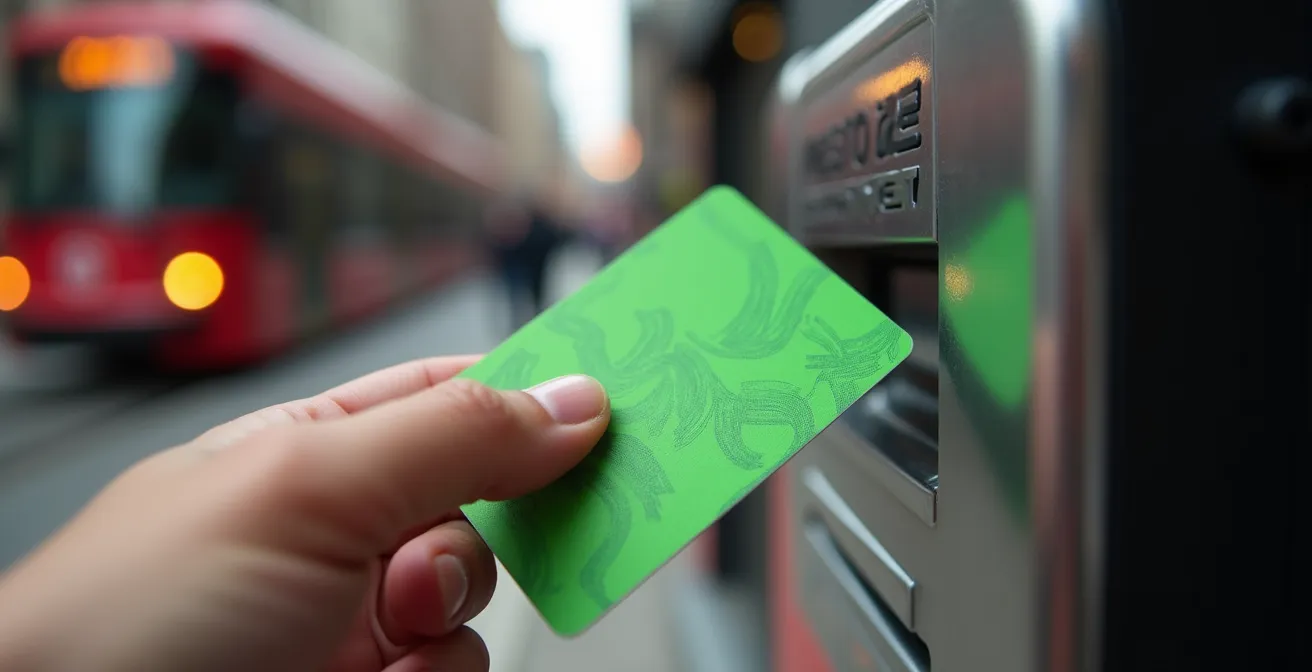
Now for the strategy. Many visitors immediately ask about day passes. While the TTC offers a Day Pass for $13.50, it’s not always the best deal. A single ride with PRESTO is $3.35. This means you need to take more than four trips in a single day to make the Day Pass worthwhile. For a couple on a strategic itinerary, you’ll likely hit 3-4 trips per day, making the pay-as-you-go PRESTO option cheaper. The pass only becomes a clear winner on a day you plan a whirlwind of cross-city travel.
This table breaks down the cost, showing how the Day Pass only provides value on your fifth trip of the day. For most strategically planned weekends, sticking with pay-as-you-go on your PRESTO card is the smarter financial move.
| Daily Trips | Pay-As-You-Go ($3.35/tap) | Day Pass ($13.50) | Savings with Pass |
|---|---|---|---|
| 2 trips | $6.70 | $13.50 | -$6.80 |
| 3 trips | $10.05 | $13.50 | -$3.45 |
| 4 trips | $13.40 | $13.50 | -$0.10 |
| 5+ trips | $16.75+ | $13.50 | $3.25+ |
CityPASS or Individual Tickets: Which Option to Choose for Visiting 4 Major Attractions?
The Toronto CityPASS is one of the most heavily promoted tourist products, promising significant savings on top attractions. It bundles entry to the CN Tower, Ripley’s Aquarium of Canada, Casa Loma, the Royal Ontario Museum, and the Toronto Zoo or Ontario Science Centre. The question is: does it actually save you money and time on a short, 3-day trip? The answer is a firm “it depends on your plan.”
The pass’s primary value lies in its potential for savings and line-skipping privileges. For a family or a couple committed to seeing at least three or four of the included attractions, the savings can be substantial. For example, a recent analysis showed a family of four visiting the CN Tower, Ripley’s, Casa Loma, and the ROM saved around $180 by using the CityPASS compared to buying individual tickets. Critically, the skip-the-line access at the CN Tower saved them a full hour during a peak visiting period, a huge win on a tight schedule. This is where the pass truly shines: it saves you both money and your most precious commodity, time.
Case in Point: The Strategic Use of CityPASS
A couple planning a 3-day trip knew they wanted to see the CN Tower, Ripley’s Aquarium, and Casa Loma. Individually, tickets would have cost them over $240. With the CityPASS, their cost was under $200, and it gave them the flexibility to add the ROM on their last day. By clustering the CN Tower and Ripley’s (which are right next to each other) on the same afternoon, they maximized their time. However, they acknowledged that without this geographic clustering, the 9-day validity period wouldn’t have mattered; they would have wasted time crisscrossing the city.
However, the pass also imposes constraints. It locks you into a specific set of attractions, potentially at the expense of discovering a smaller gallery or unique neighbourhood that truly captures your interest. If you only plan on visiting two of the five attractions, you will almost certainly lose money. Before you buy, you must do the math and check your map.
Your CityPASS Decision Checklist
- Count your must-see attractions: You need a minimum of three of the five included sites to start seeing real value.
- Factor in time savings: Is the skip-the-line access at popular spots like the CN Tower worth the upfront cost? On a weekend, it absolutely can be.
- Map your route: Group attractions geographically. Plan to visit the CN Tower and Ripley’s Aquarium on the same day, as they are neighbours.
- Check validity dates: The pass is valid for 9 consecutive days from the first use, giving you flexibility within your weekend.
- Consider the flexibility trade-off: Are you willing to be locked into these five attractions, or do you prefer the freedom to discover alternatives spontaneously?
The Planning Mistake That Makes You Lose 3 Hours in Gardiner Expressway Traffic
Here’s the single biggest mistake first-time visitors make: underestimating Toronto traffic and overestimating the utility of a car. The Gardiner Expressway, the main artery into the downtown core, can turn into a parking lot during peak hours (roughly 7-10 AM and 3-7 PM). Driving from the suburbs or the airport during these times can easily add 90 minutes to your journey each way. That’s three hours of your precious vacation time spent staring at tail lights.
The financial cost is just as punishing. Downtown parking is notoriously expensive, and comparing transportation costs reveals that a single day of parking can run you $30-50, while a day pass on regional transit might be a fraction of that. The “freedom” of having a car is an illusion when you’re trapped in gridlock and bleeding money for a parking spot.
The smart alternative is what we call “transit arbitrage.” This means using the regional GO Transit system to your advantage. If you’re driving in from outside the city, park for free at a suburban GO Station like Aldershot (from the west) or Pickering (from the east) and take the comfortable, reliable train straight to Union Station in the heart of downtown. A visitor driving from Hamilton saved 90 minutes and $38 by doing exactly this. Similarly, the UP Express train from Pearson Airport offers a fixed 25-minute journey to Union Station for about $12.35, a far better option than an unpredictable 45-90 minute taxi ride that can cost over $50. This is the essence of mastering the city’s rhythms: knowing when to drive and, more importantly, when to park and ride.
Where to Eat Like a Local Near Tourist Attractions Without Paying the “Tourist Price”
You’ve just spent the morning at the CN Tower, and now you’re hungry. The restaurants at its base have great views and astronomical prices. This is the classic tourist trap. The key to eating well and affordably in Toronto is the “Two-Block Rule.” Simply walk two blocks in any direction away from a major tourist attraction, and you’ll find prices drop by as much as 30% and authenticity skyrockets.
Instead of the restaurants at the base of the tower, walk ten minutes north to Queen Street West, a vibrant strip filled with independent restaurants, pubs, and cafes catering to locals. The food is better, the atmosphere is real, and the prices are fair. Another pro-tip is to leverage the city’s underground PATH system. On weekdays, the food courts under major office towers like First Canadian Place are bustling with office workers grabbing delicious and diverse lunch deals for under $15.

For a truly iconic Toronto food experience, head to the St. Lawrence Market. But don’t just wander aimlessly. Go in the morning and head straight to Carousel Bakery for their world-famous Peameal Bacon Sandwich—a true local staple at a local’s price. For a wider variety, the Grange Food Court next to the Art Gallery of Ontario (AGO) offers a fantastic selection of Asian cuisines at prices that are half of what you’d pay in the main tourist corridors. Finally, do what Toronto office workers do: download an app like Ritual to order ahead and access exclusive deals, letting you skip lines and save money simultaneously.
How to Combine Car and Public Transport to Cross the GTA Efficiently
For a 3-day trip focused on the city core, a car is more of a liability than an asset. But what if your plans include an outing to a suburban attraction like Canada’s Wonderland or a shopping trip to Vaughan Mills? This is where a hybrid approach—combining your car with public transport—becomes a brilliant strategy. It’s the ultimate form of “transit arbitrage,” letting you enjoy the convenience of a car for the long haul and the efficiency of the subway for the “last mile.”
The key is understanding the two main transit systems. The TTC covers the city of Toronto proper (the 416 area code). GO Transit is the regional network connecting the surrounding suburbs (the 905 area code) to the downtown core. Your PRESTO card works seamlessly across both. The strategy is to drive to a transit hub on the edge of the city, park your car (often for free, especially on weekends), and use the TTC or GO to complete your journey. This way, you avoid the worst of downtown traffic and the high cost of city parking.
The GO Weekend Pass Success Story
A family visiting Canada’s Wonderland provides a perfect example. Instead of driving all the way to the park and paying for parking, they drove to Vaughan Metropolitan Centre station, where weekend parking is free. They then took the subway one stop directly to the park’s entrance. Furthermore, by using a GO Weekend Pass ($10/day for unlimited travel), they were able to explore multiple destinations across the Greater Toronto Area (GTA) over the weekend, all while leaving their car parked and avoiding any downtown driving stress. This strategy saved them over $45 in parking and gas while significantly reducing their carbon footprint.
This park-and-ride method is the secret to efficiently exploring the wider GTA. It gives you the best of both worlds: the reach of a car and the stress-free, cost-effective nature of public transit. It requires a little planning, but the payoff in time and money is immense.
Why Visiting Fewer Neighbourhoods Allows for a Better Understanding of Toronto
The temptation on a short trip is to create a checklist: Kensington Market, Yorkville, Distillery District, Queen West. You spend 90 minutes in each, rushing from one to the next, mostly seeing the inside of a subway car. You end the day exhausted, having “seen” everything but experienced nothing. This is the opposite of a smart travel strategy. The counter-intuitive truth is this: you will understand Toronto better by visiting fewer neighbourhoods more deeply.
Instead of a frantic city-wide tour, choose one or two “neighbourhood clusters” for a full-day immersion. This approach, which we call “strategic slowness,” allows you to discover the true character of an area. You’ll find the hidden cafes, browse the independent boutiques, and maybe even strike up a conversation with a local. This is where the real memories are made, not in a selfie in front of a landmark.
Consider these full-day immersion clusters:
- The Annex & Yorkville: Start with classic bagels and intellectual vibes in The Annex, walk through the beautiful University of Toronto campus, and finish with upscale window shopping and gallery hopping in posh Yorkville.
- West Queen West, Ossington & Trinity Bellwoods: Dedicate a day to Toronto’s capital of cool. Explore the cutting-edge galleries on Ossington, hunt for vintage treasures on Queen Street West, and relax with locals in Trinity Bellwoods Park.
- The Distillery District & Old Town: Dive into Toronto’s history. Wander the cobblestone streets of the Distillery District, home to artisan shops and breweries, then walk over to the St. Lawrence Market and the historic buildings of Old Town.
As one local travel expert wisely puts it, true travel is about connection, not collection.
You’ll have a more memorable trip by truly experiencing the coffee shops, boutiques, and parks of one neighbourhood than by spending that precious time on the subway just to ‘check off’ another one.
– Local Toronto Travel Guide, Fringinto Blog
Key takeaways
- Strategic Timing: Visiting in a shoulder season like November is the single most effective way to reduce costs.
- Transit Mastery: Using a PRESTO card for pay-as-you-go and park-and-ride strategies is cheaper and faster than relying on a car.
- Depth Over Breadth: Immersing yourself in one or two neighbourhood clusters creates a more memorable and authentic experience than a rushed city tour.
How to Plan a Family Trip to Toronto Without Blowing the Accommodation Budget
The principles of smart travel—timing, transit, and focus—are universal, but they become even more critical when planning for a family. The biggest line item on any family trip is accommodation, and downtown Toronto hotel prices can be daunting. The solution, however, is surprisingly simple and ties directly into mastering the transit system: stay just outside the downtown core, but directly on a subway line.
You don’t need to be at Yonge and Dundas to have access to everything. Properties located just a 15-minute subway ride from downtown on Line 1 (Yonge-University) or Line 2 (Bloor-Danforth) can be significantly cheaper. In fact, accommodation pricing analysis shows you can find savings of 30-50% by shifting your search just a few kilometres north, east, or west of the core. This simple move can save you hundreds of dollars over a weekend, freeing up cash for family-friendly activities.
Another brilliant, often overlooked strategy for summer travel is booking a suite at a university residence. From May to August, universities like the University of Toronto and Toronto Metropolitan University rent out their empty dorm rooms to visitors. These are not spartan cells; many, like UofT’s Chestnut Residence, offer multi-room suites with kitchenettes for a fraction of the price of a comparable hotel. A family of four saved $600 over three nights with this strategy, and the kitchenette allowed them to prepare breakfasts and snacks, saving an additional $100. The central locations and safe, campus-like environments make them an ideal and affordable base for family exploration.
By applying these strategies—from timing your visit to choosing your accommodation wisely—you are no longer just a tourist. You are a strategic traveller, ready to experience the best of Toronto without the stress and overspending. The next logical step is to take these principles and build your own personalized, efficient, and unforgettable itinerary.