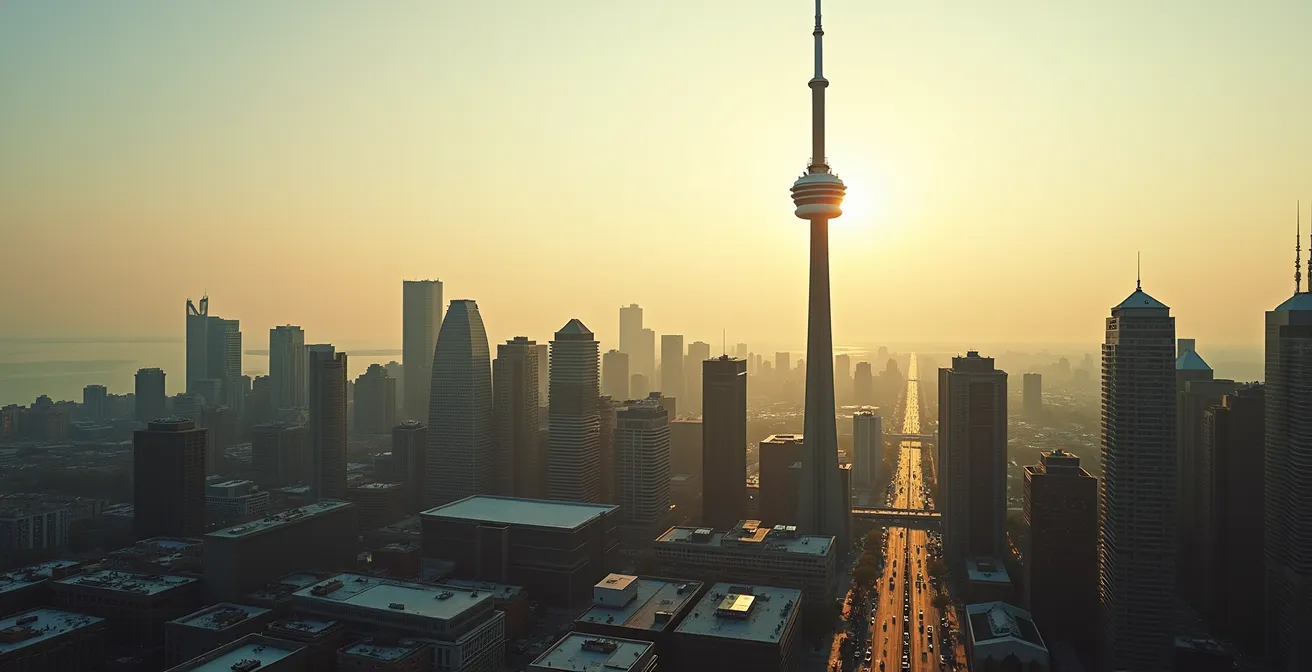
The success of your CN Tower visit is not determined by the ticket you buy, but by the strategic sequence of decisions you make beforehand.
- The optimal time to book your ticket is 45-60 minutes before sunset to experience day, “golden hour,” and night views in one visit.
- Standard weather apps are unreliable; use aviation weather reports (METAR) and live webcams to check real-time visibility at 500 meters.
- Dining at the 360 Restaurant is a legitimate strategy to bypass general admission queues, often at a comparable all-in cost to a separate ticket and downtown meal.
Recommendation: Treat your visit like a tactical mission. Lock in your strategically timed tickets online now to de-risk the experience and guarantee a flawless ascent.
For any international tourist, the CN Tower punctuates the Toronto skyline not just as a landmark, but as a mandatory experience. Yet, the iconic image of the tower is often replaced on the ground by a more frustrating reality: a seemingly endless queue snaking from the entrance, promising a two-hour wait under the sun or in the cold. The common advice—buy tickets online, go early—is a well-meaning but incomplete solution to a complex logistical problem. It addresses the transaction, but not the strategy.
The truth is, beating the crowds at a world-class attraction isn’t about finding a secret loophole. It’s about out-planning them. The difference between a memorable ascent and a day wasted in line comes down to a series of calculated decisions regarding timing, weather intelligence, and an objective analysis of value propositions like the 360 Restaurant or the SkyPod. Viewing the visit as an operational challenge, rather than a simple ticket purchase, is the key to transforming this potentially frustrating tourist rite of passage into a seamless and spectacular memory.
This guide serves as your tactical playbook. We will move beyond the generic tips and dissect each decision point you will face. From interpreting aviation-grade weather forecasts to calculating the precise break-even point of a CityPASS, you will be equipped with the actionable intelligence needed to conquer the CN Tower efficiently and get the absolute maximum value from every dollar spent and minute invested.
This article provides a comprehensive operational plan for your visit. Below, you’ll find a summary of the key strategic areas we will cover, from daredevil experiences and dining hacks to detailed timing and ticketing analysis, ensuring you’re fully prepared for a perfect trip to Toronto’s most famous landmark.
Summary: Your Complete Tactical Guide to the CN Tower
- EdgeWalk : est-ce vraiment sécuritaire pour quelqu’un qui a le vertige ?
- Manger au restaurant 360 : l’astuce ultime pour éviter de payer le billet d’ascenseur ?
- Quel créneau réserver pour voir Toronto de jour et de nuit avec un seul billet ?
- L’erreur de monter par temps couvert : comment lire les prévisions spécifiques à 500m ?
- SkyPod ou Belvédère principal : les 15 $CAD supplémentaires valent-ils le coût ?
- Comment visiter l’Aquarium Ripley sans subir la foule des jours de pointe ?
- Hôtel vue lac ou vue tour CN : lequel choisir pour un séjour mémorable ?
- CityPASS ou billets individuels : quelle option choisir pour visiter 4 attractions majeures ?
EdgeWalk : est-ce vraiment sécuritaire pour quelqu’un qui a le vertige ?
The immediate question about the EdgeWalk is safety, especially for those with a fear of heights. The answer is an unequivocal yes. The system’s engineering and safety protocols are exhaustive. It is, after all, the world’s highest external walk on a building, certified by Guinness World Records. The more relevant question is not about physical safety, but about managing the psychological experience of vertigo.
The CN Tower team has designed the entire experience as a structured psychological onboarding process, not just a thrill ride. From the moment you arrive at the EdgeWalk base camp, every step is designed to build confidence and mitigate anxiety. The 30-minute orientation on the ground is critical; guides demonstrate the dual-attachment harness system, which connects to an overhead trolley rail, making an accidental fall physically impossible. This hands-on demonstration allows you to understand and trust the equipment before you even begin the ascent.
During the ride up, guides teach controlled breathing techniques, a simple but powerful tool to manage adrenaline. Once on the 1.5-meter wide ledge, the walk begins on the south side of the tower, where the building’s mass provides a significant psychological buffer. Participants are encouraged to progress at their own pace, with continuous support and encouragement. This gradual exposure, combined with world-class safety engineering, makes it a manageable—and often transformative—experience even for individuals with a moderate fear of heights.
Manger au restaurant 360 : l’astuce ultime pour éviter de payer le billet d’ascenseur ?
Calling it a “trick” is a misnomer; it’s a value proposition. Dining at the 360 Restaurant includes complimentary access to the Main Observation Level, effectively allowing you to bypass the general admission ticket line and cost. The strategic question is whether the total cost of the meal provides a better overall value than buying a tower ticket and dining elsewhere downtown. For many visitors, particularly couples or those celebrating an occasion, the answer is a firm yes.
A prix fixe menu at 360 typically requires a minimum spend per person, which often lands in the $75-$95 CAD range. When you subtract the $43 CAD cost of a standard adult admission ticket, the meal itself costs between $32 and $52. Finding a comparable multi-course meal in Toronto’s core for that price is challenging. More importantly, this analysis doesn’t account for the unparalleled experience: 72 minutes of a slowly rotating, panoramic view of the city from your dining table. The time saved by skipping the main queue is an additional, significant benefit.
The following table breaks down the cost-benefit analysis. It demonstrates that the all-in cost of the 360 Restaurant experience is highly competitive, especially when factoring in the included elevator access and unique ambiance that a separate downtown restaurant cannot offer.
| Option | Cost (CAD) | What’s Included | Time Required |
|---|---|---|---|
| 360 Restaurant Prix Fixe | $75-95 per person | Elevator access + 72-minute rotating view + Full meal | 2-3 hours |
| General Admission + Comparable Downtown Restaurant | $43 (ticket) + $60-80 (meal) = $103-123 | Observation deck access + Separate dining without tower views | 1.5 hours (tower) + 1.5 hours (dining) |
| VUE Bistro Option | $43 (ticket) + $25-35 (casual meal) | Main observation level access + Quick bistro meal with partial views | 1.5-2 hours total |
Quel créneau réserver pour voir Toronto de jour et de nuit avec un seul billet ?
This is the single most critical strategic decision for maximizing the value of your ticket. The goal is to experience the transition from daylight to “golden hour,” sunset, “blue hour,” and full nighttime illumination with a single entry. The key is to book your timed-entry slot approximately 45 to 60 minutes before the official sunset time for that day. A timed-entry ticket grants you access at a specific time, but you can stay on the observation levels for as long as you wish.
Executing this strategy requires more than just booking; it involves tactical positioning once you are on the observation deck. As outlined by professional photographers, upon arrival, you should immediately secure a spot at the west-facing windows of the Main Observation Level to capture the best sunset views over the city and Lake Ontario. As the sun disappears and the city lights begin to emerge, you then move to the northwest corner. This position offers a commanding view of both the illuminated downtown financial core and the darkening expanse of the lake, allowing for stunning cityscape photography.
The optimal booking time varies significantly by season, as sunset times in Toronto shift dramatically throughout the year. The following table provides a clear guide for strategic booking to ensure you capture the full day-to-night transformation.
| Month | Optimal Booking Time | Sunset Time | Blue Hour Start |
|---|---|---|---|
| January-February | 4:30 PM | 5:15-5:45 PM | 5:45 PM |
| March-April | 6:30 PM | 7:15-7:45 PM | 7:45 PM |
| May-June | 7:45 PM | 8:30-9:00 PM | 9:00 PM |
| July-August | 7:30 PM | 8:15-8:45 PM | 8:45 PM |
| November-December | 4:00 PM | 4:45-5:15 PM | 5:15 PM |
L’erreur de monter par temps couvert : comment lire les prévisions spécifiques à 500m ?
One of the biggest mistakes a tourist can make is trusting a standard phone weather app. “Partly cloudy” at ground level can mean zero visibility at 346 meters. To de-risk your visit, you must use the same tools pilots and local photographers use to assess real-time conditions at altitude. This is about gathering meteorological intelligence, not just checking for rain.
The tower’s proximity to Lake Ontario creates unique micro-weather patterns, most notably the “Lake Ontario effect,” which can generate sudden fog banks that reduce visibility to nothing in under 30 minutes, even on an otherwise clear day. Conversely, the clearest views often occur in the winter months on cold, high-pressure days following a storm, when visibility can exceed 160km, sometimes offering views as far as Niagara Falls. Morning fog is common but typically burns off by noon, making afternoon visits a safer bet for clarity.
To make an informed decision, you must go beyond consumer-grade forecasts. By adopting a professional’s protocol, you can know with a high degree of certainty what the view will actually be like from the top.
Your Pre-Visit Weather Verification Checklist
- Check METAR reports from Billy Bishop Airport (CYTZ) for real-time cloud ceiling heights in meters, the most accurate predictor of being above or in the clouds.
- Monitor TAF (Terminal Aerodrome Forecasts) for 24-hour visibility predictions specifically tailored to downtown Toronto’s airspace.
- Review EarthCam’s live CN Tower webcam feed to visually confirm current conditions and visibility at tower height just before you leave.
- Look for “VFR” (Visual Flight Rules) conditions in aviation reports, which indicate visibility is greater than 5 miles and the cloud ceiling is high.
- Watch for specific Lake Ontario effect warnings from local weather authorities, which signal the potential for rapidly forming fog.
SkyPod ou Belvédère principal : les 15 $CAD supplémentaires valent-ils le coût ?
The decision to upgrade to the SkyPod for an additional fee is a classic return-on-investment question. Is the extra 101 meters of altitude worth the cost? The answer depends entirely on your visitor profile. For a first-time visitor on a budget, the Main Observation Level offers a spectacular, quintessential Toronto experience. However, for certain individuals, the SkyPod is not just an add-on; it’s the main event.
The primary benefit of the SkyPod is the dramatic shift in perspective. At 1,465 feet (447m), you are 33 stories higher than the main deck. This altitude provides a tangible top-down view of the main deck below, a unique perspective on the city’s sprawl, and on exceptionally clear days, the ability to perceive the curvature of the Earth over Lake Ontario. The second, and perhaps more valuable, benefit is the significantly lower crowd density. The SkyPod has a much smaller capacity, creating a more serene and less crowded environment, which is a major plus for photographers and those who find the main deck’s crowds overwhelming.
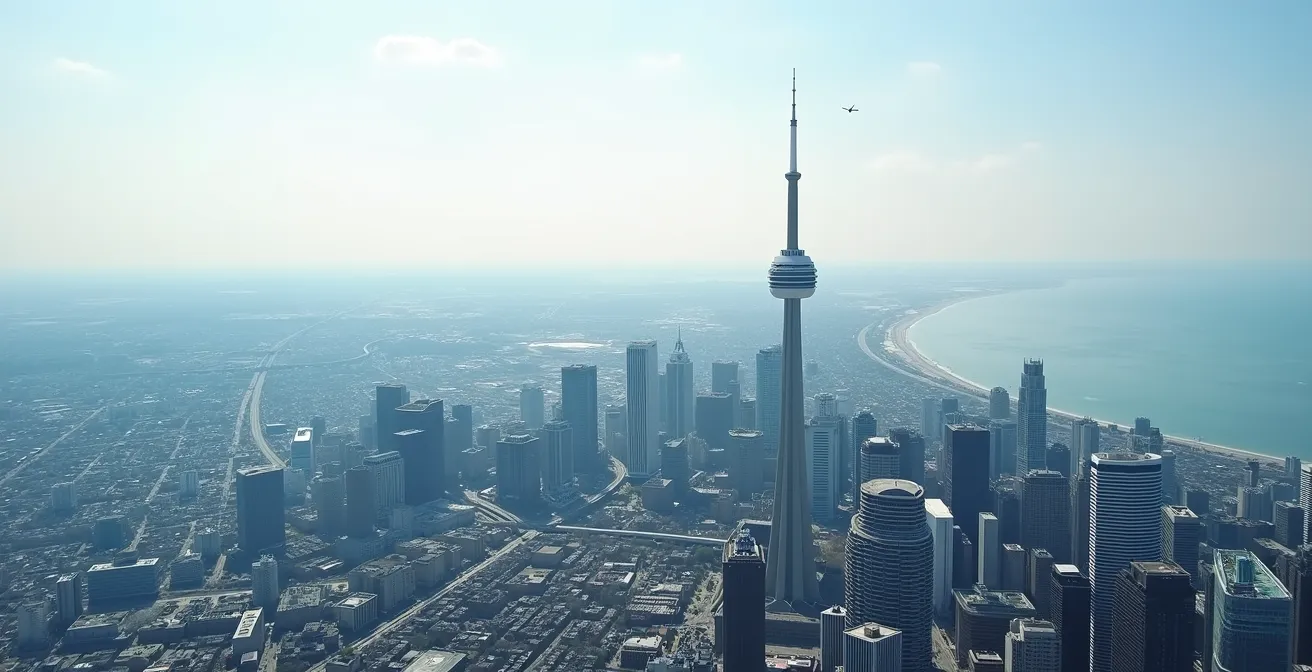
As the table below illustrates, the upgrade is best suited for repeat visitors, aviation enthusiasts who enjoy watching planes on approach to Pearson Airport from above, and photographers seeking unique compositions and fewer people. For families with young children or those simply wanting the classic “postcard” view, the Main Observation Level is more than sufficient.
| Feature | Main Observation Level (346m) | SkyPod (447m) |
|---|---|---|
| Height Advantage | 1,136 feet above ground | 1,465 feet – 33 stories higher |
| View Distance | Up to 100 miles on clear days | Up to 160km, visible Earth curvature |
| Crowd Density | High, especially weekends | Significantly lower capacity |
| Unique Views | Standard city panorama | Top-down view of main deck, full GTA sprawl |
| Best For | Families, first-time visitors | Aviation enthusiasts, photographers, repeat visitors |
Comment visiter l’Aquarium Ripley sans subir la foule des jours de pointe ?
The CN Tower and Ripley’s Aquarium of Canada are located at the base of each other on Bremner Boulevard, making them a logical pairing. However, attempting to visit both during peak hours is a recipe for “attraction fatigue.” The key is to treat them as a single logistical block and schedule them in a counter-cyclical pattern. Do not visit the aquarium during its busiest period, which is typically from 11 AM to 3 PM when school groups and midday tourists converge.
The optimal strategy is to visit the CN Tower first thing in the morning (book for a slot before 11 AM) and then visit the aquarium in the late afternoon, ideally after 4 PM. By this time, school groups have departed, and the crowds begin to thin out significantly. An even more advanced tactic is to check the home game schedules for the Toronto Blue Jays (at Rogers Centre) and Toronto Raptors (at Scotiabank Arena). Visiting the aquarium during a major home game can be surprisingly quiet, as thousands of people are occupied in the adjacent venues. According to visitor traffic patterns reported by CityPASS, crowds at the CN Tower itself peak around 12 PM and subside after 7 PM on weekdays, reinforcing the late-afternoon strategy for the neighboring aquarium.
Finally, always cross-reference your planned visit dates with the Toronto District School Board (TDSB) and Toronto Catholic District School Board (TCDSB) calendars to avoid Professional Activity (PA) Days, when the aquarium is exceptionally busy. For the quietest experience, book tickets online for a late afternoon slot between Tuesday and Thursday.
Hôtel vue lac ou vue tour CN : lequel choisir pour un séjour mémorable ?
The view from your hotel room is more than just a backdrop; it sets the entire tone for your Toronto visit. The two most coveted views are of the serene Lake Ontario or the iconic CN Tower. The choice between them is a choice between two very different Toronto experiences. A CN Tower view offers a dynamic, urban energy, highlighted by the nightly LED light show that illuminates the structure. Hotels offering this view, such as the Delta Toronto or Le Germain Maple Leaf Square, place you in the heart of the action, with walking-distance access to the Theatre District and the bustling nightlife of King Street West.
In contrast, a lake view provides a sense of peace and expanse. It’s an experience defined by tranquil sunrises over the water and the sight of sailboats and ferries. Properties like The Westin Harbour Castle are ideal for this, offering unobstructed water views and placing you a short 5-minute walk from the ferry terminal to the Toronto Islands. When booking, specifics matter. For a tower view, request a south-facing room above the 20th floor to ensure the view isn’t partially obstructed. For a lake view, an east-facing room on an upper floor will guarantee the best sunrise experience.
The decision ultimately comes down to the desired ambiance for your stay, as detailed in this strategic comparison from data provided by Destination Toronto.
| Aspect | Lake View Hotels | CN Tower View Hotels |
|---|---|---|
| Best Experience | Peaceful sunrise over water | Dynamic nightly LED light show |
| Proximity Advantage | Toronto Islands ferry (5 min walk) | Theatre District & King West (walking distance) |
| Recommended Hotels | Westin Harbour Castle, Radisson Admiral | Delta Toronto, Le Germain Maple Leaf Square, Bisha |
| Room Request Tips | East-facing, upper floors | South-facing, above 20th floor |
| Price Premium | 10-15% over standard rooms | 15-25% over standard rooms |
Key Takeaways
- The single most impactful decision is booking your timed entry 45-60 minutes before sunset to capture day, golden hour, and night views in one visit.
- Do not rely on standard weather apps. Use professional tools like aviation METAR reports and live webcams to verify visibility at altitude before you go.
- The 360 Restaurant and the CityPASS are powerful strategic tools when analyzed correctly; the restaurant offers a premium queue-skipping experience, while the pass’s value depends entirely on your itinerary’s geographic efficiency.
CityPASS ou billets individuels : quelle option choisir pour visiter 4 attractions majeures ?
With your operational plan in place, the final strategic decision is the ticketing structure. The Toronto CityPASS bundles admission to the CN Tower with four other major attractions, offering a potential 40% savings. However, its value is not guaranteed; it hinges entirely on your itinerary’s practicality and your ability to visit at least three of the included attractions. A thorough break-even analysis is required.
The CityPASS is most effective for visitors with at least two full days who can execute a “geographic cluster” strategy. For example, Day 1 could be dedicated to the downtown cluster of the CN Tower and Ripley’s Aquarium. Day 2 could cover the midtown attractions of the Royal Ontario Museum (ROM) and Casa Loma. As the table below shows, visiting just these four attractions yields significant savings. However, the inclusion of the Toronto Zoo, located 45 minutes from downtown, is often what traps tourists. For a short stay of 2-3 days, traveling to the zoo is impractical and consumes too much time, effectively reducing the pass’s value. If your plan only realistically includes the CN Tower and Ripley’s, buying individual timed tickets online is more economical and flexible.
While the pass offers skip-the-line benefits, it’s important to note that most attractions now require advance reservations for a timed-entry slot even with the pass. The primary benefit is cost savings, not queue-skipping, which is already achieved by booking any timed ticket online.
| Attraction Combination | Individual Ticket Total | CityPASS Price | Savings |
|---|---|---|---|
| CN Tower + Ripley’s + Casa Loma + ROM + Zoo | $165 CAD | $98 CAD | $67 (40% savings) |
| CN Tower + Ripley’s + Science Centre (3 only) | $108 CAD | $98 CAD | $10 (9% savings) |
| Downtown cluster: CN Tower + Ripley’s + ROM | $115 CAD | $98 CAD | $17 (15% savings) |
| With Toronto Zoo (45 min from downtown) | Adds transit time/cost | Included but distant | Poor value for short stays |
Your tactical plan for conquering the CN Tower is now complete. You have the intelligence to choose the right time, read the right weather, analyze the value of every upgrade, and structure your tickets for maximum efficiency. The final step is execution. Book your strategically timed tickets and reservations now to lock in a flawless and memorable CN Tower experience.