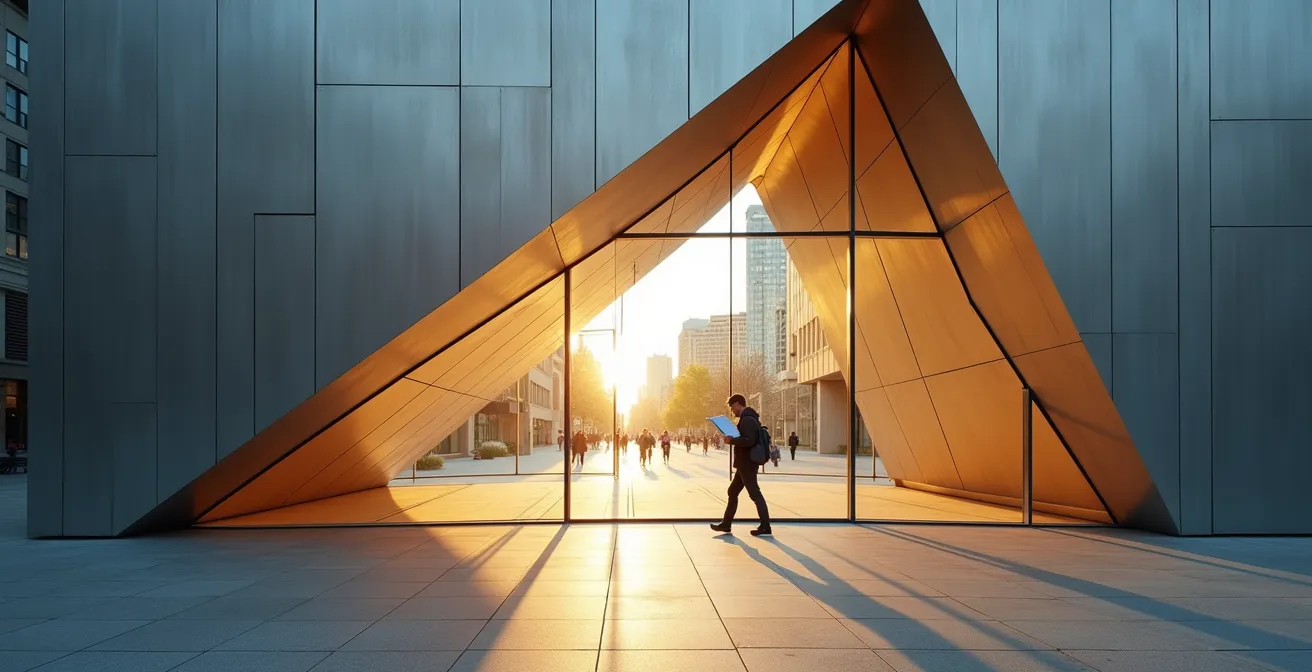
In summary:
- Treat your visit as a “cultural triage” operation, not a checklist. Prioritize high-impact exhibits.
- For families, go directly to the Level 2 dinosaurs to maximize engagement and avoid “museum fatigue.”
- For first-time visitors, skip the surcharged special exhibitions and focus on mastering the permanent collections.
- Use local Toronto knowledge: visit during a Blue Jays game for smaller crowds and consider a ROM/AGO combo over a geographically spread-out CityPASS.
The Royal Ontario Museum is not just a building; it’s a universe. With over 13 million objects spanning world cultures and natural history, the thought of seeing it all is overwhelming. The common advice is to “plan ahead” or “pick a few galleries,” but this often leads to a frantic, checklist-driven dash that leaves you exhausted and feeling like you’ve missed the real treasures. You end up with a collection of photos but no real connection to the wonders you’ve just seen.
This approach is flawed. It treats the museum like a grocery list, ignoring the psychology of the visitor experience. You can’t simply “see” the dinosaurs after slogging through two floors of dense artifacts with waning energy. You can’t appreciate the nuance of a First Peoples gallery when you’re worried about the closing time. The key isn’t just to manage your time, but to curate your energy and attention with the precision of a museum professional.
But what if the solution wasn’t to see more, but to strategically see *less*? This guide offers a different philosophy: cultural triage. It’s about making deliberate, informed choices to sacrifice the good for the great, ensuring every minute of your three-hour visit delivers maximum impact, wonder, and understanding. We will deconstruct the common mistakes and provide a strategic framework for your visit, turning a potentially stressful race against the clock into a deeply rewarding cultural immersion.
This article will guide you through the critical decisions every visitor faces, from the architecture you enter through and the price you pay, to the route you take and the larger cultural context of your visit in Toronto. Let’s begin your curated journey.
Summary: A Strategic Guide to Conquering the ROM
- Why does Michael Lee-Chin’s “Crystal” divide architects so much?
- Friday night or annual membership: which is the best option for your wallet?
- The common mistake that exhausts children before they even get to the dinosaurs
- Permanent vs. temporary exhibits: should you pay the extra?
- What is the secret time slot to get the dinosaur gallery for yourself?
- Why is the AGO a must-see for understanding Canadian identity?
- Why choose a thematic guided tour over a generic bus tour?
- CityPASS or individual tickets: which option to choose for visiting 4 major attractions?
Why does Michael Lee-Chin’s “Crystal” divide architects so much?
Your visit to the ROM begins before you even step inside, with an architectural clash that embodies Toronto’s own identity struggle. The Michael Lee-Chin Crystal, a 2007 addition by architect Daniel Libeskind, is a jagged, deconstructivist structure of glass and aluminum that seems to erupt from the side of the original 1914 neo-Romanesque building. It’s provocative, aggressive, and intentionally disruptive. For some, it’s a bold declaration of modernity; for others, it’s a scar on a beloved heritage facade.
The controversy stems from this fundamental tension. Libeskind’s deconstructivist philosophy rejects traditional harmony, favouring fragmentation and disharmony to challenge our perceptions. The Crystal does exactly that, creating dramatic, light-filled interior spaces with soaring, angled walls. Yet, it sits in stark, almost violent, contrast to the heavy, grounded, and symmetrical stone of the original structure. It’s not a conversation between old and new; it’s an argument. This visual debate is a perfect metaphor for Toronto itself—a city constantly negotiating its historical roots with its ambition for a global, futuristic identity.
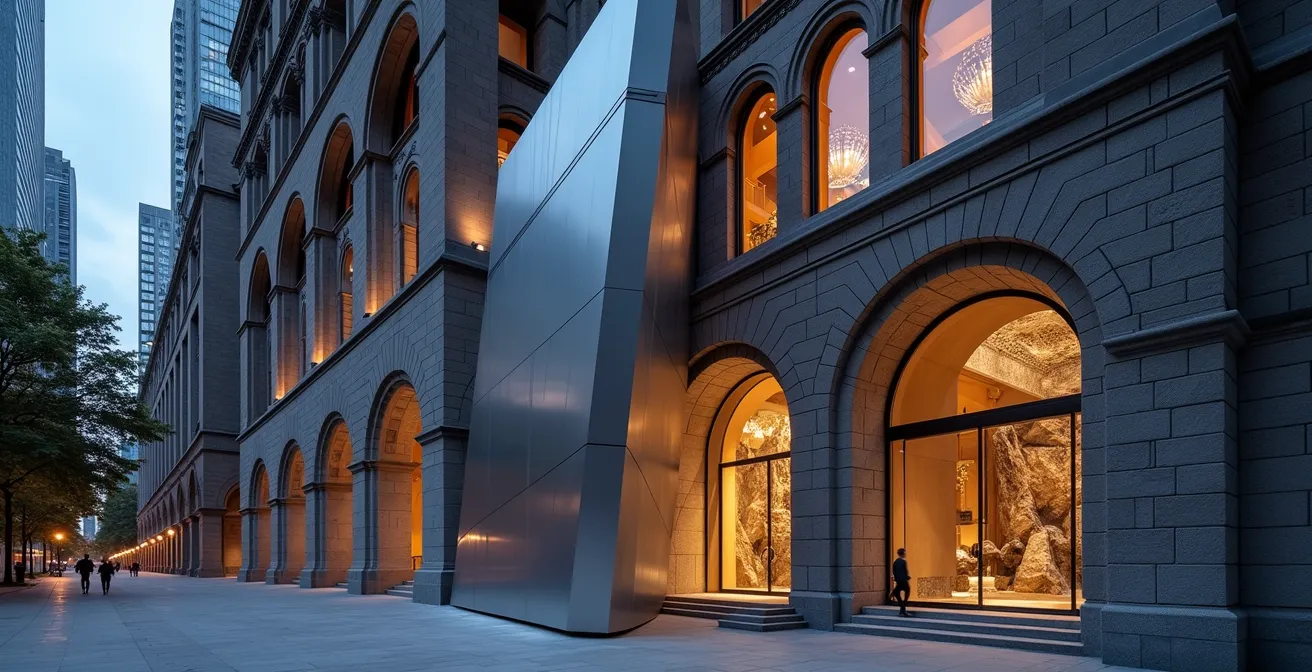
Despite the aesthetic debates, its impact is undeniable. The museum saw a 60% increase in ROM attendance in the year after the Crystal’s opening, proving that provocative architecture can be a powerful magnet for public interest. As a visitor, you aren’t just entering a museum; you are walking through a living debate about art, history, and what it means to build a city. The building itself is the first exhibit.
Friday night or annual membership: which is the best option for your wallet?
Once you’ve processed the exterior, the next strategic decision is a practical one: how to get in without overpaying. The ROM offers a spectrum of admission options, and choosing the right one depends entirely on your identity as a visitor. A tourist on a once-in-a-lifetime trip has vastly different needs than a local family or a culture-savvy student. Applying our “cultural triage” mindset here means matching the ticket to the experience you seek.
Your main options each serve a distinct purpose. Regular admission offers maximum flexibility for the first-time visitor. An annual membership provides unparalleled value for anyone planning more than two visits a year. Then there are the specialized time slots, like ROM After Dark on Friday nights, which transform the museum into a social, 19+ event with music and bars—an experience entirely different from a quiet weekday visit. Finally, the ultimate budget option is the free admission on the third Tuesday night of each month, though it requires booking well in advance.
This table breaks down the cost-benefit analysis of the primary choices. As you can see, the “best” option isn’t about the lowest price, but the highest value for your specific context.
| Option | Cost (CAD) | Best For | Key Benefits |
|---|---|---|---|
| Friday Night (ROM After Dark) | $19.50 | Young adults, social experience seekers | 19+ event with DJ, bars, themed nights |
| Regular Admission | $23 | First-time visitors, tourists | Full day access, all permanent galleries |
| Annual Membership | From $115 | Locals planning 2+ visits/year | Unlimited visits, member previews, store discount |
| Third Tuesday Night Free | $0 | Budget-conscious visitors | Free admission (book 2 weeks ahead) |
However, the truly savvy local strategy lies outside the ROM’s direct offerings. The Toronto Public Library’s Museum + Arts Pass (MAP) program is a hidden gem. Library cardholders can borrow a free family pass, turning a potential $69 expense for a family of four into a zero-cost outing. This illustrates a core principle of smart cultural consumption in Toronto: the most valuable opportunities often require a bit of insider knowledge.
The common mistake that exhausts children before they even get to the dinosaurs
Now, we move to the most critical part of our strategic visit: the route. For many, especially families, the dinosaurs are the main event. Yet, the most common mistake is to enter on the ground floor and dutifully begin a chronological journey through the galleries. By the time they reach the dinosaur collection on Level 2, children are often bored, tired, and overstimulated. This is a classic case of museum fatigue, and it’s entirely preventable.
The solution is to defy the museum’s layout and curate your visit based on psychological flow. Instead of a linear path, you must prioritize the “wow factor” to build excitement and sustain engagement. Research on visitor behaviour at the ROM confirms this: families who go directly to the dinosaurs first report an average of 2.5 hours of active engagement, compared to just 1.5 hours for those who start on the ground floor. The principle is simple: lead with your strongest asset to create a powerful, positive first impression that fuels the rest of the visit.
This “dinosaurs first” strategy is the cornerstone of an effective 3-hour family visit. It ensures the moment of peak excitement happens when energy levels are highest. After the initial thrill, you can then strategically weave in other engaging, sensory experiences like the Bat Cave or the hands-on Discovery Gallery. This approach transforms the visit from a forced march into an exciting adventure with a clear, rewarding climax.
Action Plan: The Child-Optimized 3-Hour ROM Itinerary
- Take the elevator directly to Level 2 upon entry—skip the ground floor entirely.
- Start with the Dinosaur Gallery for 30-45 minutes of peak excitement and engagement.
- Visit the nearby Bat Cave for an immersive, multi-sensory experience (15 minutes).
- Explore the Hands-On CIBC Discovery Gallery for interactive play and learning (30 minutes).
- Take a strategic snack break at a quieter location like Druxy’s Deli to recharge.
- End with the dazzling Earth’s Treasures minerals gallery on the same floor, if energy and time remain.
Permanent vs. temporary exhibits: should you pay the extra?
Another crucial “triage” decision you’ll face is whether to pay the surcharge for the ROM’s special, temporary exhibitions. These are often blockbuster shows, heavily marketed and drawing large crowds. The temptation to see a “once-in-a-lifetime” collection is strong, but for the time-pressed visitor, it can be a strategic error that derails your entire plan.
The key is to calculate the true “exhibit ROI”—the return on your investment of both money (typically an extra $14-20) and, more importantly, time (a minimum of 45-60 minutes). For a first-time visitor on a 3-hour schedule, dedicating up to half of your time to a single exhibit is rarely the best use of resources. The vast, world-class permanent collections—from Egyptian mummies to the Gallery of Chinese Architecture—offer more than enough wonder. Special exhibitions are often best saved for a second or third visit, once you have a solid grasp of the museum’s core offerings.
There’s also a counter-intuitive crowd-flow advantage to skipping the main event. While thousands are queueing for the blockbuster, vast sections of the permanent collection become blissfully quiet. This is where true discovery happens: stumbling upon an exquisite artifact in a silent gallery, free from the jostling crowds. It’s a more intimate and often more memorable museum experience.
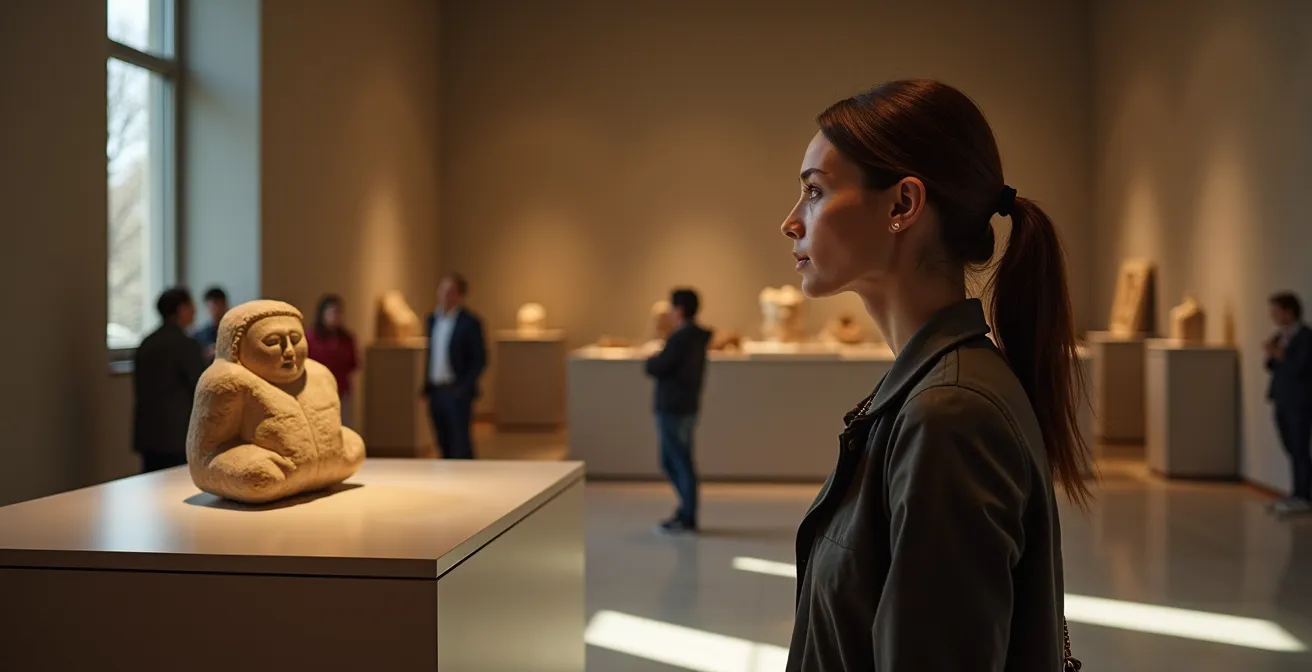
To make an informed choice, apply a simple decision framework. Is the exhibition a true global phenomenon (like a Tutankhamun or Pompeii tour) that aligns with a deep personal interest? If not, your time is almost always better spent exploring the rich and varied permanent galleries. Mastering the core of the ROM is a more rewarding goal than a fleeting glimpse of a temporary show.
What is the secret time slot to get the dinosaur gallery for yourself?
For many, the ultimate ROM experience would be to stand before a towering T-Rex in quiet contemplation, without the symphony of crowds. While having the gallery entirely to yourself is nearly impossible, strategic timing can get you remarkably close. The secret lies in understanding and outsmarting the visitor flow patterns, both within the museum and within the city of Toronto itself.
The most straightforward tactic is to arrive at the very beginning of a weekday. According to visitor flow patterns, Tuesday or Wednesday between 10:00 and 10:30 AM offers the best window. You arrive before the school groups, which typically descend after 10:30, and before the lunchtime rush. Heading straight to the second-floor dinosaur gallery during this golden half-hour can provide a level of peace and quiet that is unthinkable later in the day.
However, the more advanced strategy is what we can call “city event counter-programming.” Savvy Toronto locals know that the best time to visit the ROM is when everyone else is somewhere else. During a Blue Jays afternoon home game, for instance, family-oriented crowds are drawn to the Rogers Centre, and the ROM’s attendance, particularly in the dinosaur gallery, can drop by as much as 60%. Similarly, major city-wide events like the Canadian National Exhibition (CNE) in late August or large festivals at Nathan Phillips Square act as powerful diversions. One documented case during the opening weekend of the Toronto International Film Festival (TIFF) saw fewer than 20 people in the dinosaur gallery on a Saturday afternoon, a time when it would normally host over 150 visitors.
Why is the AGO a must-see for understanding Canadian identity?
To fully appreciate the ROM’s role in Toronto’s cultural landscape, one must understand its counterpart: the Art Gallery of Ontario (AGO). While the ROM tells the story of Canada and the world through objects, nature, and ancient history, the AGO tells it through art and soul. Visiting both provides a stereoscopic view of Canadian identity, one grounded in land and origins, the other in artistic interpretation and national myth-making.
The ROM’s narrative of Canada is one of geology, First Peoples’ heritage, and biodiversity. It grounds the nation in its physical reality. The AGO, in contrast, explores the invention of Canada as a visual and emotional concept. This is most powerfully embodied by its world-renowned collection of the Group of Seven. As one art historian noted in the Canadian Art Historical Review:
The Group of Seven didn’t just paint landscapes; they invented the visual language of Canadian nationalism – the idea that true Canada exists in the untamed wilderness north of the cities.
– Art historian analysis, Canadian Art Historical Review
This single idea is crucial. The windswept pines and rugged shield country depicted in these paintings became the iconography of a nation seeking to define itself apart from Europe and the United States. The AGO is the keeper of this foundational myth. This is complemented by its growing collection of Indigenous contemporary art, which challenges and enriches that very narrative, creating a dynamic conversation about who gets to define “Canada.”
The architectural differences are also telling. While the ROM’s Crystal is a bold disruption, the AGO’s renovation by Toronto-born architect Frank Gehry, particularly the soaring wooden Galleria Italia, is an act of warm, open integration with the city. This table highlights the two distinct narratives:
| Institution | Canadian Identity Narrative | Key Collections | Architectural Statement |
|---|---|---|---|
| ROM | Canada through land and origins | Geology, First Peoples artifacts, natural history | Libeskind Crystal: Bold disruption |
| AGO | Canada through art and soul | Group of Seven, Indigenous contemporary art | Gehry’s Galleria Italia: Open integration |
Why choose a thematic guided tour over a generic bus tour?
The philosophy of “cultural triage”—choosing depth over breadth—that we’ve applied to the ROM can be extended to your entire Toronto visit. The city is often presented to tourists through the window of a bus, a hop-on-hop-off tour that offers a sprawling but superficial overview. A generic bus tour might point out the Distillery District, for example, giving you a 3-minute glimpse and a few facts. This is the equivalent of trying to see every gallery in the ROM in one hour; you see everything and experience nothing.
The alternative is the thematic walking tour, which is the urban equivalent of focusing on a single, high-impact museum gallery. A 90-minute walking tour of that same Distillery District allows you to feel the cobblestones under your feet, touch the original limestone walls, and hear specific stories about Prohibition-era bootlegging. The difference in engagement is immense. Post-tour surveys show that walking tour participants retain 75% more historical details and rate their experience significantly higher (4.8/5 vs 3.2/5) than bus tour passengers.
This approach transforms you from a passive observer into an active participant in the city’s story. Instead of just seeing Toronto, you are engaging with it on a sensory and intellectual level. Choosing a culinary tour of Kensington Market, an architectural walk through the Financial District, or a ghost tour of Old Town provides a narrative thread that makes the city cohere. It gives you a deeper, more memorable connection to a specific facet of Toronto’s character, rather than a blurry montage of disconnected landmarks.
The lesson from our ROM strategy is clear: a curated, in-depth experience of one thing is far more valuable than a fleeting glance at everything. Applying this to your city exploration will yield a much richer and more satisfying trip.
Key takeaways
- A successful short visit to the ROM requires a “cultural triage” mindset: prioritize high-impact experiences and be willing to skip others.
- Visitor psychology is key; manage energy levels by starting with high-excitement galleries like the dinosaurs to prevent museum fatigue.
- Leverage local Toronto knowledge by using city-wide events for “counter-programming” to avoid crowds and by considering a ROM+AGO combo for a deeper cultural dive.
CityPASS or individual tickets: which option to choose for visiting 4 major attractions?
The final strategic decision for many Toronto visitors is the CityPASS. This bundled ticket offers admission to several major attractions, including the ROM and the CN Tower, at a discounted price. On the surface, it seems like a straightforward way to save money. However, a deeper analysis reveals that, like the special exhibitions at the ROM, its value depends entirely on your personal “visitor profile” and your willingness to account for a hidden cost: travel time.
The financial break-even point is simple. Based on current pricing, the $105 CAD CityPASS becomes cost-effective after visiting just three attractions, such as the CN Tower ($43), the ROM ($23), and Casa Loma ($40), which would total $106 if purchased separately. So, if your plan already includes these three, the pass is a good deal. The problem arises when visitors try to “maximize” their value by visiting all five attractions included in the pass.
The “hidden cost” is the geographic spread of the attractions. The Toronto Zoo and the Ontario Science Centre are located far from the downtown core, each requiring a 30-45 minute transit journey each way. Attempting to visit all five attractions can mean spending over six hours on public transit. The superior strategy is to create “neighbourhood clusters.” For a culture-focused visitor, it makes far more sense to buy individual or combo tickets for the ROM and the AGO, which are relatively close to each other. For a family with kids, clustering the downtown attractions of the CN Tower and Ripley’s Aquarium into one day is far more efficient than trekking out to the Zoo.
The CityPASS decision is the ultimate test of your cultural triage strategy. It forces you to define your priorities. Are you a culture seeker? A family looking for entertainment? Are you visiting in winter, when some attractions have limited appeal? Answering these questions honestly is more important than the potential savings on a ticket.
By applying this strategic mindset—from choosing your ticket to planning your route—you transform a visit to the ROM from a race against time into a masterpiece of an experience. Your three hours will be richer, more memorable, and more meaningful than a full day spent wandering without a purpose. Plan your strategic cultural immersion today.