
Renovating a Toronto Victorian is less about aesthetics and more about navigating a minefield of permits, insurance clauses, and structural risks.
- Unpermitted structural work, even minor, can instantly void your home insurance policy.
- A fully legal and compliant secondary suite can add over $200,000 to your borrowing power, turning an expense into a powerful financial asset.
Recommendation: Prioritize a pre-construction audit with a structural engineer and heritage-savvy contractor to turn financial risks into calculated investments.
Owning a Victorian home in a historic Toronto neighbourhood like Cabbagetown or Parkdale is a dream for many. The intricate brickwork, soaring ceilings, and unique character are a testament to a bygone era. However, the dream of blending modern living with historic charm quickly confronts a complex reality. Most homeowners focus on the aesthetics—preserving gingerbread trim or choosing period-appropriate colours. While important, this approach misses the most critical aspects of a successful restoration.
The common advice is to “respect the home’s character” and “budget for surprises.” But these platitudes offer little guidance when facing a denied insurance application due to knob-and-tube wiring or a stop-work order from Toronto Building. The true challenge isn’t just about preservation; it’s about navigating a high-stakes financial and legal landscape where every decision has significant consequences.
This guide moves beyond the surface-level advice. We will adopt the perspective of a heritage contractor to dissect the critical systems of your home. The real key to a successful Victorian renovation lies not in the colour of the paint, but in understanding how your choices regarding wiring, insulation, foundations, and structural walls directly impact your insurance coverage, property value, and legal standing with the city and your neighbours. It’s about turning potential liabilities into valuable, future-proofed assets.
This article provides a structured roadmap for navigating these challenges. We will examine the specific risks and opportunities inherent in these century-old homes, from securing insurance to maximizing your property’s financial potential, all within the strict context of Toronto’s building codes and heritage guidelines.
Summary: Your Guide to Toronto Victorian Restoration
- Why Insurance Companies Refuse to Cover Victorian Homes with Original Wiring?
- How to Insulate a Double-Brick Victorian Home Without Trapping Moisture?
- Wood or Vinyl: Which Windows Satisfy Heritage Toronto Guidelines?
- The Foundation Mistake That Can Collapse Your Row House During Excavation
- How to Budget for the “Surprise Factor” When Opening Walls in 100-Year-Old Homes?
- Why Removing a Wall Without a Permit Can Void Your Home Insurance?
- Why a Legal Retrofit Increases Your Property Value by Over $50,000?
- Open Concept Renovation: How to Remove a Load-Bearing Wall Safely in a Toronto Semi?
Why Insurance Companies Refuse to Cover Victorian Homes with Original Wiring?
The most immediate hurdle for many new Victorian homeowners in Toronto isn’t a design choice; it’s an insurance rejection letter. The culprit is almost always knob-and-tube (K&T) wiring. From an insurer’s perspective, K&T isn’t just old—it’s an unquantifiable fire risk. It lacks a ground wire, its insulation becomes brittle over time, and past renovations may have dangerously compromised the original system. Insurers operate on predictable risk, and K&T is anything but.
Mainstream insurance providers will typically decline coverage outright, leaving homeowners scrambling. The solution requires a strategic, multi-step approach rather than a simple fix. It begins with understanding the financial scope; a full home rewire is a significant but necessary investment. According to Toronto real estate experts, full rewiring costs for a typical Victorian home can be between $15,000 and $25,000. This isn’t just an upgrade; it’s a prerequisite to protecting your asset.
However, you can secure temporary coverage to bridge the gap while you arrange the work. This involves proving your intent to mitigate the risk. By working with specialty insurers who understand heritage properties and providing them with a professional assessment, you can often negotiate a conditional policy. This transforms an absolute “no” into a manageable, time-bound “yes,” giving you the breathing room to bring your home’s electrical system into the 21st century safely and legally.
Action Plan: Securing Insurance with Knob-and-Tube Wiring
- Initial Assessment: Hire a licensed electrician to perform a thorough inspection and provide a detailed report on the state of the existing K&T wiring.
- Safety Certification: Obtain an inspection report from the Electrical Safety Authority (ESA) to certify the current safety status of the wiring, identifying any immediate hazards.
- Specialty Outreach: Contact insurance brokers who specialize in high-risk or heritage properties, as they have access to underwriters that mainstream companies do not.
- Negotiate a Conditional Policy: Propose a policy with a clear, agreed-upon timeframe (typically 30-60 days) to complete a full rewire as a condition of coverage.
- Execute and Verify: Schedule and complete the rewiring with a licensed electrical contractor, then provide the insurer with the final ESA certificate of inspection to finalize your policy.
How to Insulate a Double-Brick Victorian Home Without Trapping Moisture?
One of the most common and costly mistakes in renovating a Toronto Victorian is treating it like a modern-build home, especially when it comes to insulation. These homes were designed to “breathe.” The iconic double-wythe (or double-brick) walls manage moisture through a slow process of absorption and evaporation. Sealing this type of wall with the wrong insulation, like closed-cell spray foam, can trap moisture, leading to devastating consequences like mould, interior water damage, and spalling (flaking) of the exterior brick during Toronto’s freeze-thaw cycles.
The key is to use an insulation material that allows water vapour to pass through it, maintaining the wall’s natural drying process. This requires a “breathable” insulation strategy. Instead of creating an impermeable barrier, the goal is to improve thermal performance without disrupting the historic moisture management system of the wall assembly.
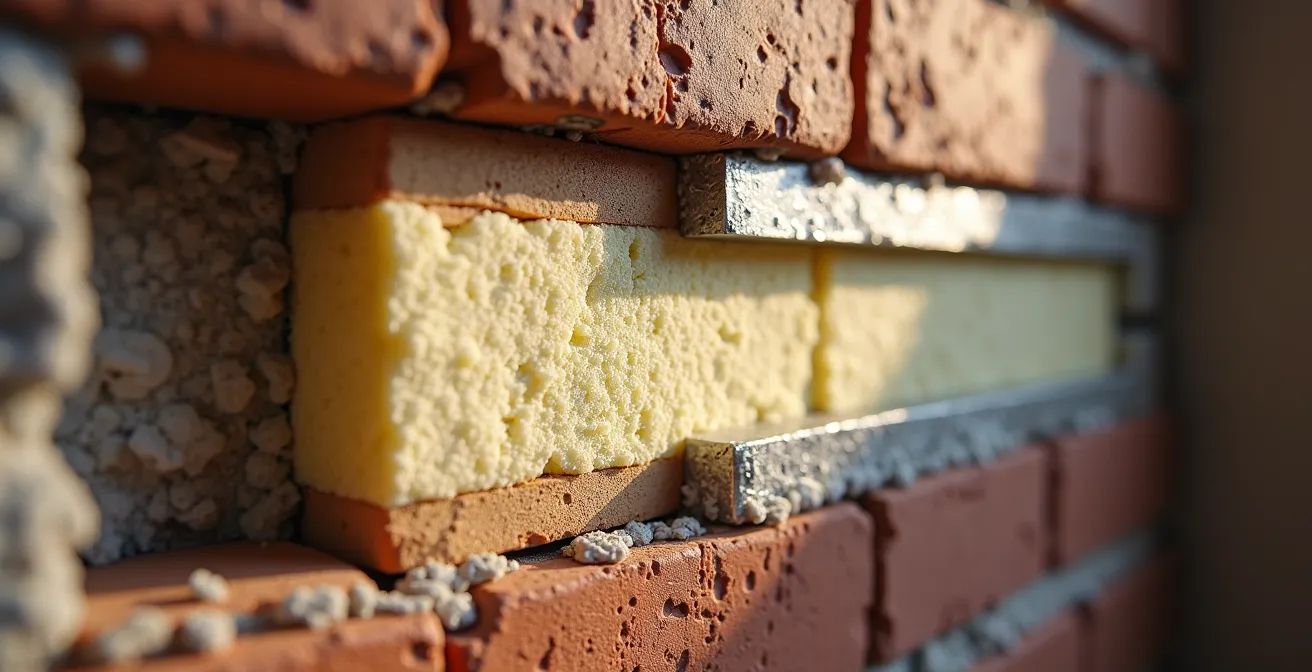
As the diagram shows, a proper installation involves materials that work with the wall, not against it. A “smart” vapour barrier is often used on the interior side, which adjusts its permeability based on humidity levels, providing protection in winter while allowing the wall to dry inward during summer. Paired with a breathable insulation material, this creates a high-performance system that respects the home’s original construction science.
Choosing the right material is critical. The table below, based on an analysis of heritage-appropriate materials, compares common insulation types for their suitability in Toronto’s climate. For most double-brick homes, mineral wool offers an excellent balance of performance, fire resistance, and breathability.
| Insulation Type | Breathability | Fire Resistance | Moisture Risk | Heritage Compatibility |
|---|---|---|---|---|
| Closed-cell spray foam | Poor | Good | High (traps moisture) | Not recommended |
| Open-cell spray foam | Moderate | Moderate | Medium (needs vapor barrier) | Acceptable with precautions |
| Mineral wool | Excellent | Excellent | Low | Highly recommended |
| Cork board | Excellent | Good | Very Low | Ideal for heritage |
Wood or Vinyl: Which Windows Satisfy Heritage Toronto Guidelines?
Windows are the “eyes” of a Victorian home, and replacing them is one of the most scrutinized aspects of a heritage renovation. While a homeowner’s priority might be energy efficiency or cost, Heritage Preservation Services’ focus is on preserving the architectural character. This often creates a conflict, as modern materials like vinyl rarely meet the strict aesthetic requirements. For most designated heritage properties in Toronto, vinyl windows are a non-starter.
The acceptable choice almost always involves wood or aluminum-clad wood. The key isn’t just the material but the details: the thickness of the muntin bars (the strips dividing the glass), the profile of the sash, and the overall sightlines must replicate the original windows. Simply putting in a wood window isn’t enough; it must be a convincing replica of what was there historically.
Furthermore, the level of strictness varies significantly between Toronto’s different Heritage Conservation Districts (HCDs), making a one-size-fits-all approach impossible. This is where local expertise becomes invaluable.
Case Study: The Annex vs. Cabbagetown Heritage Rules
In neighbourhoods like Cabbagetown, known for its preserved Victorian cottages, the rules are exceptionally strict. The HCD guidelines often demand an exact replication of the original window profiles, including precise sash dimensions and muntin bar thickness. Restoration of the original windows is heavily encouraged. In contrast, The Annex, famous for its grand Queen Anne Revival architecture, may offer more flexibility. Its guidelines sometimes permit high-quality aluminum-clad wood options, which provide the authentic look of wood on the interior while offering the superior durability needed to withstand harsh Canadian winters on the exterior. This highlights the need to consult the specific HCD plan for your property before making any decisions.
Before ordering any replacements, the first step is always to document the existing windows with detailed photos and consult with Heritage Preservation Services for pre-approval. Often, restoring the original wood windows is a more cost-effective and compliant solution than replacement. Toronto has skilled specialists who can bring century-old windows back to life, preserving the irreplaceable old-growth wood and authentic wavy glass.
The Foundation Mistake That Can Collapse Your Row House During Excavation
Lowering a basement to create more living space is one of the most popular renovations in Toronto, but in a Victorian row house or semi-detached, it’s also one of the most dangerous. These homes often share foundation walls (party walls) built over a century ago with rubble or unreinforced brick. The single biggest mistake a homeowner can make is to begin excavation without a proper engineering and permitting process, which can lead to the catastrophic collapse of a party wall and compromise the structural integrity of both your and your neighbour’s homes.
The Ontario Building Code and Toronto Building have strict protocols to prevent this. The process, known as underpinning, involves digging out sections underneath the existing foundation and pouring new concrete footings in a sequential process. It is not a job for a general contractor alone; it legally requires the oversight of a certified structural engineer. The engineer’s role is to assess the foundation, design the underpinning sequence, and create stamped drawings for the city permit.
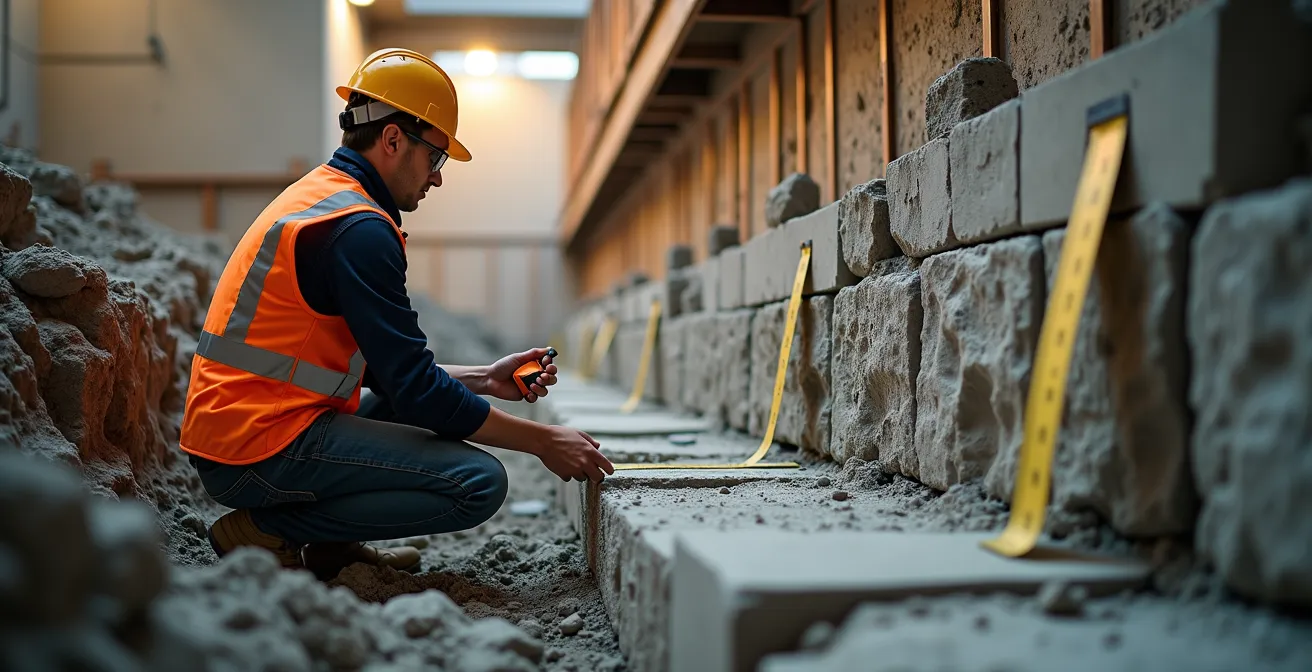
The work must be done using a ‘pin-by-pin’ method, where only small, designated sections are excavated at a time. A Toronto Building inspector must approve each poured “pin” before the contractor can proceed to the next, ensuring the shared wall is supported at all times. Furthermore, because the work affects a shared structure, a Party Wall Agreement, which is 100% mandatory for attached homes in Toronto, must be drafted by a lawyer and signed by your neighbour before any work begins. This legal document protects both parties by outlining the scope of work and liability.
Skipping any of these steps—the engineer, the permit, the inspections, or the Party Wall Agreement—is not just against the law; it’s gambling with the entire structure of your home. A properly underpinned foundation, brought up to modern code, will be worry-free for generations, making it a sound and safe investment.
How to Budget for the “Surprise Factor” When Opening Walls in 100-Year-Old Homes?
Every contractor will tell you to add a contingency fund for “surprises” when renovating a Victorian home. But this advice is useless without a method to quantify it. A vague 15-20% contingency can be easily overwhelmed by a single major issue. The professional approach is to actively convert unknowns into knowns before the main demolition begins. This is done through targeted, pre-construction “destructive testing.”
Instead of waiting to be surprised, you create small, strategic openings to investigate the home’s hidden systems. This isn’t about tearing down walls prematurely; it’s a surgical investigation to identify the most common and costly issues lurking behind the plaster. These include outdated knob-and-tube wiring, crumbling cast iron plumbing stacks, asbestos in old drywall compound or insulation, and structural deficiencies.
By identifying these problems upfront, they can be moved from the “contingency” column to the “fixed cost” column in your budget. This provides financial certainty and prevents work stoppages and costly change orders down the line. The table below outlines some of the most common surprises in Toronto Victorians and their typical cost ranges, demonstrating the financial magnitude of what could be hiding in your walls.
| Surprise Type | Cost Range (Toronto 2024) | Frequency in Victorian Homes |
|---|---|---|
| Asbestos abatement (10×12 room) | $1,500 – $3,000 | 70% of pre-1980 renovations |
| Cast iron plumbing stack replacement | $4,000 – $7,000 | 85% of original plumbing |
| Knob-and-tube rewiring (partial) | $8,000 – $16,000 | 60% of unrenovated homes |
| Lead paint remediation | $8 – $15 per sq ft | 95% of pre-1978 paint |
| Structural beam reinforcement | $5,000 – $15,000 | 40% when removing walls |
A systematic pre-construction audit allows you to build a realistic, evidence-based budget, transforming anxiety about the unknown into a clear, actionable financial plan.
Checklist: Your Pre-Construction Destructive Testing Audit
- Plumbing Inspection: Open a small 4″x4″ inspection hole in the drywall behind a toilet or under a sink to visually inspect the condition of the main plumbing stack.
- Wiring Assessment: Carefully remove one electrical outlet cover in each principal room to identify the wiring type (knob-and-tube, aluminum, or modern copper).
- Subfloor and Joist Check: Lift a small corner section of flooring in a closet or inconspicuous area to verify the condition of the subfloor and measure the joist spacing.
- Hazardous Materials Testing: Take small plaster and paint samples from multiple locations and send them to a lab for asbestos and lead paint testing before any demolition.
- Document and Budget: Photograph all findings and share them with your contractor to get firm quotes, converting potential surprises into line items in your budget.
Why Removing a Wall Without a Permit Can Void Your Home Insurance?
Many homeowners believe that if a wall isn’t load-bearing, they can remove it without a permit. This is a dangerously false assumption with massive financial repercussions. From an insurer’s point of view, any unpermitted structural modification constitutes a “Material Change in Risk.” You have fundamentally altered the state of the property they agreed to insure, without disclosing it to them. This gives them legal grounds to void your policy entirely.
The issue goes beyond just structural integrity. As the Insurance Bureau of Canada has clarified in its guidelines, this principle is central to how policies are underwritten.
Unpermitted work constitutes a ‘Material Change in Risk’ that was not disclosed to the insurer, which gives them grounds to void the policy entirely.
– Insurance Bureau of Canada, Guidelines on Heritage Property Insurance Coverage
Even if a wall is not structural, it almost certainly contains electrical wiring. In Ontario, any modification to wiring requires an inspection and a certificate from the Electrical Safety Authority (ESA). If you remove a wall and later have a kitchen fire completely unrelated to that work, the insurance adjuster will investigate the property’s history. The moment they discover unpermitted work and the absence of a required ESA certificate, they can argue that the dwelling was not maintained to code and use it as a basis to deny the entire claim. That decision to save a few hundred dollars on a permit could end up costing you hundreds of thousands of dollars in denied coverage.
A building permit isn’t just red tape; it’s a form of insurance for your insurance. It creates a legal, third-party record proving that all work was completed to the safety standards of the Ontario Building Code, protecting your investment and ensuring your coverage remains valid.
Why a Legal Retrofit Increases Your Property Value by Over $50,000?
While the title suggests a $50,000 increase, the true financial power of a legal secondary suite in Toronto is often far greater. It’s not just about the added resale value; it’s about unlocking immediate financial leverage. Lenders can consider the potential rental income from a legally registered basement apartment when calculating your borrowing capacity. In a city with high rents, this is a game-changer. For example, a legal $1,800/month basement apartment can add over $200,000 in borrowing power, which can be used to finance the renovation itself or for other investments.
The key word, however, is “legal.” An illegal basement unit with code deficiencies is a liability, not an asset. To be considered legal in Toronto, a secondary suite must meet strict Ontario Building Code requirements for safety, particularly concerning fire separation and egress. This includes installing fire-rated drywall (minimum 5/8″ Type X) between units, ensuring ceiling heights meet the minimum 6’5″ requirement, and creating a separate, safe entrance.
Crucially, interconnected smoke and carbon monoxide detectors must be installed in both units, and egress windows must be large enough for a person to escape through. Once all construction is complete and has passed city inspections, you must register the unit with the City of Toronto. Only a registered unit provides the documentation a lender needs to consider the rental income, thereby unlocking its full financial potential.
Therefore, a legal retrofit is more than a renovation. It’s a strategic financial move that transforms a portion of your home into an income-generating asset that significantly enhances your overall financial position. The cost of bringing the unit up to code is an investment that pays for itself many times over, both in monthly income and in expanded borrowing capability.
Key Takeaways
- Permits are not optional; unpermitted work, especially structural, can void your home insurance policy due to “Material Change in Risk.”
- Victorian double-brick walls must “breathe.” Using the wrong insulation (like closed-cell spray foam) traps moisture, leading to mould and brick damage.
- The value of a legal secondary suite goes beyond rent; it provides significant financial leverage by increasing your borrowing power with banks.
Open Concept Renovation: How to Remove a Load-Bearing Wall Safely in a Toronto Semi?
Creating an open-concept living space is at the top of many renovation wish lists, but in a Victorian semi-detached home, removing a load-bearing wall is a complex structural and legal procedure. It is absolutely not a DIY project. The process requires a team of professionals, a series of legal agreements, and strict adherence to a critical path to ensure the safety of both your home and your neighbour’s.
The first and most important step is to hire a structural engineer. They will assess the loads the wall is carrying and design the appropriate replacement beam—typically a Laminated Veneer Lumber (LVL) or steel I-beam—and the support columns required to transfer the load safely down to the foundation. Their stamped drawings are a non-negotiable requirement for obtaining a building permit from Toronto Buildings.
Because the work affects a party wall, a Party Wall Agreement must be drafted by a lawyer and signed by your neighbour. This is a critical step to mitigate liability. Often, it’s paired with a pre-construction survey of the neighbouring property to document its existing condition, protecting you from claims of damage caused by your renovation. Once the permit is issued, temporary support walls must be built on both sides of the wall before any demolition begins. Only then can the licensed contractor install the new beam and columns, a process that requires mandatory inspections from the city at various stages. The total project cost, from engineering to construction, for a load-bearing wall removal is between $15,000 and $28,000 in the Toronto market, reflecting the expertise and risk involved.
To ensure your renovation adds value without compromising safety or heritage, your next step should be a detailed consultation with a contractor who specializes in Toronto’s unique Victorian housing stock.