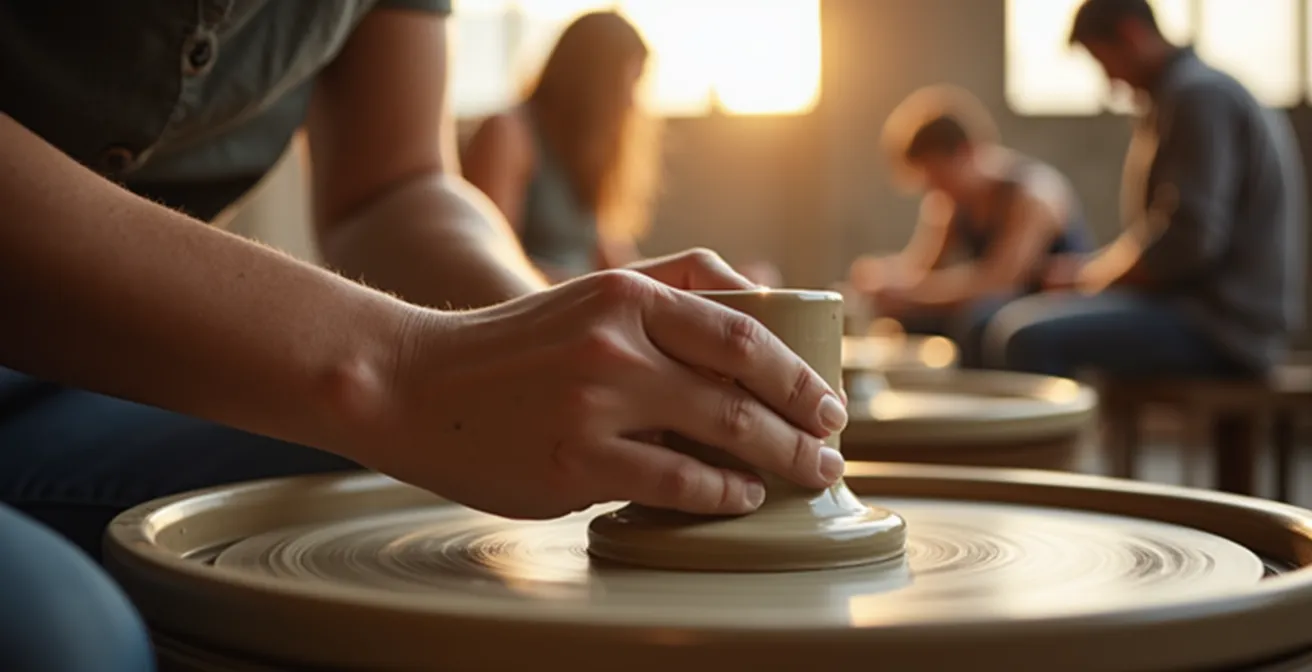
Choosing a craft workshop in Toronto is less about the finished object and more about investing in an unforgettable, hands-on experience.
- The value comes from the process itself—the ‘IKEA Effect’ psychologically proves we value things we make ourselves far more.
- Toronto offers two distinct vibes: formal, museum-quality learning (Gardiner Museum) and cozy, community-focused indie studios (Queen West, Parkdale).
Recommendation: Prioritize the studio atmosphere that best fits your personality and, if you’re a tourist, confirm their firing and shipping logistics before you book.
In a world of endless scrolling and digital notifications, there’s a growing pull toward something more real, more tangible. You feel it when you visit Toronto—a desire to connect with the city beyond the typical tourist trail. You could buy another souvenir, or you could create one with your own two hands. Many guides will simply list studios, promising you’ll “unleash your inner artist.” But this approach misses the point. The search for a pottery or glass blowing class isn’t just about finding a fun activity; it’s about finding a genuine connection to the city’s creative heartbeat.
But what if the true value of that $100 workshop isn’t the ceramic mug you take home, but the experience of creation itself? The real key is to see this not as a simple purchase, but as an investment in a memory and a skill. It’s an opportunity to plug directly into Toronto’s vibrant maker economy, supporting the local artisans who give the city its soul. This isn’t just about shaping clay; it’s about shaping a more meaningful travel experience.
This guide will navigate you through that decision. We’ll explore the real worth of a hands-on workshop, help you organize the perfect creative event, and tackle the practical logistics for travelers. We’ll compare the different atmospheres you’ll find in Toronto’s studios and demystify the first steps for absolute beginners, ensuring you find the perfect place to get your hands dirty.
This article breaks down everything you need to know to choose the right hands-on craft experience in Toronto. The summary below outlines the key topics we’ll cover, from understanding the value of a workshop to navigating the city’s unique craft culture.
Summary: Your Guide to Craft Workshops in Toronto
- Why paying $100 CAD for a workshop is worth more than buying the finished object?
- Ateliers privés : comment organiser un cours de bijouterie pour un enterrement de vie de jeune fille ?
- Le risque de ne pas pouvoir ramener sa céramique non cuite dans l’avion
- Gardiner Museum ou studio indépendant : quelle ambiance pour apprendre l’argile ?
- Tournage ou modelage : par quoi commencer si on a deux mains gauches ?
- Pourquoi l’AGO est-il incontournable pour comprendre l’identité canadienne ?
- Artisanat local ou souvenirs importés : comment repérer la véritable qualité ?
- Pourquoi choisir une visite guidée thématique plutôt qu’un tour en bus générique ?
Why paying $100 CAD for a workshop is worth more than buying the finished object?
It’s easy to look at a $100 workshop fee and compare it to a $30 mug in a shop. But that comparison misses the entire point. You aren’t paying for a product; you’re investing in an experience, a skill, and a powerful psychological reward. This shift in perspective is crucial to understanding the value of Toronto’s maker culture. The hands-on process connects you to a thriving local industry. In fact, Statistics Canada reports that Canadian craft exports have surged, showing the growing appreciation for authentic, handmade goods.
Behavioral psychology calls it the “IKEA Effect”: we place a disproportionately high value on things we partially create ourselves. That lopsided bowl you made? It holds more personal value than a perfectly symmetrical one from a store because it contains your effort, your focus, and your story. It’s a tangible memory. A workshop also offers a much-needed digital detox. For two or three hours, you’re focused on the feeling of clay or the heat of the furnace—not your phone screen. This mindful, focused creation is an experience that’s increasingly rare and valuable.
When you consider the alternatives for an evening out in Toronto—where Leafs tickets can start at $150 and fine dining can easily top $200—a craft workshop offers incredible value. Not only do you get a unique entertainment experience, but you also learn from a skilled artisan and leave with a creation that is uniquely yours. You are directly supporting the local artists who contribute to Toronto’s massive visitor economy, making your spending an active participation in the city’s creative life.
Ateliers privés : comment organiser un cours de bijouterie pour un enterrement de vie de jeune fille ?
A craft workshop is a fantastic way to celebrate a special occasion like a bachelorette party, birthday, or even a team-building event. It moves beyond passive entertainment, creating a shared experience where everyone collaborates and leaves with a personal memento. Toronto studios have embraced this, offering private bookings that turn a simple class into a memorable party. The key is to find the right craft and studio that fits your group’s size, budget, and vibe.
For a bachelorette party, jewelry making is a popular choice. It’s intricate, personal, and everyone can create a matching piece to remember the day. Other options like pottery or even glass blowing offer different kinds of dynamic and collaborative energy. Many studios now lean into the social aspect, creating packages that rival a traditional night out.
Case Study: The Rise of Toronto’s Craft-Based Social Events
Local Toronto studios have seen huge success with social-themed workshops. King West clay studios, for instance, popularized “Date Night” pottery sessions. This trend has expanded into “Fun Night Out” classes, where groups can enjoy charcuterie and drinks while crafting. These events transform the workshop into a full evening’s entertainment, offering a creative and interactive alternative for bachelorette parties and other group celebrations.
To help you choose, here’s a breakdown of common workshop options in Toronto for private groups. This comparison, inspired by offerings from places like the Harbourfront Centre, can help you match the activity to your event.
| Workshop Type | Group Size | Duration | Price Range | Best For |
|---|---|---|---|---|
| Jewelry Making | 6-12 | 2-3 hours | $90-150/person | Bachelorettes, birthdays |
| Glass Blowing | 4-8 | 2 hours | $100-175/person | Small intimate groups |
| Pottery Wheel | 8-12 | 2 hours | $75-120/person | Team building, date nights |
| Screen Printing | 10-15 | 3 hours | $60-90/person | Corporate events |
Le risque de ne pas pouvoir ramener sa céramique non cuite dans l’avion
For any tourist taking a pottery class, the excitement of creation is quickly followed by a practical question: how do I get this home? This is a critical logistic to consider, as you cannot simply walk out of the studio with your masterpiece. Freshly made pottery, known as greenware, is incredibly fragile. It’s essentially dried mud and will crumble or break with the slightest pressure, making it impossible to transport in luggage.
Your piece must go through a two-stage firing process to become durable. The first is a bisque firing, which turns the clay into a harder, porous ceramic. This process alone can take 24-48 hours, including kiln heating and cooling time. After that, the piece is glazed and fired a second time at a higher temperature, which can add another 2-3 days to the timeline. This multi-day process is often the biggest surprise for visitors on a tight schedule.
The image below shows the dramatic transformation a piece undergoes in the kiln, from the chalky texture of raw clay to the hard, glassy surface of a finished, glazed ceramic. Understanding this change is key to appreciating why the firing process is non-negotiable.

Fortunately, Toronto studios are accustomed to hosting tourists and have solutions. The most common is a shipping service, where the studio will professionally pack and mail your finished piece to you for an additional fee. If you’re in the city for a longer period, you can schedule your workshop early in your trip to allow enough time for both firings. Planning ahead is everything.
Your Action Plan: The Tourist’s Pottery Logistics Checklist
- Understand Greenware Fragility: Acknowledge that unfired clay is extremely brittle and cannot be transported before its first firing.
- Plan for Firing Timeline: Factor in that the full process (bisque firing + glazing) takes several days. Ask the studio for their specific turnaround time.
- Confirm Shipping Options: Before booking, verify that the studio offers shipping services and inquire about the cost (typically $30-$50 within Canada/USA).
- Schedule Strategically: If possible, book your workshop at the beginning of your trip to allow time for the piece to be fully fired before you leave.
- Consider Alternatives: Ask about creating smaller pieces that are easier to pack once fired, or opting for a bisque-only firing if you have access to a home studio for glazing.
Gardiner Museum ou studio indépendant : quelle ambiance pour apprendre l’argile ?
Once you’ve decided to take a class, the next big question is “where?” In Toronto, your choice largely comes down to two distinct vibes: the polished, institutional setting of a museum like the Gardiner, or the quirky, community-driven atmosphere of an independent studio. Neither is better than the other, but they offer vastly different experiences. Your personality and goals will determine which is the right fit for you.
The Gardiner Museum, located in upscale Yorkville, offers a more formal, structured approach. Classes are often informed by art history, connecting what you’re making to the museum-quality collections around you. It’s a premium cultural experience. In contrast, independent studios, often found in artsy neighborhoods like Queen West and Parkdale, are the heart of Toronto’s grassroots maker community. These spaces are often more intimate, with smaller class sizes and a bohemian, creative-hub feel. They are built around the passion of their owners.
This sentiment is perfectly captured by studios like Spin Pottery, which aims to create a welcoming space for all. As the woman-owned Toronto pottery studio states in their mission:
We’re passionate about bringing the joy of pottery to everyone. Located in the heart of Toronto at 145 St. Luke Lane, we’ve created a welcoming, inclusive space where beginners and experienced ceramic artists alike can explore their creativity.
– Spin Pottery Studio, Studio Description
The atmosphere of an indie studio, often in a converted industrial space, is part of the appeal. It feels authentic and connected to the city’s creative pulse.
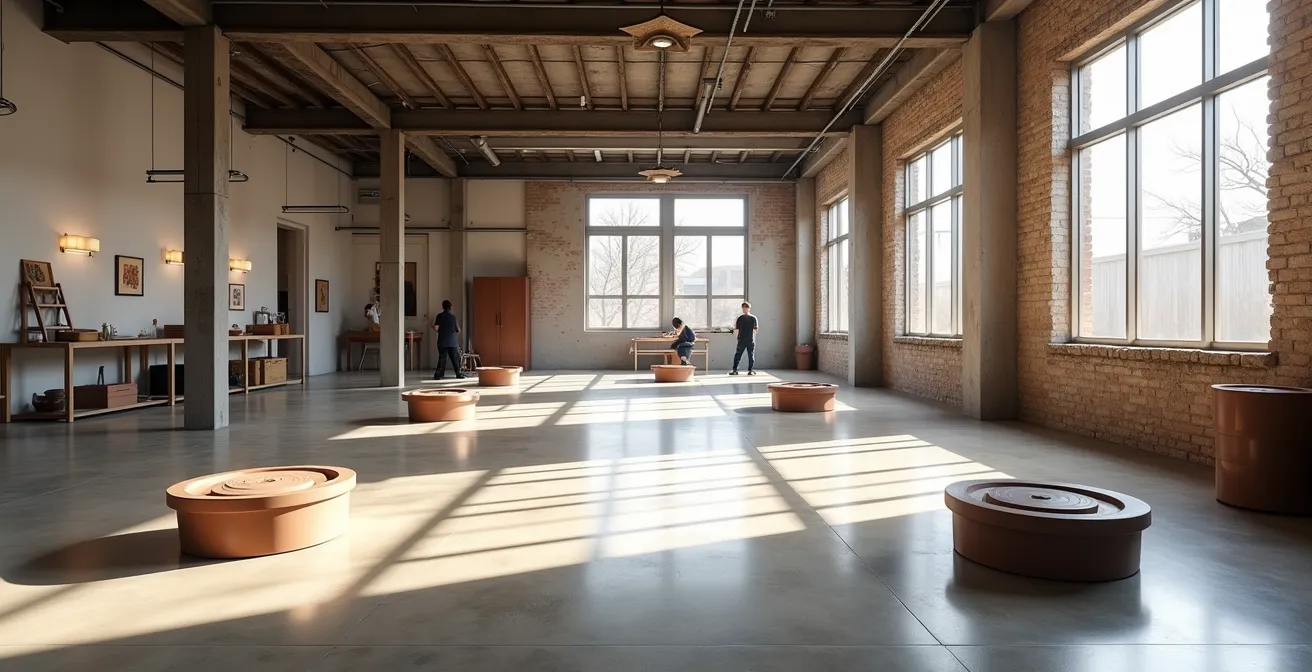
This table, informed by course listings from places like the Toronto School of Art, breaks down the key differences to help you decide.
| Aspect | Gardiner Museum | Independent Studios |
|---|---|---|
| Location | Yorkville (upscale) | Queen West, Parkdale (artsy) |
| Teaching Style | Formal, art-history informed | Personal, community-focused |
| Class Size | 10-15 students | 6-8 students |
| Price Range | $150-200 | $75-120 |
| Best For | Cultural experience seekers | Hands-on craft enthusiasts |
| Atmosphere | Museum-quality, polished | Bohemian, creative hub |
Tournage ou modelage : par quoi commencer si on a deux mains gauches ?
For a complete beginner, walking into a pottery studio can be intimidating. The most common fear I hear is, “I’m not artistic, I’ll be terrible at this!” The good news is, you don’t need any prior talent. The key is to start with the right technique. Most beginner pottery classes will introduce you to two fundamental methods: wheel throwing (tournage) and hand-building (modelage).
Wheel throwing is what most people picture: sitting at a spinning wheel, magically pulling a vessel up from a lump of clay, like in the movie *Ghost*. It’s a dynamic and mesmerizing process, but it has a steeper learning curve. Centering the clay—the first and most crucial step—requires patience and practice. It can be frustrating at first, but the feeling of successfully “pulling” a wall is incredibly rewarding.
Hand-building, on the other hand, is much more intuitive and forgiving for beginners. It involves techniques like pinching, coiling, and slab-building to create forms without a wheel. It’s slower, more meditative, and gives you a great feel for the properties of clay. If you’re feeling nervous or believe you have “two left hands,” hand-building is the perfect starting point. You can create beautiful, organic forms with less technical pressure. Many studios offer introductory workshops that let you try a bit of both, which is an ideal way to discover what you enjoy most.
Pourquoi l’AGO est-il incontournable pour comprendre l’identité canadienne ?
To truly connect with Toronto’s craft scene, you need to understand its context. A visit to the Art Gallery of Ontario (AGO) is more than just a tour of paintings; it’s an essential primer on the country’s creative heritage. The AGO provides the “why” behind the “what” you’ll be doing in the studio. It showcases the deep history of making in Canada, from Indigenous craftsmanship to contemporary works, giving you a richer appreciation for the tradition you’re about to join. Cultural activities are a huge part of the Ontario experience; tourism and culture statistics show that millions of visitors seek out these exact kinds of authentic connections.
For a DIY enthusiast, a targeted visit to the AGO is a powerful source of inspiration. Instead of wandering aimlessly, you can go on a self-guided “crafter’s tour.” Start in the Thomson Collection’s decorative arts section to see historical European masterworks, then move to the incredible collections of First Nations and Inuit art. Study the intricate beadwork, the elegant lines of stone carvings, and the complex patterns in textiles. These are not just artifacts; they are a living library of techniques and aesthetics that have shaped Canadian identity.
You can even see how these traditions are carried on today by visiting the AGO shop, which often features works by contemporary Toronto artisans. A visit to the AGO reframes your workshop experience: you’re not just playing with clay, you’re participating in a long and proud lineage of Canadian craft. For an even deeper dive, you can follow up your visit with workshops at places like the Native Canadian Centre of Toronto to learn about Indigenous craft from the source.
Artisanat local ou souvenirs importés : comment repérer la véritable qualité ?
As you explore Toronto’s shops, you’ll be faced with a sea of souvenirs. Telling the difference between a genuinely local, handmade piece and a mass-produced import can be tricky, but it’s a crucial skill for any conscious consumer. True local craft holds the story of its maker and supports the city’s creative economy. So, how do you spot the real deal?
First, look for the maker’s mark. Most artisans will sign or stamp their work, a literal mark of pride and authenticity. A business card or a small tag explaining the artist’s process is another great sign. Don’t be afraid to engage with the seller or artist if they’re present. Ask them about their process or materials; a passionate creator will be happy to share their story. Red flags, on the other hand, include finding identical items in multiple, unrelated tourist shops, or seeing “Made in China” stickers. These are clear signs of mass production.
To be certain you’re buying authentic work, visit verified craft hubs. The Distillery District is filled with galleries and studios showcasing local talent. In the winter, the One of a Kind Show is a massive exhibition of Canadian makers. Another key event is City of Craft.
Case Study: City of Craft as Toronto’s Authenticity Hub
As Toronto’s largest not-for-profit juried craft show, City of Craft is a benchmark for quality. It attracts thousands of attendees and features 55-60 vendors who have been carefully selected by a jury. The event’s mission is to connect studio craft with the DIY community. To highlight their commitment to authentic goods, they even give away tote bags screen-printed by local artists, directly contrasting with the generic, mass-produced souvenirs found elsewhere.
Ultimately, buying local is about investing in the stories and skills of the people who make Toronto a creative city. By learning to spot quality, you turn a simple purchase into a meaningful act of support for the local maker community.
Key Takeaways
- The true value of a craft workshop lies in the hands-on experience and the learned skill, not just the finished object.
- Choose your Toronto studio based on the atmosphere you seek: a formal, cultural experience at a museum or the cozy, community vibe of an indie studio.
- For tourists taking pottery classes, logistics are crucial. You must plan ahead for multi-day firing times or confirm the studio offers shipping services.
Pourquoi choisir une visite guidée thématique plutôt qu’un tour en bus générique ?
Just as you’d choose a specific craft workshop over a generic souvenir, applying a thematic lens to your exploration of Toronto will unlock a much richer experience than a standard hop-on-hop-off bus tour. A generic tour shows you the “what”—the CN Tower, City Hall—but a thematic tour explains the “why.” By focusing on a specific interest like craft and design, you can create a self-guided “craft crawl” that reveals the city’s hidden creative soul.
This approach allows you to connect the dots between different parts of the city’s maker culture. For example, you could start in the Distillery District, with its Victorian industrial architecture repurposed into galleries, and then head to a place like Artscape Wychwood Barns. This former streetcar repair facility is a prime example of Toronto’s genius for transforming industrial heritage into vibrant creative spaces. It now hosts farmers’ markets, community events, and world-renowned craft studios.
Case Study: The Artscape Wychwood Barns Craft Experience
At Artscape Wychwood Barns, you can experience the work of world-renowned, Finnish-born artist Minna Koistinen at her Playing With Fire glass studio. After taking a workshop, you can explore the surrounding arts hub. This model of repurposing industrial spaces for craft demonstrates Toronto’s unique approach to cultural tourism. It’s an immersive experience that a generic tour bus driving by could never offer.
By curating your own tour around a theme, you’re not just a passive observer; you’re an active participant in the city’s culture. You’re making choices that directly support the artists and small businesses that define Toronto’s character. This kind of focused tourism is exactly what drives the city’s economy. According to the City of Toronto’s Visitor Economy data, visitor spending has a massive ripple effect, creating billions in total economic impact. Your choice to visit a small studio or gallery contributes directly to that vitality.
The best way to understand Toronto’s creative spirit is to get your hands dirty. Choose a studio that speaks to you, book your spot, and start your own making journey. You’ll leave not just with a souvenir, but with a skill, a story, and a tangible connection to the heart of the city.