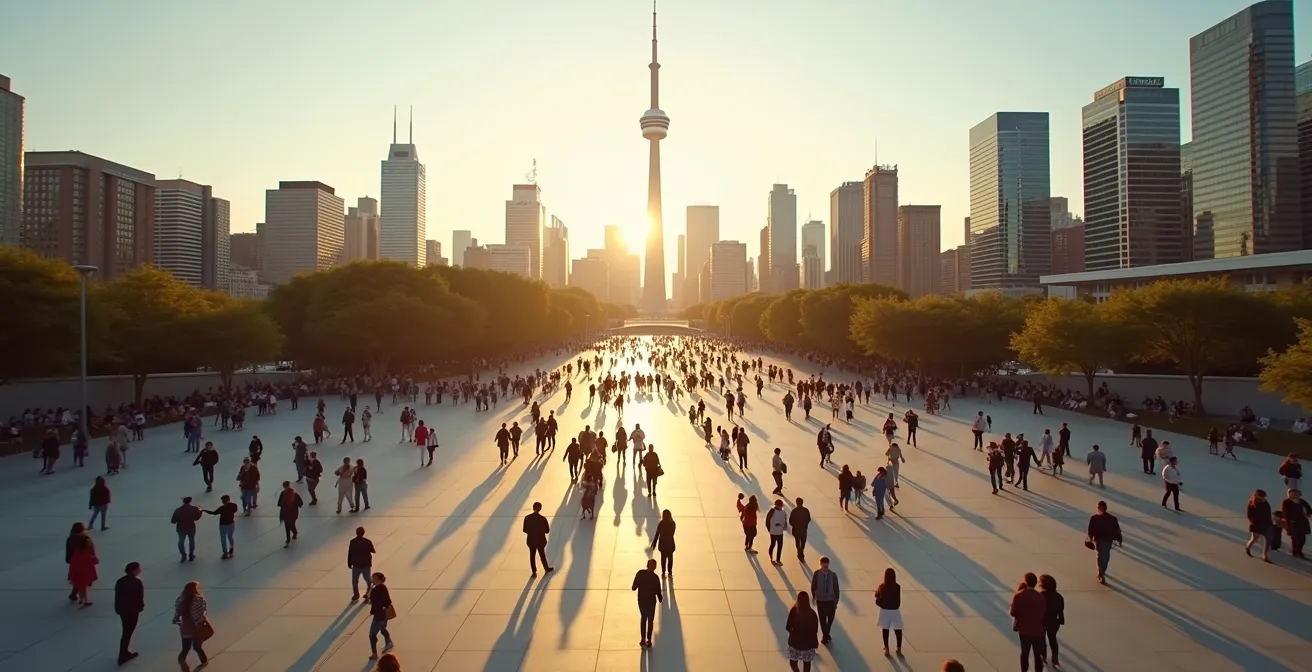
Toronto’s multiculturalism is not a passive collection of cultures, but a dynamic social engine that actively powers the city’s identity and economy.
- Diversity is a catalyst for business innovation, making the city a prime test market for global products.
- True cultural immersion comes from deep engagement within a few neighborhoods, not a rapid tour of many.
Recommendation: To truly understand Toronto, shift your focus from seeing cultural “enclaves” to participating in the everyday social and economic interactions that define its vibrant, fluid identity.
To ask why Toronto is the world’s most multicultural city is to ask what makes a forest a forest. Is it the sheer number of trees? Or is it the complex, living ecosystem they form together? Many articles point to the popular statistic that over half of Toronto’s residents were born outside Canada. They will guide you through a checklist of ethnic restaurants and weekend festivals, presenting the city as a colourful mosaic of separate, static tiles. This view, while charming, misses the fundamental point.
This mosaic metaphor is incomplete. It suggests a fixed picture, a collection of distinct pieces sitting side-by-side. The reality of Toronto is far more dynamic, more fluid, and infinitely more interesting. The city’s diversity is not a gallery to be observed; it is a powerful social engine. It is a set of active, interconnected systems that constantly shape the city’s economy, its social fabric, and the very identity of what it means to be a Torontonian. This is a city where culture is not just preserved in enclaves but is actively created and recreated daily in shared spaces.
The true key to understanding Toronto lies not in cataloguing its diversity, but in understanding the *mechanisms* of this engine. It’s about seeing how a newcomer finds their footing, how different perspectives fuel local business, and how social navigation requires a more nuanced understanding than simply knowing where to find the best souvlaki or cannoli. This article will deconstruct that engine, moving beyond the surface-level tour to explore the deep social DNA of the city. We will examine the real strategies for integration, the evolution of its “cultural” neighborhoods, the economic advantages of its diversity, and the subtle social codes that govern daily life.
This guide offers a framework for seeing Toronto not as a collection of destinations, but as a living, breathing social organism. Below is a detailed exploration of the core components that make this city a global model for urban multiculturalism, providing you with the insights to engage with it on a deeper, more meaningful level.
Summary: Why Is Toronto Considered the World’s Most Multicultural City?
- How to quickly integrate into local communities when you arrive from abroad?
- Little Italy or Greektown: which neighborhood to choose for an authentic gastronomic evening?
- The little-known advantages of Toronto’s diversity on innovation and local business
- The 3 cultural missteps to avoid during your social interactions in Toronto
- When to visit Toronto to attend the Caribana festival and live the Caribbean culture?
- Why does visiting fewer neighborhoods allow for a better understanding of Toronto?
- How to explore Kensington Market without falling into tourist traps?
- How to find work-life balance in the hustle and bustle of Toronto?
How to quickly integrate into local communities when you arrive from abroad?
Integration in Toronto is less about assimilation and more about connection. The city is built on the premise of continuous arrival; it’s a place where being “new” is a shared experience. The integration engine is fueled by the fact that Toronto is structured to welcome a constant influx of global talent. It’s not just a vague feeling of friendliness; it is a demographic reality. For instance, the city is a primary destination for newcomers, with a reported 128,000 new permanent residents arriving annually. This sheer volume means the city’s social infrastructure, both formal and informal, is perpetually adapted to onboarding new people.
Successful integration isn’t a passive process; it requires proactive engagement with the city’s many “soft-landing” networks. The first step for many begins before they even land, by joining Toronto-specific diaspora groups on platforms like Facebook. These digital communities act as a crucial first-touch point for navigating everything from bureaucratic hurdles, like applying for an OHIP card, to finding a social circle. Upon arrival, this extends to physical hubs. Toronto’s public libraries and community centres, such as Scadding Court, are not just buildings; they are vital cross-cultural connection points offering newcomer programs.
However, the most profound connections often arise from shared purpose rather than shared origin. Volunteering for city-wide organizations like the Daily Bread Food Bank or at a local festival provides an unparalleled opportunity to meet a diverse cross-section of Torontonians who share your values. This is where the “social engine” truly ignites. By contributing to the community, you move from being an observer to an active participant. This practical engagement, combined with leveraging neighbourhood-specific apps like Nextdoor and professional Meetup groups, allows you to build a multi-layered network that is both residentially and professionally grounded, forming the bedrock of a new life in the city.
Little Italy or Greektown: which neighborhood to choose for an authentic gastronomic evening?
The question of choosing between Little Italy and Greektown for an “authentic” meal is a classic Toronto dilemma, but it’s based on a slightly outdated premise. It assumes these neighbourhoods are static ethnic museums. The reality is one of cultural fluidity, where authenticity has evolved beyond traditional recipes to encompass a spectrum of experiences. College Street’s Little Italy, for example, now offers everything from classic slice shops to modern trattorias that fuse Italian tradition with Canadian ingredients. The Danforth’s Greektown similarly hosts both lively tavernas with traditional music and upscale Mediterranean restaurants offering sophisticated wine pairings.
The choice today is less about the neighbourhood’s name and more about the specific experience you seek. A detailed look at the culinary landscape reveals a nuanced matrix of options, where the “right” choice depends on your mood, budget, and company.
This table from a recent analysis illustrates how different neighbourhoods cater to diverse dining intentions, moving beyond the simple ethnic label.
| Neighborhood | Romantic High-End | Lively Group Dinner | Authentic Budget Bite |
|---|---|---|---|
| Little Italy (College St) | Family trattorias with modern Canadian-Italian fusion | Bustling patios perfect for large groups | Classic pizza by the slice shops |
| Greektown (Danforth) | Upscale Mediterranean with wine pairings | Traditional tavernas with live music | Authentic souvlaki spots under $15 |
| Emerging Spots | Scarborough’s Middle Eastern fine dining | Wilson Station’s Filipino cluster | Parkdale’s Tibetan momo shops |
As the table suggests, true “authenticity” is now a moving target, often found by following the diaspora itself. This reveals a deeper, more interesting story about the city’s demographic shifts.
Case Study: Following Toronto’s Culinary Diaspora Movement
While Greektown on the Danforth remains an iconic destination, sociologists and foodies note that the heart of the Greek community’s daily life has expanded. Some of the most authentic bakeries and community hubs are now found in Scarborough. Similarly, Little Italy has evolved into a contemporary Italo-Canadian hub, while the most vibrant, traditional experiences might be found where communities now live and eat daily. This includes the thriving Filipino restaurant cluster around Wilson Station or the diverse Middle Eastern options throughout Scarborough, proving that authenticity is a verb—it’s about following the culture in motion.

As this evening scene shows, the atmosphere of shared experience and human connection is the real heart of Toronto’s culinary culture. It’s found in the laughter across a patio table and the warm glow of restaurant lights, regardless of the specific flag a neighbourhood once flew. The search for authenticity is a journey, not a destination.
The little-known advantages of Toronto’s diversity on innovation and local business
Toronto’s multiculturalism is far more than a social asset; it is a potent economic driver. The city’s remarkable diversity, with its population representing over 250 ethnicities and 190 languages, creates a unique ecosystem for business and innovation. This isn’t just about having a variety of ethnic restaurants; it’s about possessing an unparalleled pool of global talent, market insight, and cultural intelligence. For companies with global ambitions, Toronto is not just a Canadian city—it is a microcosm of the world market.
This diversity functions as a built-in focus group for international products and services. A company can test a new app, food product, or marketing campaign on a local population that accurately reflects consumer preferences from Europe, Asia, South America, and beyond. This de-risks global expansion and provides invaluable, real-time feedback that is impossible to replicate elsewhere. The city’s workforce becomes a strategic advantage, with employees whose linguistic skills and cross-cultural communication abilities are not just a bonus, but a core competency.
This dynamic is actively fostered by dedicated organizations that bridge the gap between immigrant talent and the business community, turning diversity into a tangible economic output.
Case Study: Toronto as a Global Product Testing Ground
Toronto’s role as a perfect testbed for global products is a well-documented phenomenon. Companies leverage the city’s multicultural workforce not just for translation, but for deep cross-cultural communication training, making their teams invaluable for global expansion strategies. Organizations like the Toronto Region Immigrant Employment Council (TRIEC) play a crucial role by connecting highly skilled immigrant talent with local businesses through professional mentoring programs. This creates a unique symbiotic ecosystem where diversity isn’t just celebrated—it directly fuels innovation, problem-solving, and international business growth.
Ultimately, Toronto’s multiculturalism creates a virtuous cycle. It attracts global talent, which in turn provides local businesses with the human capital and market insights needed to compete on a global stage. This economic dynamism then further enhances the city’s reputation, attracting even more talent. It is a powerful demonstration of the social engine at work, converting demographic richness into economic resilience and innovative capacity.
The 3 cultural missteps to avoid during your social interactions in Toronto
Navigating Toronto’s social landscape requires a degree of cultural sophistication that goes beyond simple politeness. In a city where, according to the 2021 census, 55.7% of the population are visible minorities, identity is a complex, multi-layered concept. Making assumptions, even well-intentioned ones, can lead to awkwardness. Understanding a few key social nuances is crucial for successful integration and for showing genuine respect for the city’s social fabric.
The first and most common faux pas is asking, “Where are you *really* from?” While it may stem from curiosity, this question can imply that the person is not truly Canadian, regardless of their background. Many second or third-generation Torontonians, whose families may hail from anywhere in the world, identify simply as Canadian. A far better and more inclusive way to connect is to ask, “What neighbourhood are you from?” or “What’s your connection to this part of the city?” This grounds the conversation in a shared Toronto experience rather than highlighting perceived differences.
A second critical error is conflating neighbourhood with ethnicity. While areas like Koreatown or Little Portugal have strong historical roots, their resident populations are incredibly diverse today. Assuming a person living in Greektown is Greek is as inaccurate as assuming everyone in Midtown is of British descent. The key is to see people as individuals, not as representatives of their postal code. Toronto’s cultural fluidity means that communities are not geographically contained. Let people share their own stories and identities rather than imposing a label on them based on their address.
Finally, one must learn to decode the “Canadian indirect.” Torontonian culture, much like broader Canadian culture, often values harmony and avoids direct confrontation, particularly in professional settings. A soft “no,” a hesitant “that’s an interesting idea,” or a suggestion to “circle back on that later” can often be a polite way of disagreeing or rejecting a proposal. Learning to read these subtle cues is essential for effective communication. Recognizing that maintaining a positive, non-confrontational atmosphere is a cultural value will help you interpret interactions more accurately and build stronger professional relationships.
When to visit Toronto to attend the Caribana festival and live the Caribbean culture?
To experience the absolute peak of Caribbean culture in Toronto, you must plan your visit around the Toronto Caribbean Carnival, widely known as Caribana. This is not just a single-day event but a month-long festival season that crescendos during the Civic Holiday long weekend, which falls on the first Monday of August. The festival, which is North America’s largest cultural festival, attracts over 1.3 million tourists annually, transforming the city into a vibrant hub of music, food, and celebration.
While the entire season is festive, the key period for visitors to target is from late July through the first weekend of August. For 2024, the main events culminated from August 1st to August 5th. The undeniable centerpiece is the Grand Parade, which in 2024 took place on Saturday, August 3rd. This is where thousands of masqueraders in breathtakingly elaborate costumes dance through the grounds of Exhibition Place and along Lake Shore Boulevard. It’s an overwhelming spectacle of colour, sound, and energy that is the public face of the festival.

However, to truly live the culture, an urban sociologist would advise looking beyond the main parade. Deeper, more intimate experiences can be found in the lead-up events. The King and Queen Show is a must-see; it’s a competition where the leaders of the masquerade bands showcase their massive, intricate costumes, which are marvels of engineering and artistry. Another essential event is Pan Alive, an electrifying steel pan competition held at Lamport Stadium where you can feel the rhythmic heart of the islands.
Furthermore, the festival’s timing is profoundly significant, as it coincides with Emancipation Day on August 1st, which commemorates the abolition of slavery in the British Empire in 1834. This adds a deep layer of historical and cultural meaning to the celebrations. For the most authentic experience, venture out to the “fêtes” (parties) held by different promoters in venues across the GTA, particularly in areas with large Caribbean communities like Scarborough and Brampton. It’s in these spaces, away from the main tourist throngs, that you will find the true spirit and community pulse of the carnival.
Why does visiting fewer neighborhoods allow for a better understanding of Toronto?
The common tourist impulse is to “see it all”—a frantic hop from the CN Tower to Kensington Market, then a streetcar ride through Little Italy. This approach, however, often leads to a superficial, checklist-style experience. To truly understand Toronto’s social engine, a counter-intuitive strategy is more effective: go deep, not wide. Choosing to immerse yourself in one or two neighbourhoods for a few days reveals the city’s complex layers in a way that rapid-fire tourism never can. It allows you to observe the daily rhythms and unwritten social codes that form the true character of a place.
This deep-dive approach transforms you from a spectator into a temporary participant. You start to see the neighbourhood not as a themed attraction, but as a living system. For example, the case of Parkdale perfectly illustrates this concept of micro-cultures. A quick walk-through might just show you a gentrifying main street. But spending a few days there reveals a far more complex reality: the vibrant stretch of “Little Tibet” with its authentic momo shops, the lingering Caribbean cultural influences on side streets, and the “hipster” enclave on Queen Street West all coexist within a few blocks. These layers are invisible to the neighbourhood-hopper but become brilliantly clear through sustained, local-level engagement—riding the same streetcar as residents, visiting the local park, and seeing how these different communities interact (or don’t) in shared spaces.
By slowing down, you begin to notice the details that tell the real story: the community bulletin board at the local library, the particular way people queue at the butcher shop, the after-work crowd at the neighbourhood pub. This ethnographic approach provides a genuine connection and a more profound understanding of Toronto’s diversity than a dozen photos from a dozen different “ethnic” neighbourhoods ever could.
Your Action Plan: A 5-Step Neighborhood Immersion Audit
- Points of Contact: Identify all the neighbourhood’s key social hubs. List the main indie coffee shop, the local library branch, the busiest park, and the primary transit route (e.g., the 501 streetcar).
- Daily Rhythms: Collect observations of the neighbourhood’s daily life. Note the morning rush patterns, where people eat lunch, and how public spaces are used in the evening.
- Community Voices: Audit for consistency between the neighbourhood’s external reputation and its internal reality. Read the local community newspaper or blog and compare it to what you observe on the ground.
- Sensory Mapping: Evaluate the unique sensory details. What are the dominant smells from local bakeries or restaurants? What sounds define the area—streetcar bells, specific languages, music from shops?
- Integration Plan: Based on your audit, create a one-day plan to live like a local. Your goal is to replace a typical tourist action (visiting a landmark) with a local one (grocery shopping at a family-run store).
How to explore Kensington Market without falling into tourist traps?
Kensington Market is often described as the vibrant, beating heart of Toronto’s multiculturalism. As City Cruises Toronto notes, “Of all the Toronto pockets of culture, Kensington Market is the most vibrant and diverse.” However, its very popularity makes it susceptible to tourist traps that can obscure its authentic soul. To experience the real Kensington, you must navigate it with intention, peeling back the commercial layer to find the community-driven core that has defined it for generations.
Kensington Market is a microcosm of Toronto’s multiculturalism. Of all the Toronto pockets of culture, Kensington Market is the most vibrant and diverse.
– City Cruises Toronto, Deep Dive into Toronto’s International Cultures
The first rule of an authentic visit is timing. The market’s character shifts dramatically throughout the week. Saturday afternoons are peak tourist time, a crowded spectacle that’s more about consumption than community. To see the market as its residents do, visit on a weekday morning. This is when you’ll witness the true rhythm of the neighbourhood: locals doing their grocery shopping, shopkeepers chatting, and a calmer, more genuine atmosphere. This is the market in its functional, everyday state.
Second, you must venture off the main drag. The essence of Kensington is not just on Kensington Avenue. Explore the graffiti-filled back alleys and laneways, where street art tells stories of activism and community history. Discover hidden courtyards and take a moment to relax in Bellevue Square Park, a green space where locals gather away from the bustling crowds. It is in these liminal spaces that the market’s rebellious and artistic spirit truly resides. Look for the architectural ghosts of its past, like the former synagogues that hint at its origins as a Jewish market, to understand its layered history.
Finally, be a conscious consumer. The market is currently a battleground between long-standing, independent businesses and the encroaching forces of gentrification and tourist-oriented shops. Make a point to support the legacy stores—the cheese shops, bakeries, and bulk food emporiums that have been there for decades. Your patronage helps preserve the very soul you came to experience. And if your visit aligns, experiencing a Pedestrian Sunday, when the streets are closed to cars, offers a glimpse of the market at its community-led best, a stark contrast to a typical commercialized event.
Key takeaways
- Toronto’s multiculturalism is an active “social engine,” not a static mosaic, driving economic innovation and social identity.
- True cultural understanding comes from deep, immersive experiences in a few neighborhoods rather than a superficial tour of many.
- Navigating Toronto’s social landscape requires awareness of subtle communication styles and avoiding assumptions about identity based on appearance or neighborhood.
How to find work-life balance in the hustle and bustle of Toronto?
Finding work-life balance in a city as ambitious and fast-paced as Toronto is a significant challenge, but it’s one the city is uniquely equipped to solve. The “hustle culture” is real, yet the key to thriving lies in strategically using the city’s built-in release valves: its green spaces, its distinct seasonal cultures, and its hyper-local neighbourhood communities. The first, and most practical, step in this battle is winning back time. The daily commute is the single biggest drain on personal time for many Torontonians.
Making a conscious choice to live near a major transit line is not just a matter of convenience; it’s a fundamental life-balance strategy. By positioning yourself near a TTC subway station or a GO Train line, it’s possible to reclaim a significant amount of your day. In fact, studies suggest that choosing homes near transit can save 5-10 hours weekly—time that can be reinvested into health, hobbies, or family. This strategic decision about location is the foundation upon which a balanced life is built.
Beyond logistics, a successful strategy involves embracing Toronto’s four-season lifestyle. Each season offers a different mode of social connection and mental reset. Summer is defined by its vibrant patio culture, where after-work socializing blurs into relaxed networking. Fall is the time for weekend escapes to nearby farms for apple-picking, providing a necessary break from urban intensity. Winter requires a more intentional approach; creating “hygge” moments in cozy neighbourhood bars or cafes helps build tight-knit community bonds during the colder months. And spring is for reconnecting with nature by walking the city’s extensive ravine trails in places like the Don Valley or High Park to see the cherry blossoms.
Crucially, balance also comes from compartmentalization. It is vital to cultivate hobbies and social circles that are completely separate from your professional network. Joining a neighbourhood sports league, a book club, or a community garden creates a space where you are not defined by your job title. It’s in these spaces that you can decompress and build relationships based on shared interests, not career ambitions. This deliberate separation is the final piece of the puzzle, ensuring that the “hustle” of Toronto life is balanced by genuine, restorative personal time.
By understanding Toronto as a dynamic social engine rather than a static map of cultures, you unlock a deeper appreciation for the city. The next logical step is to apply this perspective to your own journey, whether you are planning a visit, a move, or simply seeking to understand your own city better.