
Contrary to popular belief, the best floor in a Toronto condo has little to do with the quality of the view and everything to do with the building’s hidden operational DNA.
- The daily reality of elevator congestion and wind-blasted balconies often outweighs the initial appeal of a penthouse panorama.
- The building’s construction (glass vs. masonry) and resident mix (owners vs. renters) are direct predictors of your future condo fees and lifestyle quality.
Recommendation: Shift your focus from subjective aesthetics to objective metrics. Analyze the resident-to-elevator ratio, view permanence, and long-term maintenance liabilities to make a sound financial investment, not just an emotional purchase.
For any discerning buyer eyeing the Toronto skyline, the quintessential question arises: which floor to choose? The conventional wisdom pits the panoramic allure of the upper levels against the grounded convenience of the lower ones. You’ve likely been told to weigh the premium for a lake view against the potential for street noise, a simple trade-off that has defined condo hunting for decades. This approach focuses entirely on aesthetics and personal preference, a dangerously incomplete picture.
As a specialist in Toronto’s luxury condo market, I can tell you what many overlook: the floor you choose is less an aesthetic choice and more a strategic investment in your future finances and daily quality of life. The most critical factors aren’t visible on a first viewing. They are embedded in the building’s very DNA—its operational metrics, its structural liabilities, and its community culture. These are the elements that truly dictate whether life at 500 feet is one of serene comfort or daily frustration.
But what if the key wasn’t simply looking out, but looking *in*? What if the true art of selecting the perfect floor lies in decoding the building itself? This guide is designed to move you beyond the superficial debate of ‘view vs. price’. We will dissect the hidden realities of high-rise living in Toronto, providing you with an insider’s framework to assess a property not just as a home, but as a complex operational and financial ecosystem.
This article will provide you with a strategic framework for your decision-making process. We will explore the critical, often-ignored questions you should be asking before you even consider the view. The following sections will equip you to analyze a building like a seasoned broker, ensuring your choice is based on lasting value and genuine comfort.
Summary: Beyond the View: A Broker’s Guide to Choosing the Right Floor in a Toronto High-Rise
- La panne d’ascenseur : pourquoi vérifier le ratio résidents/ascenseurs est crucial ?
- Pourquoi les balcons au-dessus du 30ème étage sont-ils souvent inutilisables ?
- Vue sur le lac ou vue sur la ville : laquelle s’apprécie le plus vite ?
- Tours vitrées vs maçonnerie : quel impact sur vos frais de condo dans 10 ans ?
- Propriétaires résidents ou locataires Airbnb : comment l’ambiance de la tour change tout ?
- Comment entrer sur le marché immobilier de Toronto avec un budget limité ?
- Comment aménager un condo de 600 pi² pour le rendre spacieux et lumineux ?
- Comment calculer le “Cash-on-Cash Return” réel d’un condo torontois après impôts ?
La panne d’ascenseur : pourquoi vérifier le ratio résidents/ascenseurs est crucial ?
Before you fall in love with a 45th-floor view, consider the mechanical reality that connects you to it: the elevator. In Toronto’s vertical landscape, the elevator system is the central nervous system of a building, and its inefficiency can become a source of profound daily frustration. The glamour of a penthouse quickly fades when you’re consistently waiting ten minutes for a ride during peak hours or, worse, facing a complete shutdown. This isn’t just an inconvenience; it’s a critical failure of the building’s operational DNA.
The core metric to investigate is the resident-to-elevator ratio. A healthy building might have one elevator for every 50-70 units; however, many new Toronto towers are being built with ratios that cause significant bottlenecks. This problem is compounded by a systemic strain on maintenance resources. In Toronto, a single elevator technician can be responsible for up to 100 elevators, creating a backlog for repairs and routine servicing. A building with a poor ratio and a history of breakdowns is a red flag for a compromised lifestyle and potentially mismanaged reserve funds.
As a discerning buyer, you must move beyond a simple test ride. Your due diligence should feel more like an operational audit. By rigorously assessing the vertical transport system, you’re not just avoiding a daily annoyance; you’re gaining a powerful insight into the overall health and management of the entire building.
Your Action Plan: Assessing a Condo’s Elevator System
- Request the Status Certificate to find the exact resident-to-elevator ratio for your building.
- Check the Reserve Fund Study for elevator maintenance history and modernization plans.
- Visit during peak hours (7-9 am, 5-7 pm) to experience actual wait times firsthand.
- Ask about Destination Dispatch systems if the building is newer than 2015, as these can significantly improve efficiency.
- Inquire about move-in/out elevator booking procedures and associated fees to gauge management’s organization.
Pourquoi les balcons au-dessus du 30ème étage sont-ils souvent inutilisables ?
The promise of a private outdoor oasis in the sky is one of the most powerful selling points for a high-floor condo. Yet, for many Toronto residents, this dream quickly collides with the reality of atmospheric physics. Above the 30th floor, the balcony you paid a premium for can often become a wind-swept, unusable ledge rather than a serene extension of your living space. The culprit is the wind-tunnel effect, which intensifies dramatically with altitude in dense urban environments.
This isn’t just a matter of a light breeze. The wind speeds can make it unsettling and often impossible to enjoy the space. As Ted Kesik, a renowned building-science expert at the University of Toronto, explained to The Globe and Mail, “The higher up balconies are situated, the less they are used, since high-wind speeds combined with large heights can be unsettling for many people.” This sentiment is echoed by those with firsthand experience living at these heights.
Case Study: The ‘Giant Hand Dryer’ Effect
Toronto real estate expert David Coffey provides a vivid account of his experience with a 30th-floor balcony. He describes the sensation of opening the door as “sticking your face in front of a giant hand dryer.” His report confirms that the sheer intensity of the wind at this altitude makes keeping outdoor furniture in place a constant battle and renders casual use of the space extremely challenging, turning a coveted feature into a source of frustration.
This isn’t to say all high-floor balconies are a lost cause. Thoughtful developers are now incorporating solutions like recessed designs, perforated glass windscreens, and deeper layouts. These architectural choices can mitigate wind effects and reclaim the usability of the space. However, as a buyer, you must assess whether the balcony is a genuine lifestyle asset or merely a marketing feature.

As you can see in well-designed buildings, features like heavy-duty furniture and engineered windscreens are not just accessories; they are essential tools for high-altitude living. When evaluating a unit, look for these built-in solutions. If the balcony is a simple, exposed slab, you must be realistic about its practical, year-round value.
Vue sur le lac ou vue sur la ville : laquelle s’apprécie le plus vite ?
The choice between a serene, south-facing lake view and a dynamic, north-facing city view is often framed as a matter of personal taste. However, from an investment perspective, it’s a strategic decision with long-term financial implications. While the unobstructed vista of Lake Ontario commands a significant premium, the real question is about value retention and risk. The most crucial factor to analyze is view permanence.
A lake view is often considered a safer bet because, short of major waterfront redevelopment like the Port Lands, the lake itself isn’t going anywhere. A city view, on the other hand, is perpetually at risk. The dazzling downtown panorama you buy today could be completely obscured by a new 60-storey tower in five years. This “future development risk” can significantly erode the very premium you paid for the view. A savvy buyer must become a student of municipal zoning, investigating the City of Toronto’s Development Applications portal to identify active proposals and zoning by-laws in the surrounding area.
Beyond permanence, each view has distinct operational costs and lifestyle impacts. The intense sunlight of a south-facing lake view can lead to higher air conditioning costs in the summer, while a north-facing unit may feel cooler and darker in the winter. The following table breaks down the key investment factors.
This comparative analysis, based on data from a recent Toronto real estate market report, highlights the trade-offs.
| Factor | Lake View (South-facing) | City View (North/West-facing) |
|---|---|---|
| Premium on Purchase Price | 10-15% higher | 5-8% higher |
| View Permanence Risk | Lower (protected by lake) | Higher (future development risk) |
| Natural Light | Maximum sunlight exposure | Less direct sunlight |
| Energy Costs (Summer) | Higher A/C usage | Moderate A/C usage |
| Winter Comfort | Warmer, brighter | Cooler, darker afternoons |
| Resale Appeal | Broader buyer appeal | Niche appeal for city lovers |
Ultimately, the “better” view is the one with the most predictable long-term value. A slightly less spectacular but protected view from a mid-level floor facing a park or a heritage district can often be a wiser and more stable investment than a premium-priced, high-risk penthouse view.
Tours vitrées vs maçonnerie : quel impact sur vos frais de condo dans 10 ans ?
The sleek, all-glass towers that dominate Toronto’s skyline are symbols of modern luxury. However, beneath their shimmering surface lies a significant, often underestimated, financial liability. The choice between a building with a glass “curtain wall” or “window wall” system and one with more traditional masonry or precast concrete is one of the most critical long-term financial decisions you’ll make, directly impacting your condo fees for decades to come.
The issue lies in the lifespan and replacement cost of these materials. Glass wall systems have a typical lifespan of 20-25 years before their seals begin to fail, leading to fogging, water leakage, and drastically reduced energy efficiency. Replacing these systems is an extraordinarily expensive undertaking that falls to the condo corporation—and by extension, to you, the owner, through special assessments or dramatic increases in monthly condo fees. A building’s reserve fund study should provide a clear picture of when these major capital expenditures are projected.
In contrast, buildings constructed with a higher percentage of masonry, brick, or precast concrete panels generally have a much more durable and lower-maintenance building envelope. While they may not offer the same floor-to-ceiling vistas, they represent a more conservative and financially stable long-term investment. They are less prone to catastrophic seal failure and have lower ongoing maintenance costs, insulating owners from the “facade liability” inherent in many modern glass towers.
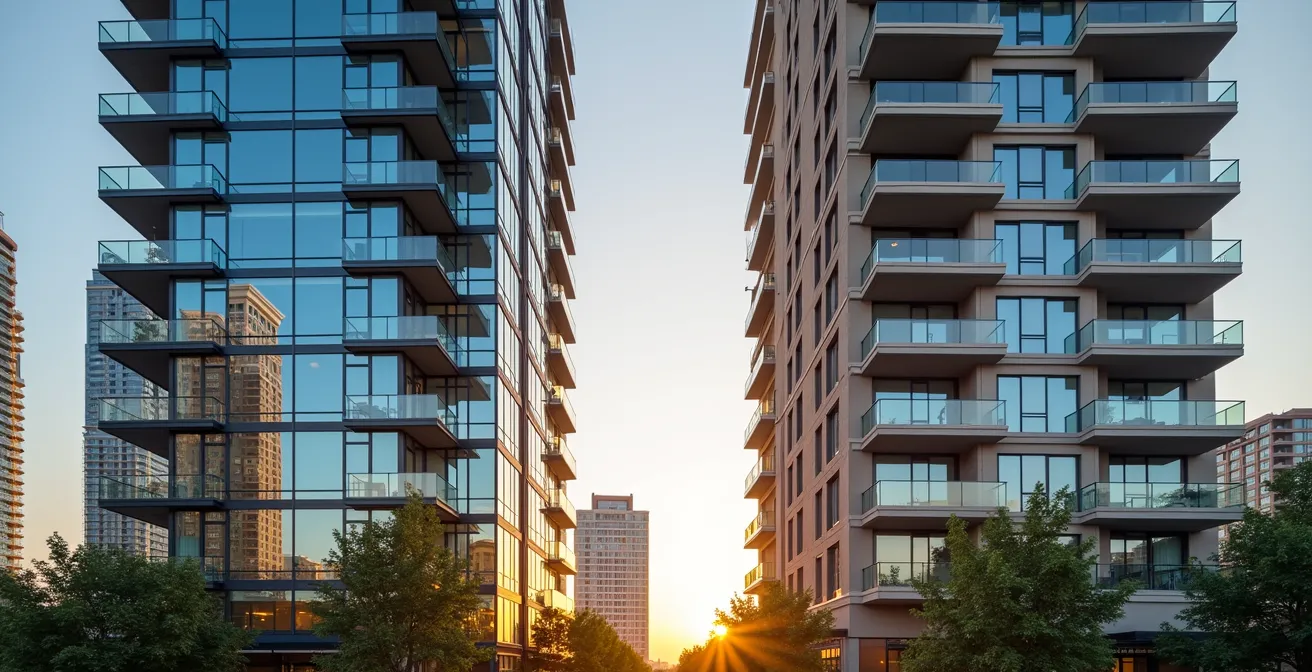
When you look at two buildings side-by-side, you’re not just seeing an aesthetic choice; you’re seeing two different financial futures. One path involves the predictable, gradual maintenance of durable materials. The other involves a massive, looming capital expense. The floor you choose is intrinsically tied to this liability; higher floors in glass towers often have more exposure and can be more complex to repair, further complicating future costs.
Propriétaires résidents ou locataires Airbnb : comment l’ambiance de la tour change tout ?
The social fabric of a condo building—its “vibe”—is an intangible but powerful factor in your long-term happiness and financial security. This atmosphere is largely determined by one key metric: the owner-occupancy ratio. A building predominantly filled with resident owners tends to foster a stable, community-oriented environment. Conversely, a tower with a high concentration of investors and short-term rentals (like Airbnb) can feel transient, impersonal, and come with hidden financial costs.
High tenant turnover, particularly from short-term rentals, can lead to increased wear and tear on common elements like lobbies, hallways, and elevators. This directly translates to higher maintenance costs for the condo corporation. More critically, buildings with a high percentage of non-resident owners are often viewed as higher risk by insurance companies. This can result in significantly increased premiums for the building’s master policy, a cost that is inevitably passed on to every single owner through higher monthly fees.
The current Toronto market conditions have exacerbated this issue, creating a clear divide between building types.
Case Study: The Financial Impact of an Investor-Heavy Market
The Greater Toronto Area is currently facing a challenging market for investor-owned units. A July 2024 market report revealed a staggering 29% year-over-year drop in condo sales, while inventory swelled. This data shows that buildings with a high ratio of investors are experiencing not only slower appreciation but also rising operational costs. Insurance premiums are on the rise in these buildings, directly impacting every owner’s monthly budget and creating a palpable “wait and see” tension that changes the entire community dynamic.
As a prospective buyer, it is essential to investigate the building’s culture. You can request the owner-occupancy percentage from the Status Certificate, check if the building’s by-laws restrict or ban short-term rentals (a very positive sign), and observe the traffic in the lobby at various times. A building with a strong sense of community is not just a more pleasant place to live; it’s a more stable and secure financial asset.
Comment entrer sur le marché immobilier de Toronto avec un budget limité ?
For many aspiring homeowners, the Toronto condo market can feel impossibly out of reach. With the average Toronto condo apartment price hovering around $663,000, even entry-level units require a significant financial commitment. However, for the strategic buyer with a limited budget, the market’s current complexities are creating unique opportunities. The key is to abandon the conventional wisdom of “buy the best view you can afford” and embrace a more sophisticated strategy: floor arbitrage.
Floor arbitrage is the practice of targeting lower-floor units in high-quality buildings, effectively leveraging the price difference between floors to your advantage. While a 40th-floor unit might command a 15-20% premium over an identical 4th-floor unit, the lower unit still grants you access to the same premium amenities, the same desirable location, and the same quality of construction. You are essentially buying into a luxury ecosystem at a discounted price point.
This strategy is particularly potent in today’s market, where many pre-construction investors are facing losses, creating a surplus of motivated sellers. This allows budget-conscious buyers to secure a foothold in a top-tier building that would otherwise be unattainable.
Case Study: Leveraging Market Shifts in Developing Neighborhoods
Recent analysis of Toronto’s pre-construction market shows that investors who bought at peak prices (around $1,500 per square foot) are now struggling as comparable resale units trade closer to $1,000 PSF. This price correction creates a prime opportunity for savvy buyers. By targeting lower-floor units in premium buildings, especially in developing areas like the Port Lands and East Harbour, buyers can enter the market at a more reasonable price point. While the current views may be of construction sites, they are betting on the massive long-term potential and planned infrastructure of the area, securing future appreciation without paying a premium for a present-day view.
This approach requires foresight and a willingness to prioritize long-term investment potential over immediate gratification. By focusing on the quality of the building and the growth trajectory of the neighborhood, rather than the altitude of the unit, you can make a strategic entry into one of the world’s most competitive real estate markets.
Comment aménager un condo de 600 pi² pour le rendre spacieux et lumineux ?
In Toronto’s market, maximizing every square foot is not just a design choice; it’s a financial and lifestyle necessity. A 600-square-foot condo can feel either cramped or surprisingly spacious, and the difference often lies in strategic, adaptable design. The key is to move beyond static furniture and embrace solutions that serve multiple purposes and utilize often-overlooked vertical and transitional spaces.
The floor level of your unit should directly influence your design strategy. A high-floor unit with intense, direct sunlight benefits from darker, matte finishes and automated blinds to control glare and create a cozy atmosphere. Conversely, a lower-floor unit that might be shaded by adjacent buildings requires an entirely different approach. Here, the goal is to amplify every bit of light with strategically placed mirrors, high-gloss surfaces on cabinetry and floors, and a bright, reflective color palette.
True space optimization comes from customization and adaptability, as demonstrated by many resourceful Toronto residents.
Case Study: A Family of Three in 660 Square Feet
A Toronto couple with a young child successfully transformed their midtown condo by prioritizing adaptability. Their den seamlessly evolved from a home office to a nursery and eventually to a child’s bedroom. They maximized a small laundry hallway with custom floor-to-ceiling shelving to store everything from a printer to stroller accessories. Their most impactful change was replacing the standard builder-grade closets with a highly-organized IKEA PAX system, which utilized the full depth and height of the closet space to store bulky items like golf clubs and tools, keeping the main living area uncluttered and serene.
This example highlights the power of seeing space not as a fixed area, but as a flexible volume. Modular furniture from local Toronto stores like Structube and EQ3 allows you to reconfigure your layout as needs change. Most importantly, investing in custom millwork for vertical storage is often the single best investment you can make in a small condo.

Ultimately, a well-designed small condo feels intentional and personal. It’s not about having less; it’s about using what you have with more intelligence and creativity, proving that a thoughtful 600 square feet can offer a better quality of life than a poorly planned 800.
Key takeaways
- Your floor choice is a financial calculation, not just an aesthetic one. Prioritize operational metrics over subjective views.
- The building’s physical (materials) and social (resident mix) DNA are the biggest predictors of your future costs and quality of life.
- Strategic opportunities like “floor arbitrage” exist for savvy buyers who are willing to look beyond conventional wisdom.
Comment calculer le “Cash-on-Cash Return” réel d’un condo torontois après impôts ?
We’ve deconstructed the hidden factors of high-rise living, from elevator logistics to facade liabilities. Now, we arrive at the ultimate metric that ties it all together: the Cash-on-Cash (CoC) Return. This calculation strips away the emotional appeal of a view and reveals the raw financial performance of your unit as an investment. For any discerning buyer, whether you plan to live in the unit or rent it out, understanding your CoC return is non-negotiable.
The formula is simple in principle: it’s your annual pre-tax cash flow divided by the total cash you invested. However, a true analysis requires a granular look at the numbers, which are directly influenced by your choice of floor. A higher floor commands a higher purchase price (and thus a larger down payment) and higher property taxes, but it may also generate slightly more rent. The crucial question is whether the increased rental income justifies the significantly larger initial cash outlay.
Let’s analyze a hypothetical but realistic comparison between an identical unit on a low floor versus a high floor in the same premium Toronto building. The following table breaks down the numbers, demonstrating how a lower purchase price can often lead to a superior investment return.
| Investment Factor | 5th Floor Unit | 45th Floor Unit |
|---|---|---|
| Purchase Price (identical unit) | $550,000 | $750,000 |
| Monthly Rent Potential | $2,400 | $2,800 |
| Annual Gross Rental Income | $28,800 | $33,600 |
| Condo Fees (monthly) | $650 | $650 |
| Property Tax (annual) | $6,600 | $9,000 |
| Net Operating Income | $14,400 | $16,800 |
| Cash-on-Cash Return (25% down) | 10.5% | 8.9% |
| Special Assessment Risk | Moderate | Higher (glass towers) |
| View Premium at Resale | None | 10-15% potential |
As the table illustrates, while the 45th-floor unit generates more rental income, its much higher purchase price results in a lower Cash-on-Cash Return. The investor on the 5th floor has their capital working more efficiently. This analysis proves that the “best” floor from a lifestyle perspective is often not the best floor from a financial one. By prioritizing strong financial metrics over a premium view, you position yourself for a more profitable and secure investment.
Now that you are equipped with this analytical framework, apply it diligently to your property search. By shifting your focus from aesthetics to analytics, you are empowered to make an investment, not just a purchase, securing both your financial future and your quality of life in Toronto’s vertical world.