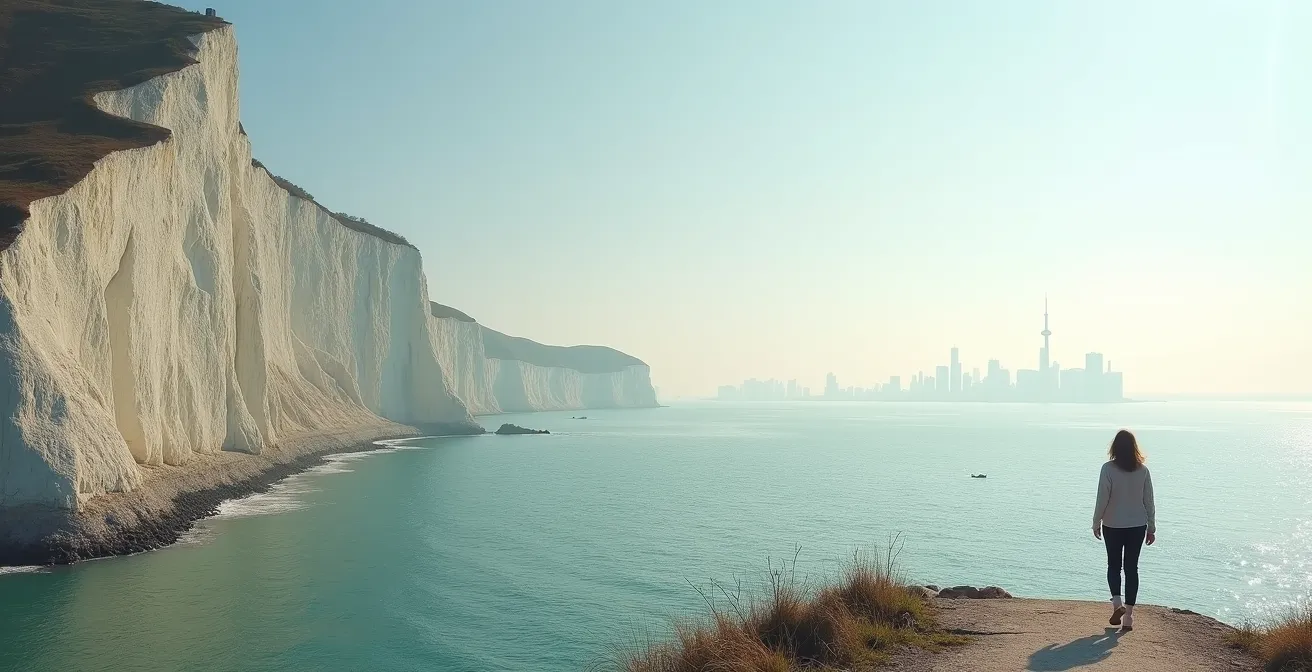
In summary:
- The desire for a perfect photo often leads to dangerous trespassing near the unstable cliff edges of the Scarborough Bluffs.
- The key to amazing, safe, and legal views is not breaking the rules, but understanding the landscape and using designated parks strategically.
- By choosing the right park for your goal (e.g., Scarboro Crescent for photos, Bluffer’s Park for family outings) and visiting during off-peak seasons like autumn, you can get better results with less risk.
- Ignoring safety barriers can lead to a $5,000 fine, but more importantly, it endangers yourself and the emergency crews who must perform rescues.
Every season, we see the same pattern at the Scarborough Bluffs. Drawn by promises of spectacular, cliff-side photos, visitors venture past fences and onto treacherous, unofficial paths. They’re chasing a shot for social media, but what they’re actually courting is a hefty fine and a serious risk of injury. The common advice is simple: “stay on the trails.” But this doesn’t capture the full picture or satisfy the desire for that truly breathtaking vantage point. People think the best view is the one that’s forbidden, the one that requires a little bit of rule-bending.
As someone who knows this landscape intimately, I can tell you that this belief is fundamentally wrong. The most rewarding experience of the Bluffs doesn’t come from a reckless scramble down an eroding cliff face. It comes from understanding the park’s rhythm, its geology, and its purpose. It’s about knowing which designated lookout offers the most dramatic sunset, why the autumn light makes the clay shimmer, or how to frame the iconic spires from a safe and stable platform. This isn’t about limiting your experience; it’s about enhancing it with knowledge.
This guide is built on that principle of informed compliance. Forget what you think you know about chasing the “best” view. We’re going to explore how to truly see the Bluffs—its grandeur, its delicate geology, and its hidden corners—safely and legally. We will break down why the rules exist, where to go for specific types of experiences, how to avoid the parking chaos, and ultimately, how to capture photos that are not just beautiful, but earned through smart, respectful exploration. The best view isn’t over the fence; it’s the one you get when you know where to stand.
To help you plan your visit, this article provides a structured approach to exploring the Bluffs safely and effectively. The following sections cover everything from the geological dangers to practical tips on parking and photography.
Summary: A Guide to Safely Experiencing the Scarborough Bluffs
- Why descending the cliffs off-trail is the most dangerous mistake to make?
- Brimley Road bondée : où se garer légalement quand les parkings sont complets ?
- Bluffer’s Park ou Scarboro Crescent : quel point de vue pour quelle expérience ?
- 5000 $CAD d’amende : les nouvelles règles strictes pour les photographes téméraires
- Pourquoi visiter les Bluffs en automne offre de meilleures couleurs et moins de foule ?
- Comment organiser une journée parfaite aux Îles de Toronto sans manquer le dernier ferry ?
- Comment créer un carnet de voyage de Toronto qui dépasse les simples selfies ?
- Rouge Hill ou Burlington : quelle station dessert le mieux les sentiers de randonnée ?
Why descending the cliffs off-trail is the most dangerous mistake to make?
The primary reason descending the cliffs is so perilous lies in the very geology that makes them beautiful. The Scarborough Bluffs are not solid rock; they are a 12,000-year-old formation of layered sand, clay, and gravel. This composition makes them inherently unstable and susceptible to constant erosion. Every year, the cliffs recede, not just from the pounding waves of Lake Ontario at their base, but from water runoff and seasonal freeze-thaw cycles from above. According to a geological study of the Bluffs, this combination creates a perfect storm for landslides, where huge sections of the cliff face can collapse without warning.
When you step off a designated path, you are walking on ground that has no structural integrity. These “unofficial trails” are often created by erosion, not by design, and can give way under your weight. The safety fences are not arbitrary; they are placed at the scientifically determined edge of stable ground. Crossing them means you are gambling against gravity and geology. Emergency rescues are a frequent and dangerous reality here, putting both the stranded person and the rescue teams at significant risk. The ground can shift during a rescue, complicating an already life-threatening situation. Respecting the barriers isn’t just about following a rule; it’s a fundamental acknowledgment of a powerful and unpredictable natural environment.
Your Pre-Hike Safety Checklist: The Bluffs Edition
- Stay behind all fences: Verify that you remain on the public side of all safety fences and barriers installed at viewing platforms.
- Use designated trails only: Inventory your route and ensure it follows official, marked pathways. Unofficial trails are unstable.
- Maintain edge distance: Even where no fence exists, measure and keep at least 3 meters (about 10 feet) from the cliff edge.
- Report dangerous behaviour: If you see someone climbing fences or on the cliffs, note their location and contact Toronto Police Services at 416-808-2222.
- Plan for emergencies: If you witness someone in distress, call 911 immediately. Do not attempt a rescue yourself; your priority is to be a good witness for emergency services.
Brimley Road bondée : où se garer légalement quand les parkings sont complets ?
On a sunny weekend, the parking lot at the foot of Brimley Road fills up fast, leading to frustration and illegal parking. The first rule of smart parking at the Bluffs is to manage your timing. Arriving before 9 a.m. or after 4 p.m. can make a world of difference. If you must arrive at peak times, you need a backup plan that doesn’t involve parking on the grass or in a no-parking zone, both of which will earn you a swift ticket. While street parking is available near the upper parks along the escarpment, pay close attention to the signage. It’s crucial to remember the city’s default three-hour maximum parking limit on most Toronto public roads unless a sign explicitly states otherwise.
A far more reliable strategy is to embrace public transit. This not only eliminates parking stress but also reduces congestion in the area. The TTC offers several routes that get you close to the action. For a visit to the base at Bluffer’s Park, the 175 Bluffer’s Park bus runs seasonally from Kennedy Station. For the upper parks, like Scarboro Crescent, the 12A Kingston Road bus (also from Kennedy Station) is an excellent weekday option. For those coming from further away, parking at a nearby GO Station and taking the TTC for the final leg is an efficient and stress-free alternative. This “park and ride” approach is the hallmark of a seasoned Toronto explorer.
Smarter Parking and Transit Options
- Street Parking Smarts: Look for street parking near other Bluffs parks (e.g., Guildwood Park, Rosetta McClain Gardens), but always obey posted signs and the three-hour city-wide limit.
- TTC Weekday Route: Take Line 2 to Kennedy Station, then transfer to the 12A bus, which stops at Kingston Road and Brimley Road.
- TTC Seasonal Route: From Kennedy Station, the 175 Bluffer’s Park bus provides direct access to the beach area, but be sure to check the schedule as it is a seasonal service.
- GO & TTC Combo: Park your car at a nearby GO Station like Scarborough or Eglinton and use a short bus ride to reach the Bluffs, avoiding the most congested areas.
Bluffer’s Park ou Scarboro Crescent : quel point de vue pour quelle expérience ?
The Scarborough Bluffs are not a single location but a 15-kilometre stretch of nine distinct parks. Choosing the right one depends entirely on your objective. Many visitors default to Bluffer’s Park at the base of the cliffs, which is perfect for a family day out. It offers a sandy beach, picnic spots, and washroom facilities, but the view is from below, looking up at the majestic cliffs. For photographers and those seeking that iconic, elevated vista, this is not the optimal choice. Your goal should be to find a strategic vantage point from the top of the escarpment.
For the quintessential “Bluffs photo,” Scarboro Crescent Park is the undisputed champion. It offers spectacular, unobstructed views from high above Lake Ontario, making it the best spot for sunset photography. Further east, Cathedral Bluffs Park provides sightlines of the dramatic “spires” that give the park its name. For a more serene experience or for visitors with mobility concerns, Rosetta McClain Gardens is ideal. It features beautifully maintained gardens and paved, accessible paths that lead to safe viewing areas. Each park is a different tool for a different job; the key is to match the location to your desired experience.

The following table breaks down the key differences between the most popular viewpoints, helping you decide where to go based on your plans for the day.
| Location | Best For | Key Features | Accessibility |
|---|---|---|---|
| Bluffer’s Park | Families with children | Beach volleyball, picnic spots, washroom facilities, Blue Flag beach | Full accessibility, parking available |
| Scarboro Crescent Park | Photographers | Spectacular sunset views from high above Lake Ontario, scenic walk overlooking bluffs | Limited accessibility, street parking only |
| Cathedral Bluffs Park | Best overall views | Highest points with spires resembling a grand cathedral | Moderate accessibility |
| Rosetta McClain Gardens | Visitors with mobility issues | Accessible paths, formal gardens, viewing areas | Full accessibility with paved paths |
5000 $CAD d’amende : les nouvelles règles strictes pour les photographes téméraires
The City of Toronto has taken a firm stance against trespassing at the Bluffs for a clear reason: public safety and the high cost of emergency rescues. The warnings are no longer just signs; they are backed by significant financial penalties. Under the city’s municipal code, anyone caught in a prohibited area of a park, which includes scaling fences or standing on unstable cliff edges, faces a set fine of several hundred dollars or, in more serious cases, could be subject to a maximum fine of up to $5,000 CAD. This isn’t an empty threat. Bylaw officers and Toronto Police regularly patrol the most problematic areas, especially during peak season.
For photographers, this means the “shot at all costs” mentality is a financially risky proposition. However, abiding by the rules doesn’t mean you can’t get professional-quality photos. The key is to use your equipment and positioning smartly. A telephoto lens is your best friend at the Bluffs, allowing you to capture stunning, compressed close-ups of the cliff textures and formations from a safe, designated viewing platform. Drones are also heavily restricted and require a specific permit from the City of Toronto to be flown legally. The best photographers are not the ones who break the rules; they are the ones who master composition and light from the safe vantage points available to everyone.
Legal Photography Guidelines for the Bluffs
- DO: Stay on the official viewing platforms at parks like Scarboro Crescent and Rosetta McClain Gardens.
- DO: Use a telephoto lens to get close-up shots of the cliff face without physically approaching it.
- DO: Plan your visit around the ‘golden hour’ (sunrise or sunset) to capture the best light and colours on the cliffs.
- DON’T: Cross any safety barrier or fence, no matter how tempting the shot looks.
- DON’T: Stand on or near any cliff edge, as the ground is unstable and can collapse.
- DON’T: Fly a drone without securing the proper permits from the City of Toronto Parks, Forestry and Recreation department.
Pourquoi visiter les Bluffs en automne offre de meilleures couleurs et moins de foule ?
While summer draws the biggest crowds to the Bluffs for swimming and sunbathing, the savvy visitor knows that autumn is the secret season for the best experience. From September through October, the weather remains pleasant, but the summer crowds have thinned out, making parking and finding a peaceful spot significantly easier. This is the essence of crowd arbitrage: using timing to your advantage. But the benefits go far beyond just having more space. The quality of the light changes in the fall, casting a warmer, golden glow on the cliff faces that contrasts beautifully with the deep blue of Lake Ontario.
Furthermore, the surrounding deciduous trees erupt in a brilliant display of red, orange, and yellow, framing the white cliffs in a stunning palette of fall colours. This makes for uniquely dramatic photography opportunities that simply aren’t available in the summer. While facilities like the snack bar at Bluffer’s Park may have reduced hours, the core experience of hiking and sightseeing is arguably at its peak. Even winter offers a stark, monumental beauty, when the cliffs are stripped of greenery and their geological structure is laid bare against the ice-rimmed lake. Every season has its charm, but autumn presents the best all-around combination of comfortable weather, fewer people, and spectacular visuals.
This table illustrates the unique pros and cons of visiting the Bluffs throughout the year, helping you plan your trip beyond the busy summer months.
| Season | Pros | Cons | Best Activities |
|---|---|---|---|
| Spring (Apr-May) | Abundance of wildlife including geese, swans, loons, egrets and migrating birds | Muddy trails, unpredictable weather | Birdwatching, nature photography |
| Summer (Jun-Aug) | Full beach access, all facilities open, warm weather | Peak crowds, difficult parking, heat | Swimming at Blue Flag beach, paddleboarding with Oceah Oceah |
| Autumn (Sep-Nov) | Fall colors, fewer crowds, comfortable temperatures | Shorter days, some facilities closing | Hiking, photography, peaceful picnics |
| Winter (Dec-Mar) | Monumental rock face has perhaps even more focal presence stripped of greenery | Trail closures, icy conditions | Dramatic cliff views, winter photography |
Comment organiser une journée parfaite aux Îles de Toronto sans manquer le dernier ferry ?
A trip to the Toronto Islands is a classic city escape, but it can quickly turn stressful if you’re not mindful of the ferry schedule. The key to a relaxed day is planning your departure before you even arrive. The single most effective strategy is to pre-purchase your ferry tickets online via the city’s official portal. This allows you to bypass the often-lengthy ticket-buying queue at the Jack Layton Ferry Terminal, saving you precious time and frustration. Once you have your tickets, your next step is to check the schedule for the last departure from each of the three main islands: Ward’s Island, Centre Island, and Hanlan’s Point. The times can vary, especially outside of the peak summer season.
A simple but effective trick is to set an alarm on your phone for 30-45 minutes before the last ferry is scheduled to leave from your island. This serves as a non-negotiable reminder to start packing up and heading back to the dock. It’s also wise to know the walking times between islands; for example, the walk from the Ward’s Island dock to the Hanlan’s Point dock takes a solid 35-40 minutes. For faster travel, consider using the Bike Share Toronto service available on the islands. As a final backup, have the number of a water taxi company saved in your phone. They are more expensive, but they offer a reliable safety net if you miss the last public ferry.

By treating the ferry schedule as the fixed anchor of your day and planning around it, you can freely explore the beaches, parks, and pathways without the nagging worry of being stranded.
Comment créer un carnet de voyage de Toronto qui dépasse les simples selfies ?
In an age of endless digital photos, the act of keeping a physical travel journal offers a more profound way to connect with a place. It transforms you from a passive tourist into an active observer. For a location as texturally rich as Toronto, and especially the Scarborough Bluffs, a journal can capture a story that a simple selfie never could. As the writers at the Great Lakes Guide so aptly put it when describing the area’s powerful atmosphere:
Standing on the sublime cliffs of the Scarborough Bluffs, you can feel as though you’ve left the city, or even the country
– Great Lakes Guide, Learn all about Toronto’s ancient Scarborough Bluffs
To capture this feeling, move beyond just writing what you did. Engage all your senses. Instead of taking a photo of the cliffs, try sketching the distinct geological layers, noting the different colours and textures of the clay and sand. Create a “sensory description” page: sit at a lookout point for ten minutes and list every single thing you can hear—the wind, the distant city hum, the call of a gull, the waves on the shore. Collect ephemera like a TTC transfer, a receipt from a local Scarborough cafe, or a fallen leaf from Rosetta McClain Gardens. These small, tangible items are potent memory triggers that will transport you back to that moment far more effectively than another photo in your camera roll.
Creative Journaling Techniques for Toronto
- Geological Sketching: Document the sedimentary striations of the Scarborough Bluffs. You don’t have to be an artist; the goal is observation.
- Urban Colour Palette: Dedicate a page to the colours of your day. Use watercolours or coloured pencils to capture the specific blue of Lake Ontario or the ochre of the cliffs.
- Texture Rubbings: Place a piece of paper over an interesting surface (like a park bench plaque or tree bark) and rub it with the side of a pencil to capture its texture.
- Architectural Contrasts: Sketch a 1960s Scarborough bungalow and contrast it with a modern downtown condo, noting the differences in materials and style.
Key Takeaways
- The primary danger at Scarborough Bluffs is geological instability; the cliffs are eroding and prone to collapse. Safety fences are not optional.
- The best photos come from strategic use of designated lookouts like Scarboro Crescent Park, not from risky off-trail adventures.
- Visiting in the shoulder seasons, especially autumn, provides a better experience with fewer crowds, comfortable weather, and beautiful fall colours.
Rouge Hill ou Burlington : quelle station dessert le mieux les sentiers de randonnée ?
This question presents a common point of confusion for visitors trying to access Toronto’s eastern nature trails via public transit. While Burlington GO station is a major transit hub, it is located far to the west of Toronto and primarily serves commuters and trails in the Hamilton and Niagara regions. For hiking in Rouge National Urban Park or accessing the eastern portion of the Scarborough Bluffs, Burlington is not a practical option. The focus should be entirely on the GO Train stations located within Scarborough itself.
Of these, Rouge Hill GO Station is unequivocally the best for direct trail access. The entrance to several key trails in Rouge National Urban Park, such as the Mast Trail and Vista Trail, is a mere five-minute walk from the train platform. This makes it the perfect starting point for a day of hiking. Other stations offer different levels of access. Guildwood GO is a 15-minute walk from the trails in Guild Park & Gardens, which includes a section of the Bluffs. Other stations like Eglinton or Scarborough GO require a connecting TTC bus ride to reach any of the main trailheads or viewpoints. Therefore, for a day dedicated to hiking, Rouge Hill is the superior choice.
The table below clarifies the best use for each of the relevant GO stations in East Toronto for accessing natural areas.
| GO Station | Distance to Trails | Main Trail Access | Connection to Bluffs |
|---|---|---|---|
| Rouge Hill GO | Direct access (0 min walk) | Rouge National Urban Park – Mast Trail, Orchard Trail | TTC bus connection to eastern Scarborough Bluffs |
| Guildwood GO | 15 min walk | Guild Park trails | 20 min walk to Guild Park section of Bluffs |
| Eglinton GO | 20 min bus ride | No direct trail access | TTC connection to Bluffs via Kingston Road buses |
| Scarborough GO | 25 min bus ride | No direct trail access | TTC 175 seasonal bus to Bluffer’s Park |
By combining knowledge of the landscape’s geology, a strategic approach to timing and location, and a respect for the established rules, your visit to the Scarborough Bluffs can be transformed. It shifts from a potentially risky photo-op into a rich, memorable, and safe exploration of one of Toronto’s greatest natural treasures. Plan your next trip with these principles in mind for a truly rewarding experience.