
The standard Cash-on-Cash Return formula is a dangerously incomplete metric for Toronto real estate; the true return is only found by accounting for tax drag, phantom liabilities, and leverage friction.
- Operating expenses are consistently underestimated, with the “1% rule” for maintenance failing to account for multi-thousand dollar special assessments common in Toronto towers.
- Tax deductibility is misunderstood; major renovations are capital expenses that do not reduce annual taxable income, creating significant tax drag on your cash flow.
- Accepting a monthly cash flow deficit in anticipation of appreciation is a flawed strategy that ignores compounding costs and borrowing capacity erosion.
Recommendation: Replace simplistic online calculators with a forensic, line-by-line analysis of all projected after-tax cash flows and liabilities before committing capital to any Toronto condo investment.
For the analytical investor, the allure of a Toronto condo is often presented through a single, appealing metric: the Cash-on-Cash (CoC) Return. Promoters and online calculators present a simple formula—annual pre-tax cash flow divided by total cash invested—that promises a clear measure of performance. This simplicity, however, is its greatest flaw. It creates a distorted picture of profitability that systematically ignores the financial realities of the Toronto market.
The standard calculation omits critical variables that can transform a seemingly profitable venture into a long-term liability. It fails to account for the nuances of Canadian tax law, the high probability of “phantom liabilities” like special assessments, and the true cost of financing. Relying on this superficial metric is akin to navigating a minefield with a tourist map. The real story of a property’s performance is not found in its pre-tax highlights, but in its post-tax, fully-loaded financial details.
The true measure of a Toronto condo’s viability requires a surgical, unemotional dissection of its numbers. This approach moves beyond marketing promises to uncover the real, after-tax return. It involves a rigorous examination of maintenance budgeting, a precise understanding of what the Canada Revenue Agency (CRA) considers a deductible expense, and a clear-eyed assessment of the risks associated with negative cash flow and long-term capital planning. This analysis is not about pessimism; it is about financial diligence.
This guide deconstructs the simplified CoC formula and replaces it with a framework for a forensic financial analysis. We will examine the hidden costs, tax implications, and structural risks inherent in the Toronto condo market to build a precise model for calculating your true after-tax return on investment.
The following sections provide a detailed breakdown of the critical factors that every serious investor must analyze. This structured approach will equip you with the necessary tools to evaluate a Toronto condo investment with the precision of a professional accountant.
Summary: A Forensic Guide to Toronto Condo Investment Returns
- Why prévoir 1 % de la valeur du bien par an pour l’entretien est un minimum ?
- Intérêts hypothécaires ou rénovations : qu’est-ce qui est réellement déductible au Canada ?
- L’erreur de miser uniquement sur l’appréciation en acceptant de perdre 200 $CAD/mois
- Condo fees : comment une augmentation de 100 $CAD impacte votre capacité d’emprunt future ?
- Guideline 2024 : quand et de combien pouvez-vous augmenter le loyer en Ontario ?
- Mise de fonds de 5 % ou 20 % : quel impact sur votre assurance prêt hypothécaire ?
- Tours vitrées vs maçonnerie : quel impact sur vos frais de condo dans 10 ans ?
- Comment structurer un portefeuille immobilier pour le transmettre à ses enfants dans 20 ans ?
Why budgeting 1% of the property’s value per year for maintenance is a bare minimum
The “1% rule” is a common heuristic for estimating annual maintenance costs. For a $700,000 Toronto condo, this suggests a budget of $7,000 per year. While a useful starting point, treating this as a sufficient buffer is a critical error in the Toronto market. This figure often fails to account for the high probability of special assessments, which are lump-sum levies imposed by the condo corporation to cover unexpected major repairs not funded by the reserve fund. These are not minor costs; they are phantom liabilities that can materialize with little warning.
In 2023, a case involving a 31-storey downtown Toronto tower highlighted this risk. The board announced a $7 million special assessment for structural and system repairs, resulting in individual unit charges ranging from $4,000 to $15,000. For an investor, this single charge could wipe out years of projected positive cash flow. These events are not black swans; they are a predictable outcome of aging infrastructure and, in many cases, chronically underfunded reserve funds. An investor’s pro-forma must include a contingency for these events, well above the baseline 1%.
The age and amenities of a building are direct drivers of this risk. An older building with a swimming pool, concierge, and extensive common areas carries a fundamentally higher maintenance liability than a newer, more basic structure. The reserve fund study, included in the condo’s status certificate, is not an optional read; it is a critical document. It provides a roadmap of planned future expenditures and the fund’s ability to meet them. Ignoring a poorly funded reserve is an explicit acceptance of future special assessments.
From a tax perspective, it is crucial to understand that a special assessment is not a deductible current expense. It is a capital expense. This means you cannot deduct the cost from your rental income in the year it is paid. Instead, the amount is added to the property’s Adjusted Cost Base (ACB), reducing the capital gain upon the eventual sale. This creates a significant tax drag, as it offers no immediate tax relief to offset the substantial cash outlay.
Mortgage interest vs. renovations: what is truly deductible in Canada?
A frequent and costly error in calculating after-tax returns is the misclassification of expenses. Investors often assume that all money spent on a property can be used to reduce their annual rental income for tax purposes. The Canada Revenue Agency (CRA) makes a sharp distinction between current expenses (repairs) and capital expenses (improvements), and this distinction has a profound impact on your actual cash flow.
Current expenses are costs incurred to restore a property to its original condition. Think of repainting walls, fixing a leaky faucet, or replacing a single broken appliance. These are 100% deductible in the year they are incurred. Capital expenses, however, are costs that provide a lasting benefit or improve the property beyond its original state. This includes upgrading to granite countertops, installing new flooring, or a complete window replacement. These costs are not deductible against rental income. Instead, they are added to the property’s Adjusted Cost Base (ACB) and can be depreciated over time through the Capital Cost Allowance (CCA) system. While CCA provides some tax deferral, it does not provide the immediate dollar-for-dollar tax reduction that a current expense does. Similarly, costs like the Toronto and provincial Land Transfer Taxes are not deductible; they are added to your ACB.

This table illustrates the fundamental difference in tax treatment for common expenses an investor in a Toronto condo will face.
| Expense Type | Tax Treatment | Toronto Condo Example |
|---|---|---|
| Current Expense (Repairs) | 100% deductible in current year | Replacing broken appliances, fixing leaky faucets, repainting walls |
| Capital Expense (Improvements) | Added to ACB, reduces capital gains | Upgrading to granite countertops, installing new flooring, replacing windows |
| Mortgage Interest | 100% deductible annually | Interest portion of monthly mortgage payment |
| Land Transfer Tax | Added to property cost base | Toronto MLTT on investment property purchase |
The only major expense that is reliably 100% deductible on an annual basis is the interest portion of your mortgage payments. Confusing a capital improvement with a current repair will lead to an overstatement of your after-tax cash flow and a potential reassessment by the CRA, with interest and penalties. A precise calculation of CoC return requires a strict adherence to these classifications.
The error of betting on appreciation while accepting a $200/month loss
A pervasive narrative in the Toronto real estate market is that accepting a small monthly negative cash flow is a sound strategy, as long-term appreciation will more than compensate for the loss. This is a speculative gamble, not an investment strategy. Treating a cash flow deficit as a minor inconvenience ignores its corrosive effect on your overall return and financial stability. A $200 monthly loss is a $2,400 annual investment required just to hold the asset, before accounting for any unexpected costs.
This strategy becomes particularly precarious when the primary drivers of expenses are outpacing rental income growth. In Toronto, condo maintenance fees are a significant and escalating cost. An investigation using condos.ca data revealed a 5.5% average annual increase in condo fees between 2022 and 2023. This is more than double the allowable rent increase guideline for the same period. This structural imbalance means that, for many investors, the cash flow deficit is not static; it is programmed to widen each year.
A sober analysis of a typical Toronto condo in 2024 reveals this reality. Consider a property with a projected annual rental income of $38,400 ($3,200/month). After factoring in annual carrying costs—mortgage payments, property taxes, insurance, and escalating condo fees—the total expenses can easily reach $43,632. This results in an immediate negative cash flow of $5,232 in the first year alone. The investor is now relying entirely on market appreciation to not only cover this deficit but also to generate a positive return. This places the entire investment at the mercy of market sentiment, interest rate policy, and other macroeconomic factors beyond the investor’s control.
The correct approach is to view the property’s operations and its potential for appreciation as two separate components of return. The operational component should, at minimum, be self-sustaining. A persistent cash flow deficit indicates that the rental income is insufficient to support the asset’s cost structure. Banking on appreciation to fix a broken operational model is a high-risk strategy that exposes the investor to significant downside if the market stagnates or corrects.
Condo fees: how a $100 increase impacts your future borrowing capacity
Condo maintenance fees are not merely a line item in your monthly budget; they are a direct input into a lender’s debt service ratio calculations. A seemingly modest increase of $100 per month can have a significant and often overlooked impact on your ability to secure future financing for other investments. Lenders treat 50% of your condo fees as a housing expense when calculating your Total Debt Service (TDS) ratio. Therefore, a $100 increase in fees adds $50 to your monthly debt obligations in the eyes of a lender.
With current market rates in Toronto, condo fees average between $0.65 and $0.75 per square foot. For a 700 sq. ft. unit, this translates to $455-$525 per month. However, this is just a snapshot. As buildings age and costs rise, these fees inevitably increase. When your TDS ratio is already near the lender’s maximum threshold (typically 42-44%), a surprise condo fee hike can be the factor that disqualifies you from a new mortgage or refinancing opportunity. It directly reduces your borrowing power.
The health of the condo corporation’s reserve fund is the leading indicator of future fee stability. As the GTA-Homes Real Estate Team notes, a poorly managed fund is a major red flag.
An underfunded reserve fund could mean a significant increase in your monthly maintenance fees, a special assessment payment, or a series of payments if a repair is needed.
– GTA-Homes Real Estate Team, Guide to Condo Maintenance Fees in Toronto 2024
This is not a hypothetical risk. It is a material financial threat that must be assessed during due diligence. An investor calculating their CoC return must project not just current condo fees, but their likely trajectory over the holding period. Factoring in a conservative annual increase of 5-7% provides a more realistic financial model than using the current fee structure alone. This disciplined forecasting protects against cash flow erosion and preserves future borrowing capacity.
Guideline 2024: when and how much can you increase rent in Ontario?
An investor’s ability to adjust rental income is a critical component of maintaining positive cash flow, especially in an inflationary environment. In Ontario, this ability is strictly regulated by the Residential Tenancies Act. For 2024, the rent increase guideline is set at 2.5%. This cap applies to most rental units, including condos, unless they meet a specific exemption: units first occupied for residential purposes after November 15, 2018, are exempt from the provincial rent increase guideline.
This exemption is the single most important factor for a Toronto condo investor focused on cash flow growth. A unit in a building completed in 2017 is subject to the 2.5% cap, while a unit in an identical building next door completed in 2019 is not. For the latter, the landlord can increase the rent to market rates, provided they give proper 90-day notice. This creates a two-tiered market and fundamentally alters the investment thesis. An investor in a rent-controlled unit is structurally disadvantaged, as their primary expense—condo fees—is rising at more than double the rate of their primary income.
For rent-controlled units, the only mechanism to increase rent beyond the guideline is through an Above-Guideline Increase (AGI) application to the Landlord and Tenant Board (LTB). An AGI can be justified by significant capital expenditures that improve the building. However, with a 35% increase in construction costs in Ontario between 2020 and 2023 according to Statistics Canada, the cost of these capital projects is soaring. The AGI process is also bureaucratic and slow, and the approved increase is capped at 3% above the guideline, spread over several years. It is not a reliable tool for quickly restoring cash flow.
Therefore, a precise CoC calculation must be based on the specific rent control status of the unit. Assuming you can raise rents to match inflation or rising costs is a fatal error for any unit occupied before the November 2018 cutoff.
Action Plan: Navigating Ontario’s Rent Increase Framework
- Identify the property’s first occupancy date to determine if it is exempt from rent control (post-November 15, 2018).
- For rent-controlled units, calculate maximum revenue growth using the current year’s 2.5% guideline, not market-rate assumptions.
- Meticulously document all capital expenditures that could potentially support an Above-Guideline Increase (AGI) application to the LTB.
- When applying for an AGI, ensure all invoices, permits, and proofs of payment are submitted to the Landlord and Tenant Board as required.
- In your financial projections, contrast the typical 5-10% annual condo fee increase against the rigid 2.5% rent increase limit to stress-test your cash flow.
5% or 20% down payment: the impact on your mortgage default insurance
The choice between a low down payment (5-19.99%) and a conventional one (20% or more) has significant and often misunderstood effects on the real Cash-on-Cash return. Opting for a lower down payment requires the investor to purchase mortgage default insurance from providers like the Canada Mortgage and Housing Corporation (CMHC). This insurance protects the lender, not the borrower, in case of default. The premium, which can range from 2.8% to 4.0% of the mortgage amount, is typically added to the mortgage principal and amortized over the life of the loan.
Counterintuitively, a lower down payment often results in a higher *on-paper* CoC Return percentage. This is a mathematical anomaly. The “Total Cash Invested” denominator in the CoC formula is much smaller, which mechanically inflates the resulting percentage, even if the monthly cash flow is worse due to the higher mortgage payment. This higher leverage amplifies returns, but it also amplifies risk and introduces hidden costs.
One of the most frequently missed costs is the Provincial Sales Tax (PST) on the CMHC insurance premium. In Ontario, there is an 8% PST on the CMHC premium that cannot be added to the mortgage. This amount must be paid in cash at closing. For a $600,000 mortgage with a 4% premium ($24,000), this “hidden” cost is an additional $1,920 cash required on closing day. This is a direct increase to the “Total Cash Invested” and is often omitted from amateur calculations, artificially inflating the CoC return.
While the lower down payment strategy can increase leverage, it creates significant “leverage friction.” The monthly cash flow is lower due to the higher amortized principal, and the upfront cash requirement is higher than just the down payment itself because of the PST. A 20% down payment avoids the insurance premium and the associated PST entirely, resulting in a lower mortgage payment and improved monthly cash flow. While the on-paper CoC percentage might be lower, the investment’s risk profile is substantially improved and its operational performance is stronger.
Key Takeaways
- True condo maintenance costs in Toronto far exceed the 1% rule due to the high probability of multi-thousand dollar special assessments.
- Only current repairs are fully deductible against rental income; renovations and improvements are capital expenses with different tax treatment, creating “tax drag.”
- Accepting negative cash flow based on appreciation hopes is a speculative gamble that ignores the corrosive effect of a widening deficit between capped rent increases and uncapped fee hikes.
Glass towers vs. masonry: the impact on your condo fees in 10 years
The architectural style of a condo building is not just an aesthetic choice; it is a long-term financial determinant. The prevalence of “window-wall” systems in many of Toronto’s newer glass towers presents a significant, deferred financial risk for investors. These systems, while cheaper to install, have a shorter lifespan and poorer thermal performance compared to traditional masonry or more robust curtain-wall constructions. The seals in window-wall panels can fail in as little as 10-15 years, leading to water ingress, energy loss, and ultimately, costly replacement projects.
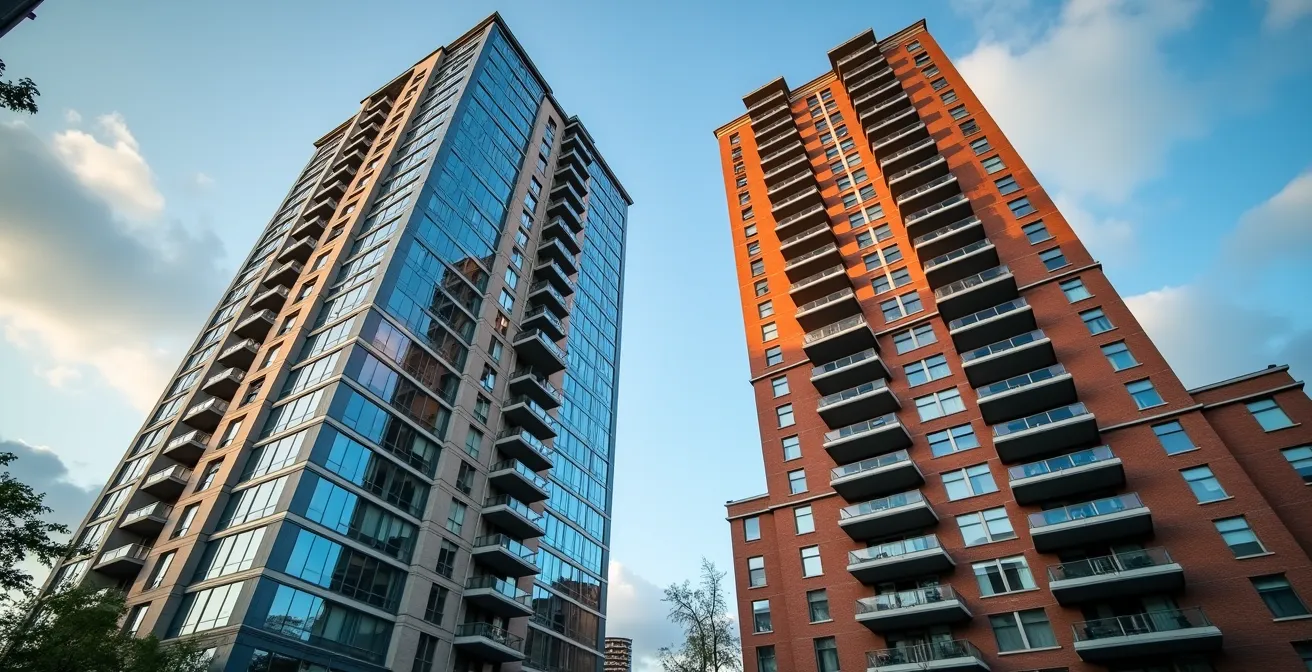
This deferred liability means that an investor buying into a new glass tower today may enjoy lower initial condo fees, but they are also buying into a predictable, multi-million-dollar replacement project a decade down the line. When these large-scale repairs become necessary, they often trigger the massive special assessments that cripple unprepared investors. The risk is systemic; a 2022 report from the Ontario Condominium Owners Association warned that as many as 30% of Ontario condo corporations could face funding gaps by 2025.
The financial consequences for individual owners can be devastating. A case study of one 40-year-old Toronto condo community illustrates the end-game of underfunded reserves and aging infrastructure. The corporation passed a special assessment ranging from $15,000 to nearly $30,000 per unit, with payment due in under three months. The alternative was a near-tripling of monthly maintenance fees. It was projected that up to 70% of owners would be forced to sell. An investor’s CoC calculation that fails to account for the building’s material composition and long-term capital plan is incomplete.
In contrast, buildings with more durable envelopes, such as those constructed with brick, precast concrete, or high-performance curtain-wall systems, generally have a more predictable and manageable long-term cost profile. While their initial purchase price or condo fees might be slightly higher, they are less likely to produce the kind of financial shocks that can erase an investor’s equity. A diligent analysis involves scrutinizing the reserve fund study for any mention of window or building envelope replacement and favoring buildings with more robust construction.
How to structure a real estate portfolio for intergenerational wealth transfer in 20 years
A long-term investment strategy requires planning for the eventual disposition of the asset. For many, the goal is to transfer a real estate portfolio to the next generation. In Canada, this process is governed by tax rules that can trigger significant liabilities if not properly managed. The most critical rule is the “deemed disposition” at death. Upon the death of an owner, the CRA treats all capital property, including investment condos, as if they were sold at Fair Market Value (FMV) on that day.
This triggers a capital gains tax liability on all accrued appreciation since the property was acquired. This tax bill is due before the assets can be transferred to beneficiaries. If the estate lacks the liquidity to pay the tax, beneficiaries may be forced to sell the properties in a fire sale simply to settle the CRA’s claim. As the Canadian Tax Foundation highlights, this is a central challenge in estate planning.
Estate planning for real estate portfolios requires careful consideration of the deemed disposition rules, where the CRA treats all capital property as sold at fair market value upon death, potentially triggering significant tax liabilities before assets can be transferred to beneficiaries.
– Canadian Tax Foundation, Tax Planning for Family Wealth Transfers
A robust estate plan anticipates this liability and structures the portfolio to manage it. One effective strategy is the use of a permanent life insurance policy. The investor can purchase a policy with a death benefit equal to the projected capital gains tax liability. The policy premiums are an ongoing cost of the portfolio, but the death benefit is paid out tax-free to the estate, providing the necessary liquidity to pay the tax bill and allowing the properties to be transferred intact.
Other structuring tools include the use of trusts. An Inter Vivos Trust can hold the properties, but investors must be aware of the 21-year deemed disposition rule for trusts, which requires careful planning. For a principal residence, joint tenancy with right of survivorship can allow the property to pass to a surviving spouse tax-free, but this does not apply to investment properties in the same way and does not solve the tax liability on the death of the second spouse. A comprehensive plan involves several key steps.
- Calculate the projected capital gains tax liability on deemed disposition at death based on estimated future property values.
- Establish an Inter Vivos Trust for holding properties, planning around the 21-year deemed disposition rule.
- Purchase a permanent life insurance policy with a death benefit sized to cover the projected tax liability.
- Regularly review and update beneficiary designations on all registered and non-registered investment accounts.
- Use joint tenancy with right of survivorship strategically, primarily for a principal residence with a spouse.
- Maintain meticulous records of the Adjusted Cost Base (ACB) for all properties, including all capital improvements and non-deductible acquisition costs like Land Transfer Tax.
Calculating the true after-tax Cash-on-Cash return of a Toronto condo is not a simple-form exercise. It is a forensic accounting process that demands a rigorous, unemotional examination of every potential cost and liability. Adopting this analytical mindset is the definitive step from being a speculator to becoming a professional real estate investor.