
In summary:
- The secret to a smooth ride isn’t medication; it’s choosing the right vessel. Large dinner cruise ships offer the most stability.
- For calmest waters and fewer crowds, book your tour for the morning. For the best sunset photos, aim for September.
- Always check the marine forecast for “Western Lake Ontario” and cancel if winds are predicted to exceed 15-20 knots.
- You cannot take a tourist cruise to Niagara Falls from Toronto; the Welland Canal is a commercial shipping route.
- For a full day on the water, combine a harbour tour with a trip to the Toronto Islands, using a water taxi to save time.
Ahoy there. There’s nothing quite like seeing that iconic Toronto skyline shimmer from the waters of Lake Ontario. It’s a view that changes with the light, a perspective that turns a familiar city into something new and magical. Yet, for so many, a nagging thought casts a shadow on that beautiful image: “What if I get seasick?” It’s a common worry that keeps too many landlubbers tied to the dock, imagining a day of misery instead of maritime bliss. You’ve probably heard the usual advice—stock up on ginger, stare at the horizon, maybe pop a pill and hope for the best.
While those tips have their place, they’re like patching a sail in a storm. As a captain, I can tell you the real solution isn’t about fighting seasickness once you’re on the water; it’s about making smart choices before you even step aboard. The secret to a perfect day on the lake is learning to read the water’s personality and matching it to the right vessel and the right time. It’s about understanding the harbour’s unique rhythm, from its calm morning moods to its breezy afternoon chop. It’s a shift from being a passive passenger to thinking like a skipper.
This guide isn’t about remedies; it’s about strategy. We’ll navigate the choices, from stately dinner cruisers to thrilling tall ships, so you can pick your “vessel personality.” We’ll chart a course for the perfect sunset photo, decode the weather like a pro, and even plan the perfect “shore leave” on the Toronto Islands. By the end, you’ll have the confidence to cast off your worries and truly enjoy the best view of the city.
In this comprehensive guide, we’ll explore every facet of enjoying Toronto’s waterfront. From choosing the right type of cruise to planning your entire day, you’ll find all the insider knowledge needed to make your experience unforgettable and, most importantly, smooth.
Summary: Your Guide to a Nausea-Free Lake Ontario Adventure
- Dîner-croisière ou tour guidé : quelle expérience offre le meilleur rapport vue/prix ?
- Coucher de soleil sur la Skyline : à quelle heure embarquer pour la photo parfaite ?
- Vents forts et orages : comment savoir si votre excursion sera annulée ?
- Grand voilier ou yacht à moteur : quelle sensation de navigation préférez-vous ?
- Peut-on aller à Niagara en bateau depuis Toronto ? Le mythe vs la réalité
- Comment organiser une journée parfaite aux Îles de Toronto sans manquer le dernier ferry ?
- Comment pratiquer le kayak sur le Lac Ontario en toute sécurité pour les débutants ?
- Le tunnel piéton ou le ferry : quelle option pour rejoindre l’aéroport du centre-ville ?
Dinner Cruise or Guided Tour: Which Experience Offers the Best View-to-Price Ratio?
The first decision on your nautical journey is the most critical for comfort: what kind of boat will you be on? This choice directly impacts stability. Think of it in terms of “vessel personality.” Are you looking for a quick, breezy introduction to the harbour, or a slow, stately glide with a meal? Your sensitivity to motion should be the deciding factor. Generally, the larger and heavier the vessel, the less it will react to the lake’s chop. A dinner cruise ship is built for stability, designed to keep plates and glasses on the table, which means it offers the smoothest ride.
In contrast, a smaller guided tour boat, while offering fantastic open-air views, will have a more noticeable motion signature. It’s more intimate with the water, which can be part of the fun, but less ideal if you’re concerned about seasickness. The price often reflects this; you’re not just paying for dinner on a cruise, you’re paying for the engineering and displacement that deliver a superiorly stable platform. The following comparison, based on typical Toronto fleet offerings, breaks down the trade-offs.
This table provides a clear overview of the main cruise options available in Toronto Harbour, helping you balance cost, time, and, most importantly, comfort.
| Option | Duration | Price Range | Stability Rating | View Quality |
|---|---|---|---|---|
| Dinner Cruise (City Cruises) | 2-3 hours | $80-150 CAD | High (Large vessel) | Indoor/Limited deck |
| Guided Harbor Tour | 45-60 min | $25-40 CAD | Medium | 360° open deck |
| Tall Ship Kajama | 2 hours | $35-45 CAD | Low (Heeling motion) | Open deck views |
| Water Taxi | 15-30 min | $10-15 CAD | Low | Basic transport |
Ultimately, if your primary goal is to avoid any chance of seasickness, the higher cost of a dinner cruise is a worthwhile investment in comfort. If you’re confident in your sea legs and prioritize 360-degree views for a shorter duration, a guided tour offers excellent value.
Sunset on the Skyline: What Time to Embark for the Perfect Photo?
Every sailor knows the true magic of being on the water happens during the “golden hour.” This is that precious time just before sunset when the light turns warm and soft, making everything it touches look spectacular. Capturing the Toronto skyline at this moment is the ultimate prize for any photographer, amateur or professional. But timing is everything. Boarding too early means you’re just waiting; too late, and you’ll miss the best light. The key is to be on deck and in position as the sun begins its descent.
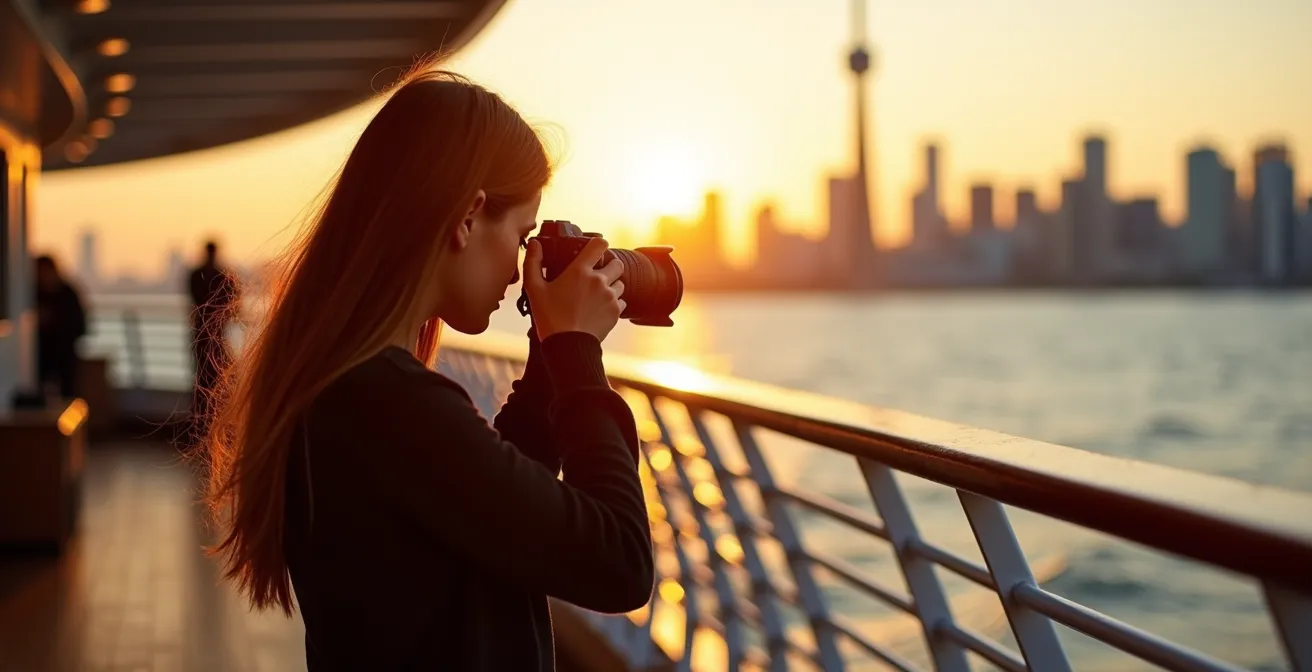
As you can see, being on the water provides an unparalleled vantage point. The reflection on the lake doubles the beauty, and the open space allows for an unobstructed composition. Based on local knowledge and light patterns, there’s a clear strategy for success. In summer, the sun sets northwest of the city, creating dramatic backlighting. However, seasonal studies show September offers optimal conditions, with the sun setting directly behind the financial district for perfect, crisp silhouettes. The following timeline is your playbook for capturing that postcard-perfect shot.
- 90 minutes before sunset: Board your cruise. This gives you ample time to find the best spot on the upper deck, ideally on the port (left) side for the initial approach.
- 60 minutes before sunset: The “golden hour” begins. The CN Tower and surrounding buildings will be bathed in warm, angled light. Start shooting.
- 30 minutes before sunset: The sun will start dipping behind the skyline. This is your chance for dramatic silhouette shots.
- Sunset moment: Focus on the sky’s vibrant colours and their reflection on the water’s surface.
- 20 minutes after sunset: Don’t pack up yet! The “blue hour” begins, and the city lights start to twinkle, creating a different kind of magic against the deep blue sky.
Strong Winds and Thunderstorms: How to Know if Your Tour Will Be Cancelled?
The one thing no captain can control is the weather. Lake Ontario is a Great Lake, and it can command respect with sudden changes. The good news is that tour operators in Toronto prioritize safety above all else, and outright cancellations are rarer than you might think. Data on marine operations shows that less than 8% of Toronto harbor cruises are cancelled due to weather. The primary culprit for a cancellation isn’t rain, but wind. Strong, sustained winds, particularly those exceeding 25 knots (about 46 km/h), create conditions that are unsafe and uncomfortable for most passengers.
So, how do you “read the lake” before you go? Don’t just look at a standard city forecast. You need to consult the marine forecast, which provides specific information on wind speed, direction, and wave height. Operators monitor this constantly. While a passing thunderstorm might delay a departure by 30 minutes, a full-day wind warning is what typically leads to a cancellation. Larger vessels like dinner cruise ships can handle more wind (up to 30 knots) than smaller tour boats or tall ships, which often have a lower threshold around 20 knots. Here is the protocol to follow to stay informed and avoid a wasted trip to the waterfront.
- 24 hours before: Check the Environment Canada Marine Forecast for “Western Lake Ontario.” Be on the lookout for any wind warnings or “strong wind” advisories.
- 12 hours before: Monitor the operator’s social media channels, like Twitter or Facebook. They often post updates on operating status there first.
- 3 hours before: Call the dock office directly. This is the most reliable way to get real-time confirmation. For Harbour Tours, for example, the number is 416-203-2322.
- 1 hour before: If you’re in the area, a visual check can be telling. If other boats from other companies are heading out, it’s a very good sign that your tour will proceed.
Knowing this process gives you control and peace of mind. A little bit of proactive checking ensures you won’t be left standing on the dock in the rain.
Tall Ship or Motor Yacht: Which Sailing Sensation Do You Prefer?
Beyond stability, the “vessel personality” defines the very sensation of your cruise. This is where you choose between two fundamentally different experiences: the historic thrill of a tall ship or the modern comfort of a motor yacht. Neither is better than the other; they simply offer different ways to connect with the water. A tall ship like the Kajama offers an authentic, wind-powered journey. You’ll hear the snap of the sails and feel the ship “heel” or tilt with the wind. An analysis of the fleet shows the Kajama can heel up to 20 degrees in moderate winds, an experience that 85% of passengers describe as “thrilling.”
However, that same tilting motion is what the remaining 15% report as causing mild discomfort. This is the “motion signature” of a sailing vessel—a rhythmic, side-to-side roll. In contrast, a motor yacht or a catamaran is designed to stay flat. Their motion signature is a more gentle, up-and-down movement when cutting through waves. They provide a stable, predictable platform, ideal for socializing, dining, or simply relaxing without needing to adjust to the boat’s angle. The choice comes down to your personal preference for adventure versus tranquility.
The decision between a quiet, wind-powered journey and a faster, engine-driven tour is a personal one, as detailed in this comparison.
| Vessel Type | Motion Level | Speed | Noise Level | Best For |
|---|---|---|---|---|
| Tall Ship Kajama | High (15-20° heel) | 6-8 knots | Quiet (wind power) | Adventure seekers |
| Motor Yacht Oriole | Low (stable) | 12-15 knots | Moderate (engine) | Comfort priority |
| Catamaran Tours | Very Low | 10-12 knots | Low | Families with children |
If the idea of feeling the power of the wind and leaning into a turn excites you, the tall ship experience is unmatched. If you prioritize a perfectly level deck for walking around, taking photos, and minimizing any sense of motion, a motor yacht or catamaran is the clear winner for you.
Can You Go to Niagara by Boat From Toronto? The Myth vs. The Reality
It’s a romantic idea, and a question I get all the time at the docks: can we take a boat from Toronto all the way to Niagara Falls? The short answer, for a tourist, is no. While it’s geographically possible and cargo ships do it every day, there is no direct passenger ferry or cruise service that makes this trip as a day tour. The reason lies in a massive piece of engineering that separates Lake Ontario from Lake Erie: the Welland Canal.
Lake Erie sits about 99.5 meters (326 feet) higher than Lake Ontario. To overcome this massive difference in elevation, ships must navigate the Welland Canal, a 43-kilometer-long system of eight giant locks. Each lock is a chamber that raises or lowers massive vessels. The transit time through the canal for a single ship is roughly 8 to 12 hours. This logistical reality makes a scenic day cruise completely impractical. The journey would be spent mostly waiting inside concrete locks, not enjoying open water views.

As this image shows, the Welland Canal is a marvel of industrial engineering, built for commerce, not tourism. The “cruise” would be a slow, mechanical process. While there have been talks of a high-speed ferry service in the past, no regular, reliable passenger service currently exists. Your best bet for experiencing the power of Niagara is a land-based tour, followed by a local boat tour like the “Hornblower” right at the base of the falls—an entirely separate and thrilling experience.
How to Organize a Perfect Day on the Toronto Islands Without Missing the Last Ferry?
A cruise around the harbour is fantastic, but for a full day of “shore leave,” nothing beats the Toronto Islands. Planning is essential to maximize your time and avoid the notorious ferry lines, especially on a summer weekend. The secret strategy is to think unconventionally. Instead of joining the long queue for the Centre Island ferry, start your day with a quicker, albeit slightly more expensive, water taxi. This can save you up to an hour of waiting time in peak season.
Once on the islands, the best way to explore the full chain—from the manicured gardens of Centre Island to the quaint community of Ward’s Island and the serene beaches of Hanlan’s Point—is by bike. You can bring your own for free on the ferry, but if you’re taking a water taxi, renting one upon arrival is the way to go. The real key to a stress-free day is your return journey. The lines for the ferry back to the city, especially from Centre Island, can be daunting as sunset approaches. The pro move is to end your day on Ward’s Island; the ferry dock there typically has lines that are 50% shorter than at Centre Island.
Here is your captain’s log for a perfect day on the Toronto Islands:
- 9:00 AM: Take a water taxi ($10-15) directly to Centre Island to beat the morning ferry rush.
- 9:30 AM: Rent bikes near the Centre Island pier ($9/hour) and grab a map.
- 10:00 AM – 2:00 PM: Cycle the boardwalks and paths. Head east towards Ward’s Island for beautiful skyline views, then west towards Hanlan’s Point.
- 2:00 PM: Enjoy a picnic lunch you brought from St. Lawrence Market at the peaceful Franklin Children’s Garden, or grab a bite at the Island Cafe.
- 3:00 PM – 6:00 PM: Relax on Hanlan’s Point Beach or the more secluded Gibraltar Point Beach.
- 6:30 PM: Cycle back to the Ward’s Island ferry dock. The atmosphere is more relaxed and the lines are significantly shorter.
- 7:15 PM: Board a ferry back to the city, avoiding the 8:00 PM peak rush and ensuring you’re well ahead of the last ferry (around 11:30 PM in summer).
How to Kayak Safely on Lake Ontario for Beginners?
If you want a more intimate connection with the water, kayaking is a superb choice. Paddling through the lagoons of the Toronto Islands or along the protected Harbourfront gives you a water-level perspective that’s both peaceful and empowering. However, Lake Ontario demands respect, especially from beginners in small watercraft. The single most important factor to consider is the wind. According to Transport Canada marine safety reports, wind speeds above 15 knots are a factor in 75% of kayaking incidents on the lake. As a beginner, if the wind is over 15 knots (28 km/h), it’s a day to stay on land.
The second rule is to stay within designated “geographical safe havens.” The inner harbour and the lagoons between the islands are largely protected from the open lake’s swell and wind. Never venture out into the open lake through the Eastern or Western Gaps unless you are an experienced paddler in a proper sea kayak. All rental companies will provide you with the mandatory safety gear, but it’s your responsibility to use it correctly. This isn’t just about rules; it’s about a safety-first mindset that ensures your adventure is memorable for all the right reasons.
Before you dip your paddle in the water, run through this essential pre-launch checklist. It’s the same mental check every good captain does before leaving the dock.
Your Pre-Launch Safety Checklist: Kayaking on the Harbour
- Choose protected zones: Stay within the Toronto Islands lagoons or the marked paddling area at Harbourfront.
- Check the wind forecast: Cancel your plans if the forecast exceeds 15 knots, especially with an offshore (north) wind that can push you out.
- Verify mandatory equipment: Ensure your Personal Flotation Device (PFD) is worn snugly, a whistle is attached to it, and a bailer or pump is in the kayak, as required by Transport Canada.
- Plan your route: Always start your paddle by heading INTO the wind. This guarantees the return journey will be easier when you are more tired.
- Navigate with caution: Cross busy ferry routes at a 90-degree angle, make eye contact with captains if possible, and stay at least 100 meters away from the airport exclusion zone marked by large yellow buoys.
Key takeaways
- Your best defence against seasickness isn’t a pill, but the right choice of vessel; larger dinner cruise ships offer maximum stability.
- For the calmest conditions, cruise in the morning. For the most spectacular sunset photos with perfect skyline silhouettes, September is the prime month.
- For beginner-friendly water activities like kayaking, stick to the protected “safe havens” of the Toronto Islands lagoons and the inner harbour.
The Pedestrian Tunnel or the Ferry: The Final Leg to Billy Bishop Airport
Your journey on the water might end with a journey *under* it. For travelers using Billy Bishop Toronto City Airport (YTZ), the final leg of the trip involves crossing the 120-meter-wide Western Gap. You have two excellent options: the quick, charming ferry or the remarkably efficient pedestrian tunnel. Your choice often comes down to your priorities: experience or efficiency. The ferry is a unique Toronto experience—a 90-second micro-cruise that offers one last, fantastic photo-op of the skyline. It’s a moment of fresh air and a lovely way to transition to or from the city.
However, the pedestrian tunnel is an engineering marvel of convenience. It’s immune to weather, operates 24/7, and its moving walkways make handling luggage effortless. Passenger surveys from 2024 reveal a clear split: 89% of business travelers choose the tunnel for its predictability, while leisure travelers are split 50-50, with many opting for the ferry’s scenic charm. If you’re motion-sensitive, the tunnel offers zero movement, whereas the ferry can be choppy on a windy day. The choice is yours, and this table lays out the factors to consider.
| Factor | Pedestrian Tunnel | Ferry |
|---|---|---|
| Journey Time | 6 minutes (predictable) | 90 seconds + waiting time |
| Weather Protection | Fully enclosed | Open deck exposure |
| Luggage Handling | Moving walkways | Manual carry on/off |
| Motion Sensitivity | Zero movement | Can be choppy in wind |
| Accessibility | Elevators & escalators | Ramp (weather dependent) |
| Experience | Efficient transit | Scenic micro-cruise |
| Operating Hours | 24/7 | Limited schedule |
My captain’s advice? If you’re in a hurry, have lots of luggage, or the weather is foul, take the tunnel. If you have a few extra minutes and want one last memorable Toronto moment, take the ferry. It’s the perfect farewell salute from the city’s waterfront.
Now you have the charts, the local knowledge, and the captain’s strategy. The next step is simple: pick your vessel, check the winds, and cast off. The Toronto skyline is waiting for you.
Frequently Asked Questions about Lake Ontario Cruises & Ferries
What happens if I miss the last ferry?
Don’t panic. In the summer, water taxis typically operate until midnight or later, though the fare for an emergency return can be $30-$50. The last official city ferry from the Toronto Islands departs around 11:30 PM in the summer and 10:45 PM in the spring and fall, so always double-check the schedule for the day.
Which island ferry has the shortest wait times?
The Ward’s Island ferry almost always has significantly shorter lines than the Centre Island ferry, often by as much as 50%, especially on busy weekends. The Hanlan’s Point ferry is the least crowded but is also furthest from the main family attractions on Centre Island.
Can I bring my own bike on the ferry?
Yes, you can bring your own bike on the city ferries to the Toronto Islands at no extra charge. However, be aware that during peak hours on summer weekends, you may have to wait for one or two ferries to pass due to capacity limits for bikes.