
The key to expanding your Toronto real estate portfolio in today’s market is shifting from passively hoping for appreciation to actively forcing it through strategic value-add initiatives.
- Acquiring a second property is less about timing the market and more about executing a sound financial strategy like the BRRRR method or accepting temporary negative cash flow for a greater long-term gain.
- Advanced planning for tax efficiency and estate structuring is not an afterthought; it is a foundational component of sustainable wealth building through real estate.
Recommendation: Instead of simply drawing equity, model the full lifecycle of your next investment—from acquisition and renovation to cash flow, refinancing, and eventual tax implications.
For many Toronto homeowners, the significant equity built up in their principal residence feels like a locked treasure chest. The common advice is simple: unlock it with a HELOC or refinance and buy another property. While this is the first step, it’s a dangerously incomplete strategy in the current economic climate. Relying solely on Toronto’s historical market appreciation is no longer a viable plan; it’s a gamble. The path to building a true, multi-generational real estate portfolio has evolved.
The new paradigm demands a more ambitious, calculated approach. It requires you to think like a developer, not just an investor. This means focusing on ‘forced appreciation’—proactively creating value through renovations, adding legal secondary suites, or converting single-family homes into multiplexes. It’s about understanding capital velocity, managing cash flow as a strategic tool, and de-risking your portfolio from the very beginning with sophisticated tax and estate planning structures. This isn’t just about buying a second property; it’s about laying the architectural groundwork for your third, fourth, and fifth.
This guide provides a strategic blueprint for the serious Toronto investor. We will deconstruct the mechanics of leveraging, analyze proven value-add strategies, and outline the critical structures needed to protect and grow your wealth for decades to come. Forget passive investing; it’s time to build your empire with intention.
For those who prefer a high-level overview of the city’s current landscape, the following discussion offers context on the challenges and political will shaping Toronto’s future—a crucial backdrop for any long-term investor.
This article is structured to guide you through the key strategic pillars of building your real estate portfolio in Toronto. We will cover everything from the initial financial manoeuvres to advanced, long-term wealth preservation techniques. Explore the sections below to master each step of the process.
Table of Contents: A Guide to Building Your Toronto Real Estate Portfolio
- Refinancing your mortgage: when and how to pull out your equity to reinvest?
- The BRRRR Method in Toronto: is this strategy still viable with current interest rates?
- The mistake of betting only on market appreciation without cash flow
- Buying pre-construction: how to spot reliable developers who won’t cancel the project?
- Selling and Capital Gains: How to structure your portfolio for retirement?
- How to structure a real estate portfolio to pass it on to your children in 20 years?
- How to choose the right floor in a 50-storey tower to maximize comfort and value?
- What are the next ‘hot’ neighborhoods in Toronto before prices explode?
Refinancing Your Mortgage: When and How to Pull Out Your Equity to Reinvest?
The foundational step in leveraging your current home is accessing its stored value, or equity. The primary question isn’t *if* you should, but *how* and *when*. The timing is critical: you should only consider pulling out equity when you have a specific, well-researched investment target identified. Accessing funds without a plan creates debt without a corresponding asset, exposing you to unnecessary interest costs. The structure of this new debt is equally important, as it dictates your flexibility and overall cost of borrowing.
In Canada, the rules for this are clear. For an investment property, Canadian lenders typically allow borrowing up to 80% of the property’s appraised value. This means if your home is worth $1.5M and your remaining mortgage is $500K, you have $1M in equity. You can borrow up to 80% of the value ($1.2M), which, after paying off the existing mortgage, would leave you with $700K in cash for your next investment. This is a powerful tool, but the method you choose to access these funds has significant implications for your financial strategy.
There are three primary vehicles for this in Toronto: a Home Equity Line of Credit (HELOC), a cash-out refinance, or a second mortgage. Each serves a different purpose and comes with a distinct risk-reward profile. A HELOC offers flexibility with its revolving credit line, whereas a cash-out refinance provides a large lump sum at potentially lower, fixed rates, but resets your entire mortgage.
The following table, based on data from Toronto mortgage specialists, breaks down the key differences to help you align your financing choice with your investment goals.
| Option | Access to Funds | Interest Rate | Best For | Key Consideration |
|---|---|---|---|---|
| HELOC | Revolving credit, use as needed | Variable, typically Prime + 0.5% | Flexible investment timing | Only pay interest on amount used |
| Cash-Out Refinance | Lump sum at closing | Fixed or variable mortgage rates | Large one-time investments | Resets mortgage term |
| Second Mortgage | Lump sum | Higher than first mortgage | Preserving current low rate | Additional monthly payment |
Choosing the right vehicle is not just a financial decision; it’s a strategic one. It sets the stage for the velocity at which you can grow your portfolio and your ability to weather interest rate fluctuations. A careful analysis of your project’s timeline and capital requirements is non-negotiable.
The BRRRR Method in Toronto: Is This Strategy Still Viable With Current Interest Rates?
The BRRRR (Buy, Renovate, Rent, Refinance, Repeat) method is a powerful strategy for achieving high capital velocity, allowing investors to recycle their initial capital into multiple properties. However, in a high-interest-rate environment like Toronto’s current market, its viability hinges on meticulous calculation and execution. The margin for error has shrunk considerably. The success of BRRRR is no longer just about finding a fixer-upper; it’s about executing a project where the After Repair Value (ARV) significantly outpaces the combined cost of acquisition, renovation, and, most importantly, carrying costs during the renovation period.
The “Renovate” phase is where value is actively created. This is the engine of “forced appreciation.” Instead of waiting for the market to rise, you are manufacturing equity through tangible improvements, transforming a distressed property into a desirable, income-generating asset. This process allows you to refinance based on a much higher appraised value.
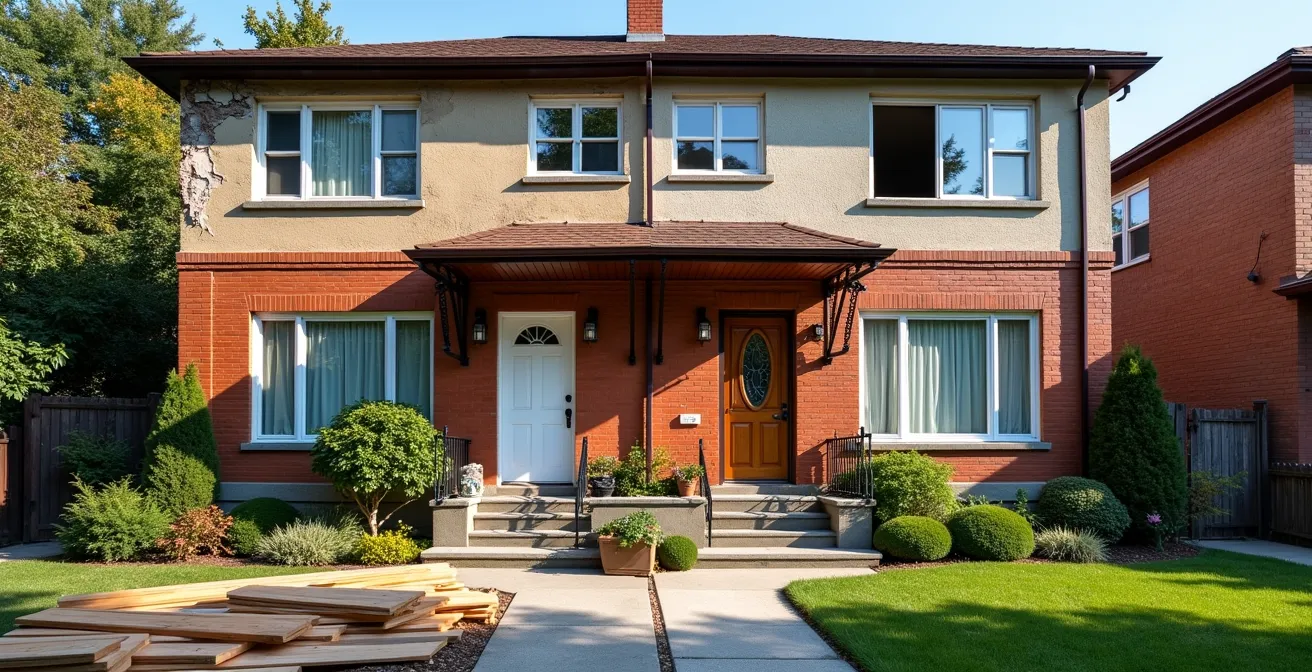
As the image illustrates, the transformation must be substantial enough to create a significant value lift. In today’s market, a successful BRRRR project requires the rental income to not only cover the new, higher mortgage payment post-refinance but also to provide a buffer for vacancies and maintenance. With interest rates hovering higher, achieving positive cash flow is challenging but remains the ultimate benchmark of a sustainable investment. The strategy is still viable, but it demands a more disciplined and analytical approach than ever before.
- Target properties requiring $100K-$200K in renovations with a clear potential for a 20-30% increase in value post-renovation.
- Secure hard money or bridge financing to cover both acquisition and renovation, understanding these come at a higher cost.
- Complete all renovations within a strict 6-month timeline to minimize carrying costs at today’s higher interest rates.
- Obtain a new appraisal that accurately reflects the increased After Repair Value (ARV).
- Refinance at 80% of the new ARV to pull out your initial capital and ideally, your renovation budget.
- Ensure the projected rental income covers the new mortgage payment, property taxes, insurance, and a 10% contingency fund for maintenance.
The Mistake of Betting Only on Market Appreciation Without Cash Flow
For years, the dominant strategy in Toronto real estate was simple: buy, hold, and wait for the market to make you wealthy. This reliance on passive appreciation is a dangerous gamble in the new economic reality. An investment property that doesn’t generate positive or at least neutral cash flow is not an asset; it’s a liability that drains your resources monthly. A portfolio built on negative cash flow properties is a house of cards, highly vulnerable to interest rate hikes, unexpected vacancies, or a flattening market.
The professional investor’s mindset shifts the focus from appreciation to profitability metrics. The key metric is the Capitalization Rate (Cap Rate), which measures a property’s annual net operating income relative to its market value. While downtown condos might offer low cap rates of 3-4%, strategic investors look for opportunities where forced appreciation can push this metric higher. For example, well-located Toronto multiplex properties can achieve a 6.5% cap rate after value-add renovations, creating a healthy spread over current mortgage rates and ensuring positive cash flow.
However, this doesn’t mean negative cash flow is always to be avoided. For a sophisticated investor, it can be a temporary, strategic tool used to achieve massive forced appreciation, as a specific case study demonstrates.
Case Study: Leveraging Negative Cash Flow for Forced Appreciation
A Toronto investor acquired a property for $1.3M, which initially ran a negative cash flow of -$500 per month. Instead of being deterred, they executed a $300K renovation to add a legal basement suite and a garden suite. During the 18-month construction period, they absorbed a total negative cash flow of $9,000. Upon completion, the property’s value surged to $1.9M. The $600,000 in forced appreciation vastly outweighed the short-term loss, and the new rental units transformed the property into a positive cash flow asset generating +$1,200 per month.
This illustrates the critical difference: enduring negative cash flow as part of a deliberate, time-bound value-add plan is a strategy. Hoping that market appreciation will eventually bail out a permanently unprofitable property is speculation.
Buying Pre-Construction: How to Spot Reliable Developers Who Won’t Cancel the Project?
Investing in pre-construction condos has long been a popular path to entering the Toronto real estate market, offering the allure of securing a property at today’s prices that will be worth more upon completion. However, this strategy is fraught with risks, the most significant of which is project cancellation. When a developer cancels a project, investors get their deposit back, but they lose years of potential market appreciation and are left back at square one, facing a market that has likely become more expensive.
Identifying a reliable developer is therefore the most critical piece of due diligence. This goes beyond looking at glossy brochures and marketing suites. It involves a deep dive into the developer’s history, financial stability, and the legal fine print of the purchase agreement. A reputable developer has a long track record of completed projects in the GTA, a strong rating with warranty providers like Tarion, and transparent communication with their buyers. They are also more likely to have secured full project financing before launching sales, significantly reducing the risk of cancellation due to rising construction costs or financing issues.

Beyond developer reliability, investors must also consider market saturation. As one real estate expert noted regarding the current Toronto market, the influx of new inventory can shift the power dynamic. In her analysis for a local report, Ashley Tearra Williams highlights this evolving landscape:
We’ve seen a surge of identical and similar condo units across the GTA giving renters rare leverage to negotiate. Landlords are more open to lowering prices to avoid vacancies in a high-inventory market.
– Ashley Tearra Williams, NOW Toronto Real Estate Report
This expert insight serves as a crucial reminder: even if a project is successfully completed, a glut of similar units in the area could suppress rental income and resale value. Therefore, due diligence must include not only the developer’s reliability but also a thorough analysis of the future supply in the immediate vicinity.
Selling and Capital Gains: How to Structure Your Portfolio for Retirement?
Acquiring properties is only half the battle. The true measure of a successful real estate investor is their ability to strategically liquidate assets while minimizing tax erosion. As you build your portfolio, you must concurrently build your exit strategy. Simply selling off properties in retirement without a plan can trigger a massive capital gains tax bill, potentially wiping out a significant portion of the wealth you’ve worked decades to create. Structuring your portfolio for a tax-efficient exit is a critical component of long-term planning.
In Canada, 50% of any capital gain is taxable at your marginal rate. For a high-income individual in Ontario, this can mean a tax rate of over 26% on the total gain. A smart portfolio structure employs several advanced strategies to mitigate this. These include strategically using the Principal Residence Exemption (PRE) by living in different properties for periods of time, or transferring a mature portfolio into a Canadian Controlled Private Corporation (CCPC) to benefit from tax deferral. A phased sell-off, where properties are sold every few years rather than all at once, is another key tactic to manage tax brackets and avoid a sudden income spike.
Case Study: Strategic Portfolio Liquidation for Retirement
A Toronto investor holding three properties with a total value of $4.5M planned a 15-year retirement runway. By selling one property every five years, they were able to keep the annual capital gains below $200,000, ensuring they remained in a lower marginal tax bracket. The proceeds from the first sale were used to fund their CCPC and create a tax-efficient investment vehicle. The second sale provided bridge financing for their retirement lifestyle before government benefits kicked in, and the final sale was timed to coincide with their full CPP and OAS eligibility. This phased approach resulted in total tax savings exceeding $180,000 compared to a scenario where all properties were sold in a single year.
These strategies transform tax planning from a reactive burden into a proactive wealth preservation tool. The following list outlines some of the most effective strategies for Toronto investors:
- Strategic PRE Designation: Use the “1+n” formula to designate different properties as your principal residence for specific years, sheltering gains.
- Corporate Structuring (CCPC): Consider transferring a portfolio exceeding $3M into a corporation for tax deferral and income splitting opportunities.
- Reverse Smith Manoeuvre: Use the equity from paid-off properties to secure tax-deductible investment loans that generate retirement income.
- Phased Sell-Off: Liquidate properties over a 5-15 year period to manage your tax bracket and spread out the capital gains impact.
- Permanent Life Insurance: Purchase a policy designed to cover the final, inevitable capital gains tax bill upon death, allowing the properties to pass to your heirs intact and unencumbered.
How to Structure a Real Estate Portfolio to Pass It On to Your Children in 20 Years?
Building a real estate portfolio is not just about personal wealth; it’s about creating a legacy. However, simply willing properties to your heirs is often the least efficient method of transfer, triggering significant probate fees and capital gains taxes that can force your children to sell the very assets you intended for them. Structuring a portfolio for seamless intergenerational transfer is an advanced discipline that must be addressed decades in advance.
In Ontario, probate fees are approximately 1.5% of the estate’s value, which can be a substantial sum on a multi-million dollar property portfolio. More importantly, death triggers a “deemed disposition,” where all capital assets are considered sold at fair market value, creating a massive final tax bill. The goal of sophisticated estate planning is to bypass or mitigate these two events. The primary tools for this are trusts and corporate structures. An Inter Vivos Trust, for instance, allows you to transfer properties into the trust during your lifetime, removing them from your estate and thus avoiding probate. Control can be retained by acting as the trustee.
However, these structures come with their own complexities. A critical rule to understand is the 21-year deemed disposition rule for trusts in Canada. Every 21 years, the assets within a trust are deemed to be sold at fair market value, triggering capital gains tax. A failure to plan for this event can be catastrophic; for example, Canadian trusts face a deemed disposition creating an approximate $2.5M tax liability on a $10M Toronto portfolio at the 21-year mark. Strategic planning involves rolling assets out to beneficiaries before this date or using other techniques to defer the tax event.
The choice of structure involves a trade-off between control, tax efficiency, and creditor protection. The table below outlines the primary options for a Toronto-based real estate portfolio.
| Structure | Probate Fees | Capital Gains | Creditor Protection | Control Retained |
|---|---|---|---|---|
| Inter Vivos Trust | Avoided | Deferred until distribution | Strong protection | Yes, as trustee |
| Joint Tenancy | Avoided | Triggered on transfer | No protection | Shared immediately |
| Will Transfer | 1.5% in Ontario | Triggered at death | No protection | Full until death |
| Family Limited Partnership | Minimized | Can be managed | Moderate protection | As general partner |
The optimal structure depends entirely on your family’s specific circumstances, the size of your portfolio, and your long-term goals. Engaging a team of tax and legal professionals is not an option but a necessity for building a true legacy.
How to Choose the Right Floor in a 50-Storey Tower to Maximize Value and Comfort?
When purchasing an investment unit in a high-rise condominium, the choice of floor is far more than a matter of personal preference; it’s a strategic decision that directly impacts resale value, rental demand, and tenant comfort. While the penthouse offers prestige and the best views, it often comes at a price-per-square-foot premium that doesn’t translate to a proportional increase in rental income, thus compressing the cap rate. Conversely, lower floors can suffer from street noise and obstructed views. The sweet spot often lies in the middle, but a truly strategic selection requires a more granular analysis.
Maximizing value involves balancing the view premium against practical considerations that affect livability. A unit’s long-term value is not just in its panoramic city view, which can be beautiful but also potentially obstructed by future developments. It is also found in the quality of the construction, the layout’s efficiency, and its insulation from the building’s operational quirks. A sophisticated investor looks beyond the immediate “wow factor” to the subtle details that define a high-quality living experience.

The view from a high floor is a powerful selling point, but it’s only one piece of the puzzle. An investor must audit a potential unit for a range of factors that are often overlooked. These include proximity to noisy amenities, potential for wind shear on balconies, and even the building’s elevator zoning, which can dramatically affect daily convenience for a tenant. A comprehensive audit is essential to ensure you are not overpaying for a view that comes with significant hidden drawbacks.
Your Floor Selection Audit Checklist
- Future-Proof Your View: Check the City of Toronto’s Development Applications portal for high-rise proposals within a 500m radius that could obstruct your unit’s view in the future.
- Calculate the Premium: Analyze the price-per-square-foot premium. Floors 20-30 often represent the best value, carrying a 5-8% premium over lower floors, compared to the 15-20% premium for floors 40 and above.
- Consider Rental Demographics: Floors 3-8 are attractive to dog owners due to easy access to the outdoors, while floors 15-25 often have optimized elevator wait times, appealing to busy professionals.
- Audit Building Nuisances: Identify the location of mechanical floors (often around floors 15, 30, 45) which can create subtle vibrations, and the pool deck (usually floors 5-8) which generates noise.
- Test Wind Exposure: If possible, request balcony access on a windy day. Balconies on floors above 35 can be unusable for a significant portion of the year due to high winds.
Key Takeaways
- Building a real estate portfolio in Toronto requires a proactive strategy of ‘forcing appreciation’ through value-add projects, rather than passively relying on market growth.
- Profitability metrics like Cap Rate and cash flow are more critical indicators of a sustainable investment than the potential for appreciation alone.
- Advanced tax and estate planning, using structures like trusts or corporations, are not optional extras but essential components for long-term wealth preservation.
What Are the Next ‘Hot’ Neighborhoods in Toronto Before Prices Explode?
Identifying the “next big thing” in Toronto real estate is the holy grail for investors. However, this is not a matter of luck or speculation; it’s a science of tracking infrastructure investment and demographic shifts. The most reliable indicator of future property value explosion is major public transit expansion. The strategy, known as Transit-Oriented Arbitrage, involves acquiring properties within a specific radius of a future transit station long before it becomes operational.
The data consistently shows a direct correlation between transit access and property values. Research indicates that properties near future Ontario Line stations typically see a 15-25% property value increase within an 800-meter radius, from the announcement phase through to completion. The key is to invest during the early construction phase, after the project is confirmed but before the value increase is fully priced into the market by the general public.
A prime example of this phenomenon is the transformation of Mount Dennis. Located at the future interchange of the Eglinton Crosstown LRT and the UP Express, the neighborhood has seen dramatic growth. Average property values in Mount Dennis climbed from $650K in 2020 to $850K by 2023. Early investors who recognized the transit potential and purchased before the construction was well underway captured over 30% in appreciation. The area is now experiencing rapid gentrification, with new businesses opening in anticipation of the Crosstown’s launch, signaling strong continued momentum. By focusing on the future routes of the Ontario Line and other planned expansions, investors can systematically identify the Mount Dennis of tomorrow.
This proactive, data-driven approach is the essence of building a strategic portfolio. It requires moving beyond today’s headlines to analyze the city’s future infrastructure map. By understanding these macro-level shifts, you position yourself to benefit from predictable growth, transforming real estate investment from a gamble into a calculated, long-term wealth-building engine.
To apply these advanced strategies effectively, the next step is to commission a professional analysis of your current property’s equity potential and model various investment scenarios against your long-term financial objectives.