
The secret to a great Ripley’s Aquarium visit isn’t just avoiding queues; it’s about mastering the venue’s rhythm to manage your child’s sensory experience.
- Evening visits (after 7 p.m.) offer a drastically calmer, more magical atmosphere with fewer crowds and better lighting.
- Preparing for sensory hotspots like the Dangerous Lagoon tunnel with headphones and a plan is the key to preventing overwhelm.
- Choosing the right ticket type online saves not only money but also significant stress on the day of your visit.
Recommendation: Plan your visit for a “Sharks After Dark” evening and use our sensory prep checklist to guarantee a meltdown-free, memorable family outing.
The thought of taking young kids to a blockbuster attraction like Ripley’s Aquarium of Canada can spark a unique blend of excitement and dread. You picture their faces lighting up at the sight of a shark gliding overhead, but that image is quickly followed by a less charming one: a sea of people, a cacophony of noise, and the rising tide of a toddler meltdown. It’s a familiar anxiety for any parent trying to create magical memories in a city as bustling as Toronto. The standard advice is always the same: go on a weekday, arrive the second the doors open, and buy tickets online.
While that’s not wrong, it misses the deeper point for families with young or sensitive children. The real challenge isn’t just the line to get in; it’s the sensory onslaught waiting inside. The constant motion, the ambient noise, and the sheer volume of visitors can turn a fascinating journey into an overwhelming ordeal. But what if the solution wasn’t about trying to be first in a race against thousands, but about choosing a different race entirely? What if the secret to a genuinely peaceful and awe-inspiring visit lies not in beating the crowds, but in strategically avoiding them by understanding the aquarium’s unique daily rhythm?
This guide is your insider playbook, written by a parent, for parents. We’ll go beyond the obvious tips and focus on tactical strategies that transform the experience. We’ll explore why a later visit can feel like a private tour, how to turn the infamous shark tunnel from a point of anxiety into a moment of wonder, and how to make smart choices on everything from tickets to nearby attractions that respect both your budget and your family’s sanity.
To help you navigate this comprehensive guide, we’ve broken down the essential strategies into clear, manageable sections. Discover the secrets to a perfect aquarium visit, smart planning for other major Toronto attractions, and budget-friendly tips for your family’s entire trip.
Summary: Your Complete Toronto Family Adventure Plan
- Why visiting the aquarium after 7 p.m. changes the experience
- Flexible or timed tickets: saving money and stress
- The mistake to avoid with sensitive kids in the shark tunnel
- Beyond the show: the aquarium’s role in Great Lakes protection
- Is the stingray experience worth the high price for families?
- How to plan your CN Tower visit to avoid the 2-hour wait
- Organizing a Toronto family vacation without breaking the bank on lodging
- CityPASS vs. individual tickets: a cost breakdown for families
Why Visiting the Aquarium After 7 p.m. Radically Changes the Experience
For most attractions, the “early bird” strategy reigns supreme. At Ripley’s Aquarium, the opposite is true. Arriving after 7 p.m. is the single best decision a family can make. By this time, the school groups, tourist buses, and peak-time visitors have departed, leaving the space feeling dramatically emptier and more serene. The frantic energy of the day gives way to a calm, almost reverent atmosphere, allowing your kids to actually get close to the glass without a wall of people in front of them.
This shift is about more than just crowd levels; it’s a complete change in ambiance. The aquarium’s lighting transitions into a more dramatic evening mode, with deep blues and purples that make the underwater worlds feel even more mysterious and magical. This calmer sensory environment is a game-changer for young children who are easily overstimulated. The “Sharks After Dark” program often offers a financial incentive as well; visitors can save money on regular admission after 5 p.m., making it a win for both your sanity and your wallet. On the second Friday of each month, this experience is often elevated with a live Jazz Night, adding a cool, sophisticated vibe that parents can appreciate while the kids are mesmerized by the fish.

As you can see, the nocturnal setting transforms the aquarium from a busy attraction into an immersive experience. Plan for about 1.5 to 2 hours for a relaxed evening exploration. This gives you enough time to see everything without feeling rushed, letting your kids set the pace. You can have a relaxed dinner beforehand on King Street and then stroll over for a perfect, peaceful end to your day.
Flexible or Dated Tickets: Which Option to Choose to Save up to 15%?
The ticket line at Ripley’s can be daunting, and buying in person often means being assigned an entry time hours later. Booking online is non-negotiable, but the choice between a “Timed Ticket” and a “Flex Ticket” can be confusing. The right choice depends entirely on your family’s travel style and tolerance for uncertainty, especially when navigating Toronto’s unpredictable traffic.
A Timed Ticket is the most common and cost-effective option. You select a specific date and a one-hour entry window. This is the best choice for families who have a structured itinerary, perhaps arriving via the predictable GO Train. The key benefit is a lower price and priority entry during your slot. A huge, often overlooked-perk for parents is that if you miss your time slot, the ticket doesn’t become void; the website confirms tickets are valid for one year, you just may have to wait for the next available entry. This removes a massive amount of stress. The Flex Ticket, while more expensive, offers the freedom to visit any time on any day within a year, which is ideal if you’re driving in on the 401 and can’t guarantee an arrival time, or if your plans are simply up in the air.
| Ticket Type | Flexibility | Cost | Best For | Key Restrictions |
|---|---|---|---|---|
| Timed Ticket | Specific date & 1-hour entry window | Lower price | Planned visits, GO Train arrivals | Priority entry but no flexibility |
| Flex Ticket | Valid 1 year, no reservation needed | Higher price point | Uncertain schedules, 401 traffic variables | May wait during peak capacity |
| Sharks After Dark | Entry after 5PM only | $5 off regular price | Evening visits, date nights | Not available before 5PM |
For most families seeking to balance cost and convenience, the Timed Ticket, combined with the evening visit strategy, offers the perfect blend. You get the best price and the least crowded experience. Just book your slot for 7 p.m. or later, and you’ve set yourself up for success.
The Mistake Not to Make with Sensitive Children in the Shark Tunnel
The Dangerous Lagoon, with its moving walkway gliding beneath sharks and sawfish, is the crown jewel of the aquarium. It’s also the single biggest potential flashpoint for a sensory meltdown. The combination of darkness, the low, rumbling ambient sound of the water filtration systems, and the enclosed space can be incredibly overwhelming for some children. The common mistake is to push through, assuming the spectacle of the sharks will override the discomfort. This rarely works.
The key to making this the highlight of your visit, not the breaking point, is preparation and empowerment. The moving walkway creates a feeling of lost control. The most crucial feature to know about are the stationary platforms located periodically throughout the tunnel. These are your strategic “decompression zones.” Point them out to your child in advance and agree that you can step off the moving belt at any time to just stand and watch. This simple plan gives them back a sense of control.
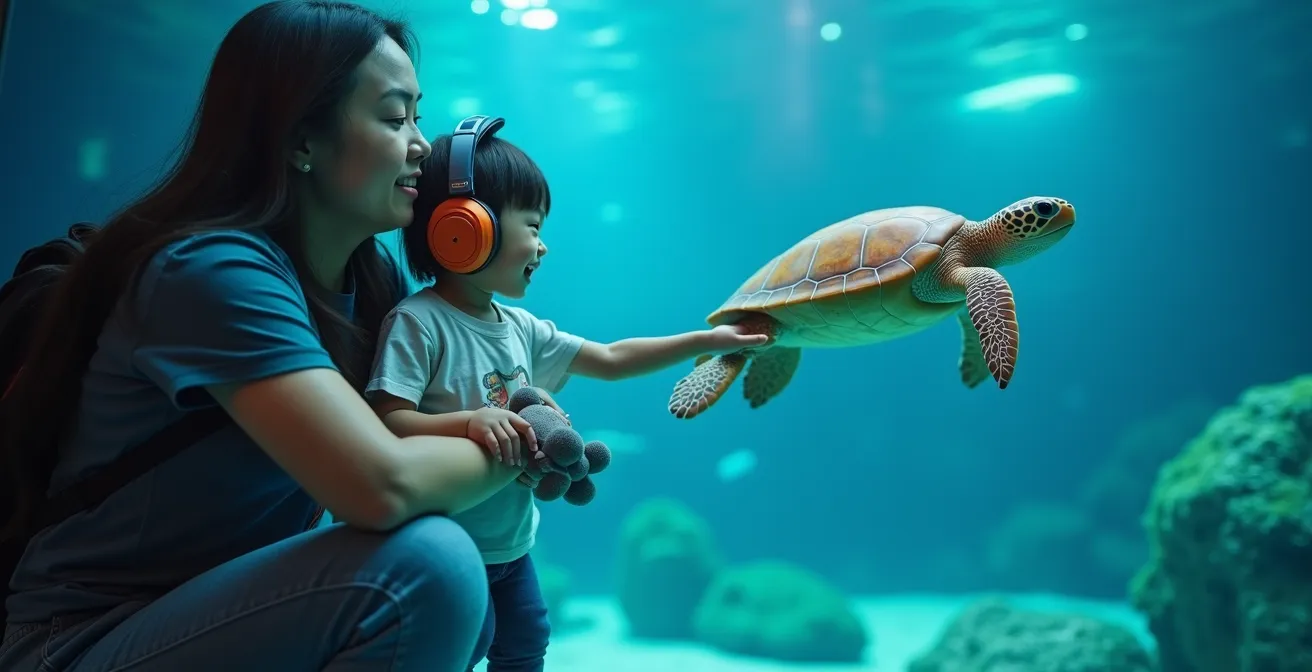
Before you even leave home, you can prepare them by watching first-person videos of the tunnel online. This demystifies the experience and turns the unknown into the familiar. For children particularly sensitive to noise, noise-cancelling headphones are not just an accessory; they are essential equipment. By managing the sensory input, you allow them to focus on the visual wonder. The following checklist provides a concrete plan for success.
Your Sensory-Friendly Checklist for the Dangerous Lagoon
- Pack the Gear: Bring noise-cancelling headphones to manage the tunnel’s ambient rumbling sounds.
- Identify Decompression Zones: Locate the stationary platforms where you can step off the moving walkway to take a break.
- Prep at Home: Prepare children by watching point-of-view videos of the tunnel on YouTube before your visit.
- Bring a Comfort Item: A favorite small plush toy or a weighted lap pad can provide comforting sensory regulation.
- Ask for the Secret Exit: To avoid the chaos, skip the crowded gift shop exit by asking a staff member to show you an alternative route out.
By treating the shark tunnel as a mission to be planned rather than a ride to be endured, you transform it from a source of potential stress into the awe-inspiring experience it’s meant to be.
Beyond the Spectacle: What the Aquarium Really Does for Great Lakes Protection
While your youngest kids are mesmerized by the glowing jellyfish and “Nemo” clownfish, older children might start asking bigger questions. What is the point of all this? Are these animals just for show? This is a fantastic opportunity to pivot from pure entertainment to education. Ripley’s Aquarium of Canada is not just a showcase; it’s also actively involved in conservation and research, with a particular focus on local ecosystems.
This provides a powerful narrative for your visit. Frame it as supporting a larger mission. The aquarium participates in and promotes major conservation initiatives, including the Great Canadian Shoreline Cleanup. You can explain to your kids that a portion of their ticket helps fund research and programs that protect the very Great Lakes that are in our own backyard. The exhibits featuring local species from the Great Lakes basin become more than just tanks of fish; they become a tangible connection to the environment around Toronto.
Making this connection adds a layer of meaning to your family’s outing. It teaches children that entertainment and responsibility can go hand-in-hand. Before your visit, you can even check the aquarium’s website for any current research projects or conservation events. Turning your visit into a story about helping to protect our waters makes the experience more memorable and impactful for everyone.
Plongée avec les Raies: L’expérience Vaut-elle Vraiment son Prix Élevé?
The “Stingray Experience” is one of the aquarium’s premium offerings: a chance to get into the water of Ray Bay for a hands-on encounter. The price tag is significant, leaving many parents wondering: is it worth it? The answer is a definite “it depends,” primarily on the age and temperament of your children. For the right child, it can be the single most unforgettable part of their trip. For the wrong one, it’s an expensive waste.
Here’s the breakdown. The experience is incredibly well-managed, safe, and educational. The staff are fantastic at making participants feel comfortable and knowledgeable. The thrill of having a gentle stingray glide over your hand is undeniable. For a child who is passionate about marine life, is at least 8 years old, and is not timid about new experiences, the value is immense. It moves the aquarium from a passive viewing experience to an active, tactile adventure.
However, for younger children (under 8), or those who are hesitant or easily intimidated, the cost is hard to justify. They may be too scared to fully participate, or not mature enough to appreciate the educational component. For the price of one Stingray Experience, you could fund another entire family outing in Toronto. Our verdict: this is a fantastic splurge for older, animal-loving kids and teens, but families with toddlers and younger elementary schoolers should save their money and stick to the main aquarium experience, which is more than magical enough.
How to Plan Your Mountée à la Tour CN to Avoid 2 Hours d’Attente
Given that the CN Tower is right next door to the aquarium, combining the two is a popular and logical plan. Unfortunately, this means you can walk from one massive queue right into another. Applying the same “beat the crowd” logic is essential. The CN Tower’s peak times are similar to the aquarium’s: late morning through mid-afternoon, especially on weekends.
Your best strategy is to purchase timed admission tickets online well in advance. This is even more critical for the Tower than for the aquarium. A general admission ticket does not guarantee immediate entry; a timed ticket does. The ideal plan is to “split the peaks.” Visit one attraction at its quietest time and the other at its quietest time. For example, book the CN Tower for the first slot in the morning (9:00 or 9:30 a.m.). You’ll ascend with minimal crowds and enjoy clearer morning views. Afterwards, you can have a leisurely lunch and explore the waterfront before heading to the aquarium for your post-7 p.m. “Sharks After Dark” visit.
Alternatively, a late-evening ascent of the Tower can also be spectacular, offering views of the glittering city lights. A plan could be an early evening aquarium visit (5 p.m. to 7 p.m.) followed by a pre-booked 7:30 p.m. trip up the Tower. The key is to never attempt to visit both attractions between 11 a.m. and 4 p.m. on the same day unless you have a high tolerance for waiting in line.
Comment Organiser des Vacances en Famille à Toronto sans Exploser le Budget Hébergement
Toronto is an expensive city, and hotel costs in the downtown core, especially in the Entertainment District near the aquarium and CN Tower, can be astronomical for a family. The mistake many visiting families make is focusing solely on walking-distance convenience, paying a massive premium for a standard hotel room that feels cramped after two days.
A smarter, more budget-friendly approach is to look at accommodation through the lens of the TTC subway system. Staying in a family-friendly neighbourhood just a short subway ride away can cut your accommodation costs significantly while offering more space and a more authentic local experience. Consider looking for suite-style hotels or Airbnb rentals in areas like:
- Yorkville: While known for luxury, it has several all-suite hotels that can be surprisingly competitive for a family needing more space. It’s located on two subway lines, making it an excellent, central base.
- The Annex: This charming, historic neighbourhood near the University of Toronto is directly on the Bloor-Danforth subway line. It’s filled with family-friendly restaurants and offers a quieter vibe.
- Leslieville or Riverdale: For families who don’t mind being a bit further east, these neighbourhoods offer great value, a cool, local feel with parks and independent shops, and are easily accessible by streetcar.
Choosing a location with a small kitchen can also lead to huge savings, allowing you to prepare your own breakfasts and pack lunches for your days out. Trading a 10-minute walk for a 15-minute subway ride can easily save you hundreds of dollars on a multi-day trip, money better spent on experiences like the aquarium.
Key Takeaways
- Evening visits to the aquarium (after 7 p.m.) are the best strategy for a calm, sensory-friendly experience with minimal crowds.
- For sensitive children, proactively preparing for the Dangerous Lagoon with noise-cancelling headphones and a plan to use stationary “decompression zones” is essential.
- Combining major attractions requires a cost-benefit analysis; the CityPASS is only worth it if you plan to visit at least four of its included attractions.
CityPASS or Individual Tickets: Which Option to Choose for Visiting 4 Major Attractions?
The Toronto CityPASS is heavily marketed as the ultimate money-saver, bundling admission to the CN Tower, Ripley’s Aquarium, Casa Loma, the Royal Ontario Museum (ROM), and the Toronto Zoo or Ontario Science Centre. For a family, the potential savings look appealing, but you must do the math. The pass is only a good deal if you are genuinely committed to visiting at least four of the five attractions.
Let’s run a quick scenario for a family of four. If you only plan to visit the CN Tower and Ripley’s Aquarium, buying individual timed tickets online (especially using the “Sharks After Dark” discount for the aquarium) will almost always be cheaper than buying four CityPASSes. The value of the pass is unlocked when you add a third and, crucially, a fourth attraction like the ROM or Casa Loma to your itinerary.
The other factor to consider is pace. Trying to cram four or five major attractions into a short trip to “get your money’s worth” can be a recipe for exhaustion, especially with young kids. A more relaxed vacation visiting just two or three highlights might be more enjoyable and cheaper with individual tickets. The bottom line: create a realistic itinerary first. List the attractions you *absolutely* want to see, calculate the cost of individual tickets, and then compare that total to the CityPASS price. Don’t let the marketing of the pass dictate your vacation schedule.
By shifting your mindset from “enduring the crowds” to “managing the experience,” you can transform a potentially stressful day into the magical Toronto adventure your family deserves. Now that you have the insider playbook, you’re ready to plan a visit that is memorable for all the right reasons.