
Forget chasing coffee shops; the real key to finding Toronto’s next hot spot is to act like a ‘development detective’, decoding the city’s own strategic plans for future growth.
- Massive infrastructure projects like the Eglinton Crosstown are actively engineering new value corridors across the city.
- Demographic data, not just trendy amenities, provides the clearest signal of where young, affluent families are moving next.
Recommendation: Learn to read Toronto’s Official Plan and Development Applications Portal—this is the playbook that reveals where densification and value increases are planned years in advance.
The hunt for Toronto’s next high-growth neighbourhood feels like a city-wide obsession. The common advice is to follow the lagging indicators: the arrival of an independent coffee shop, a new art gallery, or a surge of cyclists. But by the time you spot these signals, you’re already behind the curve, and the real investment opportunity has passed. This approach has you chasing trends, not creating wealth. It’s a reactive strategy for a market that rewards proactive vision.
The truth is, while the rest of the market is looking for superficial signs of change, the savvy investor is looking at the blueprints. The real secret isn’t in finding where the artists are moving; it’s in understanding where the city itself is engineering growth through massive infrastructure projects, zoning changes, and strategic densification. This is about shifting your mindset from a trend-spotter to a ‘development detective,’ armed with data and foresight.
But what if the key wasn’t about finding a needle in a haystack, but rather knowing how to read the map that leads directly to it? This guide provides the inside track. We’ll move beyond the clichés and dive into the structural forces shaping Toronto’s future. We will explore how to decode major transit projects, analyze school-driven price inflation, identify the red flags of stagnant areas, and ultimately, use the city’s own planning documents as your personal investment playbook. It’s time to stop guessing and start seeing the future of Toronto real estate before it happens.
This article provides a structured roadmap for the modern property hunter. The following sections break down the key indicators and strategies that will allow you to pinpoint high-potential areas long before they hit the mainstream radar.
Summary: A Detective’s Guide to Toronto’s Future Real Estate Hotspots
- The Eglinton Crosstown Line: Which Sectors Will Gain Value at Its Opening?
- Schools and Real Estate: How Do Fraser Institute Rankings Dictate Prices?
- Why Do Some Seemingly Cheap Neighbourhoods Never Appreciate?
- The Influx of Young Families: The Unmistakable Sign a Neighbourhood Is About to Change
- Urban Densification: How to Read the Official Plan to Anticipate Neighbouring Towers
- How to Combine a Car and Public Transit to Cross the GTA Efficiently
- How to Spend a “West Queen West” Day Like a True Trendy Local
- How to Enter the Toronto Real Estate Market on a Limited Budget
The Eglinton Crosstown Line: Which Sectors Will Gain Value at Its Opening?
Large-scale transit infrastructure is the most powerful force in “engineering” property value, and the Eglinton Crosstown LRT is Toronto’s prime exhibit. This isn’t about a minor bus route change; it’s a 19-kilometre corridor that will fundamentally remap the city’s east-west transit logic. For the development detective, the construction phase is the golden window of opportunity. While others see disruption, you should see a countdown to appreciation. The key is to identify the nodes with the most latent potential—areas that were previously underserved by rapid transit.
Look beyond the obvious intersections like Yonge and Eglinton, which have already seen significant price growth. The real opportunity lies in neighbourhoods where the Crosstown is the first major transit injection. Areas around stations like Oakwood and Mount Dennis are poised for significant transformation. These zones, historically reliant on slower bus routes, will suddenly have a direct artery to the city’s core and its extremities. The impact is already measurable; some market analyses show that condo prices near certain Crosstown stations have already surged by up to 135% in anticipation.
The visual below captures the essence of this transit-oriented development. It’s not just about a train line; it’s about the entire ecosystem of mixed-use buildings, new retail, and public spaces that spring up around it, drawing in new residents and investment.
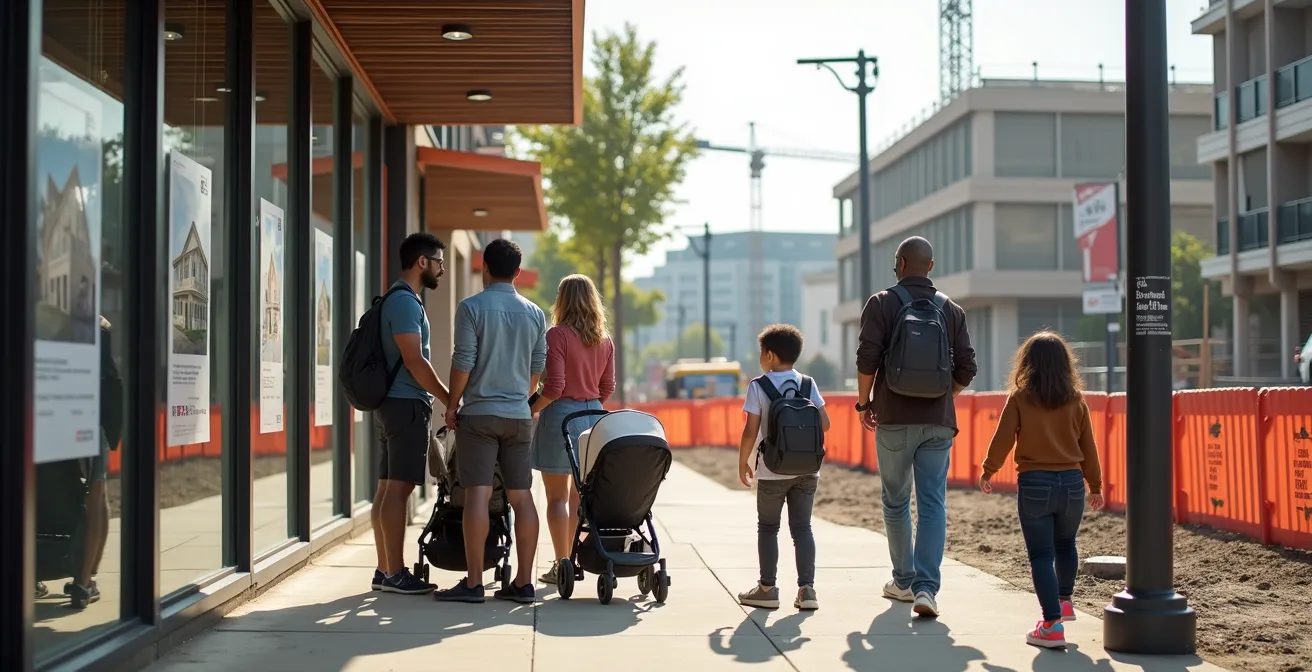
As the image suggests, the arrival of new families and commercial interest is a direct consequence of this infrastructure investment. Oakwood Village, for instance, extending from St. Clair to Eglinton, is perfectly positioned for a renaissance once the LRT is operational. The savvy investor analyzes not just the station location, but the surrounding zoning, available housing stock (especially older single-family homes ripe for conversion), and the current state of the local BIA (Business Improvement Area).
This is where you place your bets: not on where transit is, but on where it *will be*. The noise and dust of construction are the sounds of future equity being built.
Schools and Real Estate: How Do Fraser Institute Rankings Dictate Prices?
While transit builds the arteries of a city, schools build its communities. For a huge segment of the market—young families with disposable income—the quality of local schools isn’t just a factor; it’s often the *only* factor. This makes the Fraser Institute’s annual school report card one of the most powerful, if controversial, predictive tools for real estate values in Toronto. A high score acts as a powerful magnet, drawing in affluent families and creating a localized bubble of demand that can defy broader market trends.
The correlation is brutally direct: a top-tier school district creates a “catchment premium” on every home within its boundaries. Neighbourhoods like Lawrence Park, home to schools like John Ross Robertson Junior Public School which consistently achieves near-perfect Fraser ratings like 9.6/10, command significantly higher prices than adjacent areas with less-regarded schools. The sentiment was bluntly captured by one buyer in a Toronto real estate analysis.
I don’t want my child attending an elementary school where a good portion of time is dedicated to learning English.
– Anonymous Toronto home buyer, Toronto Realty Blog analysis
This quote, while stark, reveals the powerful, non-negotiable mindset of many buyers. For them, a home is also an entry ticket into a specific educational and social environment. This creates an inelastic demand that protects property values even in a downturn. As a development detective, your job is to track not just current high performers, but to spot the schools on an upward trajectory or those slated for new investment from the TDSB, as these can be leading indicators of a neighbourhood’s next phase of growth.
The table below, based on data from analyses of Toronto’s school districts, clearly illustrates the connection between top-rated high schools and the property premium in their respective neighbourhoods. It’s a clear map of where educational prestige translates directly into real estate equity.
| Neighborhood | Top School | Fraser Score | Property Premium |
|---|---|---|---|
| Lawrence Park | North Toronto Collegiate | 8.4 | High |
| Leaside | Leaside High School | 7.8 | Medium-High |
| Forest Hill | Forest Hill Jr/Sr Public | 7.2 | Very High |
Ultimately, a top-ranked school catchment acts as a moat, defending property values and ensuring a steady stream of motivated buyers. Ignoring this data is like navigating the market with one eye closed.
Why Do Some Seemingly Cheap Neighbourhoods Never Appreciate?
The allure of a “bargain” is one of the biggest traps for aspiring investors. Just because a neighbourhood is affordable doesn’t mean it’s a good investment. Some areas stagnate for decades, their low prices a reflection of deep, structural flaws rather than untapped potential. The skilled development detective knows how to distinguish a pre-gentrification gem from a value trap. It requires looking past the price tag and diagnosing the area’s underlying health.
Several factors can anchor a neighbourhood to the bottom of the market. These include poor transit connectivity (not just distance from a subway, but infrequent bus service), a defunct or inactive Business Improvement Area (BIA) signaling a lack of commercial organization, and environmental vulnerabilities like being situated on a flood plain. Another major red flag is a history of strong NIMBYism (“Not In My Back Yard”), where local opposition consistently blocks the densification and new development necessary for growth.
A recent and powerful example of a market-wide value suppressor is an oversupply of a specific housing type. In the Greater Toronto Area, recent data has shown a dramatic downturn in the condo market, with condo sales in the GTA dropping to a 27-year low in Q2 2024. This was coupled with unsold inventory reaching a record high. A neighbourhood dominated by new condo towers, especially if they were sold heavily to short-term investors, can see its value stagnate or even fall when the market turns, trapping buyers who thought they were getting in on the ground floor.
Action Plan: Auditing a Neighbourhood for Red Flags
- Transit Gaps: Map out the area’s routes. Is it more than a 15-minute walk to rapid transit? Is bus service frequent (less than 10-minute headways) during peak hours?
- BIA Vitality: Check the local BIA’s website and social media. Are they active? Do they host events? An inactive BIA often signals commercial apathy.
- Climate Risk Assessment: Use the City of Toronto’s flood plain maps to check for risks of basement flooding, a major deterrent for buyers.
- Development History: Search the City’s Development Application portal for past projects in the area. A high number of withdrawn or rejected applications is a sign of strong local opposition to change.
- Infrastructure Audit: Check for availability of high-speed fibre internet. Aging utilities and a lack of modern digital infrastructure can cap a neighbourhood’s growth potential.
In short, cheap is often cheap for a reason. Your mission is to find areas that are temporarily undervalued due to factors that are about to change, not permanently devalued by flaws that are deeply entrenched.
The Influx of Young Families: The Unmistakable Sign a Neighbourhood Is About to Change
Long before the first artisanal bakery opens, a more subtle and powerful shift occurs: the arrival of young families. This demographic wave is a leading indicator of gentrification, bringing with it a demand for better schools, safer parks, and community-focused retail. As the Greater Toronto Area has reached a population over 6.4 million, the pressure for family-friendly housing within the city is immense. Spotting where these families are choosing to land is like seeing the future of a neighbourhood’s commercial and social landscape.
This demographic isn’t looking for nightclubs and trendy bars; they’re looking for stroller-friendly sidewalks, renovated playgrounds, farmers’ markets, and, crucially, housing stock with more than two bedrooms. When you see a wave of renovations turning post-war bungalows into larger family homes, or when local library branches announce expanded children’s programming, you are witnessing the foundational layer of a neighbourhood’s transformation. This is the “pre-commercial” phase of gentrification, and it’s where the smartest investors focus their attention.
Tracking this shift requires a detective’s approach, using a mix of public data and on-the-ground observation. The signs are there if you know where to look:
- Demographic Data: Use tools like the Statistics Canada Census Mapper to monitor the growth of the 30-45 age bracket in specific census tracts. A sudden spike is a clear signal.
- School Board Minutes: Monitor the meeting minutes of the Toronto District School Board (TDSB) and TCDSB for discussions about school expansion, new portables, or catchment boundary changes. This is a direct response to rising child populations.
- Amenities Mapping: Keep a running map of new or recently renovated family-oriented amenities. This includes playgrounds, splash pads, community centres, and the locations of new daycare applications found in city building permits.
- Library Investment: Track which branches of the Toronto Public Library are receiving funding for expansions, particularly for their children’s sections. This is a tell-tale sign of a growing family population.
This human element—the search for community and a place to raise children—is a more reliable indicator of sustainable growth than any fleeting commercial trend. Where families go, investment and appreciation inevitably follow.
Urban Densification: How to Read the Official Plan to Anticipate Neighbouring Towers
If there’s a master key to unlocking Toronto’s real estate future, it’s the city’s own Official Plan. This document is the bible of urban development, outlining precisely where the city intends to encourage growth and densification. For the development detective, learning to read this plan and its associated zoning maps isn’t just an advantage; it’s like having the answers to the test. It allows you to see years into the future, anticipating where mid-rise corridors and high-rise clusters will emerge long before the first development application is posted.
The Official Plan designates certain major arterial roads as ‘Avenues,’ marking them as primary corridors for future mid-rise development. Buying a single-family home or a small duplex just off one of these Avenues can be a strategic masterstroke, as you position yourself to benefit from the increased density, new retail, and improved public realm that will inevitably follow. Similarly, the city’s push for “missing middle” housing means areas pre-zoned for multiplexes (up to 4 units) are goldmines for small-scale developers and investors.
Your toolkit for this analysis is entirely public and accessible online. It’s about knowing where to look and how to interpret the data. Mastering these tools transforms you from a passive homebuyer into a strategic land analyst. Here’s how to start:
- TOinView Map: The city’s interactive zoning map is your primary tool. Use it to identify properties currently zoned for single-family use that are adjacent to areas designated for higher density. This is where land assemblies for future towers often begin.
- Development Applications Centre: This online portal is a real-time feed of the city’s development pipeline. Track new rezoning and minor variance applications in your target neighbourhoods. A surge of applications is a five-alarm signal of impending change.
- ‘Avenues’ and ‘Centres’: Familiarize yourself with the Official Plan’s land use map. Pinpoint the properties located along designated ‘Avenues’ or within designated ‘Centres’ (like Yonge-Eglinton or Sheppard-Don Mills), as these are the city’s explicit targets for major growth.
- Land Assembly Tracking: Watch for patterns of property sales on a single block. When multiple adjacent lots are purchased by the same numbered company over a short period, it’s a near-certain indicator that a developer is assembling land for a large-scale project.
By learning the city’s language of zoning and development, you can move from reacting to the market to anticipating it, securing property in the path of planned progress.
How to Combine a Car and Public Transit to Cross the GTA Efficiently
The definition of a “prime location” in the GTA is evolving. For decades, the mantra was proximity to a TTC subway station. But as the region sprawls and housing prices in the core remain high, a more nuanced, hybrid approach to commuting is defining the next wave of valuable neighbourhoods. The smartest investors are now looking at areas that master the interplay between the car and regional transit, specifically the GO Train network.
Neighbourhoods that offer both easy access to major highways (like the Gardiner or the 401) and are a short drive or bus ride from a GO station are emerging as a new sweet spot. These “multi-modal” hubs allow residents to bypass downtown traffic for their daily commute while still retaining the flexibility of a car for weekend trips and errands. This strategy unlocks value in areas that might seem peripheral at first glance but are, in reality, highly efficient for the modern GTA commuter.
A prime example is the Mimico neighbourhood in South Etobicoke. It offers residents stunning lakefront views and a charming local atmosphere, but its strategic genius lies in the Mimico GO Station. A resident can be at Union Station in 15 minutes by train, a commute that would take double or triple the time by car in rush hour. This access to rapid regional transit, combined with proximity to the Gardiner Expressway, makes it a powerful location. This desirability is reflected in the rental market, where Toronto’s rental market near transit maintains a vacancy rate under 2%, demonstrating the premium tenants place on connectivity.
The strategy for the development detective is to identify the next Mimico. Look for GO stations that are currently underdeveloped or surrounded by older housing stock. As Metrolinx continues its “GO Expansion” project to bring two-way, all-day service to more lines, these station areas will become increasingly valuable. The combination of highway access and frequent regional rail is a formula for resilient and growing property values.
Don’t just look at the subway map; look at the entire regional transit network. The future of GTA commuting is integrated, and the most valuable properties will be those that sit at the nexus of this new reality.
How to Spend a “West Queen West” Day Like a True Trendy Local
To understand where Toronto is going, it’s instructive to look at where it’s been. Neighbourhoods like West Queen West, once voted the second coolest in the world, weren’t born that way. They evolved. By deconstructing the lifecycle of a now-famous “hot” neighbourhood, we can identify the patterns to look for elsewhere. The story is often one of industrial decline followed by artistic-led rebirth, and then finally, commercial and residential intensification.
Consider the Junction Triangle. Wedged between three rail lines, this area was once a gritty, industrial heartland. When its factories began to close in the 1990s, the large, empty industrial buildings became a magnet for artists and artisans seeking affordable, open-concept live/work spaces. They were the first wave, converting old factories into beautiful lofts and establishing a creative beachhead. This initial phase laid the groundwork for what was to come: the galleries, the independent cafes, the unique retail, and eventually, the influx of residential buyers and developers who followed the “cool.”
Spending a day in a place like West Queen West or the Junction today reveals the mature stage of this evolution. It’s about visiting the independent galleries in the laneways, grabbing a coffee at a cafe that was once a machine shop, and browsing boutiques that are now household names. But for the development detective, the real lesson is to train your eye to see the “before” picture. It’s about visiting an area like the industrial lands south of Dupont or the under-utilized factory zones near the Stockyards and asking: could this be the next Junction Triangle?
The pattern is often the same: a post-industrial landscape, a critical mass of affordable and unique building stock, an initial influx of creative pioneers, followed by growing public interest. Today’s trendy local hotspot is yesterday’s forgotten industrial park. Learning to see the potential in the grit and grime is a core skill for any visionary investor.
The next West Queen West won’t look like West Queen West today. It will look like West Queen West did 20 years ago. Train your eyes to see that past in a neighbourhood’s present.
Key Takeaways
- The most reliable investment signals are leading indicators like infrastructure plans and demographic shifts, not lagging indicators like new cafes.
- A neighbourhood’s value is directly tied to its structural advantages: transit, school quality, and forward-thinking urban planning.
- The ability to read public documents like the Official Plan and Development Applications portal is the single most powerful, non-obvious skill for a Toronto property investor.
How to Enter the Toronto Real Estate Market on a Limited Budget
The strategies of a development detective aren’t reserved for those with multi-million dollar budgets. In fact, some of the most powerful plays are designed specifically for entering the Toronto market with limited capital. The key is to shift from thinking like a homebuyer to thinking like a small-scale developer, using creative housing types and rental income to build equity.
While areas like Liberty Village offer a lower barrier to entry with some condos available for under what one analysis pegged at around the $400,000 mark, the real opportunity lies in creating your own value. The city’s recent embrace of “missing middle” housing has opened up a powerful pathway: the multiplex strategy. This involves purchasing an older, single-family home—often a bungalow—in an emerging neighbourhood and converting it into a duplex, triplex, or even a fourplex.
This approach has a dual benefit. First, the rental income from the additional units can significantly offset, or even cover, your mortgage payments, a strategy often called “house hacking.” Second, the conversion itself forces appreciation, instantly increasing the value of the property far beyond typical market growth. A well-executed renovation can be a powerful engine for equity creation. For example, a strategic $100,000 renovation to create a legal triplex could potentially add $250,000 or more in value upon appraisal.
The best hunting grounds for these opportunities are often in areas like East York and parts of Scarborough, where there is a large stock of older bungalows on generously sized lots. These are often “as-is” estate sales, perfect candidates for a full renovation. Furthermore, the city’s laneway suite program provides another avenue for adding a rental unit to a property, further enhancing its cash flow and value.
This is the ultimate detective’s play: instead of just finding value, you create it. By transforming a single-family dwelling into a multi-unit income property, you take control of your investment and build a foothold in one of the world’s most competitive real estate markets.