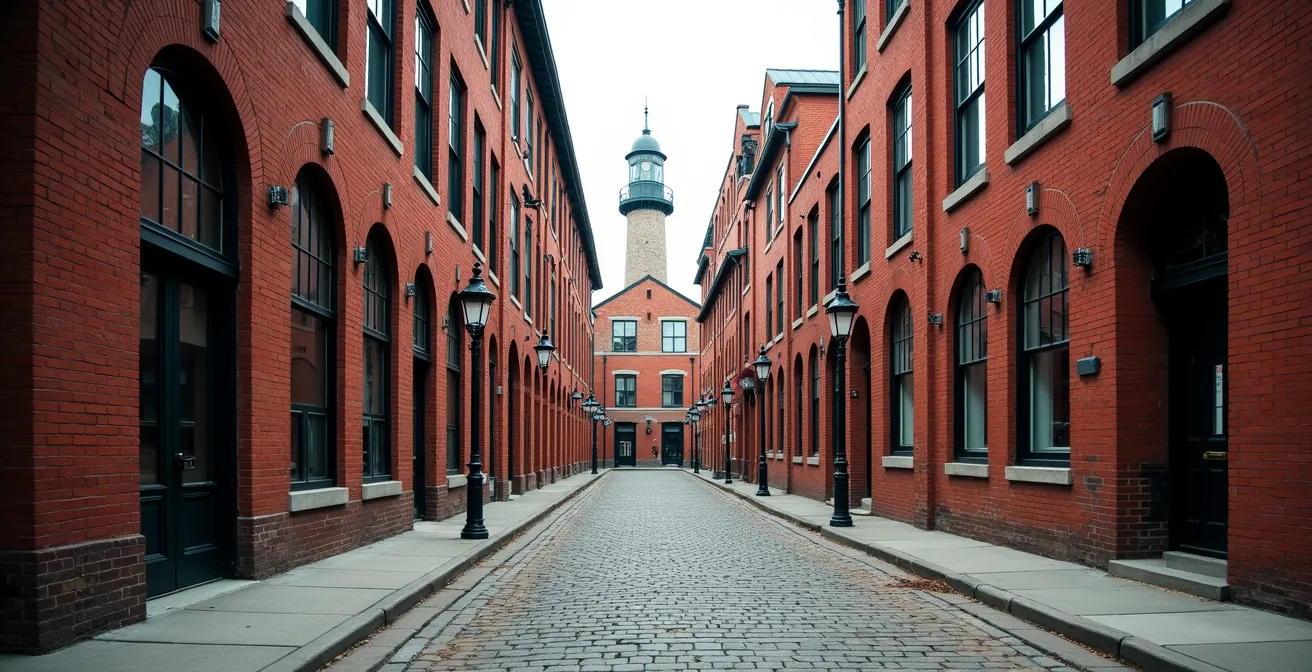
The Distillery District is more than a collection of photogenic buildings; it is a masterclass in architectural storytelling and adaptive reuse.
- Its design reveals a functional industrial past, from the monumental scale of the Stone Distillery to the specific texture of the Don Valley bricks.
- Authentic experiences, from artisan workshops to hidden culinary gems, require looking beyond the main tourist paths and understanding the district’s curated layout.
Recommendation: To truly appreciate the district, one must learn to read its material language and spatial narrative, not just observe its surface.
Many walk the cobblestone lanes of Toronto’s Distillery District and see a charming, historic neighbourhood. They capture the requisite photos of red-brick walls and romantic lighting, enjoying the atmosphere of a bygone era. For the discerning visitor, the couple on a romantic escape or the aficionado of industrial architecture, there is a palpable sense that a deeper story is being told here, just beyond the surface-level appreciation. The common advice—visit the seasonal markets, browse the galleries—only scratches the surface of this National Historic Site.
But what if the true genius of the place lies not in what you see, but in how you interpret it? As an architect specializing in the rehabilitation of heritage sites, I perceive the District not as a static backdrop, but as a living text. Every brick, every iron beam, and every street alignment is a word in a sentence that narrates the story of Victorian industrial ambition, its subsequent decline, and its masterful rebirth. The aesthetic is not accidental; it is a carefully preserved grammar of design that communicates function, power, and a distinctly Torontonian identity. This is a place built for production, and its beauty is a direct consequence of its original purpose.
This guide moves beyond the superficial to offer a designer’s perspective. We will deconstruct the strategies to experience its spaces without the overwhelming crowds, to distinguish authentic craftsmanship from imported trinkets, and to capture its architectural soul through a lens that understands form and shadow. We will uncover the narrative embedded in the walls of Gooderham & Worts, explore how its principles of preservation can inform modern renovations, and transform your visit from a simple stroll into a profound act of architectural reading. It is an invitation to see the Distillery District not just as a place to go, but as a lesson to be learned.
To fully appreciate the architectural and cultural depth of this unique Toronto landmark, this article is structured to guide you through its most defining aspects. The following sections offer a blueprint for a more intentional and enriching experience.
Summary: A Designer’s Blueprint to the Distillery District
- How to access the Winter Village without waiting 2 hours in the cold?
- Artisanat local ou souvenirs importés : comment repérer la véritable qualité ?
- Quels angles de vue privilégier pour capturer l’architecture industrielle sans la foule ?
- Le risque de payer 30 % plus cher pour un café : où aller pour le vrai goût ?
- Gooderham & Worts : l’histoire fascinante derrière les briques rouges que vous ignorez
- Comment moderniser une maison victorienne à Toronto sans détruire son âme historique ?
- Comment créer un carnet de voyage de Toronto qui dépasse les simples selfies ?
- Haunted Walk : pourquoi l’histoire sombre de Toronto fascine-t-elle autant les adultes ?
How to access the Winter Village without waiting 2 hours in the cold?
The Distillery Winter Village is an undeniable draw, a festive overlay upon the district’s robust industrial bones. However, its popularity can be its greatest detriment, with crowds that obscure the very architectural beauty one comes to admire. With over 1 million visitors expected, navigating the space requires strategic forethought, not spontaneous wandering. The goal is not merely to avoid a queue, but to reclaim the contemplative atmosphere necessary to appreciate the interplay between the ephemeral installations and the permanent structures.
A sophisticated approach transforms the visit from a test of endurance into a curated experience. The most effective strategy is to sidestep the peak-hour frenzy entirely. Weekday visits, particularly during the free admission hours from 10:00 am to 4:00 pm, offer a dramatically different environment. The late afternoon, just before the post-work rush, provides a “golden hour” opportunity where the winter sun casts long shadows across the cobblestones, accentuating the texture of the brickwork without the visual noise of a throng.
Booking dinner reservations at one of the district’s established restaurants, such as the elegant Cluny Bistro, can serve a dual purpose. It provides a civilized anchor to the evening and often includes a more streamlined entry process, bypassing the general admission lines. This transforms the logistical challenge of entry into a seamless part of a high-end evening. Furthermore, one should consider the district as a three-dimensional composition. Elevated viewpoints from adjacent buildings or public parking structures offer unconventional, crowd-free perspectives, allowing one to appreciate the village as a holistic design piece nestled within the larger urban fabric.
Artisanat local ou souvenirs importés : comment repérer la véritable qualité ?
In a district celebrated for its authenticity, the distinction between genuine local artisanry and mass-produced souvenirs is paramount. For the design enthusiast, the value of an object lies in its story, its materiality, and the hand of its maker. The challenge is to filter the signal from the noise. True quality is not advertised with loud signage but is discovered through careful observation. It is found in the weight of a hand-thrown ceramic, the unique grain of a locally sourced wood carving, or the intricate details of a piece of jewelry forged in an on-site studio.
The first principle is to seek out the creator. The Distillery District’s masterstroke in this regard is the Case Goods Warehouse, a building that eschews the traditional retail model in favour of a more transparent, studio-based approach. This five-storey building is a vertical village of creativity, housing open-to-the-public artist studios and workshops. Here, one can engage directly with jewelers, painters, and craftspeople, observing their process and understanding the provenance of their materials. This is not shopping; it is patronage. It is acquiring a piece of the district’s living creative culture, not a mere memento of a visit.
This pursuit of authenticity is a tactile experience. The image below captures the essence of this principle: the direct connection between hand and material, where form emerges from skill and intention.

As this visual suggests, the search for quality involves looking for material honesty. Does the object celebrate its base components? Is the artist’s technique visible? Asking questions about the origin of the materials—is the clay from Ontario? Is the wood reclaimed from a local heritage building?—can quickly separate the authentic from the imported. A true artisan will speak with passion about their sources and process, adding an intangible layer of value that no generic souvenir can replicate.
Quels angles de vue privilégier pour capturer l’architecture industrielle sans la foule ?
Photographing the Distillery District is a common pursuit, but capturing its soul requires moving beyond the obvious, crowd-filled wide shots. An architectural photographer does not simply document a building; they interpret it. This means focusing on light, texture, and composition to tell a story about the space. The key is to treat the district as a subject, not a backdrop, and to find the angles that reveal its essential character—the interplay of rugged industry and refined design.
One of the most effective techniques is to shoot during the “Blue Hour,” the period just after sunset when the sky holds a deep blue tint. Looking west down Tank House Lane during this time creates a stunning contrast between the cool ambient light and the warm, historic glow of the red Don Valley bricks. This is when the district’s materials truly come alive. Another powerful approach is design detail abstraction. Instead of capturing entire buildings, focus on close-ups: the maker’s marks stamped into individual bricks, the weathered texture of rusted iron bolts, or the elegant lines of wrought-iron balconies. These details are the ‘words’ in the district’s architectural grammar, and isolating them creates compelling, abstract compositions that speak volumes about its history and craftsmanship.
Furthermore, one must think vertically. The ground level is often a sea of people, but the upper portions of the facades are a masterclass in Victorian detailing. Aiming your camera upward reveals intricate brickwork, decorative cornices, and the structural beauty of the buildings, all set against the clean canvas of the sky. From a compositional standpoint, consider using modern elements as a frame or counterpoint. The soaring lines of the “Still Dancing” sculpture by Dennis Oppenheim, a 50-foot-tall steel artwork, provide a dramatic, contemporary foil to the historic masonry that surrounds it, creating a dialogue between the district’s past and present.
Le risque de payer 30 % plus cher pour un café : où aller pour le vrai goût ?
In any high-traffic historic district, a “tourist tax” is an unfortunate reality, particularly for simple pleasures like a warm beverage. The Distillery District is no exception. While the allure of sipping a hot drink from a festive market stall is strong, the discerning visitor should be aware of the significant price disparities. It is not uncommon to find specialty hot chocolates priced between $12 and $16, a premium that often reflects location more than quality. Paying a high price is one thing; paying it for a mediocre product is an aesthetic misstep.
The solution is not to forgo the experience, but to seek out establishments that prioritize quality and offer fair value—the kind of places a local would frequent. These are often tucked away just off the main thoroughfares, operating with a confidence that doesn’t require a prime, high-rent location. The key is to look for signs of genuine passion: in-house roasting, unique pastry offerings, or baristas who engage with you about the product. These are indicators of a business built on craft, not just on capturing passing foot traffic.
Case Study: Sweetie Pie Bakery
A prime example of finding value without compromising on experience is Sweetie Pie, a local bakery chain with a presence in the district. Their Belgian hot chocolate, complete with all the trimmings, is offered for a modest $6. This stands in stark contrast to the $12-$16 specialty drinks sold at many temporary Winter Village vendors. Choosing Sweetie Pie is not merely a financial decision; it’s an informed choice that supports a local business and rewards quality over convenience, allowing you to enjoy a superior product while investing your money more wisely into the local economy.
This principle of discernment extends beyond coffee. It is a mindset for navigating the entire district. By questioning whether the price is justified by the quality and seeking out the permanent, passionate local vendors, one can curate an experience that is both economically sensible and aesthetically satisfying. It is the difference between being a passive consumer and an active, informed participant in the district’s culture.
Gooderham & Worts : l’histoire fascinante derrière les briques rouges que vous ignorez
To truly read the Distillery District, one must understand its origin story, which is etched into the very fabric of its buildings. The site is not a whimsical collection of Victorian architecture; it is the physical manifestation of the immense industrial power of Gooderham & Worts, once the largest distillery in the British Empire. The scale and solidity of the structures were not primarily for aesthetic appeal but were a direct response to the functional demands of massive-scale spirit production. Every design choice was dictated by process, safety, and efficiency.
The heart of the operation was the five-storey limestone mill and distillery, a formidable structure designed by David Roberts Sr. that opened in 1861. As noted by The Canadian Encyclopedia, this single building was an engineering marvel of its time.
A five-storey limestone mill and distillery, designed by David Roberts Sr., opened in early 1861, increasing production capacity from 80 000 to two million gallons per year.
– The Canadian Encyclopedia, Distillery Historic District / Gooderham & Worts National Historic Site
This staggering output of over 2 million gallons per year required buildings of immense strength and volume. The thick masonry walls, the massive timber beams, and the logical, process-driven layout of the streets are all part of this functional narrative. The beauty we admire today is an incidental byproduct of industrial necessity.
The materials themselves tell a local story. The ubiquitous red bricks are not just any bricks; they are primarily Don Valley Pressed Brick, a celebrated local material known for its durability and rich colour, which defined much of Toronto’s Victorian-era cityscape.
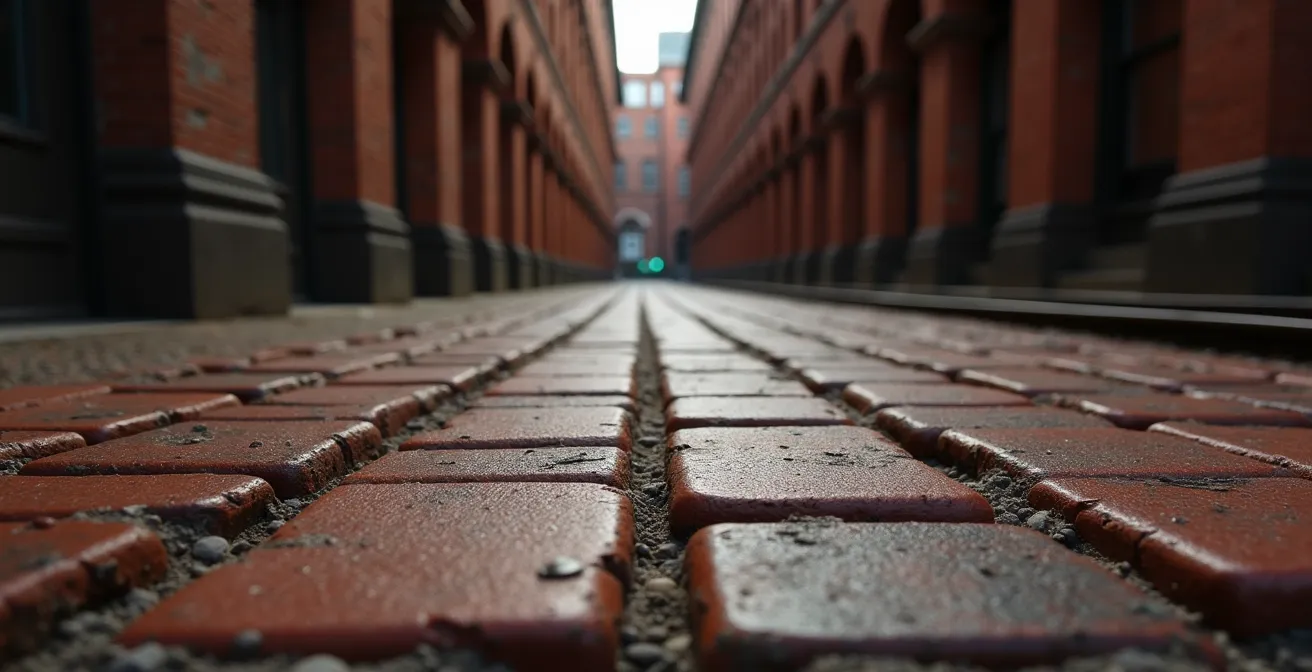
Looking closely at these bricks, one can see variations in colour and texture that speak to over a century of weathering. They are the fundamental vocabulary of the district. Understanding that these walls were built to contain the immense pressures and processes of distillation transforms them from simple scenery into a testament to engineering and ambition.
Comment moderniser une maison victorienne à Toronto sans détruire son âme historique ?
The challenge of modernizing a historic home, particularly one of Toronto’s cherished Victorians, is a delicate balancing act. The goal is to introduce contemporary comfort and functionality without erasing the very character—the “soul”—that makes the property valuable. The Distillery District itself serves as a world-class, large-scale case study in how to achieve this. The principles of adaptive reuse demonstrated here offer a powerful blueprint for any residential project.
The work done by firms like ERA Architects, who served as heritage consultants for the entire site, exemplifies the core philosophy: preservation through integration, not imitation. In their restoration of buildings like The Maltings, the approach was not to hide the new but to make it respectfully coexist with the old. Original elements like timber floors, brick walls, and even barrel storage vaults were not just saved; they were exposed and celebrated as central features of the new design. Modern additions, such as glass partitions, were used to create spatial separation without sacrificing the visual integrity of the original structure. This creates a dialogue between past and present.
This approach provides a clear set of principles for homeowners. It is about revealing the home’s “good bones” rather than covering them up. It means treating heritage elements with reverence and making modern interventions that are honest, legible, and complementary. For any renovation of a protected building in Toronto, adhering to the Ontario Heritage Act and consulting with Toronto Heritage Preservation Services is not just a legal requirement but a design opportunity to find creative, historically sensitive solutions.
Your Action Plan: Modernizing with Historical Integrity
- Material Exposition: Identify and expose original structural materials like interior brick walls and timber beams to serve as primary design features.
- Spatial Definition: Use modern, lightweight elements like glass partitions or open shelving to define spaces, maintaining the open volume and sightlines of the original structure.
- Regulatory Compliance: Before any work begins, consult the Ontario Heritage Act and connect with Toronto’s Heritage Preservation Services to understand the specific protections and guidelines for your property.
- Amenity Integration: Integrate modern systems (HVAC, lighting, plumbing) in a way that minimizes their visual impact, hiding ductwork and using fixtures that complement the historic aesthetic.
- Structural Integrity: Prioritize the preservation of the “three-dimensional integrity” of heritage elements, as outlined in the successful adaptive reuse of the District, ensuring new uses do not compromise the original form.
Comment créer un carnet de voyage de Toronto qui dépasse les simples selfies ?
Documenting a visit to a place as texturally and architecturally rich as the Distillery District demands more than a camera roll of selfies. A truly memorable travel journal captures the essence of a place, its feeling and its details. For the design-minded traveler, this means creating a record that functions as a personal analysis of the space. It is about shifting the focus from “I was here” to “This is what I saw, and this is what it taught me.” This requires engaging multiple senses and employing different methods of observation.
One of the most powerful techniques is sensory journaling. Instead of just writing about what you see, incorporate physical artifacts that evoke the place. Collect texture rubbings from the rough surface of a Don Valley brick or the iron of a lamppost. Press a fallen leaf from the ground in Trinity Square. Save a coaster from a local brewery. These physical elements create a multi-sensory scrapbook that can transport you back far more effectively than a photograph alone. Similarly, architectural sketching forces a deeper level of observation. You don’t need to be an artist; the goal is to understand, not to create a masterpiece. Focus on sketching manageable details: the elegant curve of a window in the Case Goods Warehouse, the geometric pattern of the cobblestones, or the profile of a Victorian lamppost. This act of drawing ingrains the design language of the district into your memory.
Ultimately, a meaningful journal is a collection of diverse observations. It can include snippets of conversations with local artisans, notes on the “design language” of a specific building, or your own reflections on how the space made you feel. The following table compares various methods to help you build a richer, more personal travel document.
| Method | Difficulty | Unique Value | Best For |
|---|---|---|---|
| Sensory Journaling | Easy | Physical artifacts | Tactile memories |
| Architectural Sketching | Medium | Personal interpretation | Design enthusiasts |
| Local Interviews | Medium | Human stories | Cultural depth |
| Design Language Writing | Easy | Conceptual understanding | Reflective travelers |
By adopting a multi-faceted approach, as detailed in this overview of the district’s experiences, your journal becomes more than a souvenir. It becomes a personal design document, a testament to a journey of active and engaged observation.
Key Takeaways
- True appreciation of the Distillery District lies in understanding its “architectural grammar,” not just its surface beauty.
- Strategic navigation and discernment are key to bypassing crowds and tourist traps, unlocking authentic experiences.
- The principles of heritage preservation seen in the District offer a tangible blueprint for modernizing historic properties.
Haunted Walk : pourquoi l’histoire sombre de Toronto fascine-t-elle autant les adultes ?
The enduring popularity of haunted tours, particularly among adults, speaks to a desire for narratives that penetrate a location’s polished facade. In a place as masterfully restored as the Distillery District, the “Haunted Walk” serves a crucial function: it reintroduces the grit, tragedy, and human struggle that are an inseparable part of its history. The fascination lies not in cheap scares, but in connecting with the authentic, often dark, human stories that are the foundation upon which the beautiful brick and mortar rests. It is history made visceral.
The lantern-lit stroll through the cobblestone streets, as offered by The Haunted Walk, is a powerful act of atmospheric immersion. The diminished light forces one to focus on shadow, sound, and the evocative silhouette of the industrial architecture. It is in this context that the stories of the past gain their power. These are not generic ghost tales; they are rooted in the very real, often brutal, conditions of 19th-century industrial life. Stories of accidents, despair, and conflict are the ghosts that truly haunt the district, reminding us that this was a place of relentless labour, not just genteel commerce.
The most compelling of these narratives are tied directly to the founders themselves. The history of Gooderham & Worts is marked by a foundational tragedy: the untimely death of James Worts in 1834. After his wife died in childbirth, the grief-stricken Worts, a miller by trade, ended his own life in the company’s well. This is not folklore; it is a documented event that casts a long shadow over the subsequent success of his brother-in-law, William Gooderham. This story, and others like it, fascinates because it provides a direct, emotional link to the past. It transforms the monumental buildings from abstract historical artifacts into stages for real human drama, reminding us that the “soul” of a place is composed of both its triumphs and its tragedies.
Now equipped with the tools to read its architectural language and appreciate its layered history, your next visit to the Distillery District can be a far richer experience. Start planning your own design-focused exploration today to see this Toronto landmark through a new, more insightful lens.